
Ahk Cu Peptide
AHK-Cu is a synthetic copper-binding tripeptide studied in preclinical research, not an approved therapeutic in Australia. The main biological evidence comes from 2007 follicle work, not human clinical trials, so Australian buyers should treat it as a laboratory compound first and a treatment claim never.
That distinction matters because AHK-Cu sits in a narrow but easy-to-misread part of peptide research. It is chemically interesting, relevant to follicle biology, and useful for controlled experiments, but the available evidence still stops well short of clinical validation. For laboratories, procurement teams, and curious readers, the key question is not whether the molecule sounds promising, it's what the evidence supports and how to document it properly.
Table of Contents
- What Is AHK-Cu Peptide
- Composition and Proposed Mechanism
- Laboratory Research Applications
- Quality Documentation and COA Requirements
- Australian Regulatory Context
- Key Takeaways for Laboratory Researchers
What Is AHK-Cu Peptide
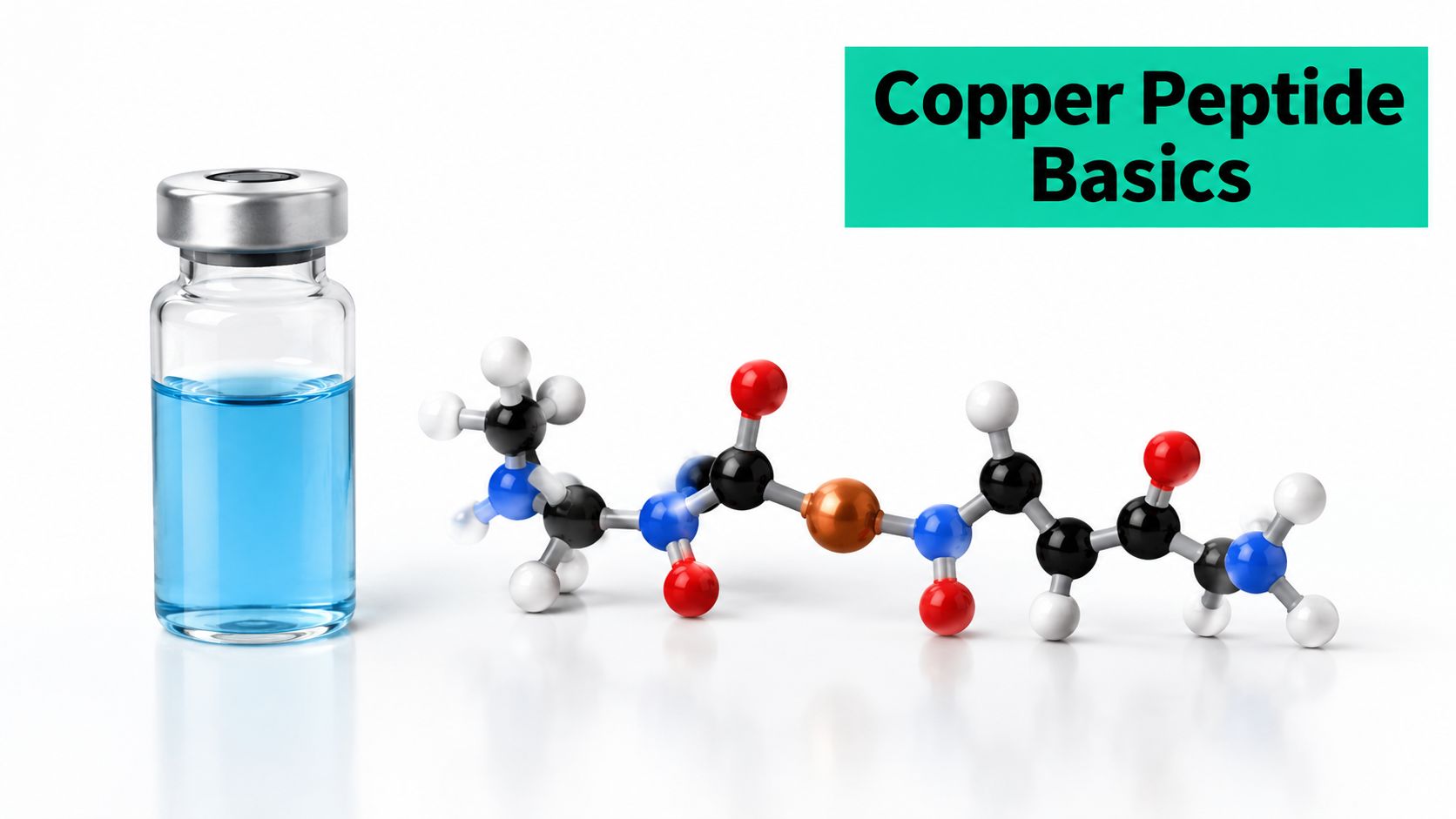
AHK-Cu peptide is the copper(II) complex of the tripeptide L-alanyl-L-histidyl-L-lysine. In plain English, it's a short chain of three amino acids, alanine, histidine, and lysine, held in a copper-binding form that researchers examine for biological activity in cell and follicle models.
Why the copper complex matters
The copper ion isn't decorative. In copper peptides, the metal changes how the molecule behaves in biological systems, which is why researchers care about the complex rather than the peptide backbone alone. AHK-Cu is structurally related to GHK-Cu, but it isn't the same compound, and the difference matters when people try to transfer findings from one peptide to another.
Practical rule: if the study tested AHK-Cu, don't describe it as proof for GHK-Cu, and don't describe GHK-Cu data as direct proof for AHK-Cu.
For Australian readers, the safest framing is simple. AHK-Cu is a preclinical research compound, not an approved therapeutic good, and any claim about hair, skin, or recovery should be treated as a hypothesis rather than a clinical fact. For a side-by-side structural comparison, see GHK-Cu vs AHK-Cu.
Composition and Proposed Mechanism
AHK-Cu is built from Ala-His-Lys, and the histidine residue is central because histidine side chains bind copper strongly under physiological conditions. That copper coordination is the reason the molecule is studied as a distinct chemical entity rather than as a generic tripeptide.
What researchers have observed
In cultured human hair follicles and dermal papilla cells, the laboratory evidence links AHK-Cu with a pattern that researchers interpret as pro-growth signalling. The reported findings include increased follicle elongation, higher dermal papilla-cell proliferation, increased VEGF, reduced TGF-β1, and an anti-apoptotic profile with a higher Bcl-2/Bax ratio plus lower cleaved caspase-3 and cleaved PARP. The evidence base described in the source material remains preclinical, so these are mechanistic observations, not clinical outcomes.
The useful way to think about this is in stages. First, copper binding may influence how the complex interacts with cells. Second, the cell response appears to favour survival and growth-related signalling. Third, the follicle model shows elongation under laboratory conditions, which gives researchers a testable pathway but not a treatment claim.
Interpreting the concentration window
The published organ-culture work used 10^-12 to 10^-9 mol/L as an exploratory range. That's best treated as an in-vitro design window, not a validated topical or systemic dose. For a lab team, that means the right controls matter just as much as the compound itself, including vehicle, untreated, copper-complex, and parent-peptide comparisons.
See AHK-Cu research details for a research-facing product context.
Laboratory Research Applications
AHK-Cu has been explored most often in hair follicle biology, especially around follicle elongation and dermal papilla-cell behaviour. That makes it relevant to researchers studying follicle signalling, tissue microenvironment questions, and copper-dependent peptide activity in ex vivo systems.
What the model can and can't answer
The strongest use case is still laboratory hypothesis testing. If your question is whether a copper peptide shifts follicle-associated signalling in a controlled system, AHK-Cu gives you a defined molecule to compare against a matched control set. If your question is whether it regrows hair in people, the available evidence doesn't get you there.
A follicle in culture can show whether a pathway moves. It can't show whether that pathway translates into a clinical outcome on a human scalp.
Practical design should stay conservative. Use clear negative controls, keep the matrix consistent, and avoid mixing AHK-Cu with unrelated actives if you want interpretable data. Researchers often confuse “interesting” with “validated”, and that mistake is costly when the compound is still preclinical.
For teams building a sourcing workflow, reconstituting research peptides is a useful companion resource. Bulk Aussie Peptides also supplies AHK-Cu as a research item in Australia, with batch documentation available for procurement review.
Quality Documentation and COA Requirements
A credible Certificate of Analysis needs to prove two different things. Identity says the material is the compound you think it is. Purity says how much of the measured material matches the main peak or expected mass profile. One number alone doesn't cover both.
| COA Quality Checklist for AHK-Cu Procurement | Purpose | What to Verify |
|---|---|---|
| Batch-specific identifier | Links the document to one vial lot | Match the batch number on the vial and paperwork |
| Analytical method listed | Shows how the result was generated | Look for HPLC for purity and mass spectrometry for identity |
| Measured values reported | Lets you judge the data, not just the claim | Check the actual result, not only a marketing summary |
| Specification stated | Shows the acceptable range | Compare the result with the stated threshold |
| Test date included | Confirms recency of testing | Make sure the document is current for the batch |
| Independent or manufacturer source | Helps assess traceability | Identify who issued the COA and where the file is stored |
The main red flag is a document that says “high purity” without showing how that number was generated. Another is a purity claim with no identity method at all. For AHK-Cu, that distinction matters because chromatographic purity doesn't prove molecular identity on its own, and identity data alone doesn't measure all impurities.
Suppliers that keep an online COA library make batch review faster and cleaner. See the COA library for the documentation model used by Bulk Aussie Peptides.
Australian Regulatory Context
In Australia, a peptide product's regulatory status depends on its ingredients, intended purpose, and how it's promoted. The TGA's position is clear, a “research use only” or “not for human use” label doesn't change whether a product is unapproved, and it doesn't make importation lawful on its own.
That matters for AHK-Cu because it's a research compound, not an approved medicine. If a supplier or reseller frames it as a treatment for hair loss, skin ageing, injuries, or recovery, that shifts the regulatory and evidence conversation immediately. For institutional buyers, the safer path is to document the material as a research reagent, verify the batch, and keep claims aligned with the actual evidence.
The TGA also expects peptide-product applications to be supported by human studies relevant to the specific peptide, dosage form, route, and claimed indication. That's why findings from one copper peptide can't automatically be transferred to another. If you're comparing suppliers, peptides in Australia is the right category lens, not a therapeutic one.
Key Takeaways for Laboratory Researchers
AHK-Cu is best understood as a preclinical copper peptide with follicle and cell-culture evidence, not as a clinically validated treatment. The strongest reading of the literature is cautious, useful for mechanistic work, not for therapeutic claims.
For procurement, the checklist is straightforward:
- Batch traceability, match the vial to the lot data.
- COA access, confirm identity and purity are both documented.
- Analytical method clarity, look for HPLC and mass spectrometry, not vague purity language.
- Regulatory alignment, keep intended use within research framing.
- Control quality, avoid drawing conclusions from poorly matched comparisons.
For Australian laboratories, that approach protects reproducibility and keeps the compound in the right evidentiary category. - BAP
Bulk Aussie Peptides supplies research-use peptides in Australian 10-pack formats with batch documentation, Certificates of Analysis, and domestic order processing. If you're assessing AHK-Cu for laboratory work, visit Bulk Aussie Peptides to review research product information, batch paperwork, and the current catalogue.