
Aus Peptides Review: Range, COAs, Pricing and Compliance
What if the purity percentage is the least useful line in an Aus peptides review? A price ranking never shows whether the batch matches the vial, which method was used, or whether a detection or quantification limit makes the figure meaningful. Set those checks beside the AUD price table before you treat a listing as documented.
Table of Contents
- Verdict on Bulk Aussie Peptides for Australian Labs
- Product Range and Pack Formats at a Glance
- Reading Batch COAs and Lab Documentation
- Shipping Timelines and Australian Support
- Pricing and Procurement Options Compared
- Compliance Checks Research Labs Should Run
- Common Questions Before You Order
Verdict on Bulk Aussie Peptides for Australian Labs
Bulk Aussie Peptides is Australian owned and operated, selling research-use-only peptides to laboratories, universities and qualified researchers. The format is standardised: sealed glass vials of lyophilised powder in 10-packs, priced in AUD, with batch Certificates of Analysis held in a public COA library or supplied on request for active customers. Orders dispatch within 1–3 business days with shipment tracking, and an Australian-based support team handles specification and selection questions during AEST hours. The company says it was founded to give local researchers a broad catalogue at transparent prices.
Four checks sit in front of checkout:
- Pack and price: the 10-pack format and the listed AUD price are visible before payment.
- Batch document: a batch COA sits in the COA library or can be requested from support. The buyer still needs to match the batch number on the vial to the document.
- Research position: supply is for research, not an approved medicine.
- Accounts path: Australian-based support can confirm product specifications and peptide selection for research needs.
The Therapeutic Goods Administration says many peptide products promoted online are unapproved therapeutic goods. They are not on the ARTG and have not been assessed for quality, safety or effectiveness. A certificate is not that assessment. A purity percentage only helps after you match batch, method and laboratory.
The closest fit is a university, biotech or procurement team that already reads documents, plus individual researchers comparing what a local supplier publishes. The verdict rests on one test a buyer can run alone: pull the COA, check the batch against the vial, read the method and its limits, then weigh that against the listed price.
Product Range and Pack Formats at a Glance
Research peptides in 10-pack vials
The catalogue holds 60+ research peptides in 10-packs, across metabolic, growth-factor, fertility and reproductive, tissue and cellular, longevity, neuroscience and other research. Most leave us as a lyophilised powder cake inside a sealed glass vial. That is the solid we ship.
| Category | Example compounds | Pack format | Listed 10-pack price (AUD) |
|---|---|---|---|
| Metabolic research | Semaglutide, Tirzepatide, Retatrutide | Sealed 10-vial pack | Confirm on the current listing |
| Tissue and cellular research | BPC-157, TB-500 | Sealed 10-vial pack | Confirm on the current listing |
| Growth-factor research | GHK-CU | Sealed 10-vial pack | Confirm on the current listing |
| Longevity and senescence research | MOTS-c | 10-vial pack, 10 mg vials | 607.00 |
| Other research | Melatonin | 10-vial pack, 10 mg vials | 622.00 |
| Other research | MT-1 | 10-vial pack, 10 mg vials | 599.00 |
| Other research | MT-2 | 10-vial pack, 10 mg vials | 584.00 |
| Other research | LL-37 | 10-vial pack, 5 mg vials | 659.00 |
Read the first three rows as named examples only. Their 10-pack prices are not fixed in this table, so those cells send you to the live listing. Later rows use listed AUD prices and known vial strengths.
Semaglutide, Tirzepatide and Retatrutide are metabolic examples. Research has examined related incretin pathways in weight-management studies. BPC-157 and TB-500 are tissue and cellular examples, where research has examined recovery and injury models. GHK-CU is the growth-factor example, where research has examined skin, hair and nail pathways. None of those sentences is an outcome we promise.
The standard 10-pack is there so a procurement count stays predictable. Prices can change, so confirm the current page in the research peptide shop before an order.
Reading Batch COAs and Lab Documentation
What a certificate of analysis must show
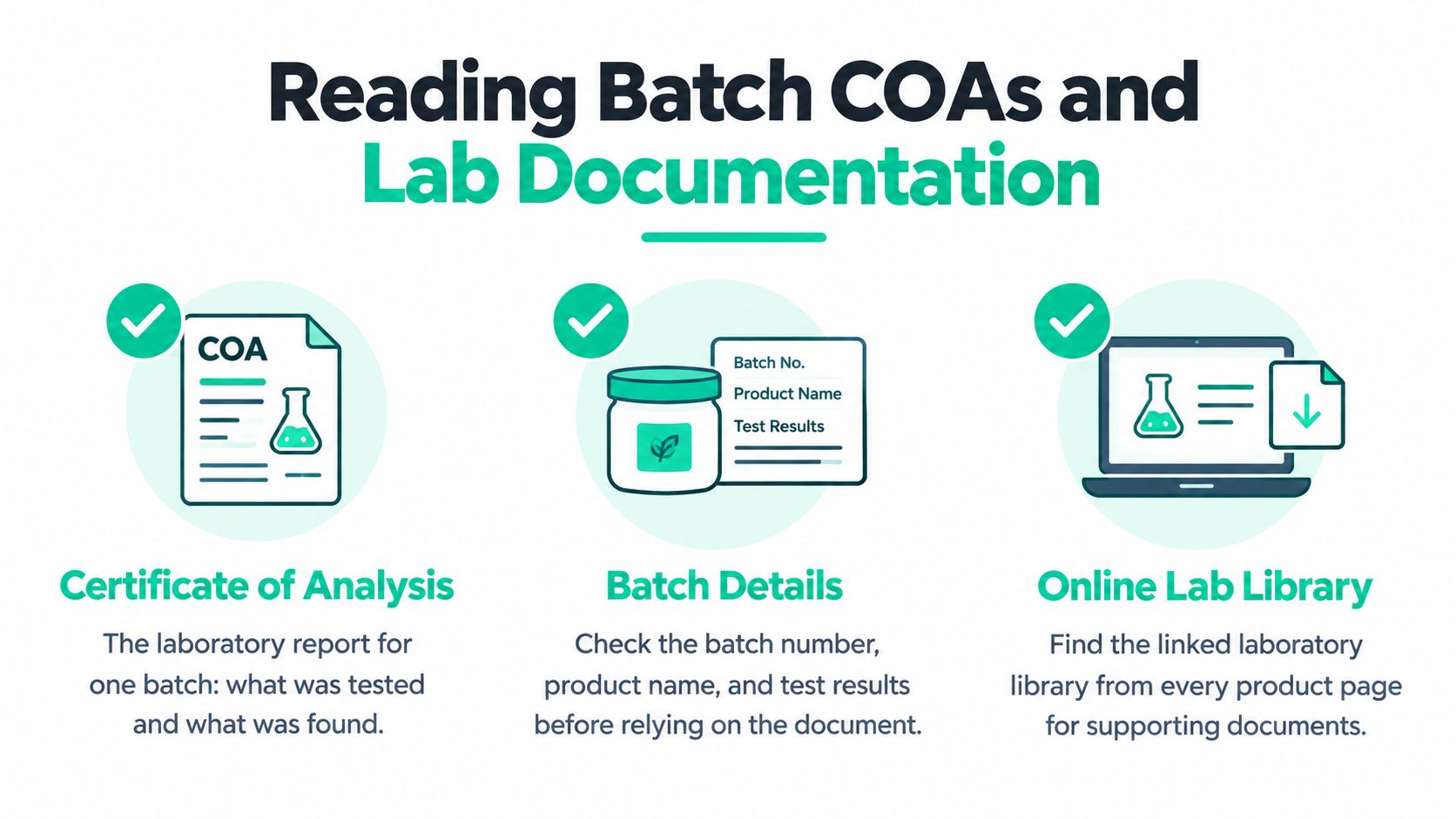
A certificate of analysis is the laboratory report for one batch: what was tested, and what was found. Bulk Aussie Peptides keeps batch certificates in a public COA library, and each listing labels whether its documentation comes from the manufacturer or an independent laboratory. Where a batch document exists, the product page links it. Where testing is still under way, the listing marks the batch in testing instead.
| Check | What to look for | Why it matters |
|---|---|---|
| Batch identifier | Matches the vial or pack | Shows the report belongs to that batch |
| Report date | A date is present | Shows when the result was issued |
| Testing laboratory | Laboratory is named | Lets the buyer see who tested the batch |
| Analytical method | HPLC or mass spectrometry is named | A purity percentage alone does not name the test |
| Units and criteria | Units and acceptance criteria are shown | A number without units cannot be compared |
| LOD or LOQ | Limit of detection or quantification where relevant | A result below a limit is not a quantified amount |
| Accreditation scope | ISO/IEC 17025 or NATA scope covers the method | Results outside scope may be rejected |
The table reduces to a lookup a buyer can run before comparing prices. Match the batch identifier on the vial to the one on the certificate. Confirm the analytical method is named. Check whether any result sits below the LOD or LOQ. Confirm the laboratory's accreditation scope covers that method. A clean-looking purity figure fails the first step if the batch numbers do not line up, and a cheap 10-pack fails the same way if no batch document exists to check.
NATA explains that ISO/IEC 17025 assesses whether a lab is competent for the methods inside its accreditation scope. Suppliers and authorities may reject results that lack the relevant accreditation. A headline purity percentage does not name the lab, the method or the analyte.
Practical rule: On a receipt, the line items matter more than the one total. Treat a purity figure the same way.
A manufacturer-supplied sheet reflects the producer's own release testing, while an independent report comes from a third-party laboratory. The per-listing labels keep that distinction visible, so the two document types can be weighed differently. One limit applies to both: a certificate describes only the batch it names, so an older report cannot vouch for a newer run. The company does not alter a page to make a product appear to have properties it does not have.
A short walk-through of how to read a report is below.
Shipping Timelines and Australian Support
Tracked Australia-wide delivery
Tracked delivery is typically around one week door to door within Australia. That figure is typical, not a guarantee, so leave margin around a study start date.
Place the order only after specifications and the batch document, or the in-testing flag, have been checked. Paperwork questions take longer to settle than the transit itself.
Ask for the specification and the certificate link before the purchase order is approved.
Our Australian-based support team, on AEST hours, confirms product specifications and which research peptide fits a documented study question. A GST invoice can go to accounts with that request. Institutional volumes are quoted on request. There isn't a second, faster shipping tier to assume. Use the shipping page for the stated path, then track the parcel once it moves.
Pricing and Procurement Options Compared
AUD 10-pack and wholesale quotes
The priced unit is the sealed 10-pack in AUD. Prices are on the page because supply is direct, with fewer reseller layers.
| Route | Best fit | What is included | Practical note |
|---|---|---|---|
| 10-vial pack | Repeat or controlled study work | Sealed 10-vial pack priced in AUD | Compare packs on the same vial strength and count |
| Bulk or wholesale quote | Universities and biotech procurement | Institutional supply arrangement | Quote on request and timing confirmed then |
| GST invoice | Accounts and finance teams | Tax invoice for Australian buyers | Confirm before purchase approval |
MOTS-c is listed at $607.00 for a 10-pack of 10 mg vials, with a lab COA. LL-37 is listed at $659.00 for a 10-pack of 5 mg vials. A per-pack comparison is valid only when vial strength and vial count match. If the live listing differs, use the live listing. Prices can change.
Ask for the institutional quote early. Confirm the GST invoice before purchase approval. Purchase-order timing is what usually sets the start date. Plan the typical one-week tracked delivery on top of that approval time, not instead of it. The product comparison tool lets you place up to three research peptides side by side while the quote is prepared.
Compliance Checks Research Labs Should Run
ARTG status versus research-use supply
Under the Therapeutic Goods Act 1989 and the Therapeutic Goods Regulations 1990, a peptide product is generally a therapeutic good when it is promoted, supplied or used to prevent, diagnose, cure or alleviate a condition, or to modify a physiological process. Claims about weight loss, muscle growth, recovery, performance, diabetes, obesity or cardiovascular effects can place a product inside that framework. Unless an exemption, approval or authority applies, therapeutic goods must be on the Australian Register of Therapeutic Goods (ARTG) before import, manufacture, supply, export or advertising. An ARTG medicine identifier begins with AUST, then L, L(A) or R.

A research-use-only supplier with named batches gives you documents to review. An unapproved product has not been assessed for quality, safety or effectiveness. The TGA states that a certificate of analysis is not regulatory approval.
Apply four questions to any catalogue claim, including weight, recovery, or skin, hair and nail research. Those topics belong in study-summary language, not as promised results.
- Research-use-only: Does the supplier state that position?
- Human-use language: Does the page avoid telling a person how to use the compound?
- Study summaries: Are claims limited to what research has examined?
- Named lab and method: Does the document identify both?
Our note on research peptide regulation in Australia is the place to read that boundary beside the catalogue.
Common Questions Before You Order
Order when the batch report matches the product, or when the lab has agreed to treat the status as in testing and confirm the documentation with support. Check that the stated dispatch timeframe and delivery window fit the approval calendar. Pause if the method is unnamed or the laboratory's accreditation scope does not cover the analyte.
Is a product page an ARTG entry?
No. Research-use supply is not an approved medicine. An ARTG identifier begins with AUST; a purity figure does not establish ARTG status.
What if the page says “in testing”?
Treat the batch as not yet documented. Ask support what remains pending, and do not treat the label as a completed certificate.
Which price do I compare?
Compare AUD 10-packs only when vial strength and count match. Check the current listing against $607.00 for MOTS-c or $659.00 for LL-37, then assess the batch documentation alongside the price.
Who confirms a specification before I order?
Bulk Aussie Peptides' Australian-based support team can assist with product specifications and peptide selection for research needs. Institutional buyers can ask about procurement options before placing an order.
- BAP
Bulk Aussie Peptides supplies Australian laboratories and research buyers with research-use-only peptides in sealed 10-packs, with AUD pricing and batch documentation. If this Aus peptides review matches your lab's checks, visit Bulk Aussie Peptides to view the catalogue, research resources and product pages. Match the live listing to the batch document, or confirm what an in-testing status means, before raising a purchase order.