
Bpc 157 Peptides: Research and Regulation in Australia
BPC 157 is an experimental preclinical research compound with no established human clinical evidence. It isn't included in the Australian Register of Therapeutic Goods and has been classified as a Schedule 4 prescription-only substance in Australia since 1 June 2024.
An Australian laboratory manager comparing suppliers can therefore face two separate questions at once. Is the material sufficiently documented for a defined research workflow, and does Australian regulation permit the intended procurement or handling pathway? Those questions are related, but they aren't interchangeable. A batch-specific Certificate of Analysis may support identity and purity review, yet it cannot turn BPC 157 into an approved therapeutic product.
For laboratories, universities, biotech teams and informed buyers, that distinction is the starting point for evaluating BPC 157 peptides. The compound has attracted substantial interest because preclinical work has explored vascular repair, tissue recovery and inflammatory pathways. The human evidence remains too limited to support confident clinical claims, while the Australian regulatory position requires careful review before any order or research activity proceeds.
Table of Contents
- Understanding BPC 157 Research Context
- Mechanistic Evidence and Human Research Gaps
- Australian Regulatory Classification and Implications
- Sourcing Research Peptides from Australian Suppliers
- Documentary Evidence and Quality Verification
- Building a Responsible Research Approach
Understanding BPC 157 Research Context
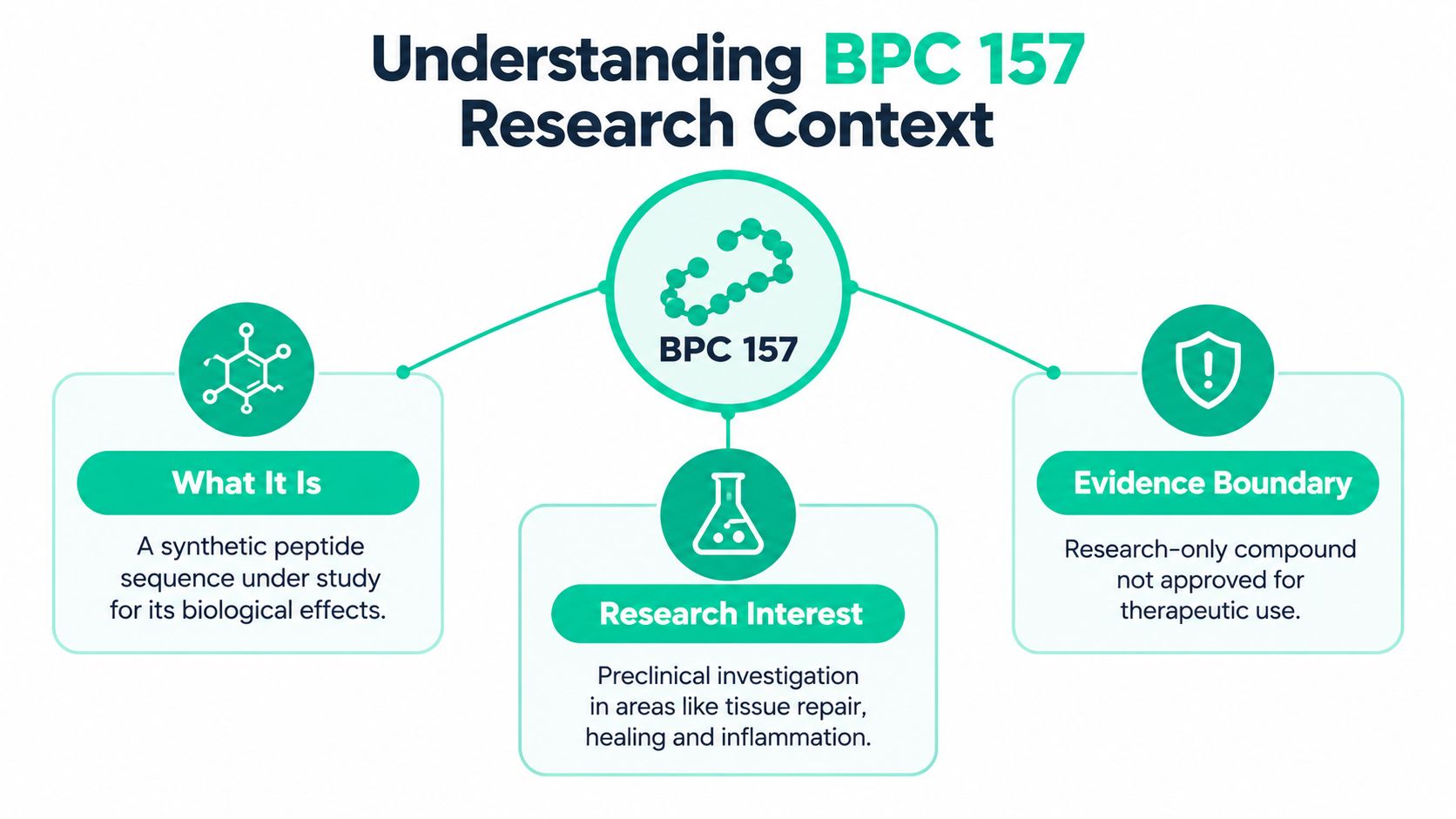
A laboratory director evaluating BPC 157 for tissue-repair research should begin with the evidence classification, not a supplier's product description. BPC 157 remains a preclinical research compound, and Sport Integrity Australia states that the possible applications examined in laboratory and animal studies have not been investigated in human subjects. Findings from those models can't establish human safety, an appropriate dose, effectiveness or the likelihood of adverse effects. Sport Integrity Australia's BPC-157 overview sets out that evidence boundary directly.
That makes the compound scientifically interesting but clinically unvalidated. Research teams may investigate proposed effects on angiogenesis, vascular repair, soft-tissue models or inflammatory pathways, but each result should remain attached to the model in which it was observed. A result in an animal model can justify a new hypothesis. It can't, by itself, justify a human treatment claim.
What researchers can reasonably conclude
The most useful way to read BPC 157 literature is to separate three layers:
- Molecular observations: Researchers can examine whether the peptide is associated with pathway activity, cellular migration or vascular responses in controlled experimental systems.
- Preclinical outcomes: Animal or in-vitro findings can indicate whether a mechanism deserves further investigation.
- Human clinical evidence: Human studies must establish safety, pharmacokinetics, dose relationships and effectiveness in an appropriately designed population.
BPC 157 has evidence concentrated in the first two layers. It does not yet have the human evidence needed to support the third. This distinction matters for research proposals, institutional review, supplier evaluation and the language used in internal reports.
A procurement team can also use the research peptide glossary to clarify technical terms before comparing specifications. That may improve communication between procurement staff and laboratory scientists, but terminology alone doesn't resolve the compound's regulatory status.
Why ARTG absence matters
BPC 157 is not included in the Australian Register of Therapeutic Goods. For an Australian research programme, that means the compound shouldn't be described as an ARTG-listed medicine, an authorised indication or a clinically validated product. A vial labelled research use only describes an intended context. It doesn't establish that the material is suitable for personal use, sterile, therapeutically effective or lawfully supplied for every proposed purpose.
The practical implication is simple. A procurement file should preserve the difference between a research hypothesis, an analytical specification and a therapeutic claim. If those categories are combined, a technically accurate document can be misread as evidence of clinical approval.
Mechanistic Evidence and Human Research Gaps
The strongest technical signal for BPC 157 is mechanistic rather than clinical. Preclinical work has associated the compound with angiogenic and vascular-repair pathways, including VEGFR2, Akt and eNOS signalling. Experimental research has also described increased blood-vessel density and improved blood-flow recovery in ischaemic rat muscle through VEGFR2–Akt–eNOS activity. A review focused on BPC 157's proposed research status discusses these pathway findings alongside the limitations of translating them to human outcomes. The mechanistic review is useful for mapping possible laboratory endpoints, not for establishing a human treatment effect.
This distinction changes how a well-designed study should be framed. Instead of writing that BPC 157 “repairs” tissue, a research protocol could define measurable questions around VEGFR2, Akt and eNOS activation, endothelial-cell migration, capillary density or tissue mechanical strength. Those endpoints test the proposed mechanism directly. They don't assume that pathway activity will produce a reliable clinical result.
The human evidence is a separate category
A 2025 narrative review reported only three pilot human studies involving fewer than 30 participants, and none was designed as a randomised controlled trial. The same review noted that a Phase I trial intended to provide foundational pharmacokinetic and safety information was terminated without published results. The peer-reviewed review of the human evidence therefore describes a substantial gap between preclinical interest and clinical validation.
The reported human studies involved areas including intra-articular knee pain, interstitial cystitis and intravenous safety or pharmacokinetic investigation. A separate review likewise described three small pilot studies and emphasised that rigorous, large-scale clinical trials are lacking. That review also discusses VEGFR2, PI3K-Akt-eNOS, nitric oxide, ERK1/2 and fibroblast-related processes, while making clear that pathway activity isn't equivalent to a demonstrated treatment outcome.
A small uncontrolled pilot can't reliably separate a compound effect from natural recovery, placebo response, regression to the mean or differences in participants' underlying conditions. That limitation is especially important in injury research, where symptoms can change over time even without an experimental intervention.
Research interpretation rule: a promising mechanism can justify more investigation, but it can't substitute for controlled human evidence.
For procurement teams, the evidence gap has a direct commercial consequence. The right question isn't merely whether BPC 157 "works". It is whether a proposed study has a clearly defined model, suitable controls, measurable endpoints and a rationale for choosing this compound over other research priorities. Vehicle controls and negative controls are particularly important where the expected outcome could arise from handling, formulation or ordinary biological variation.
Researchers should also avoid converting commonly discussed animal quantities into human-use recommendations. The available evidence doesn't establish a human dose-finding framework, so an animal research quantity can't be presented as a validated human or clinical dose.
Australian Regulatory Classification and Implications
A vial marked research use only does not receive a legal exemption or therapeutic endorsement from that label. The TGA identifies BPC 157 among unapproved peptide products and states that these products have not been evaluated for safety, quality or effectiveness. BPC 157 is not included in the ARTG. Its position under the Poisons Standard means that authority for possession, supply, advertising or use must be considered, as explained in this overview of research peptide regulation in Australia.
Australia's key scheduling milestone occurred on 1 June 2024, when BPC 157 moved into Schedule 4 of the Poisons Standard. Prescription-only controls therefore apply. The classification did not approve BPC 157 as a medicine, establish a therapeutic indication or demonstrate human safety. The TGA's guidance on importing, compounding and supplying unapproved peptide products explains why scheduling and therapeutic approval must be assessed separately.
RUO labelling and lawful procurement
Australian laboratories should assess the proposed activity and their authority before ordering. Domestic availability, online advertising and a supplier catalogue do not establish that a material can be used for a particular purpose.
The procurement record should answer four questions:
- Intended use: Is the material required for laboratory investigation, or is the proposed activity therapeutic?
- Authority: Does the organisation have the applicable approval, exemption or other lawful pathway for possession and handling?
- Supplier claims: Does the listing remain within research and analytical language, or imply treatment, prevention or guaranteed results?
- Documentation: Can the supplier identify the material, batch and testing source before procurement?
The TGA's broader guidance on unapproved therapeutic peptide products identifies separate consumer-protection concerns. Unapproved peptides may not be sterile or manufactured to appropriate standards, and the TGA has not assessed them as therapeutic products.
A COA isn't a regulatory certificate
A Certificate of Analysis can document identity and purity results for a defined batch. That evidence supports traceability and laboratory quality review. It does not establish sterility, human safety, effectiveness, accurate therapeutic labelling or ARTG inclusion. Those matters require different evidence and, where applicable, lawful regulatory assessment.
A document can improve traceability without changing the legal identity of the material.
For Australian buyers, batch testing answers a narrow analytical question: whether the tested sample meets specified findings. It cannot convert an unapproved research compound into an approved medicine. That distinction should remain explicit in procurement records, study protocols and internal approvals.
Sourcing Research Peptides from Australian Suppliers
Domestic procurement can simplify communication, invoicing, delivery tracking and documentation review, but local supply doesn't remove the need for regulatory diligence. An Australian laboratory should assess the supplier before placing an order, rather than waiting until a vial arrives to discover that the batch record or specification sheet is incomplete.

A practical review starts with the product page. Check whether the material is described as a research peptide, whether the specification is visible before checkout, and whether documentation sources are identified as manufacturer-provided or independent laboratory reports. For a supplier offering 10-pack formats, that standardisation may help a university or biotech procurement team forecast quantities and keep study materials consistent across a defined workflow.
The commercial details still matter. Australian buyers may need AUD pricing, GST invoices, sealed glass vials, freeze-dried powder cake, tracked Australia-wide delivery and domestic support. Bulk Aussie Peptides states that its research catalogue uses 10-pack formats, offers batch documentation through an online laboratory library, and ships around one week door to door. Those operational features support planning, but they don't establish therapeutic approval or human safety.
The supplier's Australian peptide range is one example of a domestic catalogue that presents research materials and associated documentation for review. Buyers should compare it with other suppliers using the same criteria, rather than treating catalogue breadth or delivery convenience as evidence of analytical quality.
A procurement checklist for laboratory teams
Review the specification first. Confirm the product name, stated vial format, storage information and research-use positioning before approving an order.
Ask for batch-specific records. A general product statement is weaker than a document tied to the lot that will be supplied.
Match identifiers. The SKU, vial label and batch number should align with the supplied documentation.
Check the testing source. Record whether results came from the manufacturer, an independent laboratory or another named testing provider.
Confirm delivery and invoicing. Tracked domestic shipping and GST documentation can support procurement records, but they don't address regulatory approval.
The accompanying video can help readers understand the practical context of laboratory supplier review.
A credible procurement file should contain more than an order confirmation. It should show why the material was selected, what documentation was available, who reviewed it and how the organisation separated analytical claims from any unsupported human-use claims.
Documentary Evidence and Quality Verification
A specification sheet and a Certificate of Analysis serve different purposes. The specification sheet describes the product category or expected characteristics. A batch-specific COA records reported testing against a defined lot, which makes it more useful for incoming-material review and traceability.
The distinction can be summarised as follows:
| Document | What it can support | What it cannot establish by itself |
|---|---|---|
| Specification sheet | General product identity, stated format and supplier specifications | That the supplied batch meets every claim |
| Batch-specific COA | Reported identity and purity results for the named lot | Human safety, therapeutic effectiveness or ARTG approval |
| Independent laboratory report | Additional testing evidence from a named external source | That the product is lawful for every intended activity |
| Vial and lot record | Physical traceability between material and paperwork | Sterility or clinical suitability without relevant testing |
A useful COA should identify the batch or lot, report the test methods or laboratory, state the identity and purity findings, and match the supplier's specification. If a document doesn't identify the tested material clearly, the laboratory should record that limitation rather than treating the document as conclusive.
How to review a COA
Use the supplier's COA library as a starting point, then compare the document with the physical vial when received. Look for an exact match between the lot identifier and the report. A mismatch doesn't necessarily prove that the material is wrong, but it does mean the discrepancy should be resolved before the material enters a controlled workflow.
The TGA's position is important here. Unapproved peptide products absent from the ARTG haven't been evaluated by the agency for safety, quality or effectiveness. A COA can therefore improve analytical traceability while leaving the central regulatory and clinical questions unanswered.
Documentation standard: record what was tested, which batch was tested, who reported the result and which conclusions remain outside the document's scope.
Laboratories should retain incoming-material reviews with the purchase record, specification sheet, COA and any correspondence used to resolve inconsistencies. That approach supports auditability and makes later interpretation more disciplined. It also prevents a common error, where “lab-tested” gradually becomes “safe” or “approved” in internal presentations.
Building a Responsible Research Approach
A responsible BPC 157 programme begins by assigning each question to the right evidence source. Regulatory classification answers whether a proposed activity has an appropriate lawful pathway. Supplier documentation addresses material traceability and reported analytical characteristics. Experimental results address the research hypothesis. None of those records can stand in for the others.
Before procurement, a research team should:
- Confirm the intended activity. Define whether the project is analytical, in-vitro, ex-vivo or another approved research format, and obtain institutional guidance where required.
- Check the Australian status. Treat Schedule 4 classification and ARTG absence as foundational procurement information, not as minor catalogue notes.
- Request records before ordering. Ask for the specification, batch documentation and testing-source information before approving the supplier.
- Reconcile the shipment. Match the SKU, vial label and batch identifier with the COA when the material arrives.
- Separate conclusions. Report identity and purity findings as analytical observations. Don't present them as evidence of therapeutic effectiveness or human safety.
Study design should reflect the actual evidence boundary. A laboratory examining vascular mechanisms might measure VEGFR2, Akt or eNOS activity, endothelial-cell migration and capillary density, with suitable negative and vehicle controls. A tissue model might also assess mechanical strength. Those endpoints can test a mechanistic hypothesis without claiming that the outcome predicts a human recovery result.
Internal communications need the same discipline. Use phrases such as “preclinical model,” “proposed mechanism,” “reported batch purity” and “unresolved human evidence gap” where they accurately describe the record. Avoid language that implies a cure, guaranteed recovery, approved indication or established safety profile.
Frequently asked questions
Is BPC 157 approved for human therapeutic use in Australia?
No. BPC 157 isn't included in the ARTG, and the TGA identifies it as an unapproved peptide product. Its Schedule 4 classification imposes prescription-only controls, but scheduling isn't the same as therapeutic approval.
What can a BPC 157 COA prove?
A batch-specific COA can report identity and purity results against the named lot, depending on the tests and methods stated. It doesn't, by itself, prove sterility, human safety, therapeutic effectiveness or lawful personal use.
Does research-use-only labelling make personal use lawful?
No. RUO labelling doesn't create permission for personal use or remove the need to consider Schedule 4 controls and any applicable authority. Buyers should assess intended use and regulatory requirements before ordering or handling the material.
Is the human evidence strong enough for clinical recommendations?
No. The available human literature is limited to small pilot studies, with no published randomised controlled trials identified in the cited review. Preclinical findings can support further research, but they don't justify confident clinical recommendations.
Why does Australian domestic supply matter?
Domestic supply can support clearer communication, tracked delivery, GST invoicing and easier access to batch records. Those procurement advantages improve administration and traceability, but they don't change BPC 157's approval status.
Bulk Aussie Peptides provides research-use-only peptide products in sealed glass vials, standardised 10-pack formats, batch documentation and an online laboratory certificate library, with Australian order processing, tracked domestic shipping and GST invoices available. For a documented starting point when comparing BPC 157 peptides and supplier records, visit Bulk Aussie Peptides and review the relevant specifications before making a procurement decision.
- BAP