
GHK Cu 50mg: A Research-Buyer Reference for Australia
Most advice on GHK-Cu 50mg starts with the wrong question. A better review starts with this: can a buyer prove the labelled mass is present, the compound is GHK-Cu, and the paperwork matches the batch that arrived in Australia? For laboratories, universities, biotech teams, and careful self-directed buyers, 50 mg is a verification problem first and a quantity label second.
That shift matters because GHK-Cu is a defined copper-peptide complex, not just a vial strength. The evidence base also matters. Research summaries describe it as a naturally occurring tripeptide first isolated from human plasma in 1973, with circulating levels around 200 ng/mL at about age 20 and about 80 ng/mL by age 60, a decline of roughly 60% Form Laboratories. Those figures sit alongside biochemical and preclinical findings, which is why the paperwork, not the marketing, should drive a purchase decision.
Table of Contents
- What GHK-Cu 50mg Actually Means as a Research Specification
- GHK-Cu Identity and the Chemistry Behind the Label
- Reading a COA Field by Field for GHK-Cu 50mg
- Identity Method Versus Purity Method and Why Both Are Needed
- Stability, Storage, and Handling for a 50mg Research Vial
- Format, Packaging, and the 10-Pack Procurement Setup
- Australian Regulatory Context and the Research-Use Boundary
- A Pre-Purchase Document Checklist for Australian Buyers
- Matching Documentation Priorities to Australian Research Buyers
- Quick Reference for GHK-Cu 50mg Buyers in Australia
- Frequently Asked Questions for Australian GHK-Cu 50mg Buyers
What GHK-Cu 50mg Actually Means as a Research Specification
GHK-Cu 50mg should be read as a procurement specification, not as a dose or a performance claim. The question is whether the vial contains the stated net peptide mass, the correct copper-bound complex, and a batch record that supports traceability for identity, purity, and handling.
A usable label answers three points:
- What compound is it? GHK-Cu, the copper complex of glycyl-L-histidyl-L-lysine.
- How much is present? The stated mass, tied to a batch record.
- How was it checked? Identity, assay, purity, and supporting documentation.
That distinction matters in Australia because a nominal 50 mg vial is a laboratory quantity, not evidence of suitability for human use. GHK-Cu is not listed on the Australian Register of Therapeutic Goods, and the TGA does not evaluate it as an approved medicine for human safety, quality, or effectiveness.
Procurement staff need traceability. Laboratory staff need analytical confidence. Compliance teams need a clear boundary between research material and anything that could be presented as therapeutic.
Practical rule: if the vial says 50 mg, the next question is what evidence shows the vial contains 50 mg of the claimed complex, from the batch you can actually trace.
Viewed that way, the label is only the starting point. That specification sits in the COA fields, the identity method, the purity result, the storage record, and the supplier's documentation trail.
GHK-Cu Identity and the Chemistry Behind the Label
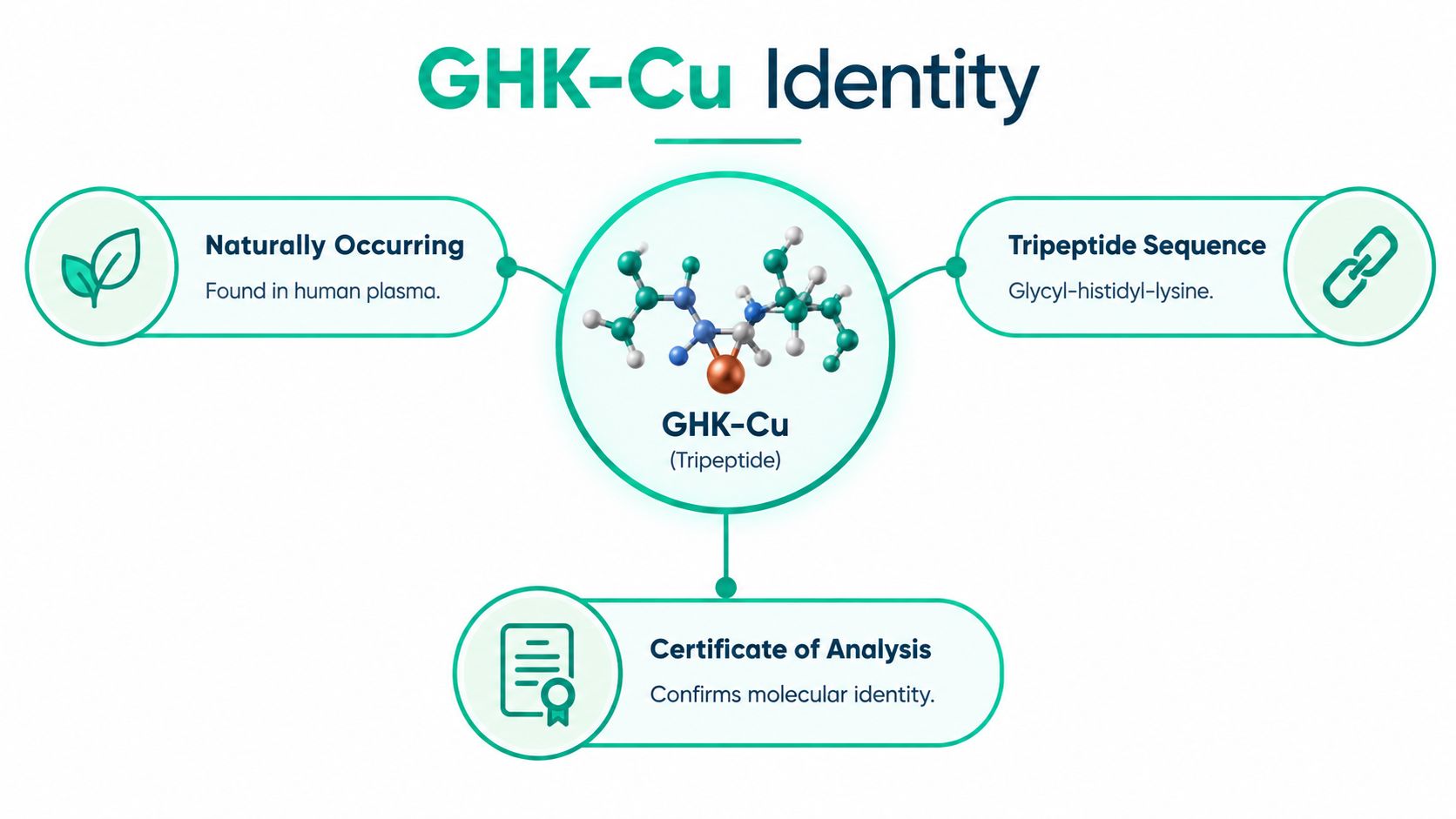
GHK-Cu means glycyl-L-histidyl-L-lysine copper complex, so the first question is molecular identity, not presentation. GHK itself is a naturally occurring tripeptide, and the copper-bound form is a distinct chemical entity whose copper occupancy should be checked separately from peptide content.
What the 50mg number is actually telling you
A 50 mg label may refer to net peptide mass, total complex mass, or a supplier-defined vial content. Those are different specifications, and two vials with the same headline number can still represent different chemical realities. A reviewer should want the specification sheet to state the salt or complex form, net peptide mass, copper content, and the identity method.
Published preformulation work describes GHK-Cu as highly hydrophilic, with log D values of about −2.38 to −2.49 across pH 4.5 to 7.4, and identifies hydrolytic and oxidative degradation products using HPLC-MS Taylor & Francis. That profile matters because it places the material in a polar analytical category, where identity, handling, and storage need documentation rather than assumptions.
Why chemistry changes handling
Hydrophilicity affects how the compound sits in solution, how it interacts with buffers, and how carefully a lab needs to think about oxidation and degradation. If the paperwork does not separate peptide integrity from copper occupancy, the buyer still does not know whether the claimed complex is intact. That is the verification problem with GHK-Cu 50mg.
Reading a COA Field by Field for GHK-Cu 50mg
A batch-specific COA is most useful when it reads like a traceable laboratory record, not a sales page. For GHK-Cu 50mg, the fields that matter are the ones that let a reviewer match the vial to the test report without guesswork.
The fields that should be visible
A defensible COA should show:
- Batch number that matches the vial and pack.
- Product name and SKU so the label and report are linked.
- Test date and a clear sample date.
- Identity method and result, ideally separate from purity.
- Purity method and result, with conditions.
- Appearance of the material.
- Peptide content, where reported.
- Copper content, where stated.
- Storage conditions and any retest or expiry date.
- Source of the documentation, meaning manufacturer-issued, independently verified, or both.
The online COA library model is useful because it lets a buyer look for that traceability before committing budget. For reference, the supplier-library format can be checked against the batch documentation library, which is the kind of document store a procurement team wants to see when records matter.
What to challenge on the page
A single percentage alone isn't enough. If the COA only gives a purity figure without identity confirmation, the reviewer still doesn't know whether the material is the intended peptide. If the report doesn't show batch number matching, the paperwork could belong to a different lot.
A COA becomes useful when it can be audited, not when it looks reassuring.
For Australian laboratories, the cleanest reading order is batch first, identity second, purity third, then storage and source. If any one of those is missing, the documentation is incomplete, even if the headline number looks strong.
Identity Method Versus Purity Method and Why Both Are Needed
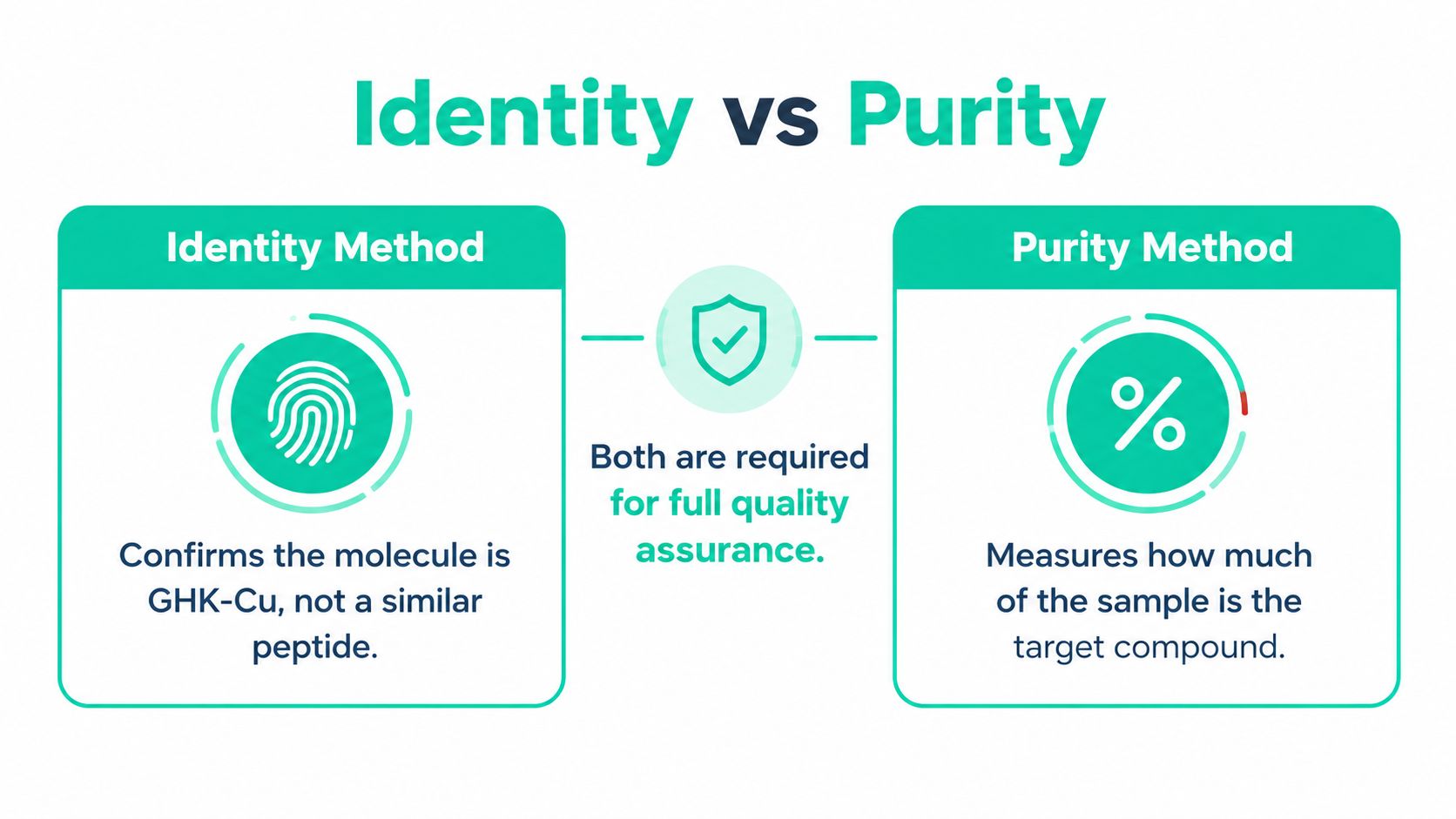
Identity and purity answer different questions. Reversed-phase HPLC is useful for assay and impurity profiling, while LC-MS or equivalent mass spectrometry confirms molecular identity of the target peptide. Copper should be checked separately where possible, because peptide integrity and copper occupancy are distinct quality attributes.
| Analytical Methods at a Glance for GHK-Cu 50mg | What it confirms | What it does not confirm | What to look for on the COA |
|---|---|---|---|
| HPLC | The proportion of the principal chromatographic peak, and impurity profile | That the peak is definitely GHK-Cu | Method, chromatographic conditions, acceptance criteria, and purity result |
| Mass spectrometry | Molecular identity, by matching the expected mass | Full purity by itself | Expected mass, observed mass, and the reported match to the target sequence |
| Copper assay | Copper content or occupancy where measured separately | Peptide sequence identity | Independent copper result and stated method |
Published testing information for GHK-Cu has described an HPLC release threshold of at least 98.0% Australian Peptide Labs. That figure only matters if the identity method lines up as well, because a high purity result on the wrong compound still leaves the wrong compound.
For a procurement review, the clean reading is simple. Use HPLC to judge purity and impurity profile. Use LC-MS or equivalent mass spectrometry to confirm the molecular label. If copper is part of the specification, ask for an independent copper result too. A report works when it separates those questions, answers them with distinct methods, and leaves a paper trail a reviewer can defend.
Stability, Storage, and Handling for a 50mg Research Vial
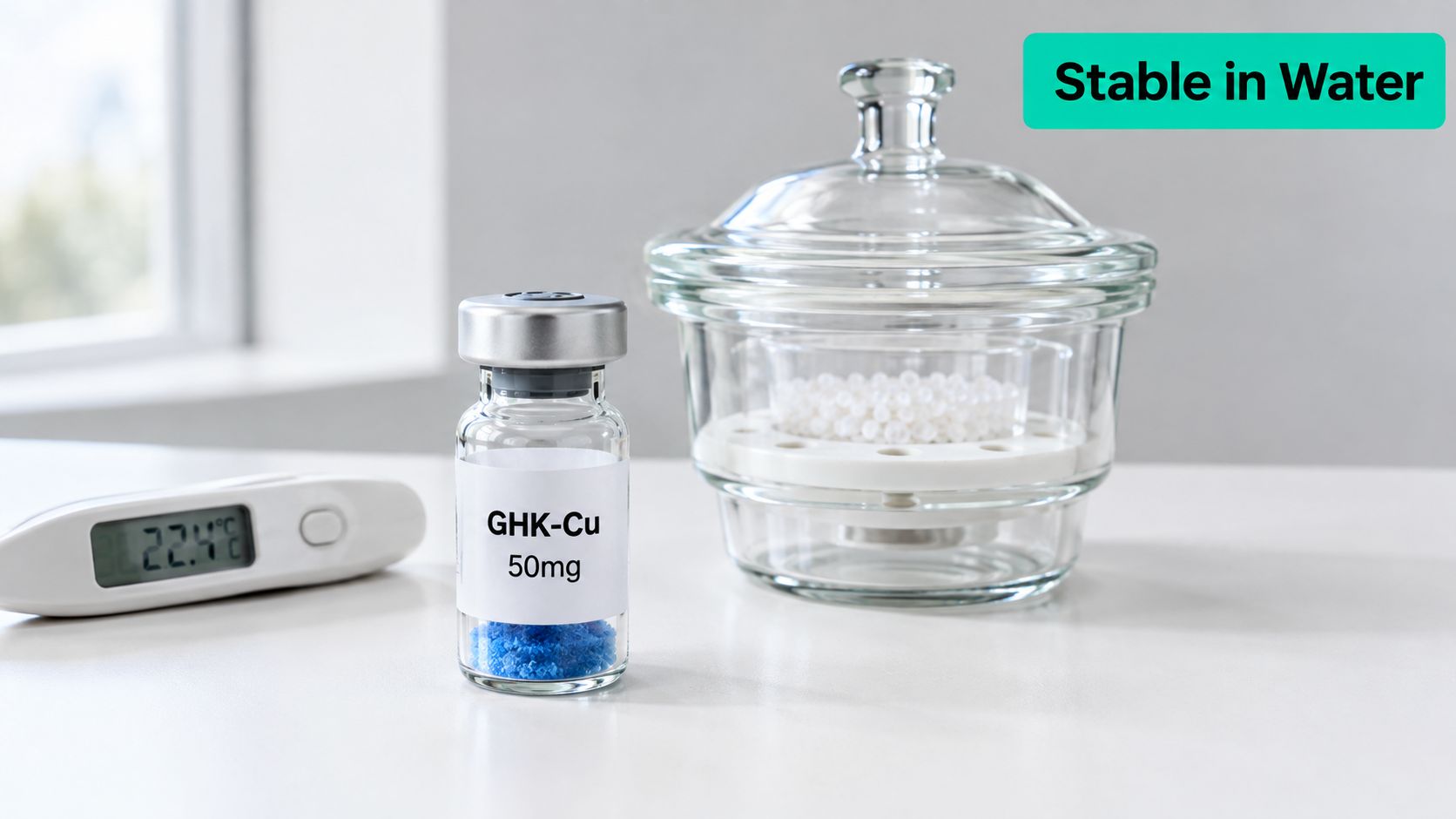
A 50mg label does not settle the storage question. Stability depends on what is in the vial, how it is packaged, and whether the handling record matches the material in front of the buyer. Excipients, container material, concentration, sterility expectations, and copper-binding contaminants can all affect performance, so the storage claim needs evidence, not assumption PMC.
What the evidence supports
One validated study reported that GHK-Cu remained stable in water and in pH 4.5 to 7.4 buffers for at least two weeks at 60 °C, while also showing greater vulnerability to basic and oxidative stress, with degradation following first-order kinetics and producing identifiable peptide fragments. That points procurement review toward pH control, oxidation control, and light control rather than a blanket shelf-life claim PMC.
A lab workflow should stay narrow and documentable. Keep the lyophilised vial sealed until use. Record storage temperature and lot identity in the lab log. Prepare only the amount the experiment needs. Use a well-characterised buffer within the supported pH range. Protect solutions from strong light. Set an internal use-by period from a stability check, not from habit.
See the detailed handling guidance in peptide storage and stability guide for temperature and light controls.
If a buyer wants higher assurance, HPLC for peptide assay, MS for identity, and an orthogonal read on copper occupancy create a stronger release gate than the label alone.
Working rule: a 50 mg vial is not stable because it is labelled 50 mg. It is stable only when the storage conditions and documentation support that conclusion.
For Australian procurement, that means a sealed vial with traceable handling is easier to defend than one whose quality is inferred from packaging alone.
Format, Packaging, and the 10-Pack Procurement Setup
A research buyer should think in terms of pack format, not just vial content. A standardised 10-pack with sealed glass vials and a freeze-dried powder cake gives the lab more predictable traceability than a loose, unlabelled transfer workflow.
What the physical format should support
The pack-level record should make it easy to check:
- Per-vial mass and pack quantity.
- Batch number on both the vial and the outer pack.
- Sealed glass vial presentation for storage integrity.
- Lyophilised powder cake for transit and controlled lab handling.
- Specification sheet that matches the COA library entry.
That format matters because a procurement officer often has to reconcile the delivery box, the vial label, and the analytical record. If one of those three doesn't line up, the material is harder to approve internally.
For buyers comparing suppliers, a product page should make documentation easy to inspect before checkout, which is why the GHK-Cu product page should be read as part of the procurement file, not as a standalone advert. The same logic applies to bulk purchasing, where a batch-recorded 10-pack is easier to review than a one-off item with thin documentation.
The practical point is not glamour, it's control. A sealed pack with clear batch linkage gives a lab something it can file, audit, and repeat.
Australian Regulatory Context and the Research-Use Boundary
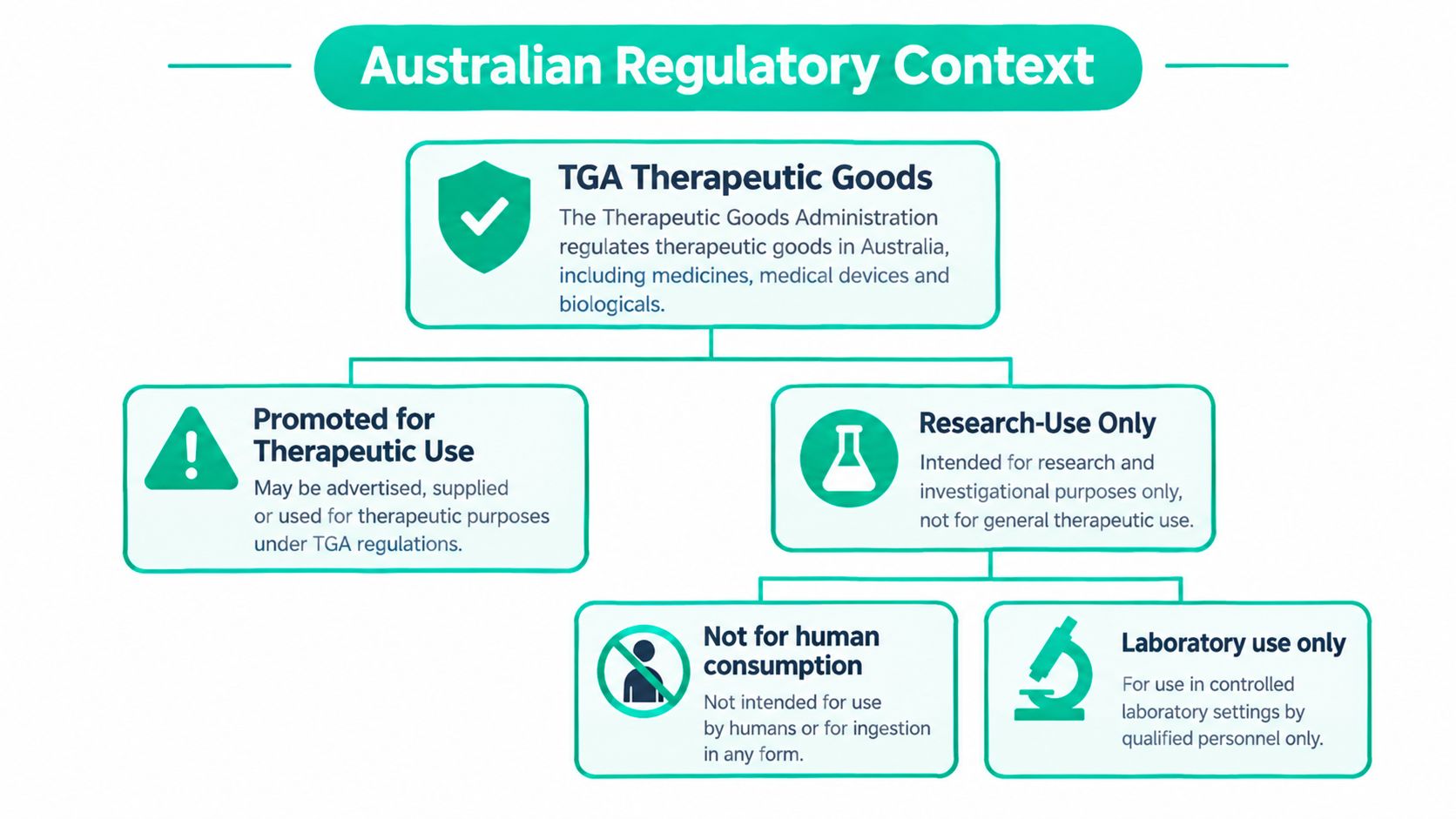
GHK-Cu sits inside a boundary buyers need to read carefully. The TGA states that peptide products can be regulated as therapeutic goods when they are promoted, supplied, or generally used for therapeutic purposes, and products in that category generally need inclusion in the ARTG before import, manufacture, supply, export, or advertising TGA.
Why the disclaimer isn't enough
A research use only or not for human use disclaimer doesn't, by itself, change regulatory status or remove supply and advertising obligations. The TGA also identifies GHK-Cu among unapproved peptide products commonly supplied online, including injectable form TGA.
That distinction matters because the same material can be treated differently depending on claims, presentation, and intended use. In-vitro research, topical cosmetic research, analytical method development, and human-use promotion are not the same category. A cosmetic ingredient discussion cannot be used to justify a therapeutic or injectable presentation.
Embedded video about peptide regulatory context
What a careful buyer should do
The cleanest review question is whether the supplier's wording stays inside research positioning while the documentation stays inside analytical proof. If the claim language leans therapeutic, the compliance review gets more serious, not less.
Research peptide regulation in Australia is worth reading alongside the label itself, because the label does not override Australian requirements. For a university, biotech, or contract-lab buyer, that boundary should be checked before the order leaves the cart.
A Pre-Purchase Document Checklist for Australian Buyers
A purchase decision gets easier when it starts with a checklist. Before anyone signs off on GHK-Cu 50mg, the file should answer the same set of questions every time.
What to verify before purchase
- Lot matching: Does the vial batch number match the COA and outer pack?
- Identity confirmation: Does the report use MS or equivalent identity testing?
- Purity method: Does the COA state HPLC conditions and result?
- Copper field: If copper is reported, is it separate from peptide purity?
- Storage data: Are the storage conditions and retest or expiry details visible?
- Documentation source: Is the COA manufacturer-issued, independently verified, or both?
- Pending status: If documentation says in testing, is that clearly marked as pending rather than complete?
That last point matters. In testing means the documentation isn't ready yet, so it shouldn't be read as a completed result. A lot number without a report is still only a number.
For Australian procurement, this checklist works across universities, biotech buyers, and individual researchers comparing suppliers. It also fits the broader research-file approach used in the peptide range and purchasing page, where the point is to make documentation visible before commitment.
The strongest internal control is simple. Match the label to the report, then match the report to the intended laboratory use. If either link is missing, the file isn't finished.
Matching Documentation Priorities to Australian Research Buyers
Different buyers need the same product, but they don't need the same paperwork. A university procurement officer, a skincare researcher, and a first-time independent buyer all read GHK-Cu 50mg through different risk lenses.
| Documentation Priorities by Australian Buyer Type | Top documentation priority | Top packaging priority | Top verification check |
|---|---|---|---|
| University or biotech procurement | Batch-traceable COA and GST invoice | Sealed 10-pack with matching lot numbers | Can the lab file withstand audit? |
| Beauty and skincare researcher | Method disclosure and stability evidence | Clear vial labelling and storage conditions | Does the documentation support analytical review? |
| Self-directed comparison buyer | Accessible COA library and research-use boundary | Plainly labelled vial and pack format | Can the buyer trace batch to report before paying? |
The packaging choice matters because a standardised 10-pack format reduces ambiguity. So does documentation access, which is why some buyers will prefer a supplier that keeps batch certificates searchable in an online library. Bulk Aussie Peptides also fits that model as an Australian-owned option with batch-linked lab certificates and 10-pack research formats, but the same review logic should be applied to any supplier.
For some buyers, the central question is not whether the vial is called 50 mg. It's whether the paperwork is good enough to justify procurement, record-keeping, and internal review.
Quick Reference for GHK-Cu 50mg Buyers in Australia
Use this as the shortest possible audit path.
- Identity. Confirms the vial is the intended GHK-Cu complex.
- Purity. Shows how much of the sample is the target compound.
- Copper. Checks the metal component separately when reported.
- Appearance. Flags obvious visual issues before use.
- Peptide content. Clarifies what the stated mass refers to.
- Batch number. Links the vial to the COA and pack.
- Retest or expiry. Shows whether the material is still within the documented window.
- Storage. Tells you whether handling conditions were controlled.
- Documentation source. Separates manufacturer paperwork from independent verification.
Each field answers one question. Together, they answer the only question that matters in procurement, which is whether the labelled GHK-Cu 50mg can be defended as the material your lab received.
Frequently Asked Questions for Australian GHK-Cu 50mg Buyers
What does 50mg mean on a GHK-Cu vial?
It should be read as the stated vial content, but a buyer still needs the COA to confirm whether that means net peptide mass, total complex mass, or another supplier-defined specification.
What should a defensible COA show?
At minimum, batch number, identity result, purity method and result, appearance, storage conditions, and the source of the document. Copper content is useful when separately reported.
Does a research-use disclaimer remove TGA obligations?
No. The TGA says disclaimers don't by themselves change regulatory status or remove import, supply, or advertising obligations for therapeutic peptide products.
What if a supplier can't produce batch-specific documentation?
Treat that as an unresolved procurement risk. Without batch-linked evidence, the label can't be matched to a verifiable record.
Bulk Aussie Peptides supplies research-use peptides in sealed 10-pack formats with batch-linked documentation, which makes GHK-Cu procurement easier to review against a real COA trail. If you're checking GHK-Cu 50mg for identity, purity, and Australian compliance boundaries, visit Bulk Aussie Peptides and review the batch documentation before you place an order.