
Glucagon-Like Peptide 1: What It Is and How It Works

Glucagon-like peptide 1 (GLP-1) is a gut-derived incretin hormone of about 30 amino acids that helps regulate blood glucose, appetite and gastric emptying.
If a hormone, a prescription medicine and a research vial all carry the GLP-1 label, are they really the same thing? They aren't. Chemical identity, Australian regulatory status and batch documentation answer different questions, and none can substitute for the others.
Table of Contents
- Glucagon-Like Peptide 1 at a Glance
- GLP-1 Compounds and Their Australian Status Compared
- How the GLP-1 Receptor Signals Through the Body
- How Researchers Measure GLP-1 Activity and Purity
- Frequently Asked Questions About GLP-1
- Verification Checklist and Next Steps
Glucagon-Like Peptide 1 at a Glance
After eating, the gut releases GLP-1 like a messenger announcing that food has arrived. It helps coordinate the body's response rather than switching hunger off.
Native GLP-1 has a short working life because the enzyme DPP-4 breaks it down within minutes. Researchers study modified analogues that last longer or engage different receptor combinations. The research peptide glossary helps distinguish a hormone, an analogue and a receptor agonist.
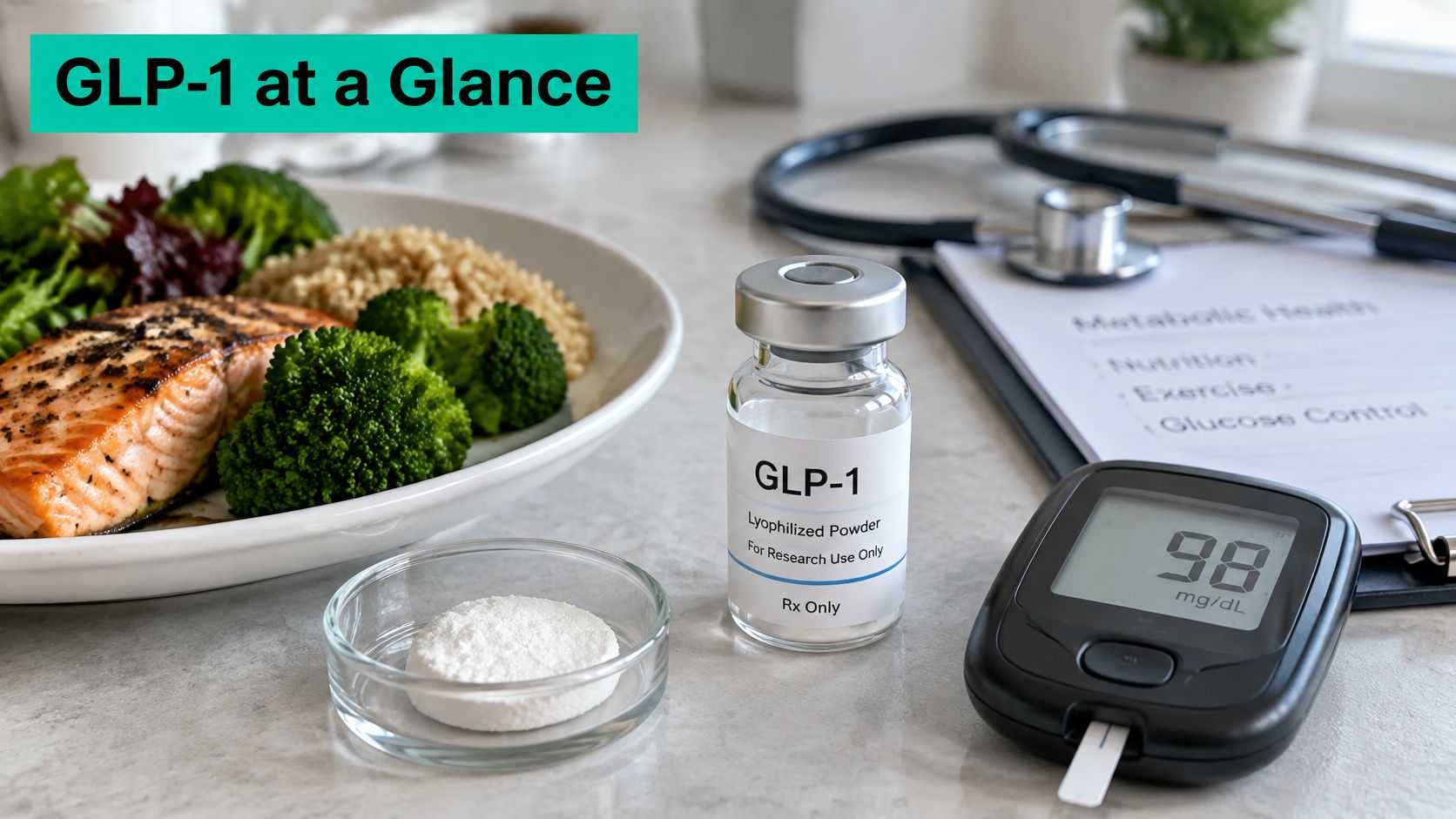
An Australian sales analysis discussed by ABC Health Report estimated more than 6 million GLP-1 receptor-agonist units were sold from May 2024 to April 2025, with semaglutide accounting for 63.3%, tirzepatide 30.7%, and private purchasing 47.8% of units.
Those figures describe medicine sales, not research-peptide quality or legal supply pathways.
Keep the questions separate: Chemical identity establishes what a molecule is. Regulatory status establishes its permitted supply pathway, while batch documentation records what was tested.
GLP-1 Compounds and Their Australian Status Compared
Read this comparison like a parts catalogue: related components can have different designs and permissions. The TGA's unregistered GLP-1 product alert distinguishes prescription medicines from native GLP-1, which isn't in the Australian Register of Therapeutic Goods (ARTG) and cannot lawfully be supplied in Australia.
GLP-1 compounds by classification and Australian status
| Compound | Classification | Key design feature | Australian status |
|---|---|---|---|
| Native GLP-1 | Endogenous incretin hormone | Broken down within minutes by DPP-4 | Not in the ARTG; cannot lawfully be supplied |
| Semaglutide | GLP-1 receptor agonist | Fatty-acid modification; prolonged persistence | Prescription-only medicine; PBS listed for type 2 diabetes |
| Tirzepatide | GIP and GLP-1 receptor agonist | Engages both incretin receptor types | Prescription-only medicine |
| Liraglutide | GLP-1 receptor agonist | Fatty-acid-linked analogue | Prescription-only medicine; obesity indication |
| Research-grade GLP-1 analogue | Research-use-only material | Exact identity requires batch verification | Not an ARTG-registered therapeutic product; laboratory research only, subject to lawful supply |
Semaglutide has an approximate half-life of one week, according to the TGA semaglutide assessment. That's a pharmacological property, not a laboratory-use instruction.
For an accessible appetite-focused explanation, Pause Medical discusses why semaglutide helps reduce cravings. Our Australian research-peptide regulation guide addresses the separate supply questions.
A research-only label doesn't override Australian law, and a purity certificate doesn't establish therapeutic approval.
How the GLP-1 Receptor Signals Through the Body
Think of GLP-1 as a key and its receptor as a lock on responsive cells. The receptor belongs to the G-protein coupled receptor family; activation can increase the internal messenger cyclic AMP, or cAMP, changing cellular behaviour.
The diagram connects receptor signalling with the organs involved.
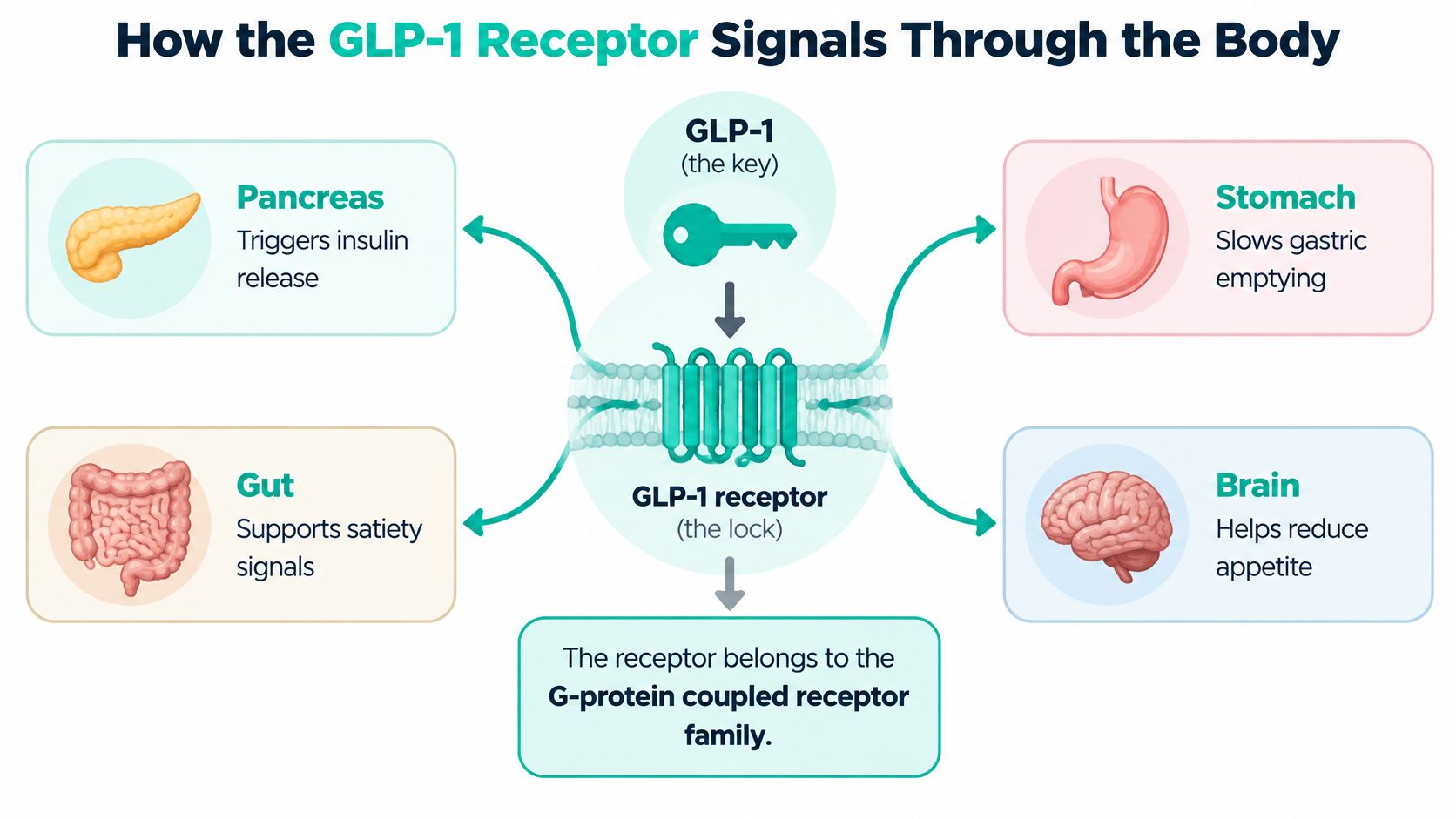
Researchers examine several connected effects:
- Pancreas: Increased insulin release from beta cells and reduced glucagon when glucose levels are high.
- Stomach: Slower gastric emptying.
- Gut and brain: Signalling involved in satiety and food intake.
The insulin response is glucose-dependent, stronger when glucose is high and weaker when it's low. In a comparison reported in TGA semaglutide product information, severe or glucose-confirmed hypoglycaemia occurred in 4.4% and 5.6% of participants in separate semaglutide groups, compared with 10.6% receiving insulin glargine.
Risk increases when semaglutide is combined with insulin or insulin secretagogues, medicines that stimulate insulin release. Laboratory reports therefore need to distinguish receptor activity from broader glucose effects and record the glucose conditions.
Our semaglutide research reference provides compound-focused context. This video offers another visual explanation of the signalling pathway.
How Researchers Measure GLP-1 Activity and Purity
Laboratory tests for GLP-1 compounds and how to read them
| Test | What it measures | Interpretation rule |
|---|---|---|
| Receptor binding | Affinity for the receptor | Affinity isn't activity; report receptor source and buffer |
| cAMP signalling | Downstream messenger response | Include native GLP-1 as a reference |
| Insulin secretion in islet or beta-cell models | Glucose-dependent insulin release | Record glucose concentration |
| Animal physiology studies | Food intake, gastric emptying and glucose effects | Require ethics approval and a defined species design |
| HPLC purity | Main peak relative to detected impurities | Match the chromatogram to the batch Certificate of Analysis |
| Mass spectrometry | Molecular mass against expected sequence | Matching mass supports identity, not purity |
These tests resemble different checks on a vehicle: identifying the engine doesn't establish how well it runs. Likewise, HPLC purity isn't proof of receptor activity.
The TGA Wegovy product information reports superior body-weight and HbA1c reductions versus placebo after 68 weeks in adults with overweight or obesity and type 2 diabetes; in a separate comparison, 37.4% receiving semaglutide achieved at least 20% weight loss, versus 7.0% receiving liraglutide.
These are clinical benchmarks, not outcomes transferable to research vials. Formulation, exposure, behavioural intervention and comparator choice affect results.
Use the online lab library to review independent batch certificates. A study report should record method, glucose concentration, comparator, duration and batch identity.
Frequently Asked Questions About GLP-1
What does research say about stopping a GLP-1 medicine?
Researchers have examined weight regain after treatment ends. An Australian policy review in the Medical Journal of Australia also highlights limited long-term safety evidence in people without diabetes and reliance on evidence from diabetes studies. Decisions about prescribed treatment and maintenance belong with a prescriber.
Why does local Australian supply matter for laboratory buyers?
Domestic processing supports Australia-wide delivery, with dispatch typically within 24 hours to 1–3 business days and shipment tracking. Certificates of Analysis in Bulk Aussie Peptides' online lab library help procurement teams check documentation before ordering.
How many Australians accessed GLP-1 medicines each month?
An Australian study indexed by PubMed estimated that 483,000–502,000 Australians accessed GLP-1 medicines monthly from May 2024 to April 2025. This is an estimate of medicine access, not a count of research-peptide buyers.
Verification Checklist and Next Steps
Treat procurement like checking a passport: the compound's identity, its regulatory status and its batch records are separate details that must each be reviewed.
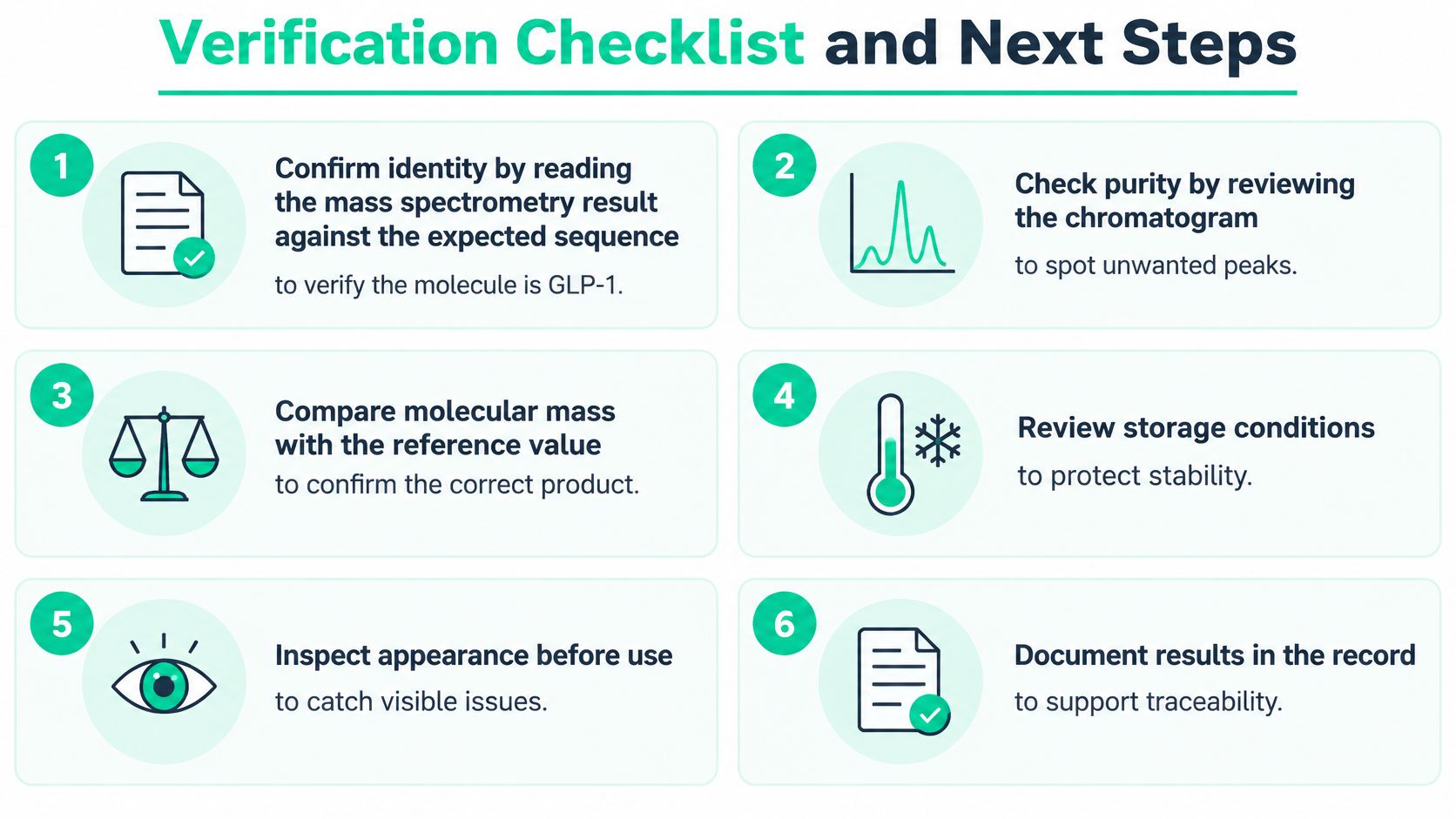
- Confirm chemical identity by comparing mass spectrometry results with the expected molecular mass and sequence.
- Review purity against the HPLC main-peak result for the relevant batch. A catalogue description alone cannot establish a batch's purity.
- Match documentation to the product name and batch number, then retain those records with the order documentation.
- Record storage conditions on arrival, including any concerns about transit. Most research peptides are supplied as lyophilised powder, which is generally more stable than a solution; appearance alone cannot establish integrity.
- Check regulatory status separately. Research-only wording is not legal authorisation for human use. The TGA's update on pharmacy compounding of GLP-1 receptor agonists states that the relevant pharmacy exemption ceased covering GLP-1 analogue medicines compounded from 1 October 2024. Compounded products are not identical to approved Ozempic or Mounjaro.
- Check availability rather than assuming continuity. The TGA Medicine Shortages Report documents demand-related shortages and spill-over effects between medicines.
For research procurement, Bulk Aussie Peptides provides a COA Library and product specifications. Institutional buyers can request bulk or wholesale arrangements and a procurement information pack. The research methodology reference supports review of research documentation. Laboratory research material is not for human use.