
Mots C Peptide Buy
In Australia, a research-use MOTS-c product isn't automatically a therapeutic good, but buyers still need to check its promotion, intended-use framing and their own institutional obligations before purchasing. That's why a “MOTS-c peptide buy” search should start with compliance and documentation, not price or shipping.
The popular vendor-first advice is to compare vial sizes, purity claims and delivery options. Those details matter, but they don't establish that a product may lawfully be supplied or that it's suitable for a particular research programme. An Australian warehouse, AUD pricing and a polished product page don't settle those questions either.
Table of Contents
- What MOTS-c Is and Why Australian Buyers Need a Different Starting Point
- Reading a MOTS-c Product Page Like a Researcher
- What a Certificate of Analysis Actually Tells You
- Reconstitution Arithmetic for Lab Protocols
- Australian Procurement and Logistics in Practice
- A Buyer's Compliance and Documentation Checklist
- Questions Australian Buyers Ask Before They Check Out
What MOTS-c Is and Why Australian Buyers Need a Different Starting Point
MOTS-c is a mitochondrial-derived peptide being studied in metabolic signalling and insulin-sensitivity contexts. The MOTS-MET trial record describes a Phase 2a, randomised, double-blind, placebo-controlled study in adults with prediabetes and overweight or obesity. It evaluates investigational MOTS-c against placebo over a 12-week treatment period, with standardised lifestyle counselling and a four-week safety follow-up. A trial design shows what researchers are investigating, not that a treatment is effective, safe for general use or suitable for self-directed use. Read the MOTS-MET trial record.
That distinction is central to buying in Australia. The TGA says peptide products promoted for therapeutic purposes are generally therapeutic goods, and unapproved products aren't included in the Australian Register of Therapeutic Goods. It also states that it hasn't assessed such products for safety, quality, effectiveness, labelling, sterility or manufacturing standards. Review the TGA's guidance on therapeutic peptide products.
A “research use only” label doesn't automatically resolve classification. The TGA's assessment can depend on the product's contents, promotion, intended use and supply activity. For buyers, that means checking how the supplier describes the product and what the purchase is for, before comparing price, claimed purity or delivery.
Practical rule: A certificate of analysis can help document a test result. It doesn't establish TGA authorisation or make a product appropriate for therapeutic use.
This is the regulatory gap many vendor comparisons miss. Bulk Aussie Peptides lists MOTS-c as a laboratory research product, not for human consumption, therapeutic use or diagnostic procedures. Buyers should still check the applicable obligations for their own organisation and project. The Australian research-peptide regulation guide is a useful place to begin that screening.
Reading a MOTS-c Product Page Like a Researcher
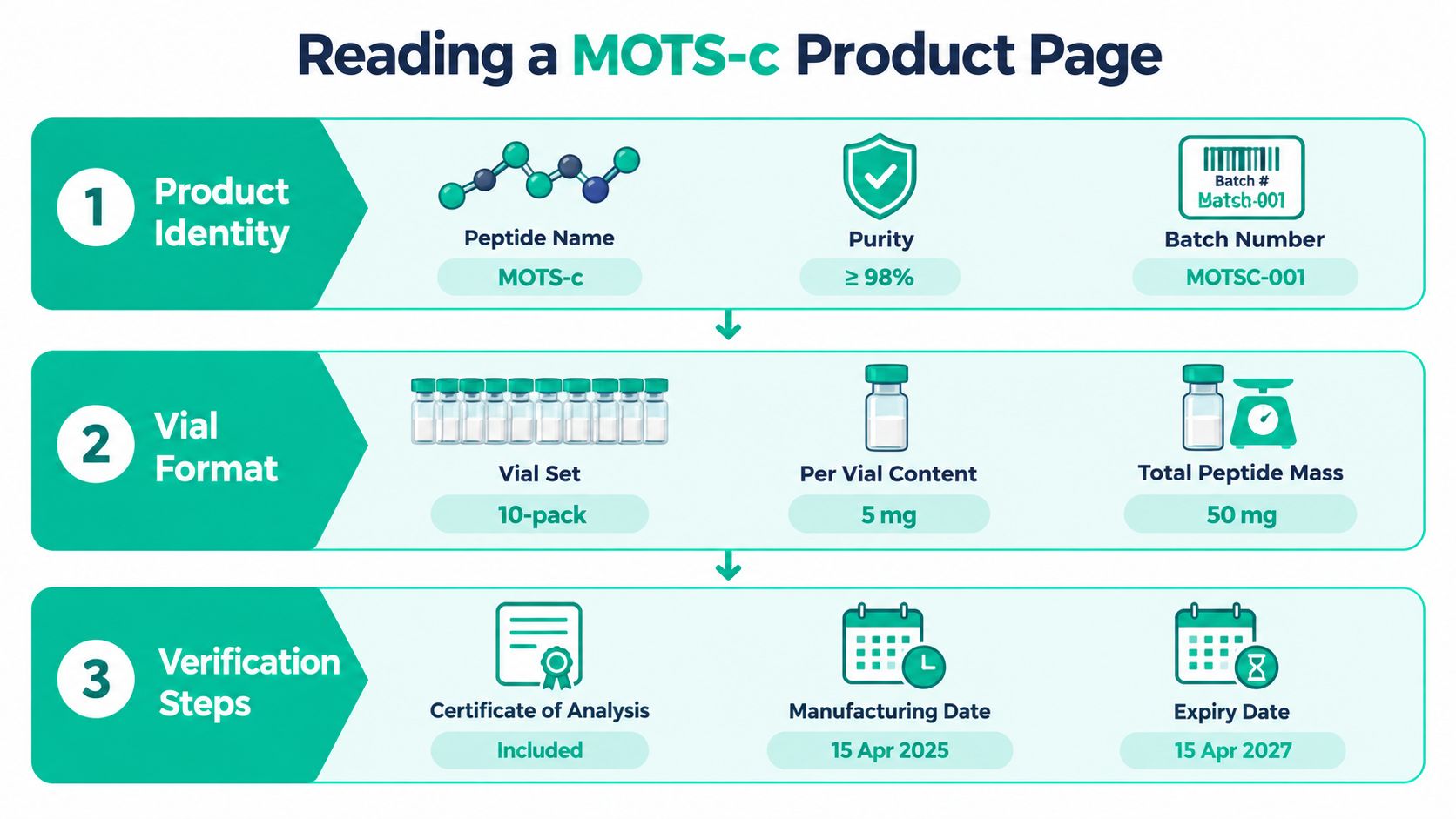
A product page should let you identify what's being offered before checkout. Start with the product name and specification sheet, then check the listed strength, pack format and storage information. For a 10-pack, distinguish the quantity per vial from the total amount across the pack. A “10 mg × 10” format, for example, means each vial is listed as 10 mg and the pack contains ten vials.
The listing should also make clear how the product is presented. Bulk Aussie Peptides describes its research peptides as sealed glass vials containing freeze-dried powder cake, with standardised 10-pack formats and stated per-vial quantities. That describes the supplied format; it isn't a claim about therapeutic suitability or experimental performance.
Separate listing details from batch evidence
Read the specification sheet as the product description, not as a substitute for batch testing. Check the SKU and listed strength before ordering, then match the batch number shown on the goods received to the relevant certificate. Product-page information can describe the format and ordering unit; batch documentation should identify the particular material tested.
It also helps to see whether a supplier distinguishes manufacturer-provided documents from independent laboratory reports. Those are different sources of evidence, and the distinction should be visible rather than implied. Bulk Aussie Peptides has a catalogue of 60+ research compounds in 10-packs, so teams can check whether a format suits a broader programme rather than treating each purchase as an isolated listing.
What a Certificate of Analysis Actually Tells You
A Certificate of Analysis (COA) is evidence of a reported test result for a sample. Its value depends on whether you can trace that sample to the batch you've received and understand what the test did and didn't establish. A certificate isn't a general guarantee, and it doesn't prove TGA authorisation or therapeutic suitability.
Match the COA to the product SKU and the batch number on the received material. Then check that the document identifies the tested batch, the analytical method and the result. If it names a laboratory, record its details and check whether the method falls within the lab's relevant accreditation scope.
The National Association of Testing Authorities explains that ISO/IEC 17025 accreditation applies to specific methods and procedures within a laboratory's scope. A lab's accreditation status alone doesn't tell you whether every test it performs is covered. For a research procurement record, keep the certificate, product specification and source-lab details together so another person can review the evidence later. Browse the Bulk Aussie Peptides COA library.
Read the source label as well as the result
A report labelled manufacturer-provided and a report from an independent laboratory aren't interchangeable. Either way, traceability matters: note the sample or batch identifier, the method named, the result reported and the laboratory responsible. If a batch's report is marked “in testing” or isn't yet available, ask what documentation can be provided and when the batch-specific record will be accessible before treating the purchase as fully documented.
A COA supports review of analytical evidence. It doesn't replace institutional checks for ethics, biosafety, storage or supplier obligations. The procurement file should preserve both what was tested and who issued the report.
Reconstitution Arithmetic for Lab Protocols
For laboratory planning, concentration arithmetic is straightforward: divide the mass of material by the chosen liquid volume. The result is a concentration in mg/mL. To express the same concentration in μg/mL, multiply the mg/mL figure by 1,000. These are examples of arithmetic for a research record, not preparation or use instructions.
Suppose a protocol records a 10 mg vial and a hypothetical 2 mL volume. The calculation is 10 mg ÷ 2 mL = 5 mg/mL, or 5,000 μg/mL. For a 5 mg vial and a hypothetical 1 mL volume, it's 5 mg ÷ 1 mL = 5 mg/mL, also 5,000 μg/mL. A calculator can help check the division, but the protocol must specify the material, volume and units so another researcher can reproduce the calculation on paper.

Record assumptions, not just the answer
A concentration entry is only useful if its inputs are clear. Record the vial quantity, the volume used in the calculation, the resulting units and the applicable batch identifier. If a calculator is part of the workflow, save or transcribe the inputs rather than keeping only the final number. The peptide concentration calculator can support this arithmetic, but it doesn't determine which conditions are appropriate for a specific study.
Handling records matter beyond the vial. As an example from related laboratory testing, the Royal Children's Hospital Melbourne specifies serum-gel as its preferred specimen for C-peptide, with lithium-heparin plasma also acceptable. Its guidance calls for transport on an ice pillow, serum freezing and shipment on dry ice, illustrating how analyte-specific pre-analytical requirements can affect sample integrity. See the hospital's C-peptide specimen guidance. Don't transfer those instructions to MOTS-c; check the requirements for the actual material and workflow.
Australian Procurement and Logistics in Practice
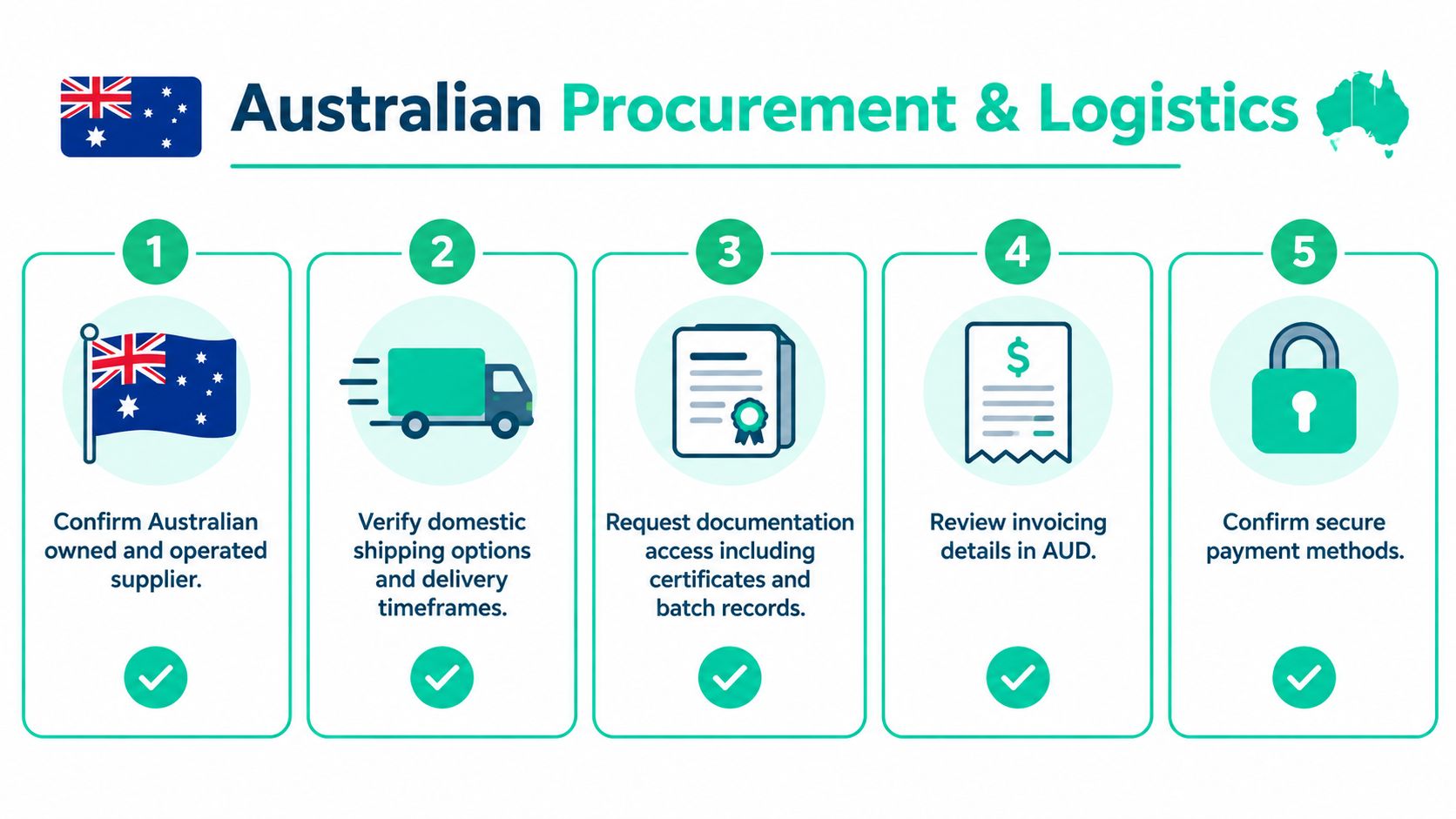
A supplier comparison is more useful when it separates commercial convenience from compliance and analytical evidence. The table below summarises what to check rather than treating any one feature as proof of product status.
| Procurement point | What to verify |
|---|---|
| Format | Pack size, per-vial quantity and product specification |
| Documentation | COA access, batch match and document source |
| Commercial terms | AUD pricing and whether a GST invoice is available |
| Fulfilment | Domestic shipping options, tracking and stated delivery window |
| Payment | Checkout methods and the supplier's order terms |
Bulk Aussie Peptides is Australian owned and operated, sells online, lists prices in AUD and offers secure checkout through Stripe and Apple Pay. Its stated order processing and dispatch window is within 1–3 business days; tracked Australia-wide delivery typically takes around one week door to door. Free shipping is available over $500 AUD, and GST invoices are available on request. These are planning details, not a promise of faster delivery. Check the current terms and destination-specific options before placing an order.
Match ordering to the project
For university or biotech teams, confirm the internal purchase order process, invoice requirements and who will retain the batch records. Bulk and wholesale research supply, institutional arrangements and quotes on request provide a separate route for teams buying for a programme rather than a one-off order. Ask for the details needed by your procurement system before submitting an order.
For fulfilment terms and tracking information, review the shipping and delivery details. A supplier's local operations can make administration more straightforward, but they don't replace checks on intended use, lawful supply or institutional requirements.
The logistics overview below complements the written terms. Use the supplier's current policy pages as the reference for an actual order.
A Buyer's Compliance and Documentation Checklist
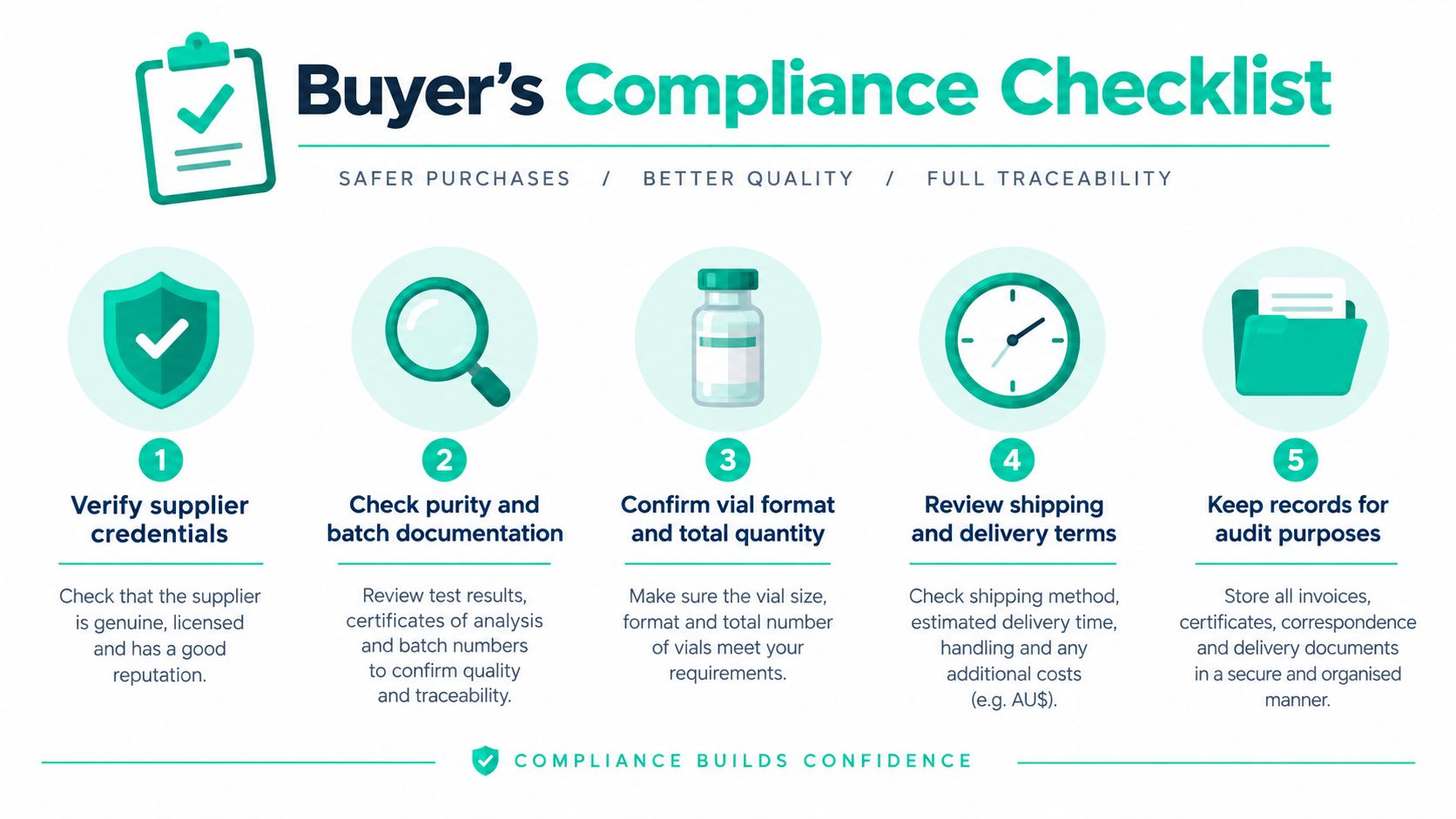
Before checkout, work through the decision in order. Don't begin with a price comparison if the product's intended-use framing or documentation is unclear.
Screen the intended use. Confirm the product is presented and supplied strictly for laboratory research. Check how the supplier describes it, and assess the regulatory and institutional obligations that apply to your project.
Review the listing. Make sure a specification sheet is available and that the pack format and per-vial quantity match the study's requirements. Don't infer the total amount from the per-vial figure alone.
Trace the COA. Confirm that the report identifies the tested batch, analytical method, result and laboratory. Check the relevance of the laboratory's accreditation scope, and retain the document with its source details.
Confirm order administration. Check the AUD price, whether a GST invoice can be issued, the payment options and the stated domestic delivery window.
Keep the institutional checks in view
A domestic purchase doesn't transfer responsibility for importation, storage, ethics, biosafety or supplier obligations to the seller. Institutional buyers should involve the people responsible for procurement and research governance before placing an order, especially if project requirements affect which suppliers or documents are acceptable.
Keep one audit-ready file: Save the product specification, batch COA, supplier details, invoice and relevant internal approvals together. That gives the team a clear record of what it ordered and what evidence it reviewed.
If a required record is missing, pause and request clarification. A neat listing or an available certificate shouldn't be treated as a substitute for the remaining checks.
Questions Australian Buyers Ask Before They Check Out
How long does delivery take?
Bulk Aussie Peptides says tracked delivery typically takes around one week door to door, with order processing and dispatch within 1–3 business days. Check the current shipping terms for your destination before ordering, and leave room for transit when scheduling research work.
What if the batch COA isn't in the library yet?
Ask the supplier whether the report is pending, whether it can be provided for the batch you're considering, and how you'll match it to the batch received. Don't treat a generic or unrelated report as batch-specific evidence. Keep the response with your procurement records.
Can institutional buyers request a GST invoice?
Yes. GST invoices are available on request. If your organisation has required billing details or purchase-order procedures, confirm those before checkout so the invoice can be handled through your normal process.
How do bulk quotes and returns work?
Bulk and wholesale research supply is available by quote on request, including institutional supply arrangements. For returns, damaged goods or other order issues, check the current terms or contact the supplier before ordering; don't assume a particular return outcome without confirming the policy. The FAQ and ordering information can help resolve process questions before checkout.
- BAP
Bulk Aussie Peptides offers research-use MOTS-c in standardised vial packs with product specifications and batch documentation for procurement review. Visit Bulk Aussie Peptides to check the current product details, access the lab library and discuss documentation or institutional supply requirements.