
Peptides in Research: A Practical Australian Reference

Peptides are short chains of amino acids used as laboratory research tools, and in Australia they're distinct from prescription peptide medicines such as approved GLP-1 products. You're probably standing at a bench with a sealed vial, a product page open, and a simple question. What's inside, what does the documentation prove, and what are you allowed to claim from it? The 2025 NSW Population Health Survey finding that approximately 8% of adults self-reported current use of GLP-1 medicines shows why that distinction matters now, as set out in the NSW information on unapproved peptide use. That figure covers GLP-1 medicines generally, not every peptide product.
Table of Contents
- What Peptides Actually Are in a Research Setting
- From Amino Acid Sequence to Synthetic Analogue
- Major Research Categories Seen in an Australian Catalogue
- Reading a Certificate of Analysis the TGA Way
- Vial Format, Lyophilised Presentation and Concentration Maths
- Australian Regulatory Status and Research-Only Positioning
- Procurement Guide for Australian University and Lab Teams
- Frequently Asked Questions for Australian Researchers
What Peptides Actually Are in a Research Setting
You pick up a sealed glass vial. Inside is a small freeze-dried powder cake, not a ready-made solution, and the label gives a compound name and batch number. Before any further work, you need three things clear. What the molecule is, what literature exists on it, and what your records should confirm.
A peptide is a chain built from amino acids, the same building blocks that make proteins. The difference is mainly length and complexity. Peptides are shorter, proteins are longer, and that shorter length often makes peptides easier to synthesise, characterise and study in controlled laboratory systems.
Peptide bond: The amide link that joins one amino acid to the next. Read a sequence along those bonds and you're reading the peptide's primary structure.
Endogenous Peptides and Synthetic Versions
Your body makes endogenous peptides itself. Insulin is a familiar example, and so is native GLP-1, a hormone involved in metabolic signalling. These natural molecules are precise, but they're often short-lived because enzymes break them down quickly and clearance removes them fast.
Synthetic analogues are lab-made versions built from a known sequence, sometimes with deliberate changes. Researchers design those changes to improve stability in an experiment, sharpen receptor selectivity, or extend how long the molecule persists in a test system. That doesn't make the analogue mysterious. It's an engineered relative of a sequence biology already uses.
That distinction helps you read supplier language carefully. A catalogue name tells you which sequence or analogue is being offered for research. It doesn't tell you what human outcome, if any, has been proven.
Why Research Use Only Is the Starting Lens
In this setting, peptides sit on the bench as research materials, not consumer goods. The relevant questions are analytical ones. Does the batch match its stated identity, what's its reported purity, and can you trace the vial back to a tested batch?
Keep that framing and the rest gets easier. Literature can be read as evidence about mechanisms under study, marketing can be separated from measurement, and documentation becomes something you check rather than something you trust on sight.
From Amino Acid Sequence to Synthetic Analogue
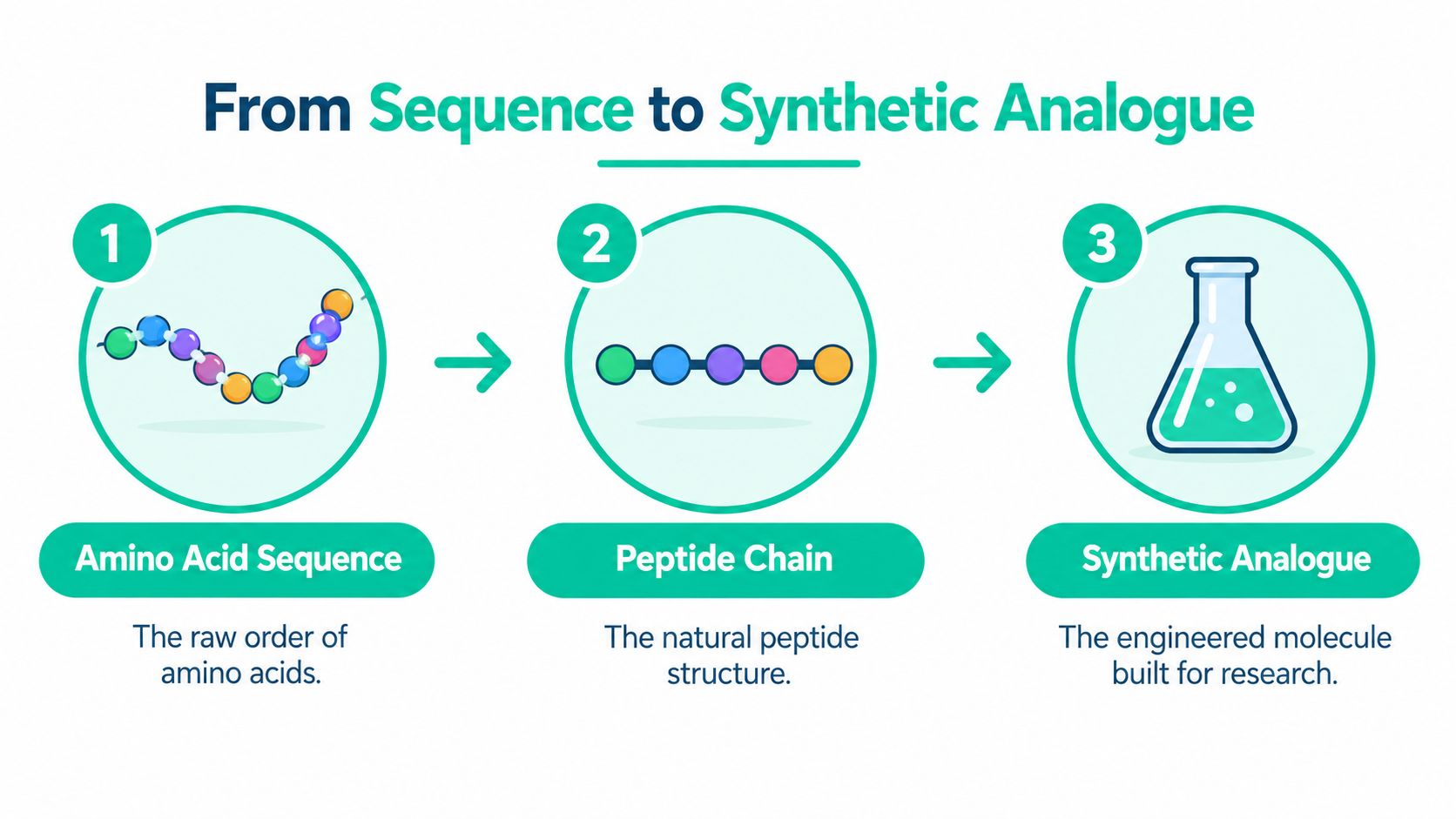
Read a peptide from one end to the other and you're reading its amino acid sequence. Each letter or three-letter code stands for one amino acid, and the order matters because receptors recognise shape and chemistry, not just ingredients. Change one position and binding, stability or breakdown can change too.
From that sequence, chemists calculate molecular mass. That expected mass becomes a reference point for later identity testing, because analytical instruments can compare what is observed in a sample with what the sequence predicts. It's an early, practical link between a string of letters and a measurable physical property.
The diagram below maps that progression from raw sequence to engineered compound.
Why Analogues Are Modified
Native GLP-1 illustrates the problem researchers face. In the body it's rapidly degraded, which suits normal signalling but makes sustained study difficult. Synthetic GLP-1 receptor agonists keep the core recognition features while adding modifications intended to resist breakdown or alter how the molecule behaves in experimental systems.
Semaglutide is a well-known example of this design logic, with fatty-acid modification forming part of how the synthetic molecule differs from the native hormone. You don't need to memorise its structure. You do need to recognise that modification language on a specification sheet signals deliberate engineering, not a copy of the untouched native sequence.
| Feature | Native GLP-1 (research context) | Synthetic GLP-1 agonist (research context) |
|---|---|---|
| Sequence basis | Endogenous hormone sequence | Derived from the native sequence with changes |
| Modification | None, as produced by the body | Substitutions or additions such as fatty-acid attachment |
| Persistence in systems | Short-lived and rapidly cleared | Designed to be more tractable for sustained study |
| Research relevance | Reference for natural signalling | Tool for examining receptor activity over longer windows |
That table also explains a common confusion. Two compounds can share a biological origin and still be different materials with different specifications, different documentation and different regulatory status. Treating them as interchangeable because their names sound related is where procurement errors start.
Major Research Categories Seen in an Australian Catalogue
Open an Australian catalogue and you'll see dozens of names. Grouping them by research category is more useful than memorising each compound, because category language tells you what mechanism the literature has examined and which specification sheets belong together in a procurement file. A structured entry point is a research compound database for Australian laboratories, which lets you compare compounds by research area rather than by marketing label.
Metabolic Incretin Agonists
This group draws the most public attention. Semaglutide, tirzepatide and retatrutide sit here, and research has examined how incretin-related receptors influence metabolic signalling and weight-management pathways. Keep the language precise. Approved prescription medicines in this area are regulated products, while catalogue compounds with related names are research materials, and those aren't the same thing.
Tissue, Cellular and Growth Factor Related Compounds
BPC-157 is the representative name most buyers recognise in tissue and cellular research, where research has examined repair-related signalling in preclinical models. Growth-factor-related lines sit nearby in many catalogues, and the overlap confuses newcomers. A compound can appear under more than one heading because different research groups study it for different mechanistic questions.
Longevity, Senescence and Neuroscience Lines
Longevity and senescence categories collect compounds where research has examined cellular ageing pathways, stress responses and related signalling. Neuroscience lines cover compounds studied in relation to receptors and pathways in the nervous system. In both cases, study-summary language matters. Research has examined a mechanism is a defensible statement. An implied human benefit is not.
GHK-Cu often appears in skin, hair and nail research contexts, where research has examined copper-peptide signalling in cellular models. It's a good example of category overlap, since you'll also see it referenced in broader cellular research discussions.
Categories are a map, not a verdict. They tell you where to start reading and which documentation to request. They don't tell you a compound works for any purpose outside the study systems where it was examined.
Reading a Certificate of Analysis the TGA Way
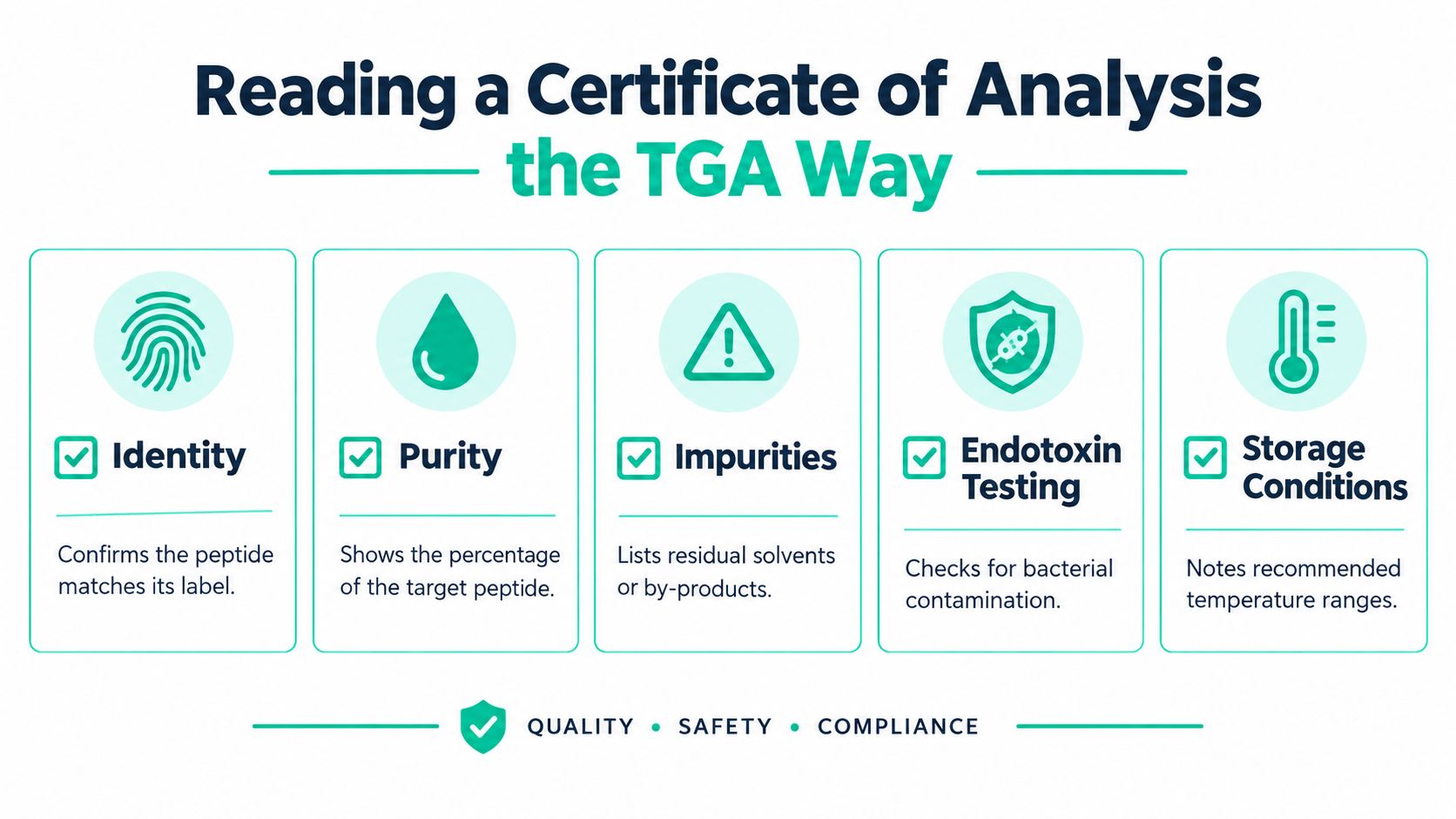
Forget the headline purity percentage for a moment. Read the document the regulator's way. The TGA defines a certificate of analysis as a document certified to truthfully state the tests and results for an individual manufactured batch, with specified information including product name, batch number, dates, tests performed, results, acceptance criteria and a reference to each test method, as set out in the TGA guidance on quality requirements for listed medicines.
That definition gives you a checklist you can apply before checkout, including when you review documents in a supplier's COA library of batch certificates.
The infographic below summarises the five checks that follow from that definition.
Your Batch Document Checklist
- Batch number match: The certificate's batch identifier must match the vial and your order record, or the document isn't evidence about your material.
- Named methods: Each result should reference the analytical method used, not appear as an unattributed number.
- Results against criteria: Numerical results mean little without acceptance criteria showing what counted as a pass.
- Dates present: Manufacturing, testing and certificate dates let you place the batch in time and judge currency.
- Laboratory provenance: The document should make clear who performed the testing, whether manufacturer or independent laboratory.
A generic certificate without a traceable batch number or named methods provides much less evidence than a batch-specific document. It may describe a product type. It doesn't verify the material in your hand.
Repeatability matters too. For regulatory submissions, the TGA says applicants must provide at least three certificates of analysis for the final product to demonstrate compliance with batch-release specifications, relating to production batches or trial batches with differences identified, per the TGA user guide on information for quality of a medicine finished product. One certificate supports one batch. Several support a claim of manufacturing control.
Identity and purity are different claims. Identity asks whether the material is the stated peptide, supported by methods such as mass spectrometry or HPLC retention behaviour. Purity asks how much of the sample is that target peptide.
A certificate also has limits you shouldn't blur. It's evidence of a tested batch, not proof a product is clinically safe, effective or legally approved. Keep that boundary and the document does its job well.
Vial Format, Lyophilised Presentation and Concentration Maths
The vial below shows the standard presentation you'll encounter in Australian research supply.
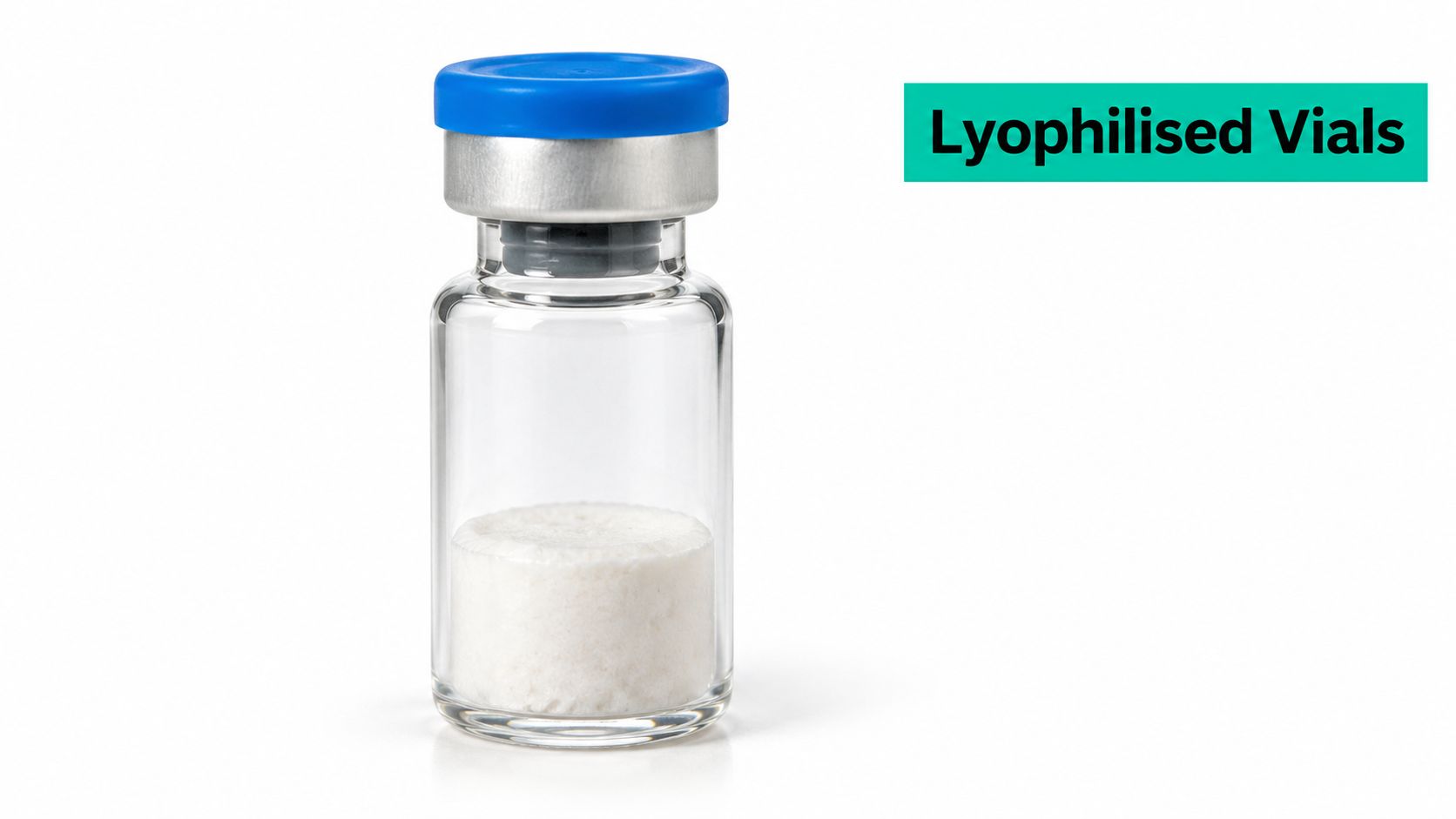
Lyophilisation means freeze-drying. Removing water leaves a dry powder cake that's more stable during shipping and storage than a solution would be, and it keeps the material sealed until a laboratory workflow calls for it. Sealed glass vials also protect against moisture ingress, which matters because peptides can degrade when exposed to water, heat or repeated handling.
Standardised 10-pack formats help procurement planning. A research program can draw from vials of the same stated presentation, record batch numbers consistently, and compare suppliers on like-for-like documentation rather than on mismatched pack sizes. The per-vial quantity on the specification sheet states how much material each vial contains before any laboratory preparation.
Concentration Arithmetic Without the Protocol
Concentration maths is unit conversion, and it's worth separating from any preparation procedure. The relationship is simple. Total peptide mass divided by solution volume gives concentration, expressed as milligrams per millilitre. Double the volume for the same mass and the concentration halves. That's arithmetic, not a method.
A peptide calculator for concentration conversions automates that conversion so records stay consistent across a team and transcription errors don't creep into study files. Use it to check figures on paper, then file the calculation with the batch record it belongs to.
The short video below walks through that concentration relationship visually.
Storage and Handling Records
Follow the storage conditions stated on your product documentation, and note whether they specify ambient or refrigerated conditions. Keep vials sealed, limit unnecessary light and moisture exposure, and log where each batch is stored. The batch number should appear on the vial, the certificate and your internal record. If those three don't align, stop and resolve it before the material enters any workflow.
Australian Regulatory Status and Research-Only Positioning
Three categories get conflated constantly, and separating them is the most important Australian lesson in this guide. The hierarchy below sets them out before the detail.
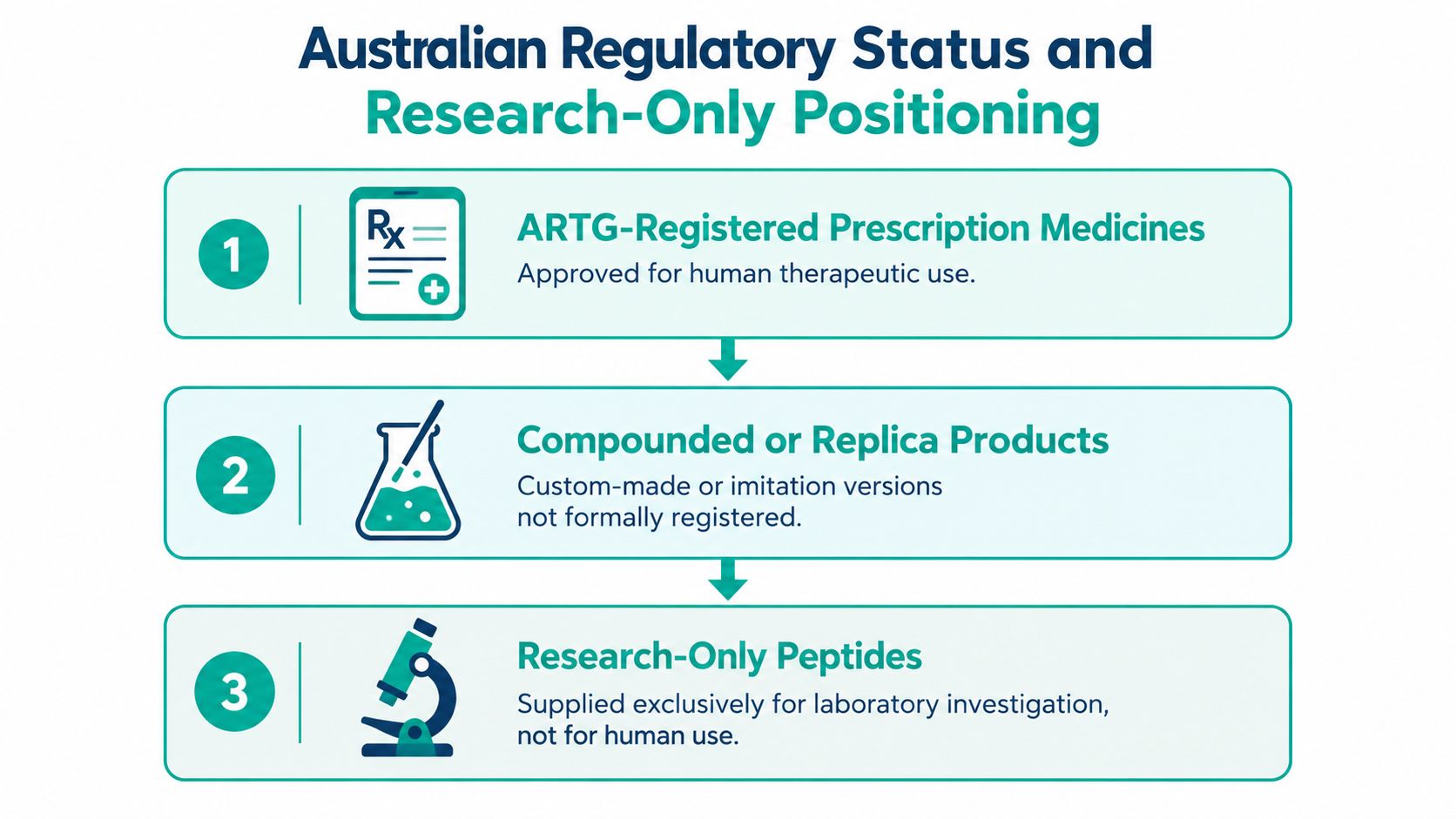
At the top sit ARTG-registered prescription medicines, including approved GLP-1 products assessed through the medicines system. Below them sit compounded or replica products. Australia's Department of Health notes that compounded GLP-1 products are not identical to TGA-approved semaglutide or tirzepatide products and aren't clinically evaluated by the regulator for safety, quality or efficacy, as explained in the Australian Government statement on compounding of replica weight-loss products. Laboratory research-only supply is a third, separate category again.
Intended Use Drives Classification
Regulatory status in Australia depends primarily on ingredients, intended use and promotional claims, not just chemical identity. The TGA treats peptide products as therapeutic goods when they're promoted to influence physiological processes or address health conditions, capturing claims about weight loss, muscle growth, recovery and performance, per the TGA explanation of how therapeutic peptide products are regulated. For products that qualify, ARTG inclusion is generally required before importation, manufacture, supply, export or advertising.
The TGA states that research use only and not for human use disclaimers do not, by themselves, remove regulatory obligations.
That means you review the complete presentation. Product descriptions, website language, packaging and customer communications all count, which is why a dedicated summary of research peptide regulation in Australia is worth reading alongside any product page.
Why the NSW Data Changed the Conversation
NSW emergency departments recorded 1,180 presentations mentioning unapproved peptide use between 1 July 2025 and 30 September 2026, rising from 5 in July 2025 to 217 in September 2026, and 18% resulted in hospital admission, according to the NSW Health report on unapproved peptide presentations. Of those presentations, 71% mentioned retatrutide only. Common associated diagnoses included gastrointestinal conditions, cardiovascular conditions such as chest pain, and allergic reactions including anaphylaxis.
That's jurisdiction-specific surveillance data, not a national prevalence estimate. Its value here is context. Unapproved products haven't been assessed for safety, quality or effectiveness, and clear labelling and traceable documentation are part of keeping research materials separate from therapeutic supply.
If your work crosses into human studies, the TGA identifies two pathways, the Clinical Trial Notification scheme and the Clinical Trial Approval scheme, for trials involving unapproved therapeutic goods, as described in the Australian Government overview of health and medical research. The Australian sponsor determines whether a product is an unapproved therapeutic good, so governance sits well beyond a supplier page.
Procurement Guide for Australian University and Lab Teams
Treat supplier selection as a comparison exercise, not a price hunt. Institutional buyers who've done this well compare across consistent dimensions, and a structured guide to choosing a research peptide supplier in Australia helps keep that comparison honest.
One Australian option in this market is Bulk Aussie Peptides, which supplies research-only peptides in 10-pack vial formats with specification sheets, batch documentation and certificates in an online lab library, marked as in testing where a certificate is pending.
Five Dimensions Worth Scoring
- Documentation transparency: Specification sheets visible before ordering, batch certificates accessible in a lab library, and testing sources clearly labelled as manufacturer-provided or independent.
- Packaging predictability: Standardised 10-pack formats with stated per-vial quantities, supporting study planning and repeat ordering.
- Finance readiness: AUD pricing and GST invoices available for institutional acquittal, with quotes on request for bulk or wholesale supply.
- Dispatch clarity: Stated processing and shipping windows with tracked Australia-wide delivery, typically around one week door to door.
- Australian-based support: Local, Australian owned and operated support that can answer documentation questions in business hours.
Catalogue scale matters for continuity. A range of 60+ compounds in consistent formats reduces the need to qualify a new supplier every time a program adds a compound, and a procurement information pack gives finance and compliance teams something concrete to review.
A Checklist You Can Paste Into a Procurement File
Confirm the specification sheet matches your required compound and presentation. Match the batch number across vial, certificate and invoice. Record the analytical methods, results and acceptance criteria from the batch document. Note storage conditions and retest or expiry information. File dispatch and tracking details, and confirm the GST invoice is attached. If any element is missing, request it before the material is booked into your inventory system, not after.
Frequently Asked Questions for Australian Researchers
Are research-only peptides legal to possess in Australia? Legitimate laboratory possession differs from promoting a product for therapeutic outcomes, and intended use drives classification.
How do I read a certificate of analysis? Match the batch number first, then check named methods, numerical results, acceptance criteria and dates.
Why buy from an Australian supplier? Domestic dispatch, AUD pricing, GST invoices and tracked shipping simplify procurement records.
Where should a first-time buyer start? Review the specification sheet, the lab library certificate, the peptide calculator and the procurement information pack before ordering.
Start your next order the documented way by reviewing specification sheets and batch certificates for 60+ research compounds in standardised 10-pack formats, priced in AUD with tracked Australia-wide shipping. Visit Bulk Aussie Peptides to compare compounds, open the lab library and request procurement support for your lab. - BAP