
Peptides Australia: A Research Buyer's Practical Guide
A Tuesday morning procurement request can expose every weak point in a peptide supply chain. A study lead needs a 5 mg custom peptide batch before a grant deadline, the laboratory freezer is holding at -20°C, and three supplier PDFs are open in separate browser tabs. One lists a purity result, another offers a low price, and the third has a certificate that may not match the vial arriving at the receiving dock.
For Australian laboratories, the decision isn't where to buy peptides. It covers research-use-only positioning, TGA requirements, batch-matched Certificates of Analysis, supplier verification, dispatch conditions, storage control and bulk cost-per-milligram calculations. A supplier can be easy to order from while still creating avoidable problems during an audit, a reorder or a long comparative assay.
Australia's peptide therapeutics market generated USD 1,906.3 million in 2025 and is projected to reach USD 3,711.1 million by 2033, with a projected 7.8% CAGR from 2026 to 2033. Metabolic disorders were identified as the largest and fastest-growing application segment in that outlook, according to the peer-reviewed market outlook. That commercial growth makes disciplined procurement more important, not less.
Table of Contents
- What This Guide Solves for Australian Peptide Buyers
- Research Peptide Categories Supplied in Australia
- Australian Regulatory Positioning for Research Peptides
- Reading a Certificate of Analysis for Peptide Sourcing
- Domestic Versus International Peptide Supply Pathways
- Ordering, Bulk Formats, Dispatch and Storage Timelines
- Reconstitution Calculations and Working-Aliquot Discipline
- Institutional Buyer Checklist and Common Compliance Questions
What This Guide Solves for Australian Peptide Buyers
The immediate question is usually, “Can this supplier give us the material, documentation and delivery confidence our protocol requires?” Answering it properly means separating commercial convenience from laboratory evidence.
Start with the regulatory description. A product labelled research use only must remain positioned for laboratory investigation. It shouldn't carry therapeutic claims, administration guidance or human-use language in the quotation, invoice, product page or shipping paperwork. The Therapeutic Goods Administration's guidance on peptides and social media makes clear that products described as “research-grade” or “for research use only” aren't approved for human use.
Next, reconcile the paperwork. The lot or batch number on the vial must match the COA, and the COA must identify the peptide, its net content and relevant dating. A generic sample specification isn't enough for a longitudinal study because it doesn't prove that the material received belongs to the tested production run.
The five decisions that affect the study
- Regulatory framing: Confirm whether the intended use, wording and supply pathway place the material within laboratory research rather than therapeutic-goods supply.
- Batch integrity: Check that the vial, packing slip, purchase order and COA refer to the same lot.
- Supplier verification: Identify who issued each document and whether testing was manufacturer-provided or independently commissioned.
- Dispatch planning: Ask how the order is processed, tracked and protected during transit.
- Bulk mathematics: Compare the usable, documented peptide content across pack formats, not just the headline vial price.
The following sections address the practical blockers that usually delay sign-off. They cover catalogue categories, Australian regulatory positioning, COA review, domestic and international supply routes, dispatch and storage, neutral reconstitution calculations, and a procurement checklist for universities, biotechnology companies, CROs and research institutions.
Practical rule: Treat the compound name as only one procurement variable. Intended use, documentation and chain of custody determine whether the material is suitable for a controlled research workflow.
Products are supplied strictly for laboratory research purposes only. They are not for human consumption, therapeutic use or diagnostic procedures.
Research Peptide Categories Supplied in Australia
Research-use-only peptides are synthetic amino-acid chains supplied for laboratory investigation, not for human or veterinary therapeutic administration. The category describes the intended research context, not a clinical status, treatment effect or approval pathway.
Australian buyers commonly encounter several supply formats. A catalogue peptide is generally a defined sequence selected from a supplier's standard range. A custom synthesis order is produced against a requested sequence or specification and needs especially careful review because the buyer may be responsible for confirming the exact identity, modifications and acceptance criteria.
Catalogue, custom and modified materials
Modified peptides can include stabilising or analytical modifications requested for a research method. The modification must appear clearly in the product identity and documentation. A mismatch between the requested sequence and the reported mass can invalidate an otherwise well-organised experiment.
Peptide libraries are supplied for screening campaigns, where many related sequences are assessed under a shared workflow. Here, consistent labelling and a complete map of member identities matter as much as the certificate for the individual material. Cosmetic-research-only peptides sit in a different commercial context, but their laboratory label still needs to avoid cosmetic treatment claims or human-use language.
Every category should carry clear research-use-only or laboratory-investigation-only wording. Procurement teams should inspect incoming cartons, vials, invoices and product pages for consistency. Cosmetic-research terminology doesn't remove the need to police the boundary between formulation investigation and therapeutic supply under the Australian Therapeutic Goods framework.
Peptide categories supplied to Australian labs at a glance
| Category | Typical Australian buyer | Standard lot size | Documentation expectation |
|---|---|---|---|
| Catalogue research peptide | University laboratory or CRO | Supplier-defined | Identity, lot-matched COA and storage information |
| Custom synthesis order | Biotechnology company or research institute | Project-defined | Confirmed sequence, modification details, batch identity and analytical record |
| Modified peptide | Assay development or formulation team | Supplier-defined or custom | Modification identity, analytical confirmation and lot-specific documentation |
| Peptide library | Screening or discovery group | Campaign-defined | Member list, sequence map, plate or vial identifiers and batch records |
| Cosmetic-research-only peptide | Formulation research team | Supplier-defined | Research-only labelling, identity and lot-specific COA |
A standard pack format doesn't automatically make a material interchangeable with another supplier's product. The sequence, counter-ion, net content, analytical method and batch record all need to fit the protocol.
Australian Regulatory Positioning for Research Peptides
Australian peptide procurement sits within the Therapeutic Goods Act 1989. The TGA requires therapeutic goods supplied in Australia to be included in the Australian Register of Therapeutic Goods, unless an exemption, approval or authority applies, as explained in the TGA's peptide regulatory guidance.
That means a laboratory buyer shouldn't rely on a blanket statement that all research peptides are either approved or prohibited. The relevant questions are more specific. What is the intended use? How is the material described? Is it supplied as a laboratory reagent, or is the supplier making therapeutic claims? Does the supply pathway support the stated use?
Positioning begins with intended use
An Australian regulatory discussion from Pillar Research on the peptide landscape highlights the practical distinction between bona fide laboratory use and supply connected with human administration. The same molecule can therefore require different scrutiny depending on the purpose and wording attached to it.
Before a purchase order is approved, check:
- Product language: The catalogue, quotation and invoice should describe laboratory research, not treatment, dosing or patient use.
- Label status: The vial should carry clear research-only positioning and an identifiable product name.
- Traceability: Manufacturer details, lot numbers and supporting records should remain consistent across documents.
- Institutional review: Ethics, biosafety and other internal approvals still apply where the research design requires them.
- Import pathway: Imported or unapproved materials need documentation that allows the consignment to be identified and assessed.
The TGA specifically warns that unlabelled powders or injectables, missing concentration details and code-only markings are high-risk indicators because they make identification and lawful import more difficult under the Personal Importation Scheme. Those warnings are directly relevant to institutional receiving teams, even when the intended work is entirely in vitro.
For a working internal reference, procurement teams can also review research peptide regulation in Australia. The useful operational approach is to keep three checks separate: research-only supply, ARTG-listed therapeutic goods and the actual intended use recorded on the purchase documentation.
A compliant-looking label won't repair a therapeutic claim elsewhere in the transaction. Keep the wording aligned from product page through to invoice, receiving record and laboratory inventory.
Reading a Certificate of Analysis for Peptide Sourcing
A COA should be treated as a batch identity document, not a decorative quality badge. The first check is mechanical: the lot number on the certificate must match the number printed on the vial. If those identifiers disagree, quarantine the material while the supplier investigates.
Australian laboratory guidance states that a COA should at minimum identify the peptide clearly, match the vial's lot or batch number, state manufacture, retest or expiry dating under stated storage conditions, and specify the nominal net content per vial. The laboratory-facing COA guidance for ipamorelin provides a practical example of those receipt-level controls.
What a quality officer checks first
Review the identity and sequence description before reading the headline purity figure. For modified peptides, the modification and counter-ion should be identifiable. Then compare the stated net peptide content with the gross vial weight, because gross mass includes the container and other material and shouldn't be used as the working peptide mass.
The analytical record should identify the methods used. Buyers commonly look for:
- HPLC data: Claimed purity should be supported by a chromatogram or an appropriately described result.
- Mass spectrometry: The reported mass should support identity confirmation.
- Residuals: Water, solvents or counter-ions may matter to assay interpretation.
- Endotoxin information: Request it where the laboratory's method or institutional quality system requires it.
- Dating: Retest or expiry information should state the storage conditions behind the date.
The distinction between documentation sources matters. A manufacturer-provided COA records the supplier's or manufacturer's own release information. An independent laboratory report indicates that an external facility performed the stated analysis. Neither should be described as independent unless the document identifies the external testing source.
A simple reconciliation exercise
Suppose the certificate reports a purity result and includes a chromatogram. Compare the lot identifier, sample name and reported result with the trace itself. A phrase such as “for reference only” should trigger a query because it may indicate that the attached result isn't a release test for the vial received.
Other warning signs include a missing chromatogram, a batch number that appears on a generic template, an unexplained retest window or a product name that doesn't specify the sequence. File the final COA against the purchase order and retain the supplier lot number before opening or aliquotting the vial. The peptide certificate of analysis resource can sit alongside the laboratory's own receiving SOP.
Domestic Versus International Peptide Supply Pathways
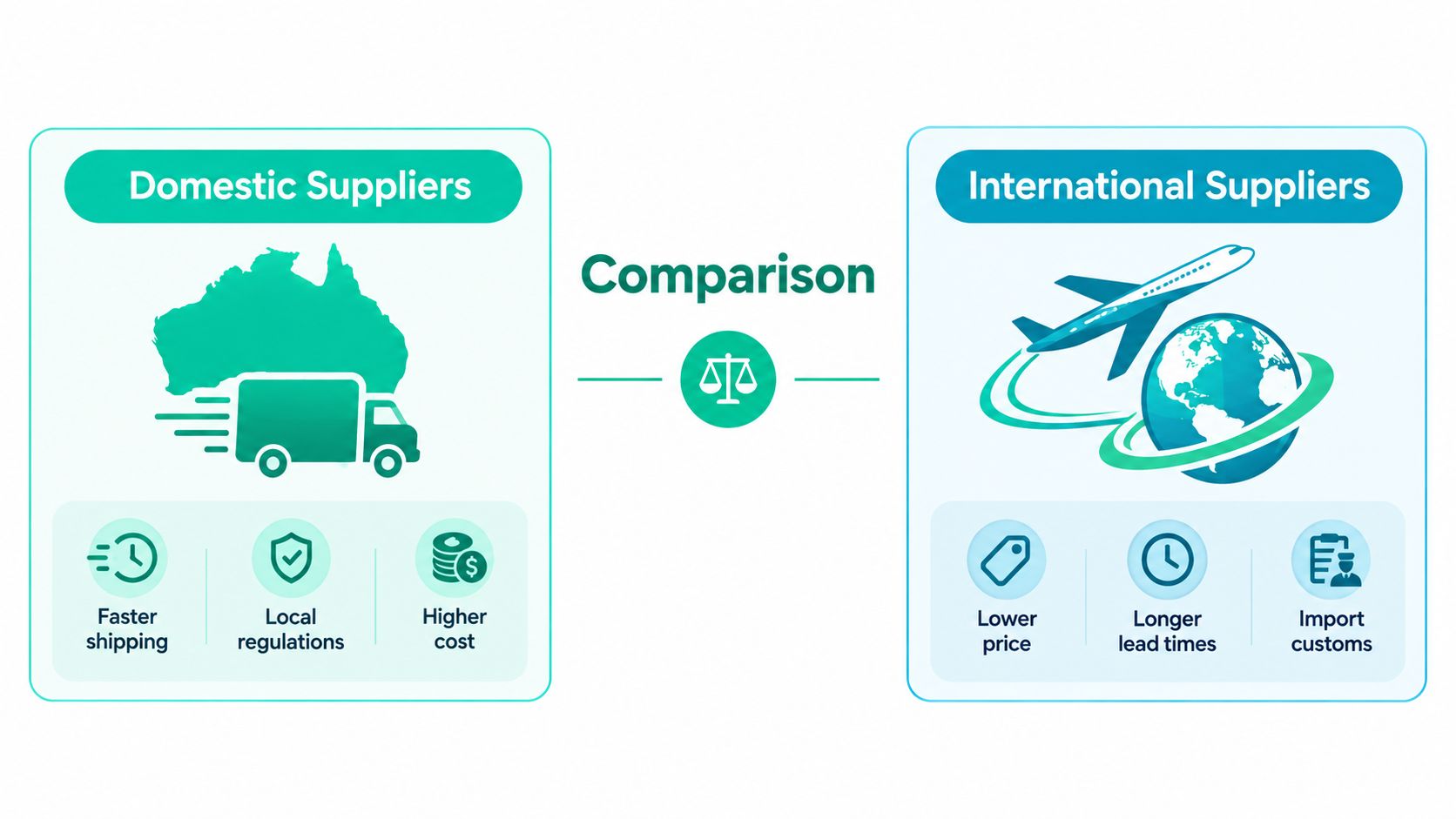
Domestic and international supply routes can both serve legitimate research programmes, but they expose the laboratory to different operational risks. The right comparison isn't just the quoted price. It includes customs variability, document continuity, temperature exposure, incident investigation and the ability to reorder the same lot or a suitably documented replacement.
International shipping can introduce additional hand-offs. A consignment may move through overseas manufacturing, freight, customs and local delivery before the receiving team sees it. If a shipment is delayed or split, the laboratory needs records showing where the material travelled and whether the packaging remained intact.
The variables that matter at bench level
| Procurement variable | Domestic pathway | International pathway |
|---|---|---|
| Customs exposure | Lower exposure to import clearance after domestic dispatch | Requires import documentation and may face clearance delays |
| Chain of custody | Usually simpler to reconstruct within the Australian delivery network | Can involve more parties and hand-offs |
| Reorder response | Domestic processing can support more predictable replenishment | Lead time can vary with manufacturing and border processes |
| Temperature risk | Transit still needs appropriate packaging and receiving checks | Longer freight routes can increase exposure to uncontrolled conditions |
| Incident review | Local supplier contact may simplify document queries | The buyer may need to coordinate across supplier, freight and customs contacts |
The TGA's warnings about unlabelled powders, injectables, missing concentrations and code-only markings are particularly important for imported products. Customs and institutional receiving staff need enough information to identify the material, its concentration and its declared research purpose.
A lower invoice price isn't a lower study cost if the laboratory has to repeat an assay, investigate a missing batch record or discard material that arrived without usable traceability.
A practical decision rule is to reserve international routes for orders where the supplier can provide complete batch documentation and a clear import pathway. For time-sensitive or multi-stage studies, a domestic source may offer better control over replenishment and document queries, even when the unit price is higher. Compare the entire risk profile before allocating a critical SKU.
Ordering, Bulk Formats, Dispatch and Storage Timelines
Order planning should end at the freezer shelf, not at checkout. The buyer needs a record of the requested product, pack format, batch documentation, dispatch method, receiving contact and storage destination before the order is submitted.
Bulk formats can help a laboratory standardise a longitudinal study, but only if the vials are tied to a documented lot and the total requirement has been calculated. A supplier policy may offer 10-pack vial formats, domestic order processing, Australia-wide delivery and dispatch within 1–3 business days. Those are operational features, not evidence of analytical quality, and should be recorded separately from COA review. The Australian peptide storage and stability information sets out the supplier-side handling context.
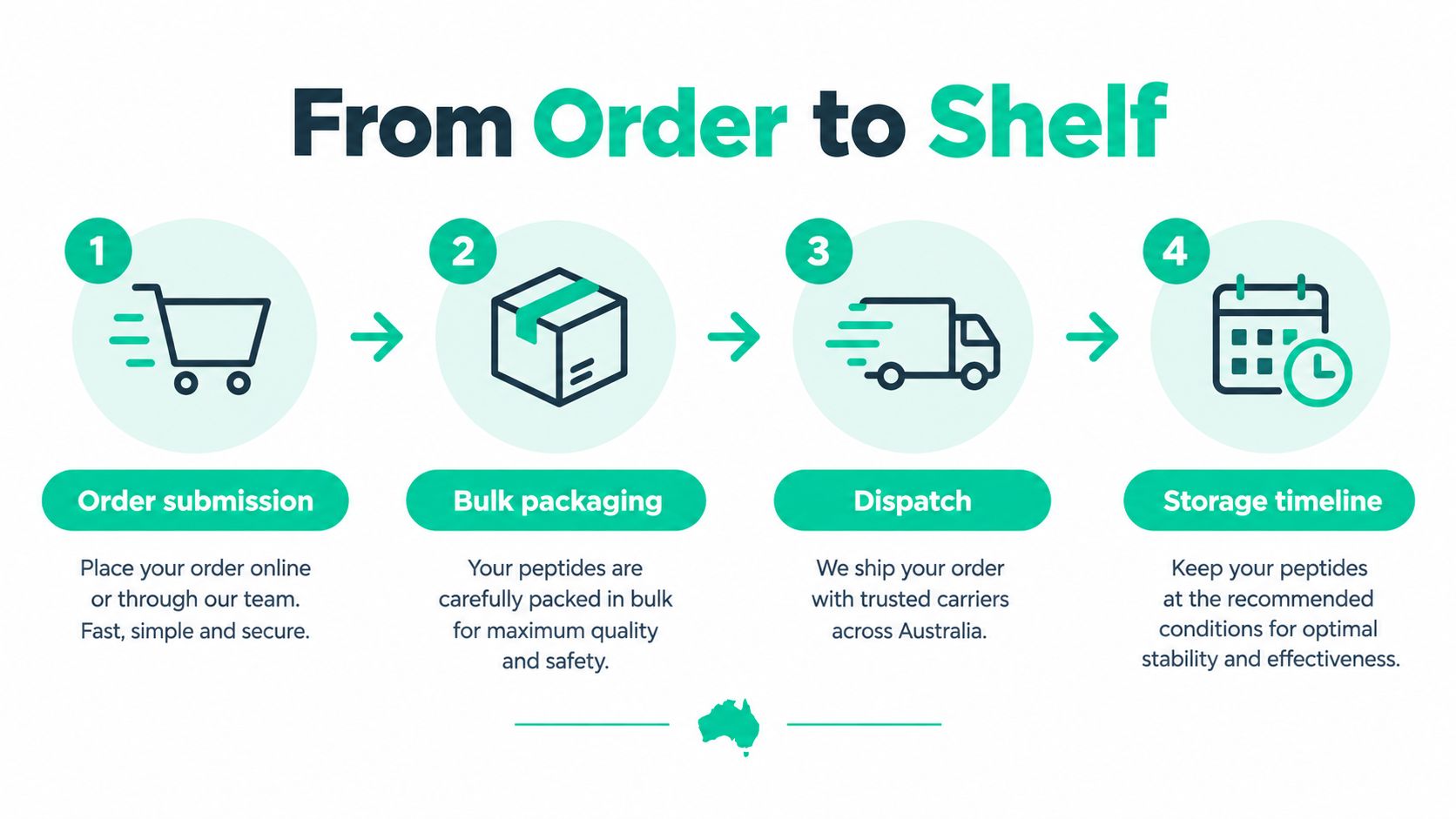
Receiving should be a controlled handover
At delivery, assign one person to reconcile:
- Packing slip and purchase order: Confirm product name, quantity and pack format.
- Vial labels and COA: Match every lot or batch identifier.
- Physical condition: Record damaged packaging, wet cartons, broken seals or unusual labelling.
- Storage transfer: Move unopened lyophilised material into the designated controlled-temperature location.
- Inventory record: Enter the receipt date, lot, expiry or retest information and storage location.
Australian guidance recommends keeping unopened lyophilised peptides in a cool, dry environment away from direct light, with long-term storage commonly around -20°C and reconstituted solutions refrigerated at 2–8°C. These temperature bands and the associated moisture and light precautions are described in the Australian peptide reconstitution guide.
Don't open a cold vial immediately after removing it from storage. Allowing it to reach room temperature before opening helps reduce condensation risk. Use the product's stated storage conditions and your institutional SOP rather than assuming that one temperature applies equally to lyophilised material and reconstituted solution.
Free shipping thresholds, delivery windows and bulk pricing should be confirmed in writing before the purchase order is released. They're useful for budget planning, but they don't replace lot verification or storage discipline.
Reconstitution Calculations and Working-Aliquot Discipline
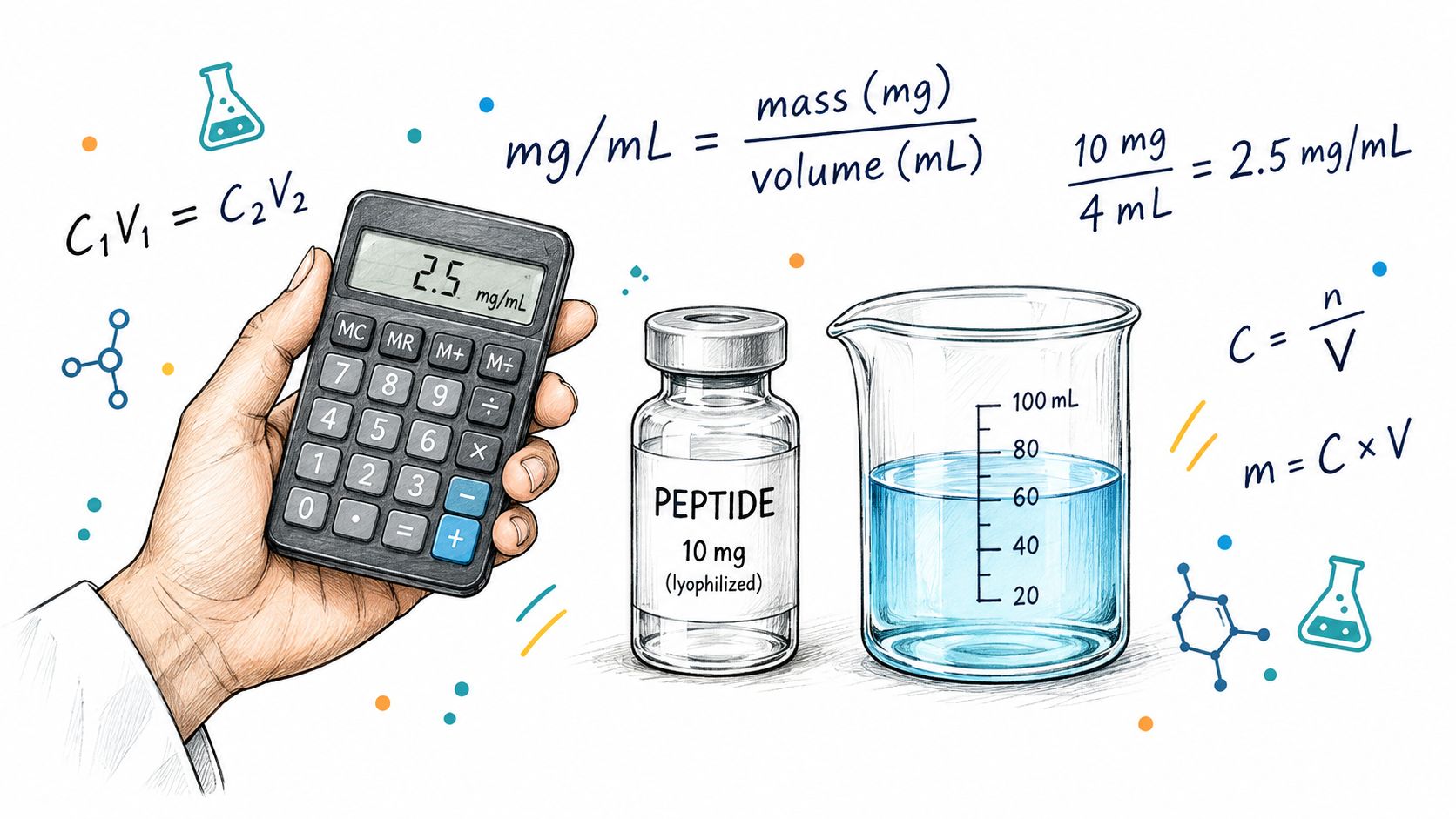
Reconstitution calculations are laboratory mathematics, not instructions for human use. The basic concentration relationship is:
concentration in mg/mL = peptide mass in mg ÷ diluent volume in mL
To convert mass concentration into molar concentration, divide by the peptide's molecular weight. Keep the molecular-weight form consistent with the documented material, especially where a salt, counter-ion or modification changes the reported mass.
A neutral example uses a 10 mg vial and 2 mL of diluent. The resulting concentration is 5 mg/mL. To prepare a 100 µM working stock, the laboratory must use the documented molecular weight to calculate the required dilution volume. The peptide reconstitution calculator guide can support the arithmetic, but the researcher remains responsible for confirming the input values.
Errors that distort assay gradients
The most common mistakes happen before the calculator is opened:
- Gross weight substitution: The vial's total mass isn't the same as net peptide content.
- Wrong molecular weight: The researcher uses a free-peptide value when the documented material includes a counter-ion or modification.
- Uneven dissolution assumptions: A lyophilised cake may not be uniformly distributed if it has been disturbed or handled poorly.
- Unrecorded dilution: A working tube is prepared without preserving the original batch and concentration calculation.
For short-term laboratory work, divide a reconstituted solution into clearly labelled working aliquots using the laboratory's approved sterile technique. Protect the material from unnecessary light and repeated temperature cycling. Any snap-freezing, freezer transfer or freeze-thaw limit must follow the peptide's validated handling information and the institution's SOP, rather than an assumed universal rule.
Freezer records worth keeping
A useful freezer log captures:
- Batch number
- Reconstitution date
- Diluent identity and lot
- Calculated concentration
- Aliquot identifier
- Remaining freeze-thaw count
- Storage location and temperature record
The point is reproducibility. A later researcher should be able to connect an assay tube to the original vial, calculation, diluent and batch record without relying on memory.
Institutional Buyer Checklist and Common Compliance Questions
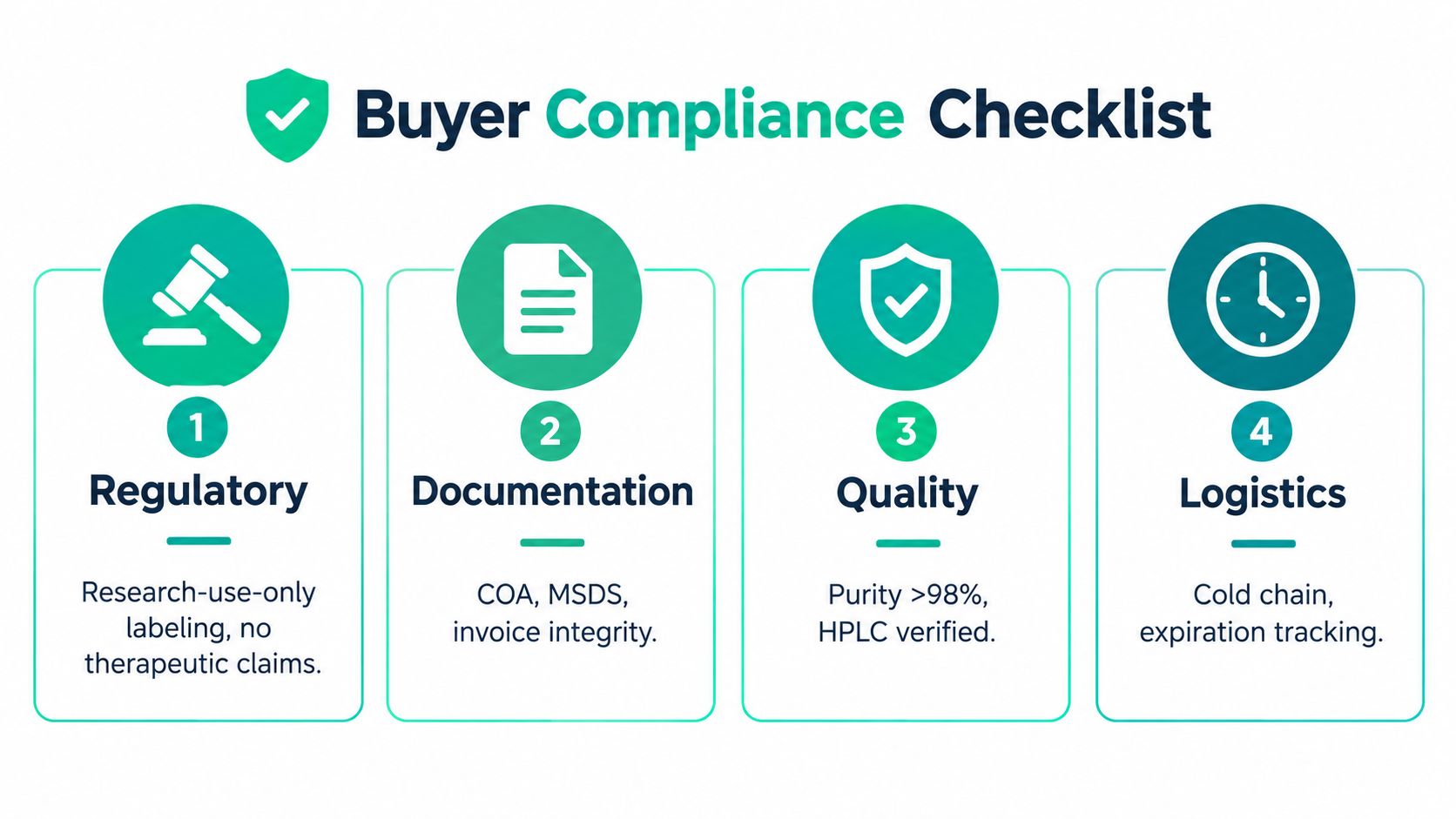
A procurement file should let a quality officer answer four questions quickly: Is the supply correctly positioned, can the material be identified, can the delivery be reconstructed, and was storage controlled? If any answer depends on an undocumented verbal assurance, pause the order.
Four verification pillars
Regulatory positioning
- Confirm research-use-only wording on the product and invoice.
- Remove therapeutic, dosing or human-use language from internal purchasing descriptions.
- Record the intended laboratory use.
- Escalate unusual sequences or wording to the institution's regulatory and biosafety contacts.
Documentation integrity
- Match the COA lot to every vial.
- Confirm peptide identity, sequence or modification and nominal net content.
- Check the analytical method and whether the report is manufacturer-provided or independent.
- Record retest or expiry dating with the stated storage conditions.
Logistics verification
- Confirm domestic dispatch arrangements or import documentation before ordering.
- Ask how the consignment is tracked and packaged.
- Inspect the shipment at receipt.
- Photograph damaged packaging and quarantine discrepancies.
Storage controls
- Transfer unopened lyophilised material into controlled storage.
- Protect it from moisture and direct light.
- Record the freezer location and receipt date.
- Document reconstitution, aliquot identity and working-solution storage.
Common questions from Australian procurement teams
Are research peptides automatically ARTG-listed therapeutic goods?
No blanket assumption is safe. The TGA framework turns on the product's status, intended use, wording and supply pathway. The TGA states that therapeutic goods supplied in Australia generally need ARTG inclusion unless an applicable exemption, approval or authority applies. Research teams should keep laboratory supply and therapeutic supply distinct.
What does “research use only” mean on a certificate?
It identifies the stated laboratory purpose and doesn't approve the material for human use. The TGA explicitly says products described as “research-grade” or “for research use only” aren't approved for human use.
Why must the vial and COA share a batch number?
The match links the physical material to the analytical record. Without it, a certificate may describe a different production run.
How does third-party testing differ from in-house QC?
Third-party testing is performed by an external laboratory identified in the report. In-house or manufacturer-provided documentation can still be useful, but it shouldn't be described as independent unless an external test facility produced it.
What does a retest date signal?
It indicates when the material should be reassessed under the stated storage conditions. It isn't proof that every vial remains suitable outside those conditions.
Do bulk 10-pack formats remove all variability?
No. They can help a study use a common lot and simplify inventory, but the buyer still needs to verify lot matching, net content and documentation for the received pack.
Products are supplied strictly for laboratory research purposes only. They are not for human consumption, therapeutic use or diagnostic procedures.
Bulk Aussie Peptides provides research-use-only peptide supply, bulk 10-pack formats, product specifications and batch documentation for Australian laboratory procurement. Review the documentation and storage requirements before placing an order, then visit Bulk Aussie Peptides to assess the available research catalogue.