
Tb 500 Australia

A university tissue-repair team in Melbourne has selected TB-500 as a reference material for a controlled cell-migration study. The purchase request looks routine until the procurement officer checks the Australian regulatory position, asks for batch evidence, and discovers that an online label saying “research use only” doesn't settle the legal question.
The key point for anyone searching for TB-500 Australia is straightforward: TB-500, also referred to as thymosin beta-4 or TB4, isn't approved for human use anywhere in the world and isn't approved by Australia's TGA. Sport Integrity Australia lists TB4/TB-500 as an unapproved peptide hormone, while a TGA safety alert names TB-500 among examples of unapproved peptide products. Sport Integrity Australia's thymosin beta-4 guidance should be part of any institutional review.
That makes procurement a regulatory decision first and a product decision second. A laboratory must establish its research purpose, institutional approvals, supplier documentation and import or supply pathway before it treats an online product page as an orderable material.
Table of Contents
- Why Australian Labs Are Asking About TB-500 Right Now
- What TB-500 Actually Is in Research Context
- The Australian Regulatory Pathway for TB-500
- Reading Batch Documentation and Certificates of Analysis
- Reconstitution Mathematics for 5 mg and 10 mg Vials
- Domestic Ordering, Shipping and Lead Times
- Procurement Checklist for Australian Research Teams
Why Australian Labs Are Asking About TB-500 Right Now
Researchers studying cell migration, actin regulation and tissue-repair pathways may encounter TB-500 while reviewing preclinical literature or planning an in-vitro assay. Australian-facing laboratory descriptions place the compound in a controlled research context, with interest focused on actin regulation, cell migration, angiogenesis and tissue-regeneration mechanisms rather than therapeutic use. This Australian TB-500 research description illustrates the distinction between a laboratory reference material and a medicine.
At the same time, Australian buyers are working in a more closely scrutinised environment for unapproved peptide products. The TGA states that peptide products not included in the Australian Register of Therapeutic Goods, or ARTG, haven't been evaluated for safety, quality or effectiveness. It also makes clear that “research use only” and “not for human use” wording doesn't remove obligations under therapeutic goods law. The TGA's guidance on importing, compounding and supplying unapproved peptide products is essential reading for procurement teams.
Practical rule: A research label describes intended use. It doesn't, by itself, create a legal exemption.
For a university, hospital, biotechnology company or CRO, the first questions should therefore be:
- What is the scientific purpose? Define the assay, reference-material role or analytical study without therapeutic language.
- Who has approved the work? Confirm the responsible institutional committee and local handling requirements.
- What exactly is being supplied? Check identity, batch traceability and the source of every quality document.
- What happens if the pathway isn't clear? Pause the order rather than assuming that domestic shipping, a disclaimer or an invoice resolves the issue.
What TB-500 Actually Is in Research Context
Start with the parent molecule. Thymosin beta-4 is a naturally occurring peptide associated with actin regulation, and researchers often describe the full-length molecule as a 43-amino-acid peptide encoded by the TMSB4X gene. TB-500 is generally presented in Australian laboratory guidance as a synthetic fragment related to thymosin beta-4, rather than as the full endogenous peptide.
The commonly discussed research sequence is LKKTETQ, a seven-residue fragment associated with the actin-binding region. In a simplified model, actin exists in monomeric form, often called G-actin, before it participates in larger cytoskeletal structures. A peptide research tool connected with this region may be studied for how it interacts with actin-related processes and cellular movement. That description concerns molecular biology, not a claim that the material repairs tissue in humans.
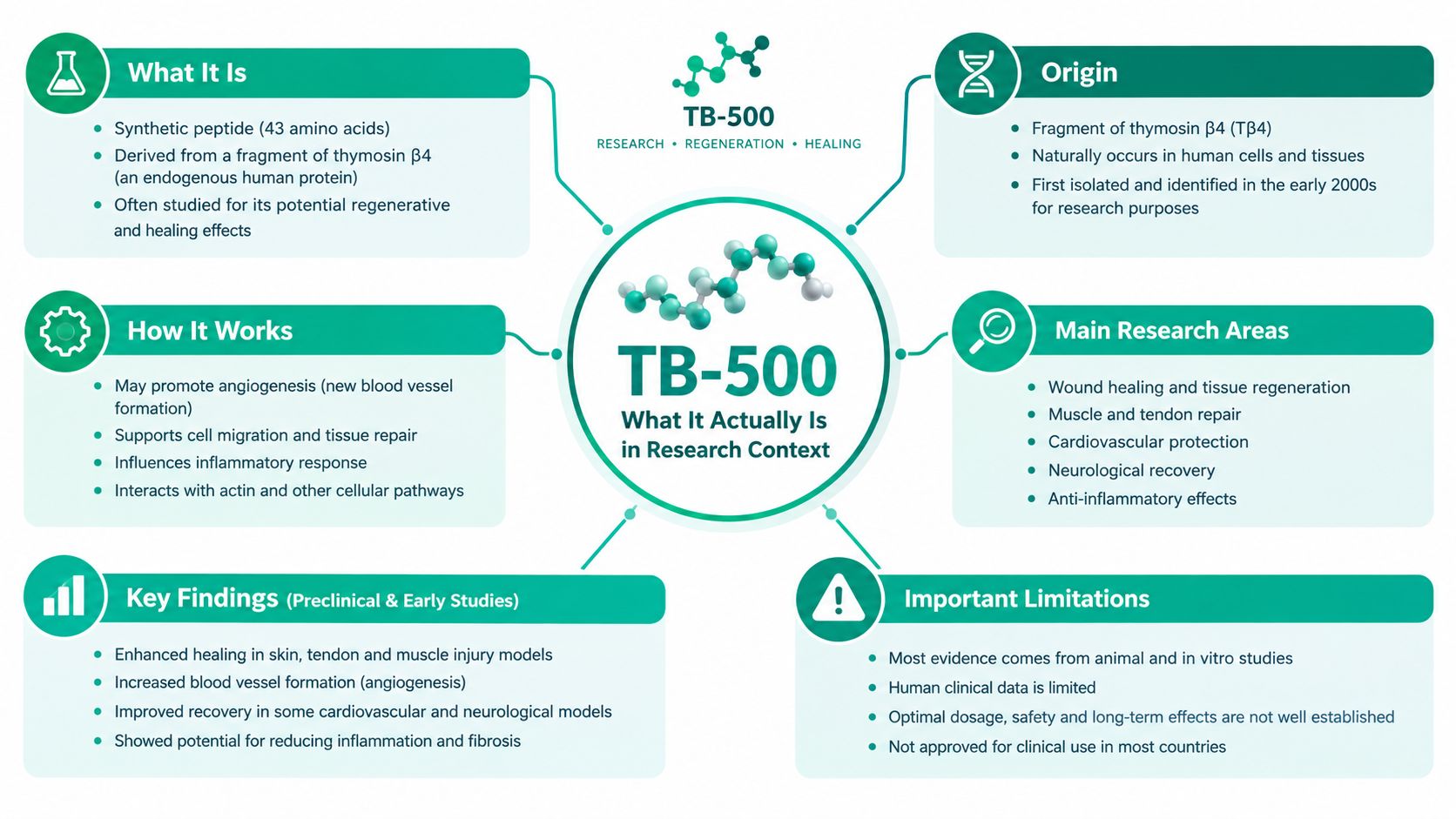
The research context matters because product pages and informal discussions can blur different materials. A buyer should distinguish between full-length thymosin beta-4, a fragment such as LKKTETQ, and other peptides that appear in similar research conversations. Thymosin alpha-1 and BPC-157 are separate research subjects with different sequences, structures and evidence bases. Similarity in a catalogue category doesn't establish interchangeability.
The TB-500 research overview can help a team record the intended scientific context in its internal purchase file. The file should state whether the material is being used for cell culture, analytical method development or another approved laboratory purpose.
The University of New South Wales notes that claims about TB-500 regenerating or repairing tissue, or calming inflammation, come from a limited body of laboratory work involving cells and animals, not human trials. Its discussion of injectable peptides and human evidence reinforces why procurement documents must avoid clinical wording. The material should be described as a synthetic research peptide, not as a finished therapeutic.
The Australian Regulatory Pathway for TB-500
An institutional buyer can treat the regulatory review as a decision tree.
First, check the TGA position. TB-500 isn't an approved therapeutic good and isn't included in the ARTG. It isn't approved for human use in Australia. If a proposed order is intended for administration, treatment, personal use or therapeutic supply, it isn't an appropriate research procurement request.
Second, define the intended use in writing. A genuine laboratory purpose might involve an in-vitro assay, analytical characterisation or controlled preclinical study. The words “research use only” help communicate intended use, but the TGA explains that labels don't remove obligations where a product is intended for therapeutic use. The TGA's therapeutic peptide compliance guidance belongs in the compliance file.
Third, ask the institution which approvals apply. A synthetic peptide isn't automatically a genetically modified organism, so GMO requirements and non-GMO research should be distinguished rather than combined. The responsible biosafety or research governance office can determine whether an Institutional Biosafety Committee review, risk assessment, chemical register entry, import review or other local approval is required. State and territory controls may also affect peptide handling and supply, so a national assumption isn't enough.
A practical consultation map
| Regulator or committee | Question it answers | Required documentation |
|---|---|---|
| Therapeutic Goods Administration | Is the proposed supply or use consistent with therapeutic-goods requirements? | Intended-use statement, supplier details, product description and regulatory review |
| State or territory medicines and poisons authority | Do local scheduling or possession rules affect the proposed activity? | Institutional authorisation, responsible officer details and handling procedures |
| Institutional Biosafety Committee | What biosafety, containment or research-governance controls apply? | Protocol summary, risk assessment and laboratory procedures |
| Sport Integrity Australia | Could the work involve an athlete, prohibited substance testing or anti-doping implications? | Study declaration, participant separation controls and research records |
Sport Integrity Australia identifies TB4/TB-500 as an unapproved peptide hormone, and the Australian anti-doping discussion places peptides such as TB-500 within the prohibited peptide-hormone and growth-factor context. The Australian Sports Drug Medical Advisory Committee's peptide overview provides useful background for teams working near athlete samples or performance research.
The correct pathway depends on intended use, institutional authority and the proposed supply arrangement. A product page can't make that decision for the lab.
If an IBC-approved framework covers possession and use, the buyer should retain the approval reference and protocol scope. If the supplier requires a research-only declaration, that document should match the institutional purpose. If the lab can't demonstrate a legitimate, approved research framework, it should stop before ordering.
Reading Batch Documentation and Certificates of Analysis
A Certificate of Analysis is only useful when it identifies the exact material received. Start with the SKU, product name, batch number and stated net content. Those fields should match the purchase order, outer packaging and vial label. A generic document for “TB peptide” doesn't provide the same traceability as a lot-matched record.
What the analytical fields tell you
An HPLC result can support an assessment of chromatographic purity when the report includes the trace, retention-time information, method details and the stated result. It doesn't, on its own, prove sequence identity. ESI-MS or MALDI-TOF data address a different question, whether the observed molecular mass is consistent with the declared material.
A procurement officer should also look for the issuing laboratory, test date, sample identification, residual-solvent information, water content and endotoxin information where those tests are relevant to the approved protocol. Missing fields aren't automatically proof of failure, but they are a reason to ask the supplier for clarification before release to the research team.
The source of the document matters as much as its layout. A manufacturer-provided COA reports what the manufacturer or its contracted laboratory supplied. An independent retest is a separate evaluation commissioned from an external laboratory. Neither should be described as equivalent without checking the scope, methods, sample chain and laboratory identity.
Anatomy of a TB-500 Certificate of Analysis
| COA field | What to check | Acceptable signal | Red flag |
|---|---|---|---|
| Product and SKU | Does the name match the purchase order? | Exact product identification | Generic or inconsistent naming |
| Batch number | Does it match the vial and carton? | Lot-matched reference | Mismatched or absent number |
| HPLC | Is the chromatogram visible and interpretable? | Trace, method and reported result | Blurred image or result without trace |
| Mass spectrometry | Is the expected molecular mass addressed? | Identified spectrum and method | Unlabelled or missing spectrum |
| Net peptide content | Is the declared amount clear? | Stated quantity and units | Ambiguous quantity |
| Test laboratory | Who issued the report? | Named laboratory and date | Unidentified source |
| Additional tests | Are relevant water, solvent or endotoxin fields addressed? | Scope fits the protocol | Unsupported “complete testing” language |
File the COA with the purchase order and receiving record. If the batch ID doesn't reconcile, quarantine the shipment administratively and ask for a corrected document before the material enters stock. The available COA library can show how documentation is organised, but the receiving team must still verify the specific batch supplied.
Reconstitution Mathematics for 5 mg and 10 mg Vials
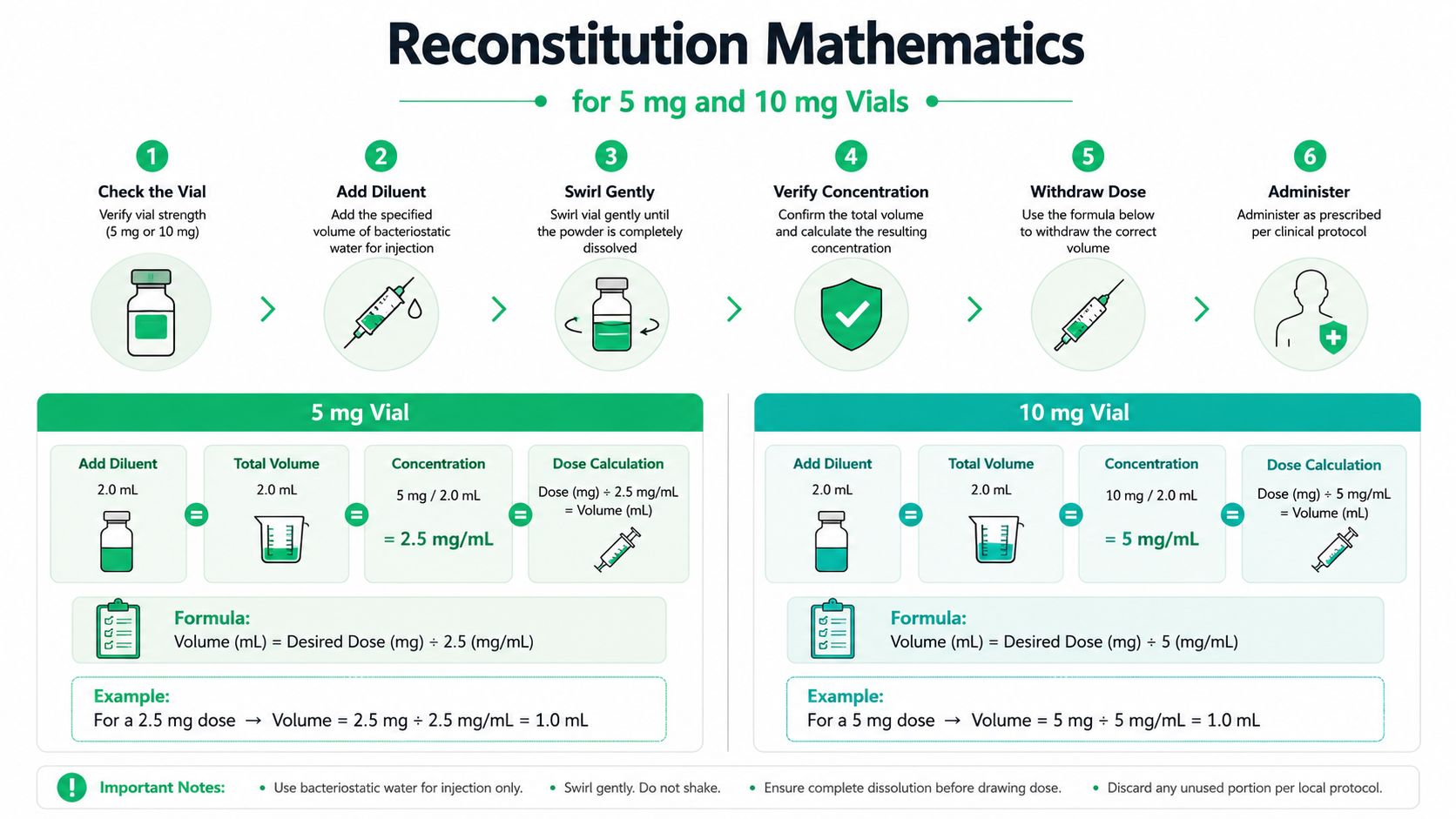
Reconstitution is a laboratory concentration calculation, not a dosing or administration instruction. The basic relationship is:
C₁V₁ = C₂V₂
Here, C₁ is the starting concentration, V₁ is the volume taken from that stock, C₂ is the target concentration and V₂ is the final volume. For a lyophilised vial, the initial peptide amount is easier to use directly: concentration equals mass divided by final liquid volume.
A 5 mg vial brought to a nominal 2.0 mL final volume gives:
- 5 mg ÷ 2.0 mL = 2.5 mg/mL
- 2.5 mg/mL = 2,500 micrograms/mL
A 10 mg vial brought to 2.0 mL gives 5 mg/mL. The same 10 mg amount in 2.5 mL gives 4 mg/mL. These are arithmetic examples for preparing laboratory stocks and planning downstream dilution into an assay system.
To calculate the volume of stock required for a working solution, rearrange the formula:
V₁ = (C₂ × V₂) ÷ C₁
For example, if a laboratory stock is 2.5 mg/mL and the assay requires a lower concentration in a defined final volume, convert every unit first. Keep milligrams with millilitres, or convert both to micrograms and microlitres. Unit mismatches cause more errors than the algebra.
What the arithmetic doesn't tell you
The nominal final volume may differ from the volume recovered in practice. Vial headspace, incomplete recovery, adsorption, lyophilisation characteristics and the selected diluent can affect the usable stock. A laboratory must follow its approved SOP for aseptic handling, mixing, aliquoting, storage and disposal.
Bacteriostatic water and sterile saline aren't interchangeable by default. The correct diluent depends on the assay, compatibility requirements and institutional procedure. No concentration calculation establishes suitability for human use, and none is a substitute for an approved laboratory protocol.
Domestic Ordering, Shipping and Lead Times
A domestic order still needs the same compliance checks as an imported order. The practical difference is that the buyer can work with an Australian supplier, a local delivery address and a defined dispatch process rather than treating customs clearance as an informal assumption.
Before checkout, confirm the supplier's current cut-off time, stock position, dispatch window, tracking process and delivery restrictions. Operational details can change, so procurement staff should obtain the current terms in writing rather than copying a previous order record. A stated one to three business day dispatch window is a logistical estimate, not a guarantee that every postcode or campus receiving desk will process a parcel at the same speed.
A controlled ordering sequence
- Raise the institutional request first. Record the project, approved end user, material description, quantity and receiving location.
- Validate the delivery address. Include building, room, loading-dock and contact details, particularly for multi-campus universities.
- Confirm documentation availability. Ask whether the relevant batch COA is available before payment or will be supplied after dispatch.
- Check the courier conditions. Establish whether tracking, signature on delivery and delivery-attempt rules suit the laboratory.
- Record the transaction. Store the invoice, supplier correspondence, end-user declaration and receiving confirmation together.
Pricing should be assessed in AUD, with the institution's finance team confirming GST treatment for its own purchase category. Don't assume that a displayed price, bulk tier or free-shipping threshold applies to every organisation or destination. Remote-area surcharges, campus access rules and signed-delivery requirements can affect the final procurement cost and receiving plan.
Plain labelling may reduce unnecessary attention during routine delivery, but it doesn't change the legal status of the contents. A parcel that arrives domestically still needs to be checked against the purchase order, batch documentation and approved research purpose before it enters controlled stock.
Procurement Checklist for Australian Research Teams
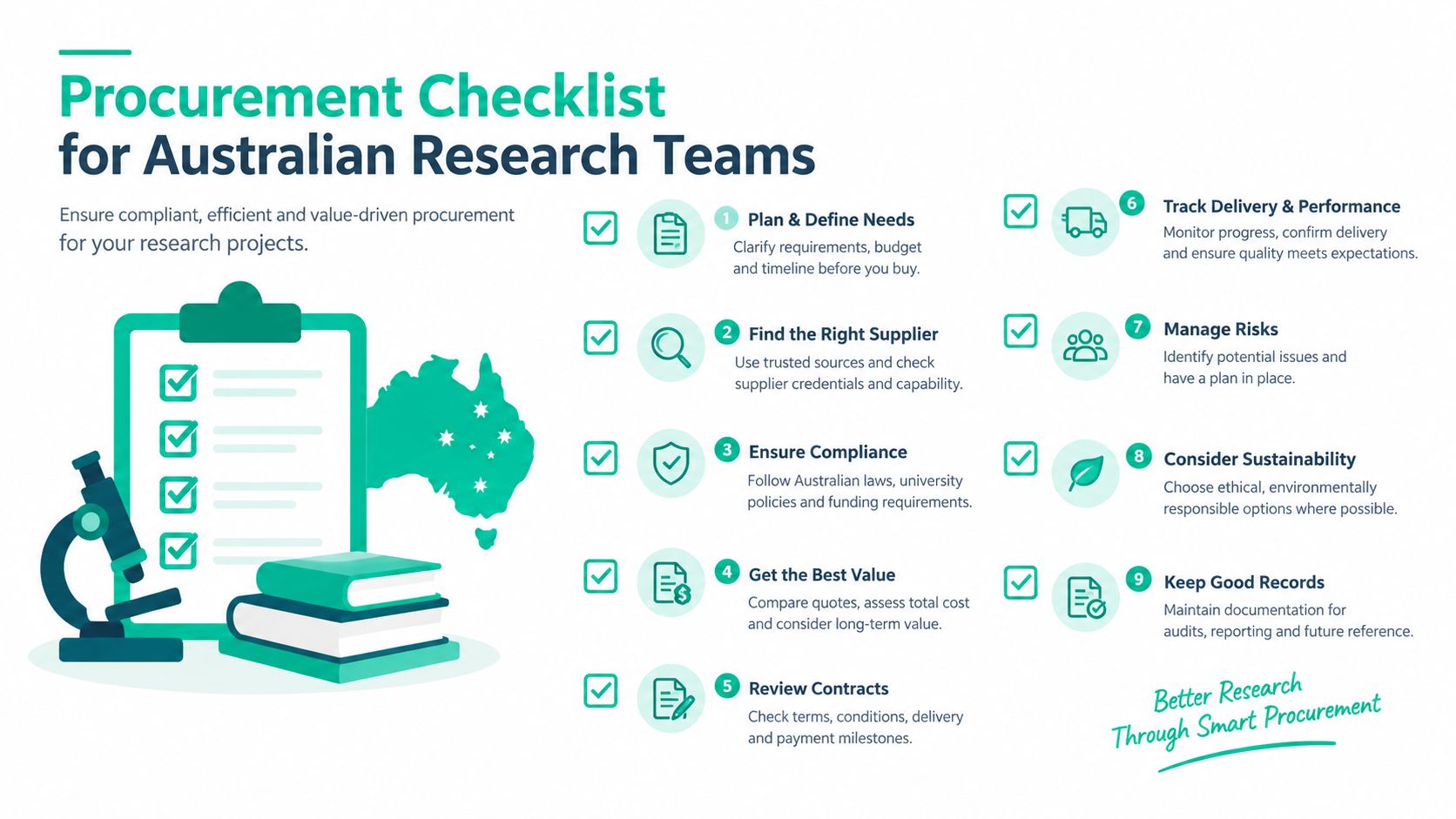
A defensible TB-500 purchase file should allow a finance controller, biosafety officer or research-integrity committee to understand why the material was ordered, who approved it, what was received and how the batch was verified. Use the following workflow before placing an institutional order.
Phase one, pre-order due diligence
- Define the research purpose: Write the assay or analytical objective in scientific terms. This prevents therapeutic claims from entering the purchase request.
- Confirm the regulatory position: Record that TB-500 isn't approved for human use and isn't an ARTG-listed medicine. This keeps the request separate from registered-medicine procurement.
- Ask the institution for the right review: Confirm whether the IBC, biosafety office, chemical governance team or another committee must approve the activity. The committee, not the supplier, determines institutional scope.
- Check supplier identity: Obtain the legal business name, Australian contact details and current research-use terms. A traceable supplier gives the institution a clear party for documentation queries.
- Request batch evidence: Ask for a lot-matched COA and identify whether it's manufacturer-provided, contract-laboratory documentation or an independent retest. The distinction prevents overstatement of analytical assurance.
- Check the declared material: Confirm whether the product is described as TB-500, a thymosin beta-4 fragment or full-length thymosin beta-4. Similar names can represent different research materials.
Phase two, order placement
The purchase order should identify the product, vial strength, pack format, requested batch documentation and end user. Avoid vague descriptions such as “healing peptide” or “medical peptide”, because they don't describe a legitimate laboratory purpose and may create confusion during internal review.
- Use the institutional PO process: Match the order to the approved cost centre and project. This creates an auditable financial trail.
- Complete any end-user declaration: State that the material is for laboratory research only, where the institution requires it. The wording should match the protocol.
- Validate the receiving address: Confirm that a named laboratory contact can receive and inspect the parcel. Unattended delivery creates avoidable chain-of-custody problems.
- Keep supplier correspondence: Save the quotation, specifications, COA response and shipping confirmation. These records support later reconciliation.
Phase three, receipt inspection
Inspect the package before distributing it to researchers. Check outer-pack integrity, vial condition, label legibility and the presence of the expected quantity. Then reconcile the vial batch number against the invoice and COA.
A receiving record should include:
- Batch reconciliation: The vial, carton, invoice and COA should identify the same lot.
- Documentation filing: Store the COA, specification sheet and receiving photographs in the project folder.
- Storage decision: Follow the supplier's stated storage information and the laboratory's approved SOP. Don't improvise a temperature requirement from an online discussion.
- Non-conformance action: If the label, quantity or paperwork doesn't match, hold the material and escalate it before use.
Phase four, ongoing compliance
Review the approved protocol whenever the project changes. A new assay, a different laboratory, work involving human samples or an athlete-adjacent project may require a fresh governance check.
Sport Integrity Australia's position should be revisited if staff, participants or samples connect the research to sport. The Australian anti-doping framework is separate from ordinary laboratory procurement, so a team shouldn't assume that an internal research approval answers every anti-doping question.
Conduct a supplier review periodically. Look for consistent batch records, responsive documentation support and clear identification of testing sources. A low price doesn't compensate for an untraceable material, and a polished website doesn't replace analytical evidence.
Reject or pause the order when: the supplier can't provide a batch identifier, the COA is missing or generic, the vial is unbranded, the synthesis origin is withheld, or the paperwork uses therapeutic claims.
Those red flags don't prove what's inside a vial, but they prevent the lab from making a defensible identity or quality decision. The same applies to documents with mismatched batch IDs, missing chromatograms or unreadable mass spectra. Ask for clarification, independent testing or a replacement pathway before the material is accepted into the study.
Products are supplied strictly for laboratory research purposes only. They are not for human consumption, therapeutic use or diagnostic procedures.
Bulk Aussie Peptides provides research-use-only peptide supply in standardised bulk vial formats, with product specifications and batch documentation identified by source where available. Review the current information for Bulk Aussie Peptides and confirm the regulatory pathway, documentation and receiving requirements with your institution before ordering.