
Anti Ageing Skincare: What the Research Supports in 2026
Melanoma was estimated to affect more than 18,200 Australians in 2023, with an average diagnosis age of 65, according to Cancer Council Australia. About two in three Australians are expected to be diagnosed with skin cancer in their lifetime. That is why anti ageing skincare here starts with stopping new ultraviolet damage, not with another serum. Creams can support tone and texture. They cannot undo exposure that keeps arriving each day.
Table of Contents
- Anti Ageing Ingredients Ranked by Research Evidence
- Why UV Protection Comes First in Australia
- Daily Routine, Vitamin D and Sensitive Skin
- Reading Anti Ageing Claims Without Overpromising
- Anti Ageing Skincare Questions Answered
- Check the Evidence Before You Buy
Anti Ageing Ingredients Ranked by Research Evidence
Anti ageing skincare is the set of habits and products aimed at fine lines, uneven tone, dullness and loss of firmness. The evidence behind each ingredient is not equal, so rank protection and renewal first.
| Ingredient | Research focus | Evidence strength | Timeframe reported |
|---|---|---|---|
| Broad-spectrum sunscreen (SPF30+ to SPF50+) | Limits UV damage to collagen and elastin | Strong, many controlled studies | Ongoing daily use |
| Topical retinoids (retinol, tretinoin) | Fine lines, texture and uneven tone | Strong for prescription and well-studied retinoids | Often 12 weeks or longer |
| Vitamin C (L-ascorbic acid) | Antioxidant activity and skin brightness | Moderate | Often 8 to 12 weeks |
| Niacinamide | Skin barrier function, tone and redness | Moderate | Often 8 to 12 weeks |
| Hyaluronic acid | Surface hydration and plumpness | Moderate for hydration, limited for deeper ageing | Days to weeks |
| Alpha hydroxy acids (glycolic, lactic) | Surface texture and exfoliation | Moderate | Several weeks |
| Copper peptides (GHK-Cu) | Skin repair and collagen-related pathways | Limited, mainly laboratory and small studies | No agreed clinical timeframe |
Strong means multiple controlled trials. Moderate means consistent but smaller or shorter studies. Limited means early laboratory or small-sample work. Copper peptides such as GHK-Cu sit in that last group: research has examined repair pathways, not a proven treatment. A plain walk-through of retinol and peptides explained by BotoxBarb is useful before you compare labels.
Retinoid evidence and vitamin C research
Retinoids and vitamin C are add-ons to sunscreen, not substitutes. The ingredients with the most research protect or renew skin over months. Most need about 12 weeks or longer before measurable change is reported, and no topical product reverses sun damage already present or damage that continues outdoors. For laboratory context on one copper peptide, see the GHK-Cu research notes.
Why UV Protection Comes First in Australia
Applying repair ingredients while UV keeps striking your skin works like repainting a wall during a storm. The fresh coat never gets time to set. Every ingredient ranked earlier in this article only earns its place once that daily damage is under control.
Repeated UVA and UVB exposure drives oxidative stress, DNA injury and enzymes that break down collagen and elastin. The visible result is wrinkles, laxity and uneven pigmentation.
The Therapeutic Goods Administration identifies UVA as a contributor to skin ageing and notes that SPF mainly measures UVB. A high number without a broad-spectrum label leaves ageing rays poorly covered. Higher SPF blocks more UVB, though the gain narrows as the numbers climb, so generous application, reapplication, shade, clothing and hats still do the heavy lifting.
| UV Index | Risk level | Protection needed |
|---|---|---|
| 0-2 | Low | Usually none needed, but keep checking the UV Index |
| 3-5 | Moderate | Broad-spectrum SPF50+, hat, shade or sunglasses |
| 6-7 | High | Full protection, seek shade and reapply sunscreen |
| 8-10 | Very high | Full protection, avoid midday sun where possible |
| 11+ | Extreme | Full protection, stay in deep shade or indoors where possible |
Cancer Council Australia recommends sun protection once the UV Index reaches 3, and favours SPF50 or SPF50+ sunscreen that is broad-spectrum and water-resistant. Apply it every morning on exposed skin, then reapply after swimming, sweating, towelling off or a long stretch outside. Pair it with shade, clothing, a broad-brimmed hat and sunglasses rather than relying on sunscreen alone.
Practical rule: Topical actives cannot compensate for photodamage that is still happening. Sun protection is step one of any routine.
Daily Routine, Vitamin D and Sensitive Skin
The habit gap is large. The Australian Bureau of Statistics reported that in late spring and summer 2023-24, 38.1% of Australians aged 15 and over used SPF30-or-higher sunscreen on most days, while 15.2% of people aged 15-24 had sunburn in the previous week compared with 2.0% of those aged 65 and over.
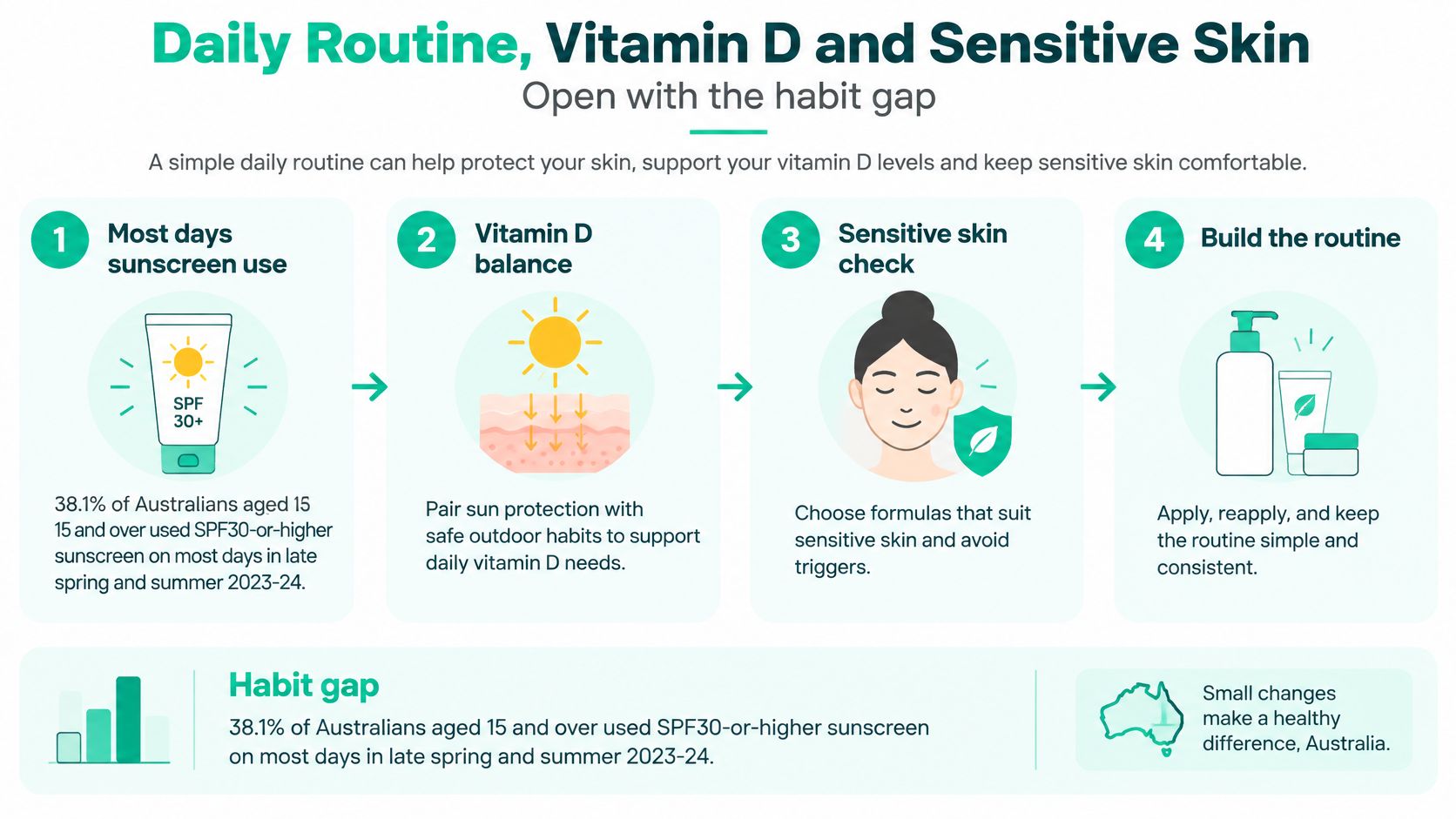
Cancer Council reporting on the QIMR Berghofer Sun D Trial found adults assigned daily SPF50+ for one year were more likely to become vitamin D deficient. Researchers still concluded sunscreen should stay as one of five sun-protection measures. Keep the sunscreen habit and ask a clinician whether testing makes sense. People often judge UV risk by warmth, so cool or cloudy days can still burn.
- Cleanse gently. Oil comes off without stripping the barrier, so later products sit evenly.
- Add a morning antioxidant if you tolerate it. Vitamin C remains an extra; sunscreen still does the baseline work.
- Support the barrier. A moisturiser or niacinamide product makes the routine easier to keep.
- Finish the morning with broad-spectrum SPF50+. Cover every exposed area, not only the face.
- In the evening, go slower. Cleanse, use a retinoid on alternate nights, then moisturise.
If an active stings, cut how often you use it and keep sunscreen in place. Choose fragrance-free formulas. Common slips are skipping protection on grey days, using too little, and starting several actives at once. If price is the sticking point, keep the same order and use find affordable anti-aging product swaps for lower-cost cosmetic substitutes instead of dropping SPF. Research summaries such as AHK-Cu research notes sit outside a cosmetic routine.
A short clip on checking the UV Index before you leave the house makes the same point as the steps above.
Reading Anti Ageing Claims Without Overpromising
A jar that says "clinically proven to reverse ageing in seven days" tells you almost nothing until you ask what was measured, on whom, and against what. Learning to ask those questions is the skill behind every other choice in this guide, because even the best-studied serum is read against the daily UV baseline, never above it.
Start with the legal line. In Australia, therapeutic goods need market authorisation from the Therapeutic Goods Administration, while ordinary cosmetics do not. Wording, ingredients, concentration, purpose and presentation decide which side a product sits on. Authorisation does not mean every anti-ageing outcome is guaranteed, so read the exact wording of any claim closely.
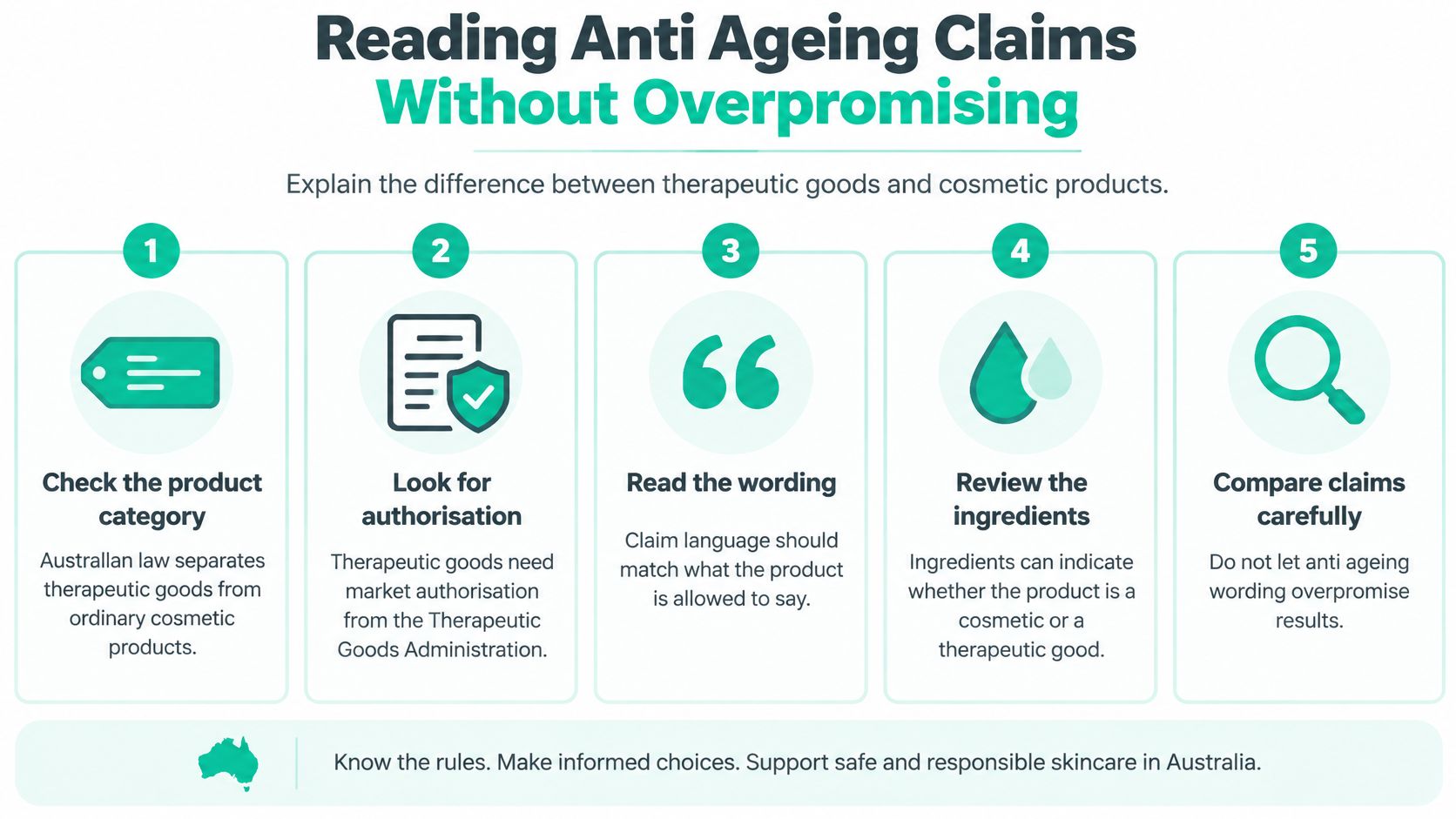
Five questions sort strong claims from weak ones:
- Appearance or treatment? "Helps the look of fine lines" is a cosmetic claim. "Treats a skin disease" is a therapeutic one that needs authorisation.
- Humans or a dish? A lab assay shows what an ingredient does to cells. Only a trial on people shows what it does on skin.
- How many, and for how long? A weekend test on a handful of users is weak next to a longer controlled study.
- Compared with what? A control group gives a real benchmark. "Better than day one" alone does not.
- Promise or finding? "Research has examined" reports a finding. "Guaranteed results", "reverses ageing" or "clinically proven" with no method behind it are warning signs.
Run each label through all five, then place whatever survives on top of daily broad-spectrum protection as an addition. No cosmetic-level claim outranks sunscreen.
Persistent lesions, changing pigmentation or a spot you suspect is skin cancer need a clinician rather than a jar. Laboratory peptides carry the same boundary, and our research disclaimer sets out that they are for laboratory study only, never a skincare step.
Anti Ageing Skincare Questions Answered
Is sunscreen enough on its own?
Sunscreen is the foundation everything else builds on. UV exposure drives visible skin ageing, so every serum sits on top of that protection rather than replacing it. Research has examined topical actives as additions to daily UV protection, not as substitutes for it.
Can I skip sunscreen to get more vitamin D?
No. Keep sunscreen. If you're worried about vitamin D, ask a healthcare professional about testing and supplementation.
How long before ingredients show change?
Longer than the marketing suggests. Study summaries typically report retinoid changes only after months of consistent use. Hyaluronic acid can change surface hydration within days, and neither reverses existing sun damage, which is why prevention outranks repair.
Does peptide research prove ingredients like GHK-Cu work?
Not yet. For GHK-Cu the evidence is limited, mainly laboratory and small-sample work. The same caution applies to expression-line peptides: read the Snap-8 research summary as study context, not a result you can expect on skin.
Check the Evidence Before You Buy
A sunscreen label and a peptide vial ask for the same thing: read the evidence before you pay. Work through this checklist in order.
- Start with broad-spectrum SPF50+ every morning on exposed skin. No serum can outwork daily UV exposure.
- Add one active at a time, such as a retinoid or vitamin C, and review it after about 12 weeks rather than a few days.
- Use the evidence table and the claims checklist before you pay for a product.
- Match batch documents to the vial and the batch. Read independent certificates in the COA library, and use the product specifications published on each page when you review a listing. The research methodology page sets out how that documentation is handled.
Bulk Aussie Peptides is 100% Australian owned and operated, supplying research peptides in 10-pack quantities with transparent AUD pricing across a catalogue of 60+ products, including GHK-CU. Each order ships with product-specific storage recommendations, and batch Certificates of Analysis and third-party laboratory reports are available or on request for active customers. All products are strictly for laboratory research purposes and are not for human consumption, medical use, veterinary use, or therapeutic application.
If you're comparing Australian suppliers for laboratory work on skin-related peptides, start with the evidence, then the paperwork. Visit Bulk Aussie Peptides to review the catalogue and the COA library.