
Peptide Aus: Legal Status and Supplier Checks for 2026
Research-use-only peptides are not automatically lawful in Australia, because a product's intended use, claims, presentation and ingredients decide whether it is regulated as a therapeutic good. A research-use-only line on a label does not, by itself, clear importation, supply or public promotion.
If you're sorting peptide aus supply for a bench, the usual purity question is too small. Can you show what the vial is, how it was handled, and that nobody is presenting it as a treatment?
Table of Contents
- Where Peptides Stand Under Australian Law
- What Peptides Are and What Researchers Study
- Verify a Batch and Confirm Research-Only Use
- Pack Sizes, Pathways and Delivery Timing
- Keeping Lab Records Separate From Human-Use Pathways
- Frequently Asked Questions
Where Peptides Stand Under Australian Law
What makes one peptide vial a research material and another a regulated medicine in Australia? The Therapeutic Goods Administration anchors peptide rules in the Therapeutic Goods Act 1989 and the Australian Register of Therapeutic Goods (ARTG). A product promoted or used to prevent, diagnose, cure or alleviate disease, injury or another condition is generally a therapeutic good. An approved therapeutic peptide must be on the ARTG before import, manufacture, supply or advertising, unless a specific exemption, approval or authority applies.
Purity alone does not settle that status. Identity, stated purpose, presentation, handling records and batch traceability all help show whether the same molecule is being kept as research stock or moved toward a therapeutic pathway.
Approved categories include insulin and insulin analogues, GLP-1 receptor agonists such as semaglutide, oxytocin, vasopressin analogues such as desmopressin, and somatostatin analogues such as octreotide. Approval needs quality, safety and effectiveness from human clinical trials. Many of these medicines are prescription-only and generally can't be advertised to the public.
Other regimes sort biologics by purpose as well: a plain comparison of US and EU stem cell regulations shows the same intended-use boundary in a different field.
| Use case | Regulatory treatment | What it means for a buyer |
|---|---|---|
| Research use, no therapeutic claims | Assessed by intended use, claims and presentation | Research-only wording must match invoices, labels and product pages |
| Therapeutic claim (prevent, diagnose, treat, alleviate) | Generally a therapeutic good; must be on the ARTG unless an exemption applies | Not suitable for research supply under a research-use label |
| Approved peptide medicine (for example semaglutide) | Registered on the ARTG; often prescription-only | Access runs through approved clinical channels, not research procurement |
| Human study using an unapproved product | Clinical Trial Notification or Clinical Trial Approval plus ethics approval | Procurement records alone are insufficient |
For a laboratory buyer, the practical read is simple: match the paperwork to the claim. Read the stated use and claims before you order, keep that wording consistent on the page, the invoice and the lab file, and keep human-study or clinical access on its own authorised pathway rather than inside research procurement.
What Peptides Are and What Researchers Study
Think of a peptide as beads on a short thread. Each bead is an amino acid. The body uses twenty standard amino acids to build peptides and proteins, and peptides are the shorter chains. The sequence sets the shape, and the shape is what a study follows.
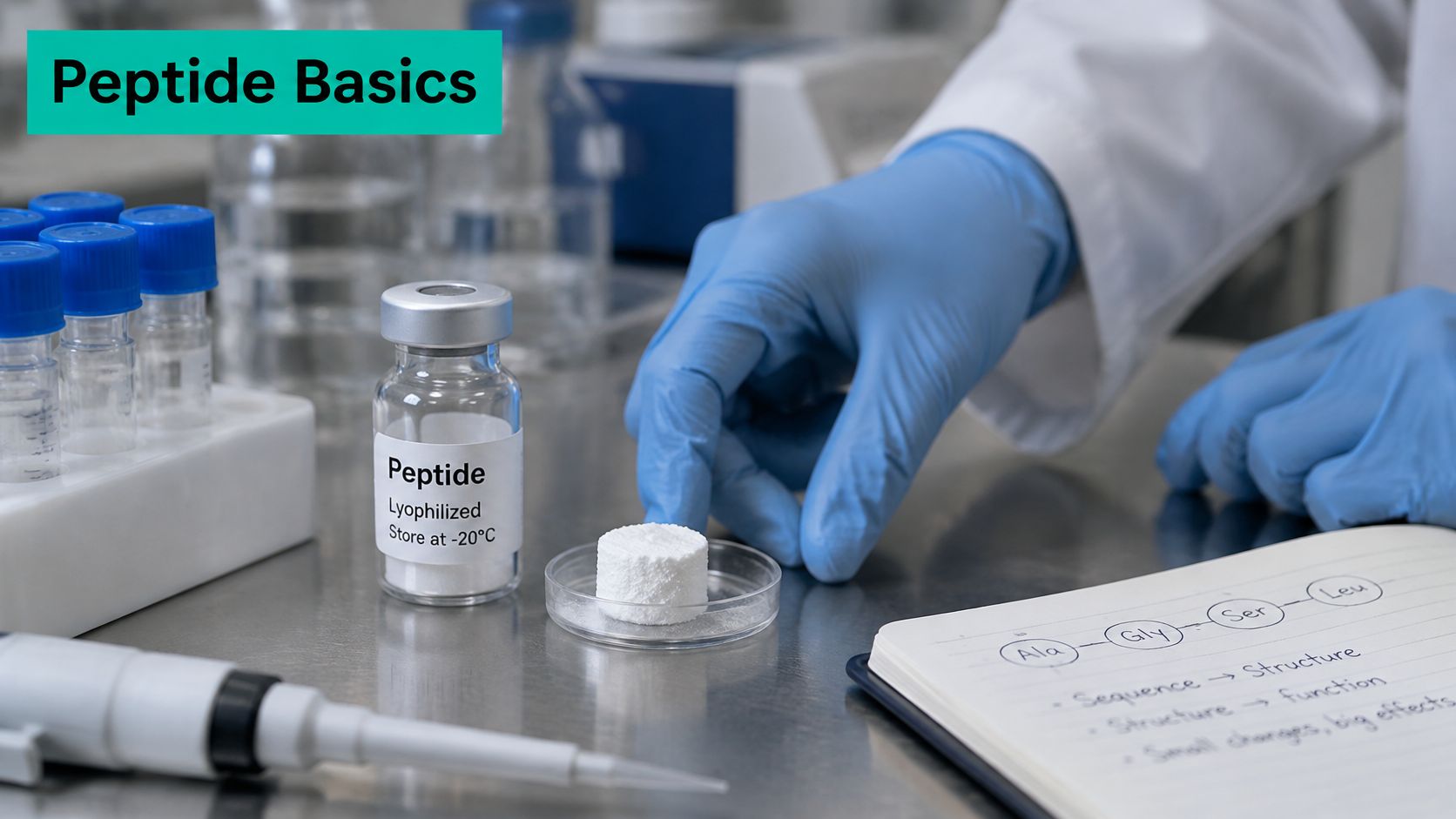
Most research peptides we supply arrive as a lyophilised (freeze-dried) powder cake in a sealed glass vial, so the molecule stays stable in storage and transit. Catalogues usually group work like this:
- Metabolic incretin research: studies have examined signalling linked to appetite and glucose.
- Growth-factor research: work looks at signalling molecules in cell models.
- Tissue and cellular research: assays track repair-related pathways in the dish.
- Longevity and senescence research: studies examine ageing markers in cells.
- Neuroscience research: experiments follow peptide signals in neural models.
- Fertility and reproductive research: studies look at reproductive signalling, not treatment plans.
An approved medicine sits on a different shelf. In December 2024, Australia approved Wegovy (semaglutide) for secondary prevention of cardiovascular events in people with overweight or obesity, a BMI of at least 27 kg/m², and established cardiovascular disease without diabetes, according to Australian Prescriber. That approval has its own evidence and route. It is not a research-supply shortcut.
Clinics sometimes explain the same chemistry for patients, as in this peptide guidance for Easton wellness patients. Dosing, preparation and administration sit outside this guide. Unfamiliar terms are defined in our research peptide glossary.
Verify a Batch and Confirm Research-Only Use
The sharper question is not only "Is it pure?" The TGA warning on unapproved peptide imports describes powders in unmarked or poorly labelled vials, sometimes without the active name or concentration. For many unapproved products there is no assurance of composition, sterility, contamination control or manufacturing quality. A purity percentage does not show sterility, endotoxin control, identity, stability or fill.
We're 100% Australian owned and operated, and batch papers live in the COA library, linked from each product page.
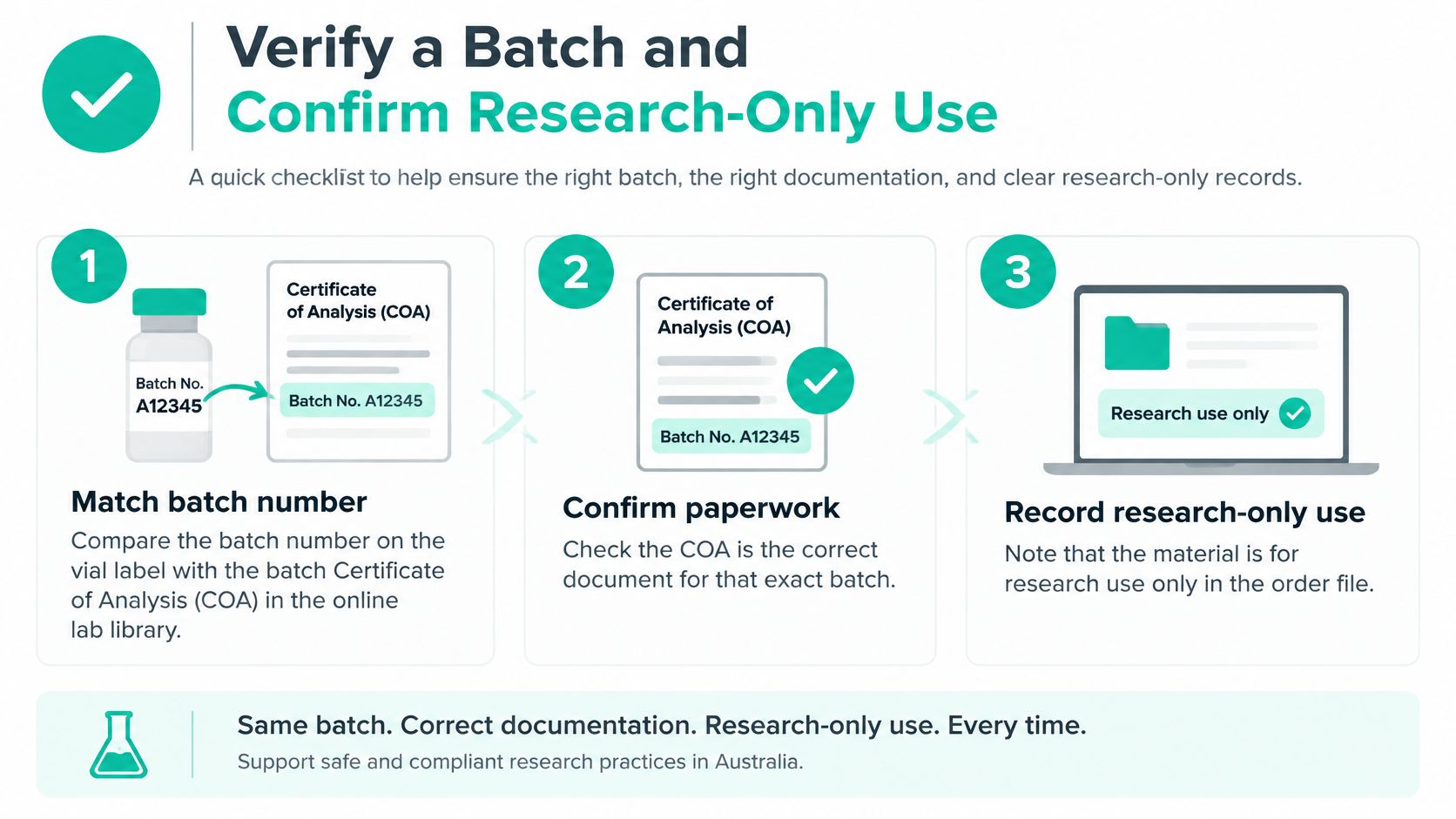
- Match the vial batch number to that batch's certificate, not a general sheet.
- Note the laboratory and the method.
- Label manufacturer results separately from independent results.
- Confirm identity, not purity alone.
- Look for separate sterility or endotoxin evidence.
- Check storage, transport and lot expiry.
- Treat the COA as evidence to weigh, not a safety guarantee or permission for human use.
| Red flag | Why it matters | What to do |
|---|---|---|
| Unmarked or poorly labelled vial | Name and concentration can't be traced | Don't accept it; request a replacement |
| No batch number | Results can't be matched | Ask for batch-specific papers first |
| COA for another batch or a general sheet | Results may not describe this vial | Compare batch numbers line by line |
| Purity only, no identity or sterility | Contents and sterility stay unshown | Request identity plus sterility or endotoxin evidence |
| Laboratory or method unnamed | Independence can't be judged | Ask for the laboratory, method and report date |
| Results shown as in testing | Final results aren't posted yet | Hold the batch until finals appear |
Go or no-go: Proceed only when the use is laboratory research only, with no therapeutic or human-use claims on the page, invoice or file, the batch matches a batch-specific COA, and the file records that laboratory use. If a check fails, stop and ask us.
Then compare 10-pack formats, open the linked library entry, and ask our Australian support team about specifications. For institutional orders, request a quote or procurement pack and GST invoices.
Pack Sizes, Pathways and Delivery Timing
Choosing a pack size works like sizing any reagent order: match the quantity to the number of runs your protocol calls for. A 10 mg x10 pack and a 5 mg x10 pack suit planned, multi-vial studies, while a single trial vial lets you check a product before committing to a larger order. All prices appear in AUD on each product page, and we sell to customers in Australia only. Ten-packs ship from our overseas facility, and trial vials ship from Brisbane. Dispatch and delivery windows are stated on our shipping page, so check them before setting a study start date.
| Format | Quantity | Typical use |
|---|---|---|
| 10 mg x10 pack | 10 vials | Planned multi-vial studies |
| 5 mg x10 pack | 10 vials | Lower-strength studies and comparisons |
| Single trial vial | 1 vial | Checking a product before a larger order |
| Custom bulk quantity | Quote on request | Institutional and procurement volumes |
To compare formats fairly, work out cost per milligram: divide the pack price by its total milligrams, so a 10 mg x10 pack is divided by 100 and a 5 mg x10 pack by 50. That puts every strength on the same basis before you commit.
Australian laboratories, universities and qualified researchers planning larger volumes can request a quote for custom bulk quantities, which are held to the same independent testing standards as catalogue items.
- Confirm format and quantity against your protocol.
- Calculate cost per milligram to compare strengths.
- Request a custom quote if the study needs bulk volumes.
- Check the shipping page for dispatch and delivery windows before setting the study start date.
Keeping Lab Records Separate From Human-Use Pathways
A COA and an invoice do not authorise a human study. The TGA clinical trial pathways require sponsors to decide whether each product is a therapeutic good and whether it is unapproved. All Australian clinical trials need Human Research Ethics Committee (HREC) approval, and unapproved goods need an exemption, approval or authority. Our research disclaimer states the research-only boundary.
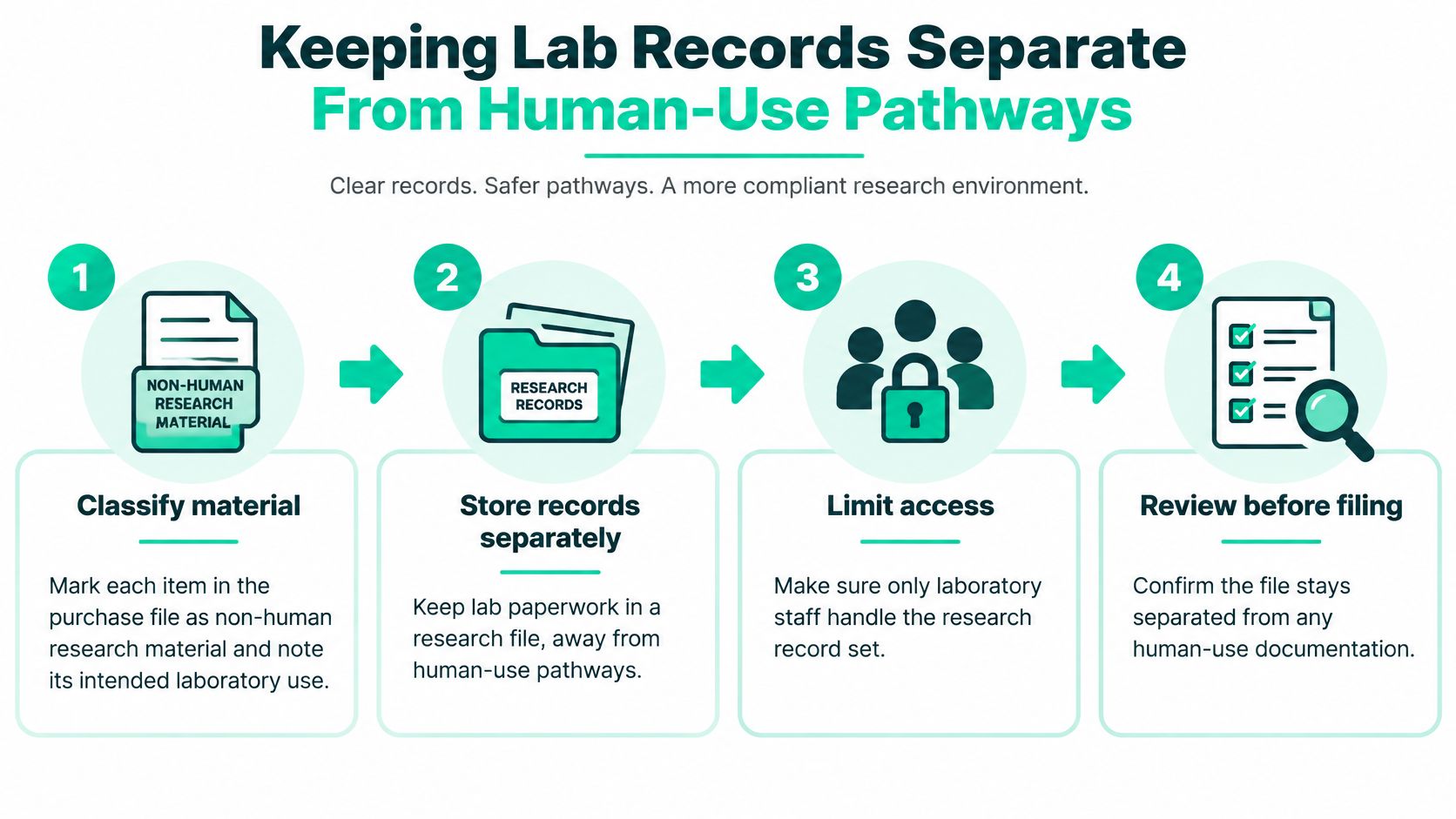
- Classify each item as non-human research material and write the laboratory use.
- Store the batch COA, storage records and invoice together.
- Before any participant contact, establish whether the product is a therapeutic good and unapproved.
- Choose Clinical Trial Notification (CTN) or Clinical Trial Approval (CTA) from the sponsor's assessment.
- Consult an HREC.
- Confirm any unapproved therapeutic good is covered by an exemption, approval or authority.
If the aim shifts from analytical or in-vitro work to participants, stop purchasing for that aim and seek regulatory advice before going further.
Frequently Asked Questions
Is buying research peptides legal in Australia? It depends on intended use, claims, presentation and ingredients. A research-use-only label does not by itself make a product lawful for therapeutic supply, so check the framework or take legal advice before ordering.
Does a COA prove a peptide is safe? No. A batch COA is evidence to weigh for identity and purity. It does not confirm sterility unless separate evidence is provided, and it is not permission for human use.
Where are batch documents kept? Specifications are visible on product pages before ordering. Batch certificates of analysis and third-party laboratory reports are available on product pages or on request for active customers, and the COA library is accessible for review, with "in testing" where results are pending.
How long does delivery take? Orders typically dispatch within 1–3 business days, with tracking and Australia-wide delivery. Dispatch timing is a planning guide rather than a guaranteed arrival date. More buying questions are on our Frequently Asked Questions page.
Bulk Aussie Peptides supplies research-use-only peptides in sealed 10-vial packs, with AUD pricing, batch certificates of analysis, and tracked Australia-wide delivery for laboratories that keep research files separate from human-use pathways. Compare formats, open the batch file, and confirm the stated use before you order. Visit Bulk Aussie Peptides to review the catalogue and documentation.