
Are Peptides Growth Factors: What the Science Says
Are peptides growth factors, or are people mixing up two different ideas because both terms show up in the same research conversations? The short answer is that not all peptides are growth factors. A peptide describes a molecule's structure, while a growth factor is defined by what it does at a receptor and the biological response that follows. That distinction matters in lab work, product comparison, and Australian regulatory decisions.
The confusion keeps coming up because some peptides can influence growth pathways without being growth factors themselves. In practice, that means a product can sit near the same biology, without sharing the same classification. Think of it as the difference between the material a tool is made from and the job the tool performs.
In Australian research and procurement, that difference matters even more. A name like “growth-factor related” does not automatically prove a molecule is a classical growth factor, and a batch sheet does not replace receptor biology or a measured endpoint. The sections below break that down with plain examples, a comparison table, and the Australian regulatory context that most general explainers leave out.
Table of Contents
- The Short Answer and Why the Question Comes Up So Often
- What a Peptide Actually Is
- What Makes a Growth Factor a Growth Factor
- How a Peptide Can Drive Growth Without Being One
- Why the Distinction Matters for Research and Regulation in Australia
- Designing a Study and Reading Documentation With the Right Lens
- Frequently Asked Questions About Peptides and Growth Factors
The Short Answer and Why the Question Comes Up So Often
Are peptides growth factors? Sometimes, but usually no. A peptide is a short chain of amino acids, while a growth factor is a signalling molecule defined by its biological function. That means a peptide can be a hormone, a receptor ligand, an antagonist, or a signalling compound without being a growth factor at all.
Structure and function are not the same thing
The simplest way to think about it is this. Peptide tells you what the molecule is made of, while growth factor tells you what the molecule does in a biological system. A chain of amino acids can belong to many different classes, so the label alone doesn't tell you whether the compound promotes proliferation, differentiation, survival, migration, or tissue repair.
That's why the question causes so much confusion in research and buying decisions. Marketing often groups together recovery peptides, tissue-repair peptides, and anabolic compounds under the same broad banner, even when their receptor biology is different. In Australian laboratory settings, that kind of shorthand can blur the line between a research category and a mechanistic claim.
Practical rule: if the name only tells you the molecule is a peptide, you still need receptor data and a measurable biological endpoint before calling it a growth factor.
A clear example is growth hormone, which is a peptide hormone and a growth factor because it activates growth-hormone receptors and drives downstream pathways such as IGF-1 production. By contrast, many other peptides affect biology without meeting that definition. The rest of this article follows that line from molecule structure, to receptor action, to the Australian rules that shape how these products should be discussed.
What a Peptide Actually Is
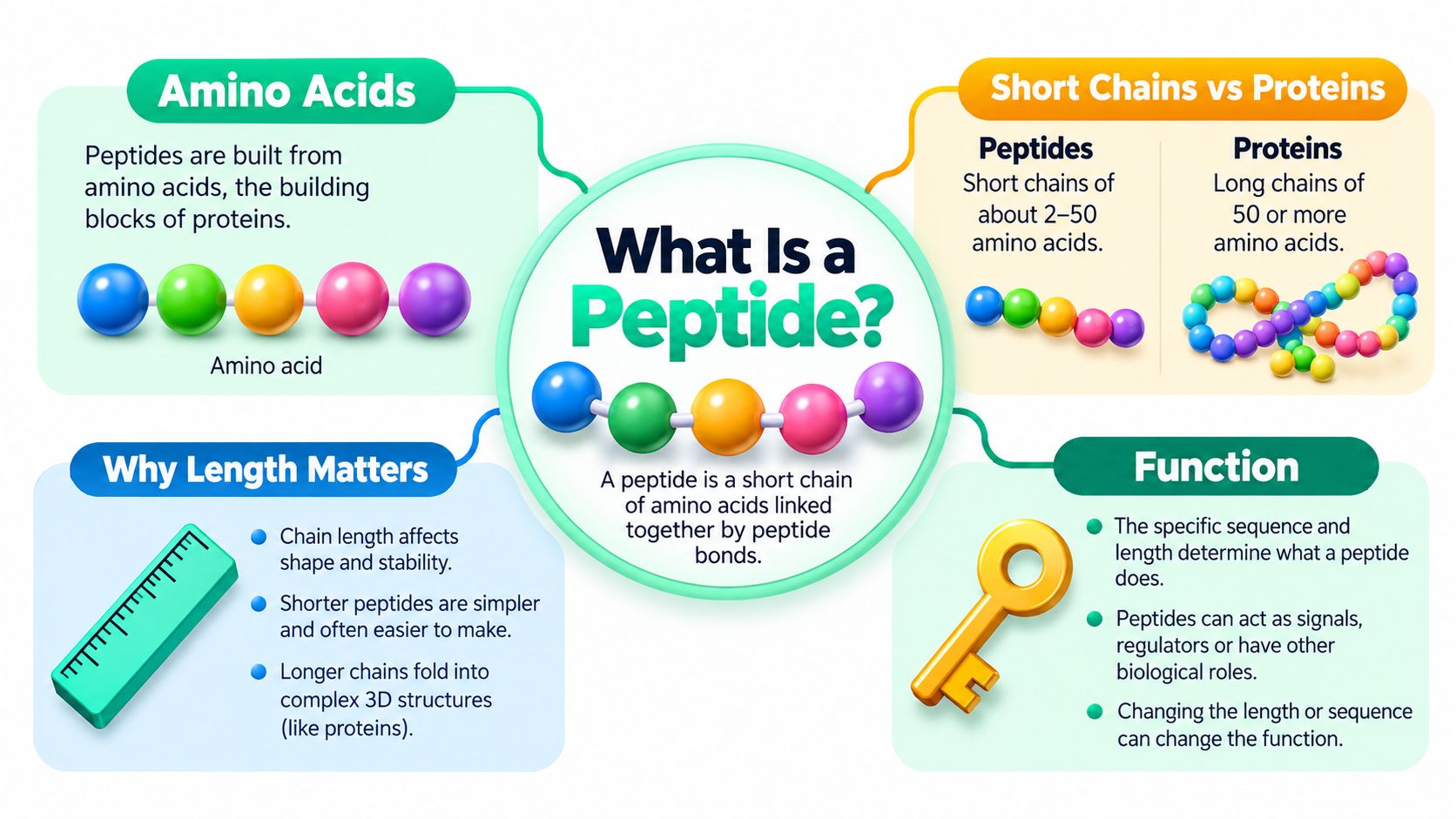
A peptide is a short amino-acid chain, and amino acids are the small building blocks linked together like beads on a string. If the chain is short, we usually call it a peptide. If the chain is longer and folds into a more complex structure, it may be treated as a protein.
Why length matters
Length matters because structure affects how a molecule behaves in the body. A short chain may bind a receptor, signal through a pathway, or act as a messenger, but it won't automatically behave like a growth factor. Some peptides are hormones. Some are antagonists. Some are signalling ligands. The category is structural, not functional.
That's why the same kind of molecule can be discussed in different ways depending on context. A peptide in one research model might be studied as a hormone analogue, while another peptide may be explored for tissue repair signalling. The amino-acid chain stays a peptide either way, but the biological role changes.
Simple check: ask what the molecule binds to, what pathway it activates, and what measurable change the lab is tracking.
For readers comparing products, that distinction helps prevent over-reading the label. A vial described as peptide-based, or even growth-factor related, does not automatically mean it behaves like a classical growth factor. For glossary-style definitions and related research terms, the Bulk Aussie Peptides glossary is a useful starting point.
What Makes a Growth Factor a Growth Factor
A growth factor is defined first by function, not by size. It usually has a specific cell-surface receptor, triggers a downstream signalling cascade, and produces a measurable phenotype such as proliferation, differentiation, survival, migration, or tissue remodelling. If one of those pieces is missing, the classification gets weaker.
IGF-1 is the clean example
IGF-1 is the clearest example here because it directly activates the IGF-1 receptor. That receptor engagement turns on downstream signalling such as PI3K-AKT and MAPK, which are associated with growth and differentiation. In other words, IGF-1 is not just a peptide by structure, it's a growth factor by biological role.
By contrast, a peptide acting at GHS-R1a works upstream. It can stimulate growth-hormone release, which then leads to IGF-1 production later in the chain. That means the peptide affects growth biology, but it isn't necessarily the growth factor itself.
The diagnostic lens
If you're classifying a compound, these three questions do most of the work:
- Which receptor does it bind? Receptor identity tells you whether the signalling is direct or indirect.
- What pathway changes? Look for downstream markers, not just a product name.
- What outcome is measured? A growth factor should produce a quantifiable cellular or physiological change.
| Molecule | Primary receptor | Downstream pathway | Measurable endpoint | Growth factor? |
|---|---|---|---|---|
| IGF-1 | IGF-1 receptor | PI3K-AKT, MAPK | Proliferation, differentiation, tissue growth | Yes |
| EGF | EGF receptor | Growth and repair signalling cascades | Cell proliferation, migration, repair response | Yes |
| FGF | FGF receptors | Proliferation and remodelling pathways | Cell growth, differentiation, tissue repair | Yes |
| CJC-1295 | GHRH receptor pathway | GH release, then IGF-1 rise | IGF-1 increase, pathway activation | No |
| BPC-157 | Not established as a classical growth-factor receptor ligand | Research-dependent signalling effects | Variable preclinical endpoints | No |
| GHK-Cu | Copper peptide signalling pathways | Repair-related signalling | Repair markers, collagen-related research endpoints | No |
| TB-500 | Research peptide context | Tissue-repair related pathways | Preclinical migration or repair markers | No |
The IGF-1 LR3 research page is a useful example of how one peptide can sit close to classical growth-factor biology without turning every peptide into a growth factor. The table also shows the key pattern, the structural peptide column stays broad, but the true growth-factor category stays narrow.
How a Peptide Can Drive Growth Without Being One
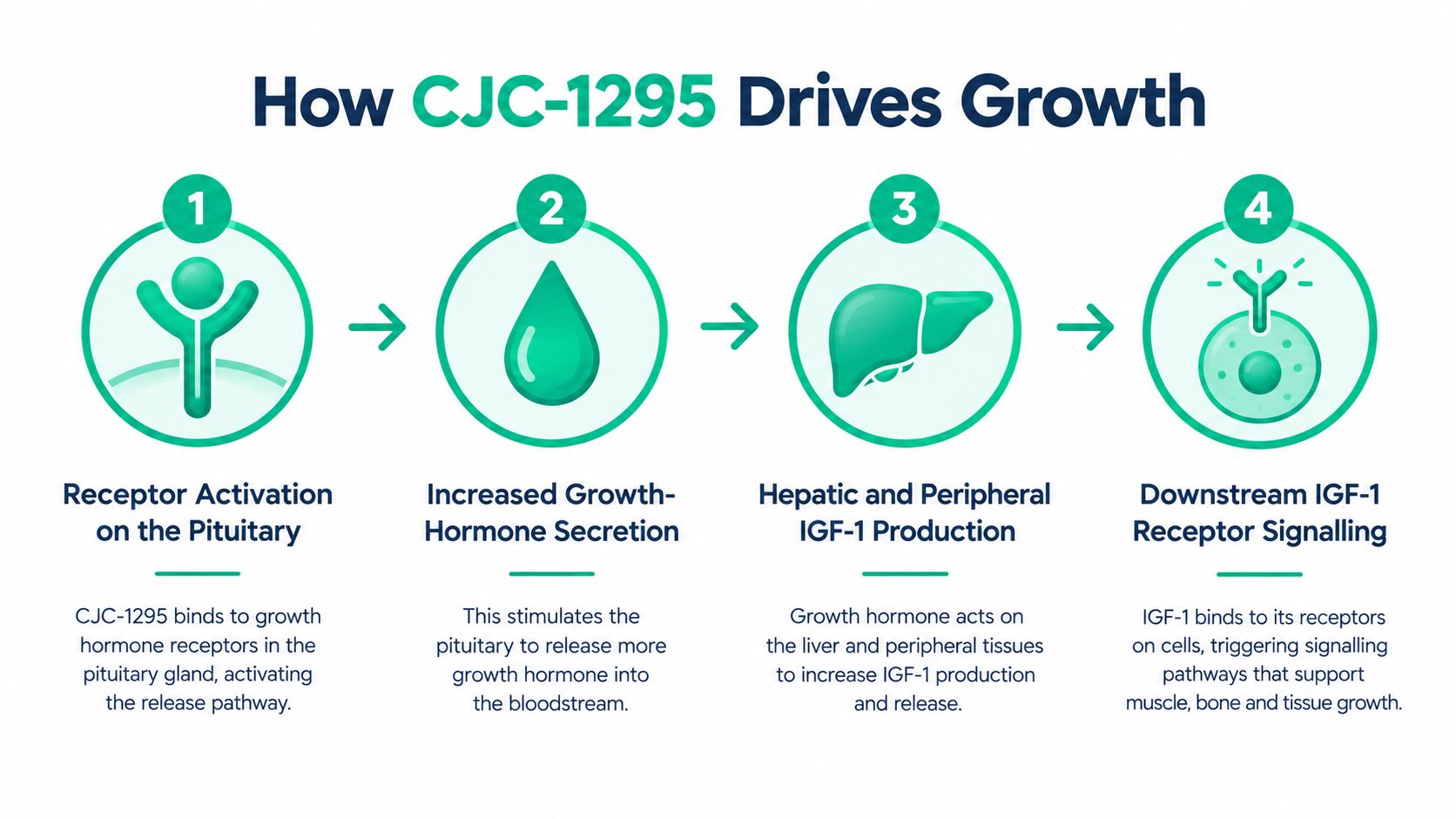
CJC-1295 makes the structure-versus-function difference easier to see. It acts through a receptor-mediated pituitary pathway, which increases growth-hormone secretion, which then raises IGF-1 production in the liver and peripheral tissues, which then activates IGF-1 receptors in responsive tissues. Each step is distinct biology, even though the end result can look growth-related.
The chain matters more than the label
That sequence shows how a peptide can produce a growth-factor response without being a growth factor itself. The University of Sydney expert report notes that a single dose has been reported to raise IGF-1 by up to approximately three-fold for more than a week. That is a strong endocrine effect, and the signal still starts upstream of IGF-1 administration.
CJC-1295 changes the signal that controls the signal; IGF-1 is the signal. The first molecule influences the pathway that leads to growth-related activity, while the second is the growth-related mediator itself.
The CJC-1295 versus Ipamorelin research page shows how research compounds can be compared by pathway rather than by marketing label. In an Australian laboratory setting, the readout might be GH, IGF-1, receptor phosphorylation, or a phenotypic marker, depending on the model.
Why the Distinction Matters for Research and Regulation in Australia
Australian buyers often see “recovery”, “anabolic”, or “regenerative” language and assume the peptide must be a growth factor. That shortcut causes problems. The Australian Department of Health warns that unapproved peptide products have not been evaluated by the TGA for safety, quality or effectiveness, and it lists examples including BPC-157, GHK-Cu, TB-500, retatrutide and CJC-1295 in its public warning about unapproved peptides. The TGA also states that therapeutic peptide products generally need to be entered in the Australian Register of Therapeutic Goods before they can be imported, manufactured, supplied, exported or advertised, subject to limited lawful pathways.
COAs are useful, but they don't prove everything
A batch Certificate of Analysis can document tested identity or composition for a batch. It does not establish lawful human use, sterility for human administration, clinical efficacy, or a suitable dosing framework. That's the point many buyers miss when they treat paperwork as a substitute for approval.
A COA can support traceability. It can't turn a research product into an approved therapy.
That matters for procurement teams as much as it does for individual buyers. The research peptide regulation in Australia page is the sort of resource that helps separate lab documentation from therapeutic claims, which is the right frame for anything marketed as growth-factor related.
Designing a Study and Reading Documentation With the Right Lens
When a team is planning research, the first question shouldn't be “Does the name sound regenerative?” It should be “What pathway are we testing, and what will count as evidence?” For peptides that may influence growth biology, useful endpoints include GH, IGF-1, receptor phosphorylation, proliferation markers, differentiation markers, and, where relevant, tissue-repair readouts.

What documentation can tell you
Specification sheets and batch documentation help answer practical questions about identity, composition, and traceability. The lab library on product pages is where independent certificates and supporting documentation belong, because that's where a buyer can compare batches without mistaking paperwork for therapeutic approval. For researchers, that's the right use of the material.
Bulk Aussie Peptides fits into that documentation-first model with 60+ compounds in sealed glass vials as 10-pack freeze-dried powder cakes, with AUD pricing, GST invoices, and tracked Australia-wide shipping. Those details help procurement teams standardise ordering, but they don't change the biology of the compound itself.
A simple interpretation rule works well:
- Name: tells you the category being sold.
- COA: tells you what was tested in that batch.
- Study endpoints: tell you whether the molecule is functioning like a growth factor, an upstream signal, or something else entirely.
For methodology, the research methodology page is the right place to look at how documentation and study design fit together.
Frequently Asked Questions About Peptides and Growth Factors
Can a peptide influence growth without being a growth factor? Yes. A peptide can act upstream of growth biology, for example by triggering hormone release that later raises IGF-1.
What does a COA prove for an Australian buyer? It can support identity or composition for a batch. It doesn't prove lawful human use, sterility, or clinical effectiveness.
Why do growth-factor-related peptides sit in a research-only category? Because TGA guidance treats unapproved peptide products as unauthorised for normal therapeutic supply, and their effects need to be judged by receptor biology and human-relevant evidence, not product wording alone.
How should a lab classify a new peptide if only the name is available? Treat the name as a starting point only. Classify it by receptor target, pathway behaviour, and measurable endpoint once those data are available.
-BAP
If you're comparing peptides by pathway, documentation, and Australian supply terms, Bulk Aussie Peptides keeps the research focus clear with batch documentation, COA access, and product listings designed for lab procurement. Visit Bulk Aussie Peptides to review the research range and check the documentation that supports comparison before you place an order.