
Bacteriostatic Water 10ml: A Research Buyer's Guide
A new laboratory buyer comparing catalogue listings can easily mistake bacteriostatic water 10ml for ordinary sterile water in a smaller bottle. The more accurate view is that it's a defined, preserved, multi-dose research consumable. Its suitability depends on the preservative system, sterility and endotoxin documentation, compatibility with the material under study, and the supplier's traceability, not on the printed volume alone.
For Australian procurement teams, that distinction matters. Water for injection sits within the Therapeutic Goods Administration's regulated therapeutic-goods framework, even when it contains only an excipient, while research-use laboratory supplies can have a different status. A ten-pack should therefore be assessed as a documented laboratory product, not automatically treated as approved for human or animal administration.
Table of Contents
- What Bacteriostatic Water 10ml Actually Is
- How Bacteriostatic Water Differs From Sterile and Purified Water
- Reconstitution Considerations in Peptide Research Workflows
- Why the 10 mL Vial Format Matters for Research Programs
- What Bacteriostatic Actually Guarantees in Multi-Dose Use
- Reading a Certificate of Analysis Before You Order
- Procurement, Supply Continuity, and Australian Sourcing
- Storage, Compatibility and Common Buyer Questions
What Bacteriostatic Water 10ml Actually Is
A first-time buyer usually starts with a practical question: what exactly is inside a 10 mL bacteriostatic-water vial? At its simplest, it's sterile Water for Injection combined with an antimicrobial preservative, commonly benzyl alcohol. The preservative helps inhibit bacterial growth during repeated access, but it doesn't make the vial self-sterilising and doesn't remove the need for controlled handling.
The term 10 mL describes the nominal volume, not the concentration of a peptide, the final pH of a prepared solution, or the amount of preservative that will remain after a research preparation. Those outcomes depend on the target material, displacement volume, excipients, compatibility data and validated study documentation.
A multi-dose consumable, not just a solvent
The easiest analogy is a multi-dose eye-drop bottle or a multi-dose vaccine vial. The container is designed for repeated entry, so the closure, preservative, labelling and storage instructions all form part of the product specification. A 10 mL format may suit a programme that needs controlled access across several planned preparations, but that doesn't mean every compound should share the same diluent strategy.
Australian pharmaceutical documentation shows why volume alone can mislead. In the TGA product information for OGIVRI trastuzumab, reconstituting a 440 mg vial with 20 mL of bacteriostatic water produces approximately 21 mg/mL trastuzumab at a pH of approximately 6.0, with the final concentration affected by formulation and displacement details (TGA product information for OGIVRI trastuzumab). The example is not a preparation guide for research buyers. It demonstrates that a solvent vial's volume doesn't define the resulting formulation.
The TGA's ARTG records also show an Australian pharmaceutical presentation containing bacteriostatic water, OGIVRI trastuzumab 440 mg powder for injection supplied with bacteriostatic water for injection, registered on 11 December 2018 under ARTG identification 288223 (TGA ARTG record). That establishes an Australian pharmaceutical role for the ingredient, not automatic authorisation of every 10 mL research vial.
| Product Type | Typical Use | Defining Feature |
|---|---|---|
| Bacteriostatic water 10ml | Controlled multi-dose laboratory workflows | Sterile water with a validated antimicrobial preservative |
| Sterile Water for Injection | Product-specific sterile dilution | Preservative-free specification and route-related labelling |
| Purified or distilled laboratory water | General laboratory work | Not necessarily sterile, injectable, or suitable for sensitive preparations |
When comparing a 10 mL BAC Water product, check the label, intended-use statement, container closure, preservative identity and batch documents together. The vial size is only one field in the purchasing decision.
How Bacteriostatic Water Differs From Sterile and Purified Water
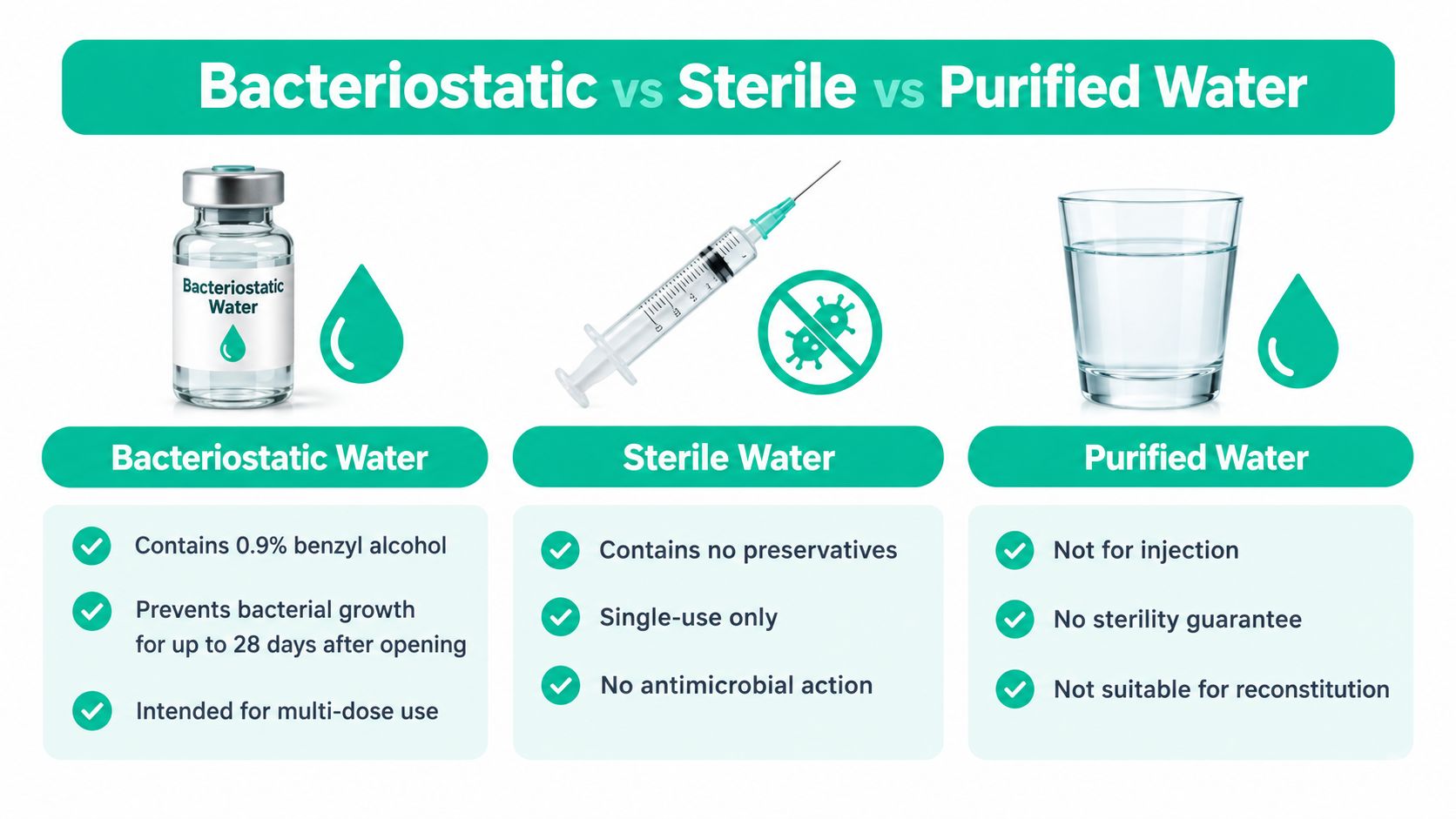
The three terms describe different specifications, not interchangeable names. Bacteriostatic water contains a preservative intended to help control microbial growth during multiple access. Sterile Water for Injection is sterile but preservative-free, and purified or distilled water may be suitable for general laboratory work without carrying a sterility or injectable specification.
The TGA describes Water for Injection as hypotonic and indicates it for dissolving or diluting injectable therapeutic substances when water is a suitable solvent. It also warns that intravenous administration is contraindicated unless the hypotonic water is adjusted to isotonicity with suitable solutes (TGA safety update on Water for Injection). For a research buyer, the lesson is straightforward: don't choose a water product because it sounds cleaner. Choose the specification that matches the approved laboratory workflow and documented compatibility requirements.
Read the label as a procurement document
A useful comparison looks beyond the product name:
| Feature | Bacteriostatic water | Sterile Water for Injection | Purified or distilled water |
|---|---|---|---|
| Preservative | Present when stated in the product specification | Normally absent | Variable or absent |
| Multi-dose suitability | May be designed for repeated access | Usually product-specific and commonly single-use | Not established by the word “purified” |
| Sterility claim | Must be supported by product documentation | Must be supported by product documentation | Must not be assumed |
| Endotoxin information | Should be available where relevant | Should be available where relevant | Depends on grade and supplier |
| Research relevance | Depends on preservative and compound compatibility | May suit workflows requiring no preservative | Often unsuitable for sterile or sensitive preparations |
The TGA identifies Water for Injection as a regulated therapeutic good even when it contains only excipients, so Australian purchasers shouldn't assume that a listing labelled “bacteriostatic water 10ml” has the same regulatory status as a general laboratory solvent (TGA information on Product Information and the ARTG).
The same distinction applies to ordinary purified water. A clear bottle doesn't prove sterility, low endotoxin content, container-closure integrity or compatibility with a peptide research workflow. Those are specification questions, and they require documentation.
Reconstitution Considerations in Peptide Research Workflows
Research teams often refer to bacteriostatic water when planning work with freeze-dried peptide materials because the format supports controlled access to a preserved diluent. That doesn't make it universally suitable. The diluent is another reagent in the experiment, and its composition can influence observations downstream.
Think of the solvent as part of the analytical environment. A researcher assessing a freeze-dried material needs to consider the vial's displacement volume, the intended final concentration range, pH, preservative exposure, excipient interactions and the behaviour of the prepared material under the study's storage conditions.
Treat compatibility as a study variable
A diluent can affect solubility, turbidity, precipitation, pH shift, adsorption to surfaces or degradation. Two materials in the same laboratory may therefore require different diluent decisions, even if both arrive as a freeze-dried powder. A product label that names benzyl alcohol doesn't replace a compound-specific compatibility assessment.
For that reason, preparation planning should remain separate from administration advice. The research peptide reconstitution guide can help buyers identify the documentation questions to ask, but the laboratory's validated method, safety documentation and compound-specific evidence must control the actual workflow.
A useful record should connect the diluent lot to the study material and the prepared solution. Record the product identity, lot number, opening details, storage conditions and any observed change in appearance. This creates a traceable link between the consumable and later analytical results without treating a generic product description as proof of compatibility.
Why the 10 mL Vial Format Matters for Research Programs
A 10 mL vial is a format decision, not just a packaging detail. It provides a defined quantity for a planned multi-dose workflow, while a 10-pack can help a laboratory organise stock across projects, batches or scheduled testing windows.
The right question isn't whether ten millilitres sounds large or small. Ask how often the study expects access, how the team will record first opening, whether the product's in-use instructions fit the study timeline, and whether unused stock can be stored under the stated conditions without losing traceability.
Packaging supports control
Sealed glass vials, intact septa and readable labels give the buyer practical points to inspect on arrival. The label should connect the product to its lot, expiry, storage conditions and intended-use information. If the container arrives damaged or the documentation doesn't identify the batch, the low unit price becomes less meaningful.
A 10-pack can also reduce fragmented purchasing, but it can create excess stock if the study schedule is uncertain. Procurement teams should balance planned access against expiry, storage capacity and the organisation's discard policy. A format is suitable when the access pattern and documentation system match it, not just because it's available in bulk.
What Bacteriostatic Actually Guarantees in Multi-Dose Use
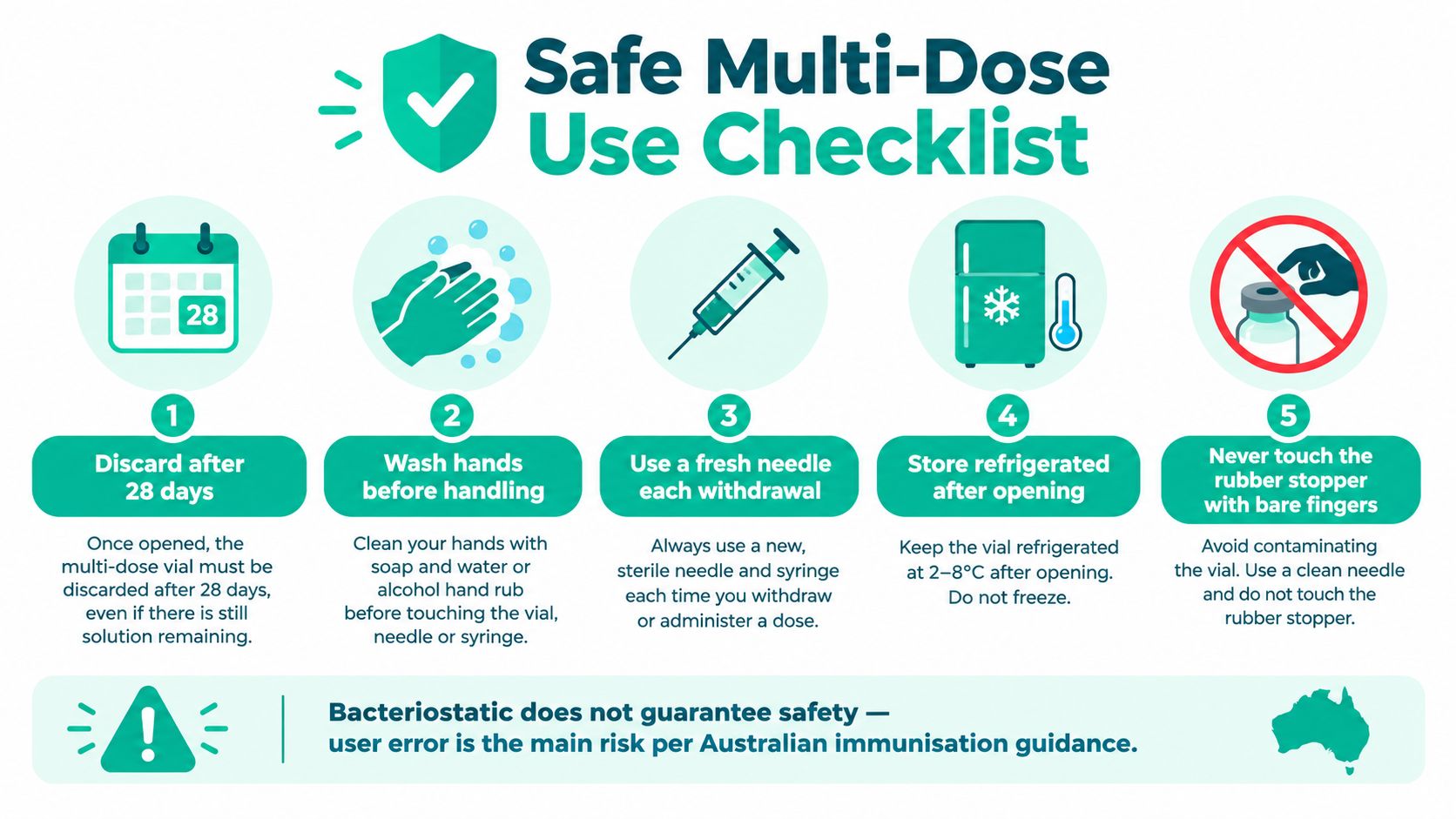
“Bacteriostatic” means the preservative helps inhibit bacterial growth. It doesn't guarantee that a vial remains safe after careless access, contaminated equipment, incorrect storage or retention beyond the manufacturer's recommendation.
Australian immunisation guidance identifies multi-dose-vial risks such as inserting a non-sterile needle, reusing a contaminated syringe, incorrect storage and keeping an opened vial longer than recommended. It also warns that bacteria and bloodborne viruses can be transmitted through inappropriate vial use (Australian Immunisation Handbook guidance on multi-dose vials).
Preservation doesn't replace aseptic discipline
In a controlled laboratory workflow, every withdrawal should use a new sterile syringe and needle, the stopper should be disinfected, and the vial should be labelled with opening details. The manufacturer's storage and discard instructions take priority over informal conventions.
Practical rule: Treat the preservative as one layer of contamination control, not as permission to relax handling standards.
The testing and quality information can help a buyer understand how supplier documentation is presented, but no testing page can compensate for poor handling after delivery. A Certificate of Analysis can describe a batch at testing, while the laboratory remains responsible for maintaining control of the product once it enters its facility.
A 10 mL format suits a study only when the team can support its access pattern, storage controls, labelling and discard policy. Research-use-only status also remains important. It doesn't convert an unapproved preparation into a medicine or authorise human or veterinary administration.
Reading a Certificate of Analysis Before You Order
A Certificate of Analysis is useful only when it is linked to the product in your hands. A generic certificate, an undated marketing statement or a document for a different lot cannot establish that your vial matches the tested batch.
Start with identity and traceability. The document should identify the product, manufacturer or testing laboratory, batch or lot number and expiry information. The lot on the vial, carton and COA should agree.
What the document should show
Review the certificate alongside the product specification and the laboratory's own quality records:
- Product identity: Confirms which material the certificate covers.
- Batch or lot number: Links the document to the physical stock.
- Sterility status and method: Shows what sterility claim was tested and how it was assessed.
- Bacterial endotoxin specification: Helps identify whether endotoxin testing or limits form part of the release criteria.
- Preservative identity and concentration: Matters because benzyl alcohol exposure can affect compatibility.
- pH and appearance: Provides useful release information, though visual clarity alone can't prove sterility or chemical purity.
- Storage conditions: Defines how the product is meant to be kept before and after opening.
The TGA states that sterile medicines should comply with the harmonised pharmacopoeial Test for Sterility and, where applicable, the Bacterial Endotoxins Test. It also says sterility and relevant endotoxin specifications should appear in release and expiry specifications, with each batch generally tested for sterility before release unless an approved exception applies (TGA guidance on sterility and endotoxin expectations).
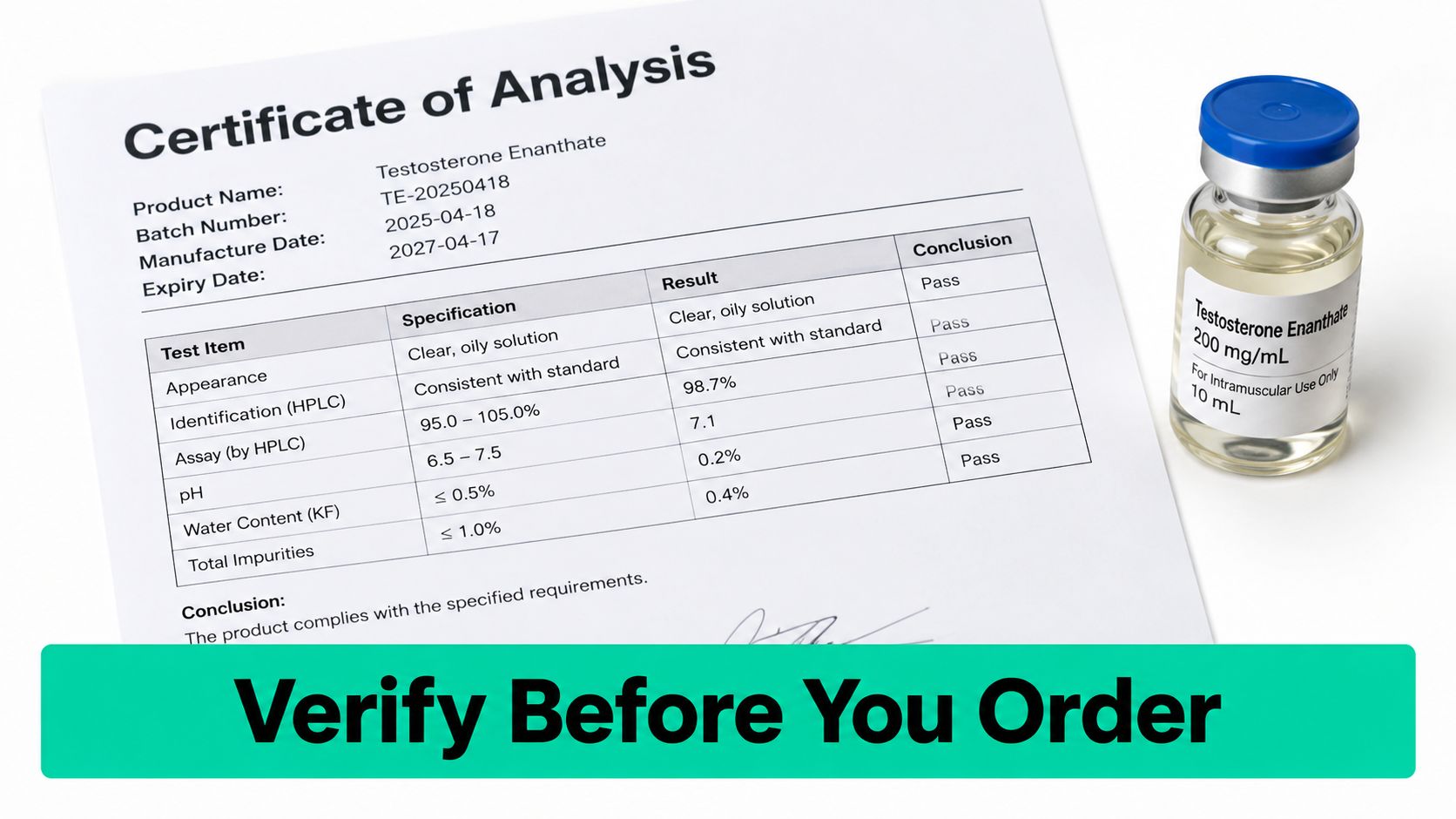
A COA can confirm what the issuing laboratory tested against stated criteria. It can't prove that a vial remained uncontaminated after opening, that every peptide is compatible with the preservative, or that a preparation will remain stable throughout an unvalidated study. Australian research organisations receiving NHMRC or Australian Research Council funding must comply with the Australian Code for the Responsible Conduct of Research, making supplier records and batch traceability part of sound research governance (Australian Code for the Responsible Conduct of Research). The online COA library is therefore most useful when buyers match each document to the exact stock they plan to order.
Procurement, Supply Continuity, and Australian Sourcing
Australian buyers should evaluate more than price and dispatch location. Before ordering, confirm the product's intended use, manufacturer information, supplier identity, batch traceability, expiry, storage conditions, preservative details, documentation access and GST invoicing.
Supply continuity deserves its own check. The TGA operates a Medicine Shortages Information Initiative and publishes shortage alerts because inadequate supply can affect access to medicines. Its reporting framework includes mandatory reporting for defined reportable medicines, with notifications required within 2 working days for critical-impact shortages and 10 working days for other shortages (TGA information on major or ongoing medicine shortages). Those rules don't prove that every bacteriostatic-water listing is regulated or included in the shortage database, so buyers should use the information as supply-risk context, not as proof of product approval.
A practical Australian purchasing file
A university or biotech procurement team may want to retain:
- Supplier details: Australian business identity, contact pathway and invoice records.
- Product records: Label, intended-use statement, specifications and storage requirements.
- Batch evidence: Lot-specific COA, sterility information, endotoxin information and preservative details.
- Continuity planning: A validated alternative or contingency supplier where the study timeline makes interruption costly.
Bulk Aussie Peptides provides Australian-owned and operated supply, 10-pack formats, sealed glass vials, batch documentation, an online lab library, tracked domestic shipping and GST invoices. Buyers can review the procurement information pack as one example of how product and supply records can be organised. The relevant comparison is not just cheapest per vial. It's whether the documentation, traceability and continuity support the laboratory's quality system.
Storage, Compatibility and Common Buyer Questions
Does every vial need refrigeration? No single storage assumption applies to every product. Follow the specific label for unopened and opened material, protect the container from unsuitable heat, light or freezing, and apply the prepared compound's own stability information separately.
Why does benzyl alcohol concentration matter? Preservative concentration affects compatibility. A regional regulatory datasheet describes a product containing 1.1% benzyl alcohol, equivalent to 11 mg/mL, while other formulations may differ (Medsafe bacteriostatic-water datasheet). For a nominal 10 mL product, that concentration would correspond to approximately 110 mg across the vial, but the supplier's label and COA must control.
Can one diluent suit every peptide? No. pH, excipients, solubility, adsorption and preservative interactions vary, so each material requires documented compatibility evidence.
What should a buyer keep with the stock? Retain the label, lot, expiry, storage information, COA, supplier invoice and opening record. A COA supports batch identity and tested specifications, but it can't verify later handling or guarantee study outcomes.
| Specification Field | Why It Matters | Source |
|---|---|---|
| Product identity and lot | Connects the COA to the vial | Supplier label and batch COA |
| Sterility method | Defines the sterility claim | TGA sterile-medicine guidance |
| Endotoxin specification | Identifies relevant release controls | TGA sterile-medicine guidance |
| Preservative identity and concentration | Supports compatibility review | Product label and COA |
| pH and appearance | Flags release or inspection issues | Product specification and COA |
| Storage and opened-vial instructions | Controls post-delivery handling | Manufacturer label |
Bulk Aussie Peptides supplies bacteriostatic water in 10 mL ten-pack formats alongside research-use-only peptides, with sealed glass vials, batch documentation and an online COA library. Visit Bulk Aussie Peptides to review the product specification and procurement information before choosing a documented Australian supply option.
- BAP