
TB 500 Peptide: What Australian Researchers Should Know

What is a TB 500 peptide in Australia, and why do so many readers end up asking a paperwork question instead of a biology question? The short answer is that TB-500 is a research peptide with interest in tissue-repair research, but in Australia it sits inside a regulatory framework that matters just as much as the science. For Australian researchers, the issue is not only what the molecule is, but whether the product is being handled, described, and documented in a way that fits laboratory use rather than therapeutic supply.
Table of Contents
- What TB 500 Peptide Is and Why Researchers Search For It
- Sequence, Class, and the TB 500 versus Thymosin Beta-4 Distinction
- What the Research Evidence Does and Does Not Support
- Common Research Applications Studied in the Literature
- Handling, Reconstitution, and Storage Notes for Laboratory Work
- Batch Documentation, COAs, and What Lab Testing Verifies
- Evaluating Australian TB 500 Peptide Suppliers
- The Australian Regulatory Lens Researchers Need to Carry
What TB 500 Peptide Is and Why Researchers Search For It
TB 500 peptide is the label many readers see on a synthetic research material linked to thymosin beta-4. In practical terms, it belongs to the peptide category studied in tissue repair and signalling work. In Australia, it is not an approved human medicine and it is not included in the Australian Register of Therapeutic Goods. The TGA also treats TB-500 as part of the group of unapproved peptide products, so import, supply, compounding, and advertising controls may apply depending on how it is handled and described. The key question is what the product is being bought for, and whether the paperwork matches that use. TGA safety alert on unapproved peptide products
The basic identity question
Researchers search for TB-500 because product pages, academic discussion, and forum language often blur several ideas into one phrase. Some buyers want a lab material for comparison work. Others are checking whether the supplier's documentation is complete. Others are matching a product page against published literature. Those tasks do not use the same standard of review.
Practical rule: if the product page does not clearly separate research-use material from therapeutic supply, treat that as a documentation gap, not a small detail.
For Australian work, the local setting matters. Domestic shipping, a tidy product page, or a certificate from the supplier does not change whether the item sits outside the ARTG. It only affects how easy it is to trace the batch and review the records.
Sequence, Class, and the TB 500 versus Thymosin Beta-4 Distinction
The name confuses people because TB-500 and thymosin beta-4 are related, but they are not the same phrase for the same job. TB-500 is the research designation commonly used for a synthetic fragment associated with thymosin beta-4, while thymosin beta-4 refers to the naturally occurring protein found in the literature. That distinction matters because product pages often compress both names into one marketing label, even though the evidence base doesn't treat every labelled item as interchangeable.
Reading a product page without getting lost
A clean way to sort the details is to separate the chemistry from the packaging and the claims. The chemistry tells you what family the item belongs to. The packaging tells you how it is supplied. The claims tell you whether the seller is talking about research, identity, purity, or something much bigger than the data allow.
| TB 500 Peptide at a Glance | |
|---|---|
| Field | Detail |
| Peptide class | Research peptide related to thymosin beta-4 |
| Common research alias | TB-500 |
| Supplied form | Lyophilised freeze-dried powder cake in a sealed glass vial |
| Packaging format | Standardised 10-pack vial format |
| Lab context | Research-use material, not an approved human medicine in Australia |
When a listing uses both names, the safest reading is careful rather than casual. A TB-500-labelled vial may help with research comparison, but it doesn't automatically mean every thymosin beta-4 paper applies cleanly. The molecule label, the supplied form, and the documentation all have to line up before you can compare like with like.
What the Research Evidence Does and Does Not Support
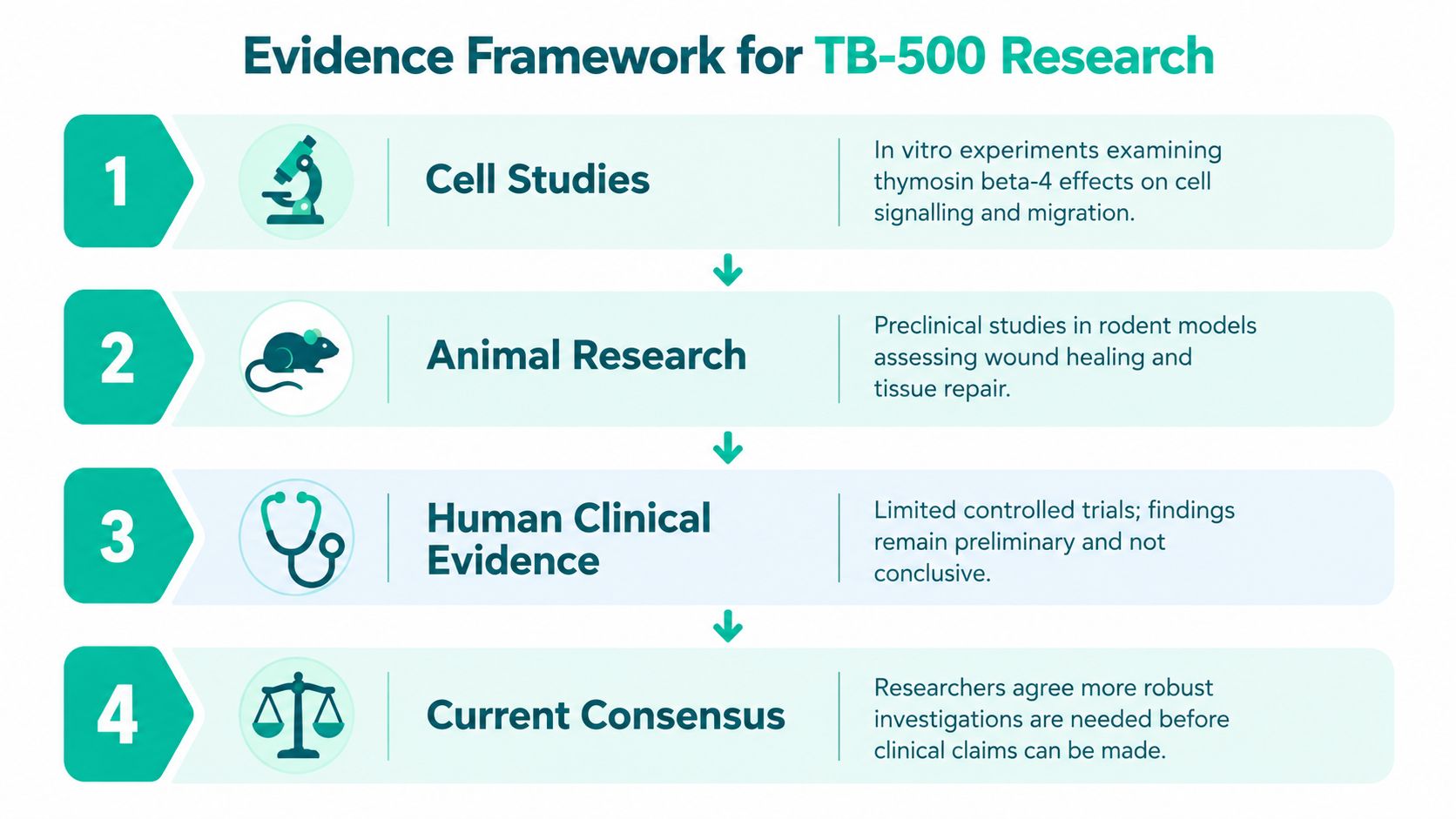
The literature around TB-500 is often discussed as if one encouraging result can be stretched into a clinical answer. That leap is too fast. The cleaner reading is a four-level framework: cell studies, animal research, human clinical evidence, and current consensus. Mechanistic plausibility exists in tissue-repair pathways, but that is not the same thing as proof of clinical benefit, safe use, or product equivalence across all TB-500-labelled material. Academic synthesis on TB-500 and thymosin beta-4 evidence
Four levels of evidence
At the first level, cell studies look at signalling, migration, and repair-related behaviour in controlled lab conditions. At the second, animal research explores what happens in living systems, often in wound-healing or tissue-repair models. These stages can be useful, but they don't tell you how a human injury will respond.
At the third level, human clinical evidence is limited and not conclusive for the claims people often attach to TB-500. At the fourth level, the current consensus stays cautious, because the literature does not establish clinical efficacy, optimal dosing, administration route, product equivalence, or long-term musculoskeletal safety. Claims about recovery or return-to-training often outrun the evidence.
The right question is not whether a mechanism exists. It's whether the human data support the specific claim being made.
That distinction helps Australian readers avoid a common trap. A plausible pathway in a paper is not a licence to talk about treatment results, and a lab result is not a human outcome.
Common Research Applications Studied in the Literature
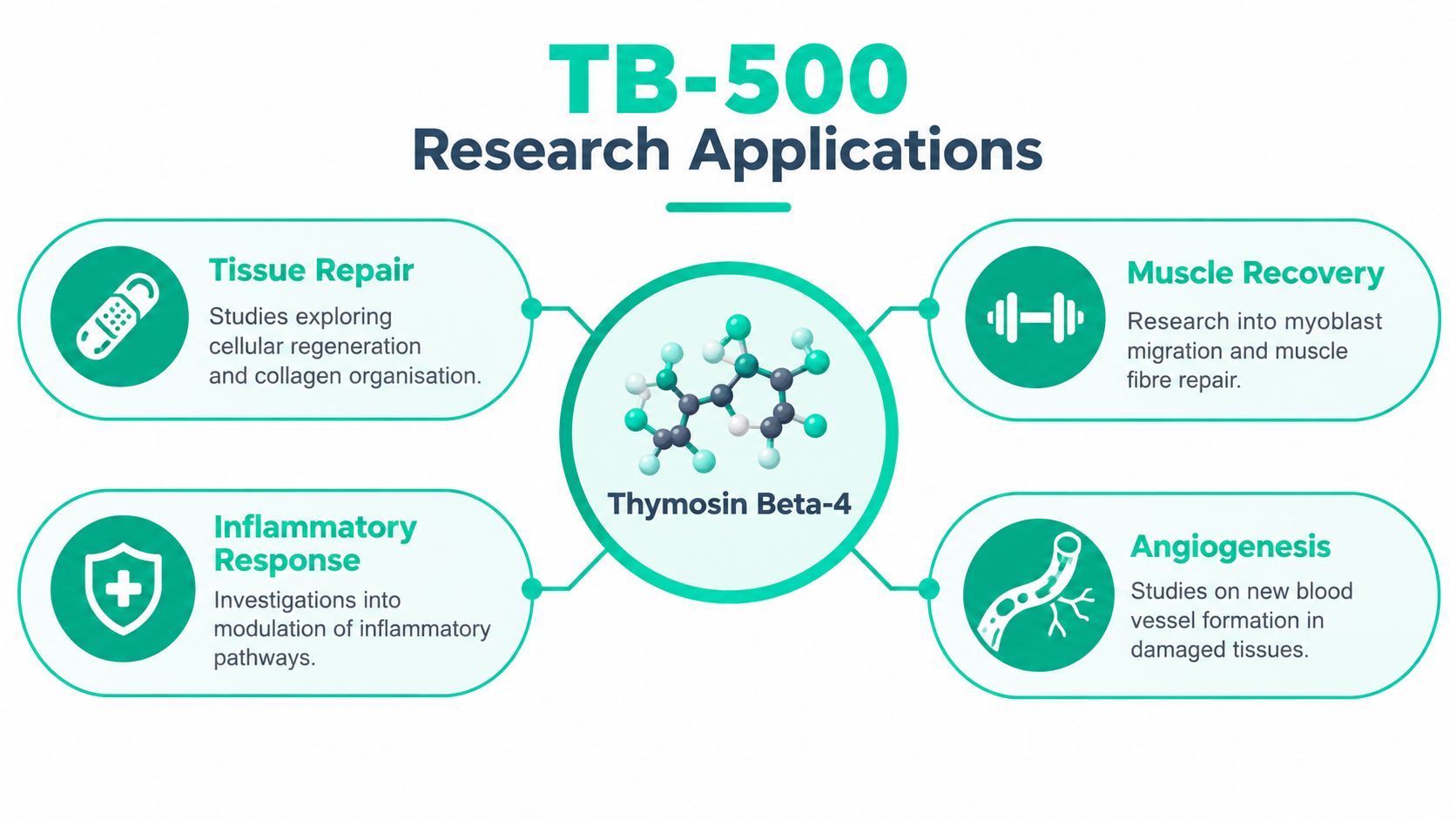
The literature most often links TB-500 and thymosin beta-4 to tissue repair, regenerative biology, inflammatory signalling, and cell migration. Those are research themes, not promises. They help explain why the compound draws attention in laboratory and veterinary settings, but they don't justify confident injury-treatment language for human use.
Where the curiosity comes from
Researchers have examined how these peptides relate to cell movement, repair processes, and blood-vessel formation in damaged tissue. That is why you see the compound discussed near wound-healing models, connective tissue work, and broader recovery research. Some of that interest also came through equine and veterinary injury models, which helped seed later human curiosity.
If you're reading papers for procurement or project design, the important move is to match the material to the hypothesis. A lab studying inflammatory signalling has a different question from a team studying tissue regeneration, and neither question is answered by marketing language on a product page.
For readers comparing related compounds, a side-by-side overview of BPC-157 versus TB-500 can help frame the literature in the right way, especially when product names overlap in search results: BPC-157 versus TB-500 comparison
Handling, Reconstitution, and Storage Notes for Laboratory Work
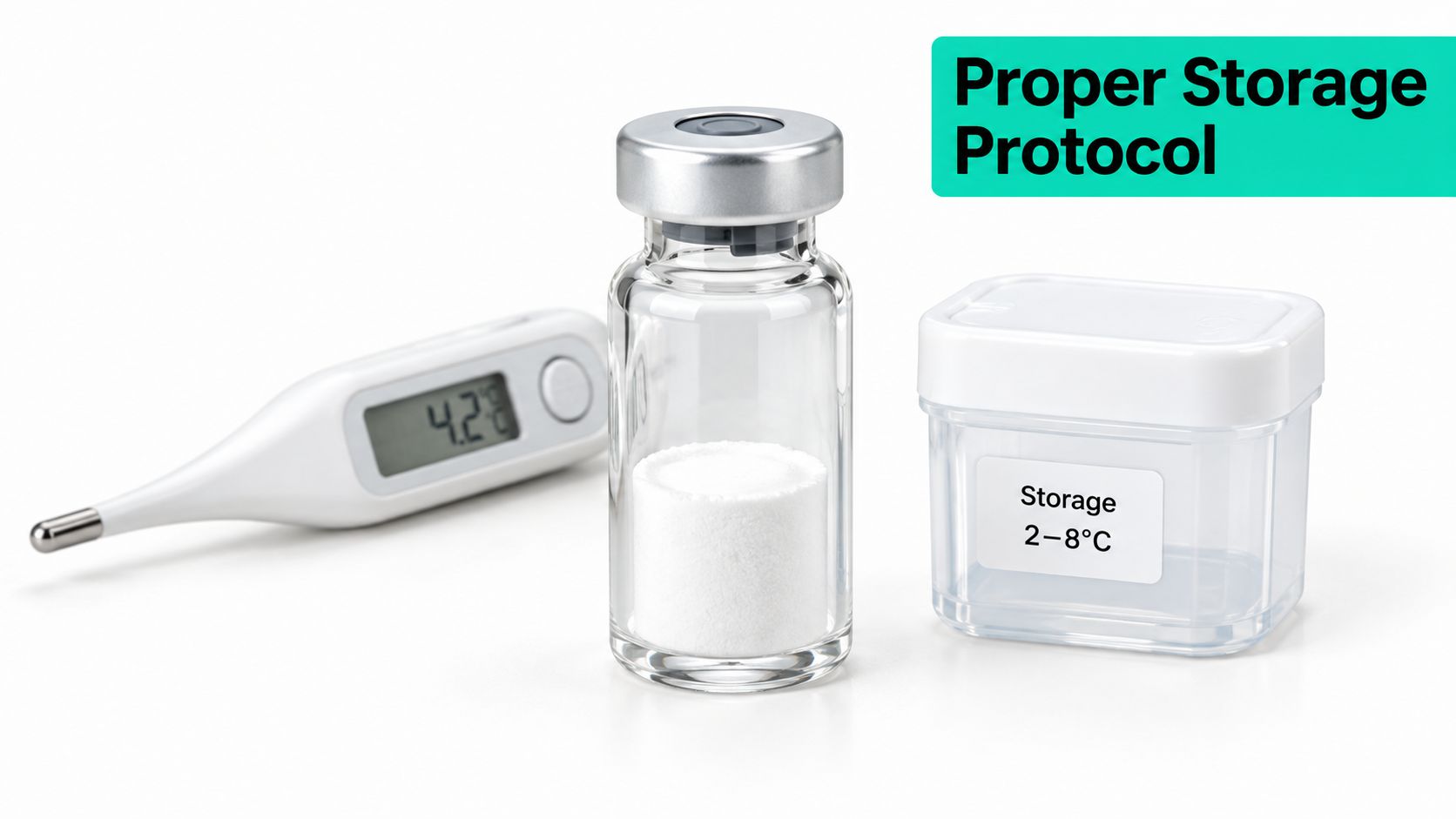
A TB-500 vial usually arrives as a sealed glass container with a freeze-dried powder cake. For laboratory work, that format matters because it helps preserve identity, supports recordkeeping, and makes storage easier to document. The practical question is not convenience, it is whether each step keeps the material traceable and the workflow consistent.
A peptide concentration calculator helps researchers plan mg/mL preparation and reduce simple errors during repeat work. Standardised 10-pack vial formats can also make matched replicates easier to organise and compare across batches.
- Traceability first: keep the batch identity, specification sheet, and related records together.
- Workflow consistency: use the same preparation logic across comparable experiments.
- Storage discipline: follow laboratory temperature requirements, not guesswork.
If your team needs a plain-language reconstitution reference for research planning, use the reconstituting research peptides guide rather than ad hoc notes.
Batch Documentation, COAs, and What Lab Testing Verifies
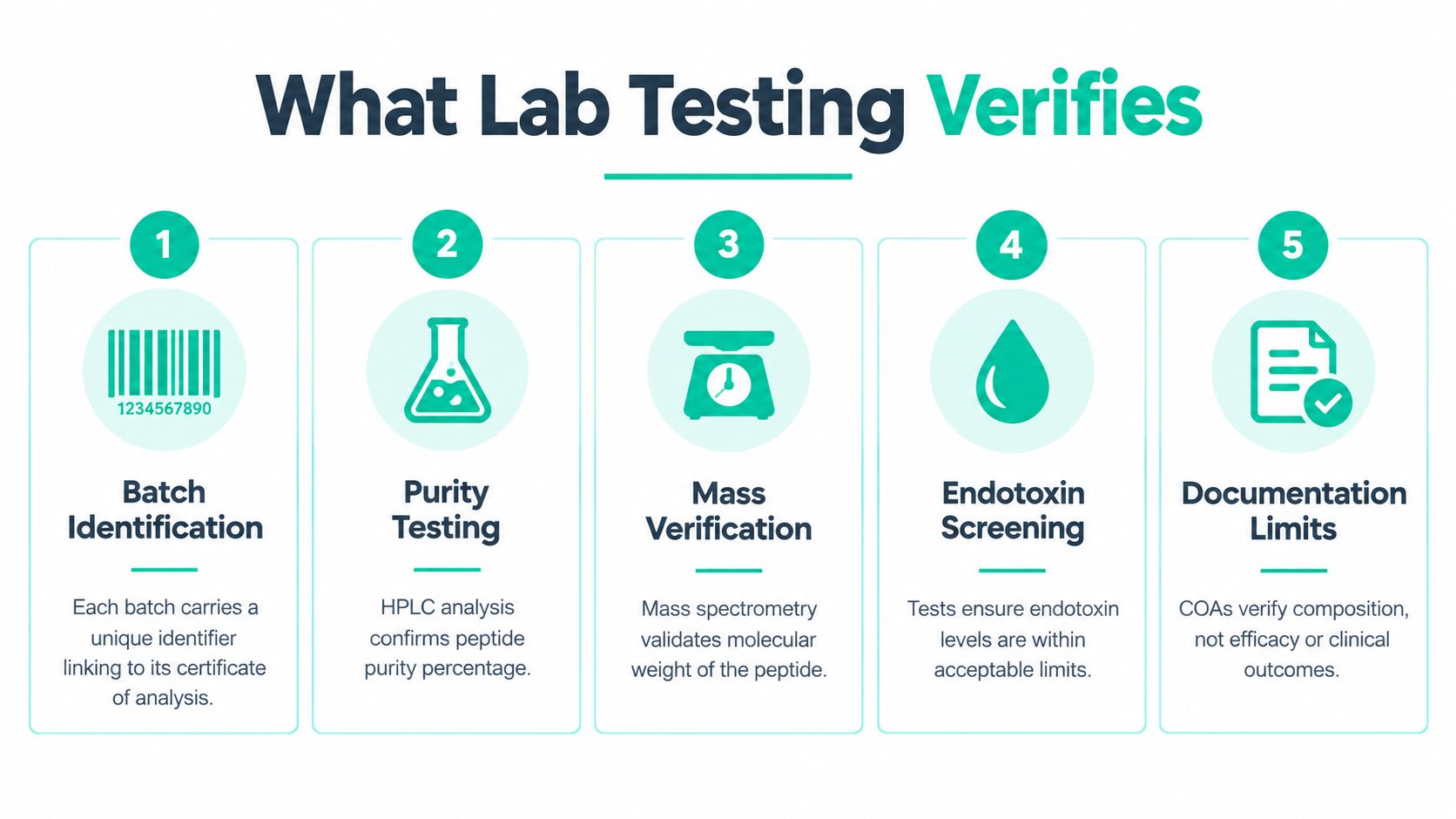
Why does a Certificate of Analysis matter if it does not prove everything people hope it will? Because it can still show which batch was tested, what the measured identity or purity results were for that lot, and how the material ties back to the paperwork. That is traceability. It is not TGA approval, clinical suitability, or proof of sterility for injection. Sport Integrity Australia education on thymosin beta-4
What the documents should show
A usable document set links the batch number to the SKU, specification sheet, and laboratory report. That makes it easier to check whether the item purchased matches the product description and whether the record set is complete.
A COA works like a lab label, it helps you follow the sample through the paperwork. It does not establish clinical effectiveness, long-term safety, or lawful use for another purpose.
For teams reviewing supplier records, an online COA library is most useful when it can be searched by product, batch, and document type. Pending documents should be clearly marked, and product pages should show whether a report is manufacturer-provided or independently generated. For a public-facing example of that documentation approach, see the testing and quality information page.
Evaluating Australian TB 500 Peptide Suppliers
Australian buyers should compare suppliers on operational basics, not on vague claims. That means looking at AEST support hours, domestic order handling, tracked shipping, GST invoices, and whether the supplier keeps independent lab records accessible in one place. If the catalogue is broad, that can help procurement teams standardise sourcing across related research areas.
A practical checklist
- Local support: check whether the business is Australian owned and operated, with support hours listed in AEST.
- Fulfilment clarity: look for domestic order processing, dispatch windows, and tracked delivery estimates.
- Commercial paperwork: confirm AUD pricing and GST invoices before checkout.
- Research format: standard 10-pack vial formats help with planning and repeatability.
- Payment and access: secure checkout through providers such as Stripe and Apple Pay can reduce friction for routine purchases.
For buyers comparing documentation access, the COA archive is worth checking alongside the product page: COA library
A supplier can also be easier to evaluate when the catalogue is structured across metabolic, tissue, longevity, and neuroscience lines, because that makes bulk procurement more predictable. Bulk Aussie Peptides is one Australian option in that space, with research-use products presented in standardised formats, but the same checklist still applies when you compare any other vendor.
The Australian Regulatory Lens Researchers Need to Carry
What matters first in Australia is intended use, then the recipient, the wording used to describe the material, and the import path. That sequence matters because better paperwork can improve traceability without changing the regulatory status of an unapproved peptide product. A certificate or invoice may help organize the file, but it does not make research material approved therapeutic supply.
A simple decision lens
For a registered lab, keep the language neutral, keep the records complete, and keep the batch paperwork attached to the procurement file. If the material starts being discussed for importation, advertising, or non-research supply, that is the point for regulatory or professional advice. A polished website does not change that line.
For Australian researchers comparing options, a broad product page can help orient the category before a specific purchase decision, such as the peptides in Australia page.
TB-500 sits at the meeting point of evidence, paperwork, and intended use. That makes it a documentation-first topic in Australia, not a performance shortcut. A COA can show what a batch was tested for, but it does not establish approved use, clinical benefit, or suitability for a separate research question. If you are checking batch records or building a procurement file, Bulk Aussie Peptides presents product pages, batch documentation, and lab-library records in one place, which helps researchers match the paperwork to the question before ordering.