
Australian Peptides: A 2026 Research Guide

The common advice to buy Australian peptides from a local seller with a certificate of analysis leaves important questions unanswered. An Australian address, a research-use-only label and a laboratory certificate don't establish medicine approval or clinical safety. For laboratory buyers, Australian peptides means research compounds supplied to customers in Australia, with identity, specifications and batch records that need checking before procurement.
The useful starting point isn't a promised outcome. It's the compound class, the question a study examines, and the evidence that connects the labelled vial to its documentation.
Table of Contents
- Australian Peptides by Research Category
- Lyophilised Powder in Sealed Research Vials
- Research Use Only and the TGA Line
- What a Certificate of Analysis Actually Shows
- How to Compare Australian Peptide Suppliers
- A Procurement Path for Labs and Universities
- Questions to Settle Before You Order
Australian Peptides by Research Category
Research peptide catalogues group compounds by the biological questions researchers investigate. These categories help organise a search, but they aren't treatment categories or evidence that a catalogue product has an approved medical role.
A familiar compound name can cause confusion. A research product labelled semaglutide isn't interchangeable with an approved medicine because both labels name the same molecule. Product status, formulation, provenance and lawful supply pathway must be assessed separately.
Research peptide categories in Australian catalogues
| Category | Examples seen in catalogues | What research examines | Supply status to keep separate |
|---|---|---|---|
| Metabolic incretin research | Semaglutide, tirzepatide, retatrutide | Research has examined glucose metabolism, appetite signalling and receptor pharmacology | Research material isn't the same pathway as an ARTG medicine with a similar name |
| Growth-factor related | Growth-factor-related research peptides | Research has examined signalling pathways in experimental models | Research-use documentation only |
| Tissue and cellular | BPC-157 | Research has examined preclinical tissue and cellular repair models | Not an approved recovery treatment |
| Longevity and senescence | Longevity and senescence research peptides | Research has examined cellular ageing and senescence markers | No longevity outcome claimed |
| Neuroscience | Neuroscience research peptides | Research has examined neural signalling in laboratory models | Research supply only |
| Fertility and reproductive | Fertility and reproductive research peptides | Research has examined reproductive signalling in experimental literature | Not a fertility therapy |
| Skin, hair and nail | Compounds catalogued for skin, hair and nail research | Research has examined tissue biology and cellular signalling in experimental settings | No cosmetic or clinical outcome established by catalogue placement |
| Other research | Catalogue compounds outside these groups | Research has examined compound-specific analytical and mechanistic questions | Check each product specification and batch file individually |
The approved-medicine market provides context, not proof about research products. During May 2024 to April 2025, semaglutide accounted for 63.3% and tirzepatide for 30.7% of GLP-1 medicine use in Australia, according to a peer-reviewed study indexed by PubMed.
Match the model to the question
Someone reading about weight management may encounter metabolic receptor studies. Someone interested in injury research may encounter preclinical tissue models, while skin and hair searches may lead to cellular signalling experiments. These are different kinds of evidence.
Before comparing compounds, identify whether the work examines a purified receptor, cultured cells, an animal model or a clinical medicine. Then check whether the exact compound and material specification match the study question.
A research category tells you where to start reading. It doesn't tell you what outcome a person should expect.
For procurement, the useful sequence is compound class, product specification, physical format, legal status and batch evidence. Price becomes meaningful only after those checks.
Lyophilised Powder in Sealed Research Vials
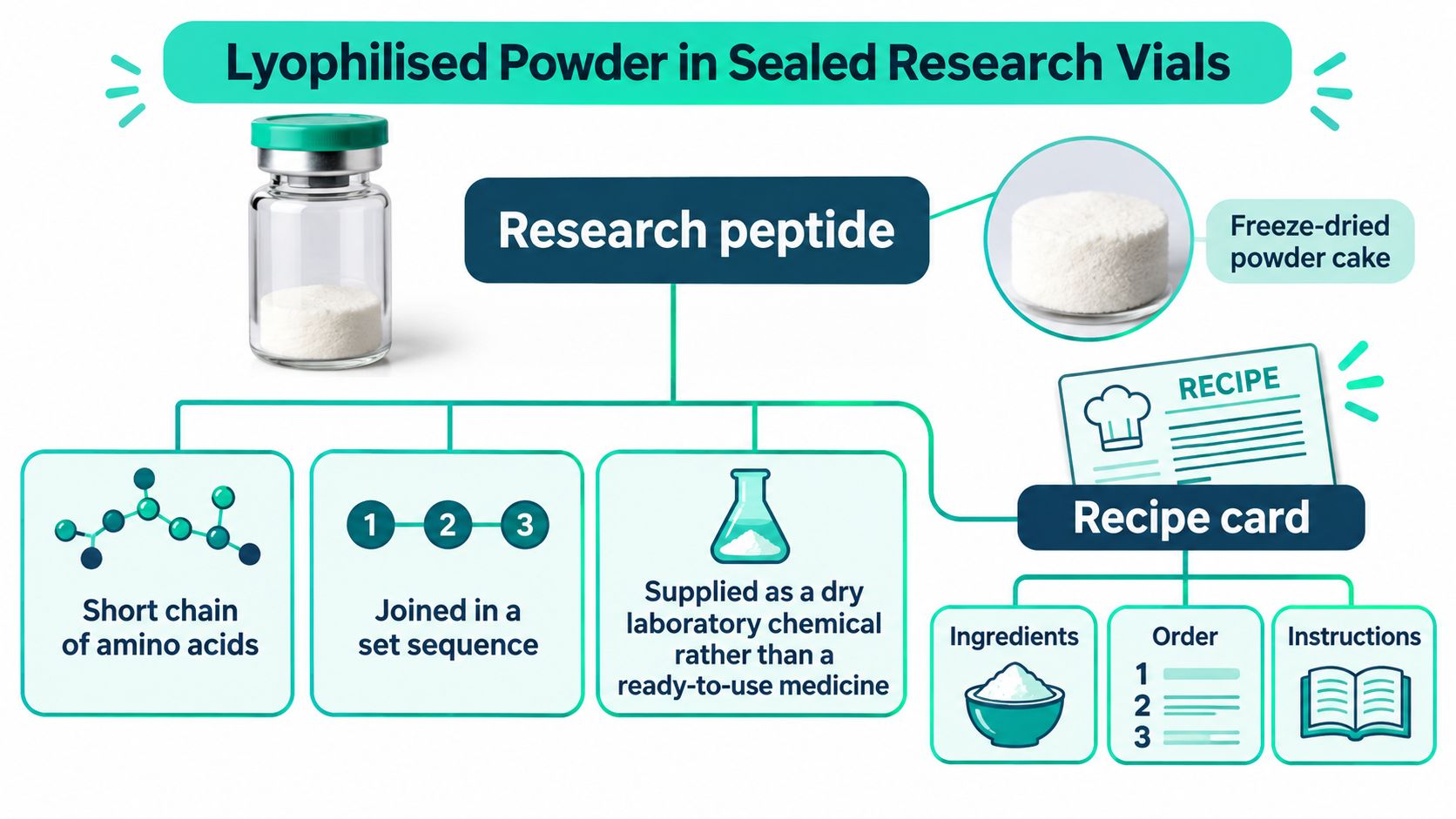
A peptide is a short chain of amino acids joined in a particular sequence. That sequence helps define its identity, while its physical presentation determines what the laboratory receives and records.
Think of a recipe card locked in a jar. The ingredients and their order represent the amino-acid sequence; the jar lets the laboratory connect a labelled item to its paperwork. The analogy explains identity and packaging, not biological effects.
The physical format is illustrated below.
What the dry cake means
Lyophilised means freeze-dried. Most research peptides we sell are supplied in this form, commonly as a dry powder cake inside a sealed glass vial.
The cake is a laboratory storage and shipping form, not a ready-to-use medicine. Its appearance doesn't establish identity, purity or stability, so a buyer still needs the specification, storage conditions and relevant analytical records.
Our lyophilised research products guide provides context for this format. Any preparation belongs within the receiving laboratory's authorised standard operating procedure, not an online shopping guide.
A supplier's Peptide Calculator is a concentration arithmetic aid. It doesn't establish suitability for an experiment, replace a laboratory procedure or provide instructions for use.
Pack format and provenance
Consider a university laboratory planning repeated analytical measurements. A standardised 10-vial pack can provide one SKU, a consistent stated amount per vial and stock allocated to a study plan. A single trial vial can support a smaller specification check before a larger purchase.
Neither format proves that separate vials are analytically identical. The laboratory still needs a receiving record, appropriate storage and a clear connection between the supplied batch and its certificate.
- Pack consistency: Match the SKU, stated vial amount and pack description.
- Container condition: Check seals, readable labels and signs of damage on receipt.
- Provenance: Record where the material was manufactured, tested and dispatched.
We are 100% Australian owned and operated, but ownership isn't a manufacturing-origin statement. Our 10-packs ship from our overseas facility, while trial vials ship from Brisbane, so buyers shouldn't assume that every Australian-owned supplier dispatches every item domestically.
Format and dispatch location help explain the supply chain. They don't decide whether a particular transaction is lawful.
Research Use Only and the TGA Line
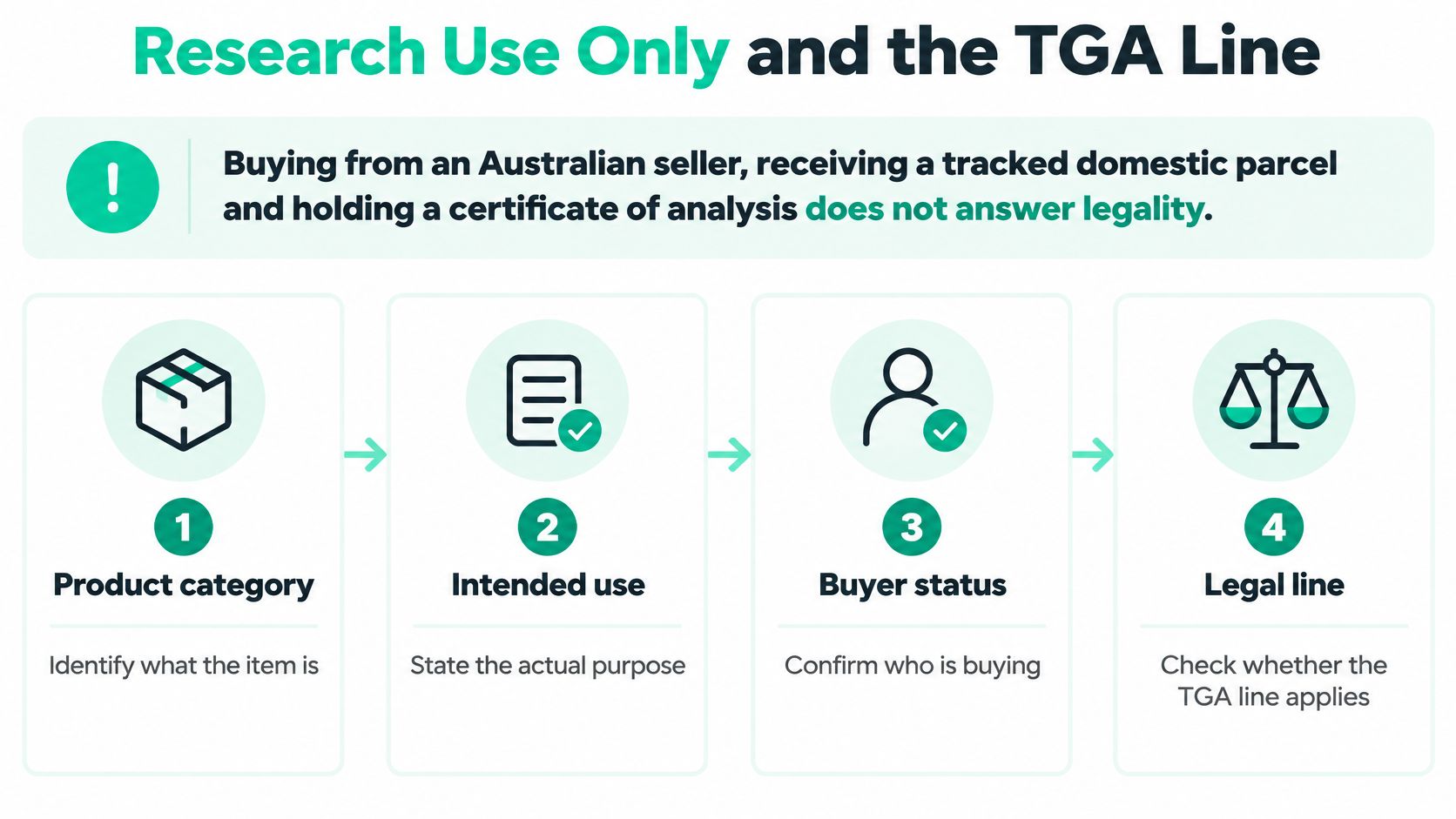
Buying from an Australian seller, receiving a tracked domestic parcel and holding a certificate of analysis does not answer legality. The label must be considered alongside what the product is, how it's promoted, who buys it and its actual intended purpose.
This checklist illustrates the separate compliance questions.
Ask the legal questions in order
Is the product an approved medicine for the proposed indication? Approved peptide medicines include insulin and insulin analogues, some GLP-1 receptor agonists such as semaglutide, oxytocin and vasopressin analogues such as desmopressin. That doesn't confer approval on similarly named catalogue materials.
Is the proposed importation, supply, advertising or compounding lawful? Therapeutic promotion, including claims about diabetes, obesity, cardiovascular disease, weight loss, muscle growth, recovery or performance, can bring a product within therapeutic-goods regulation. A research-only disclaimer doesn't neutralise contradictory marketing.
What does the paperwork establish about the batch? Analytical evidence concerns the supplied material. Regulatory approval is a different determination.
Is this buyer entitled to possess and use the material for the stated purpose? Institutional permission, applicable Australian law and the actual research activity need review before purchase.
The TGA's guidance on therapeutic peptide products describes the framework under the Therapeutic Goods Act 1989 and the ARTG, and records $10 million in civil penalties against Peptide Clinics Pty Ltd for advertising-related breaches.
Products classified as therapeutic goods generally require ARTG entry before importation, manufacture, supply, export or advertising, unless a specific exemption, approval or authority applies. Unapproved products haven't undergone the TGA's assessment of safety, quality or effectiveness.
Why the distinction matters
NSW Health reported 1,180 emergency-department presentations among people aged 16 years and older mentioning unapproved peptide use between 1 July 2025 and 30 September 2026, with 71% mentioning retatrutide only, in its unapproved-peptide surveillance report. Presentations mentioning use aren't a laboratory assessment of every product, but they underline why research supply mustn't be presented as a substitute for an approved-medicine pathway.
For another explanation of the regulatory context, the video below provides additional discussion.
Procurement rule: Record the intended use and provenance, and keep research materials clearly separated from therapeutic claims.
Our Australian research peptide regulation guide supports that document review. A research label should accurately describe an established purpose, not serve as a shortcut around the legal assessment.
What a Certificate of Analysis Actually Shows
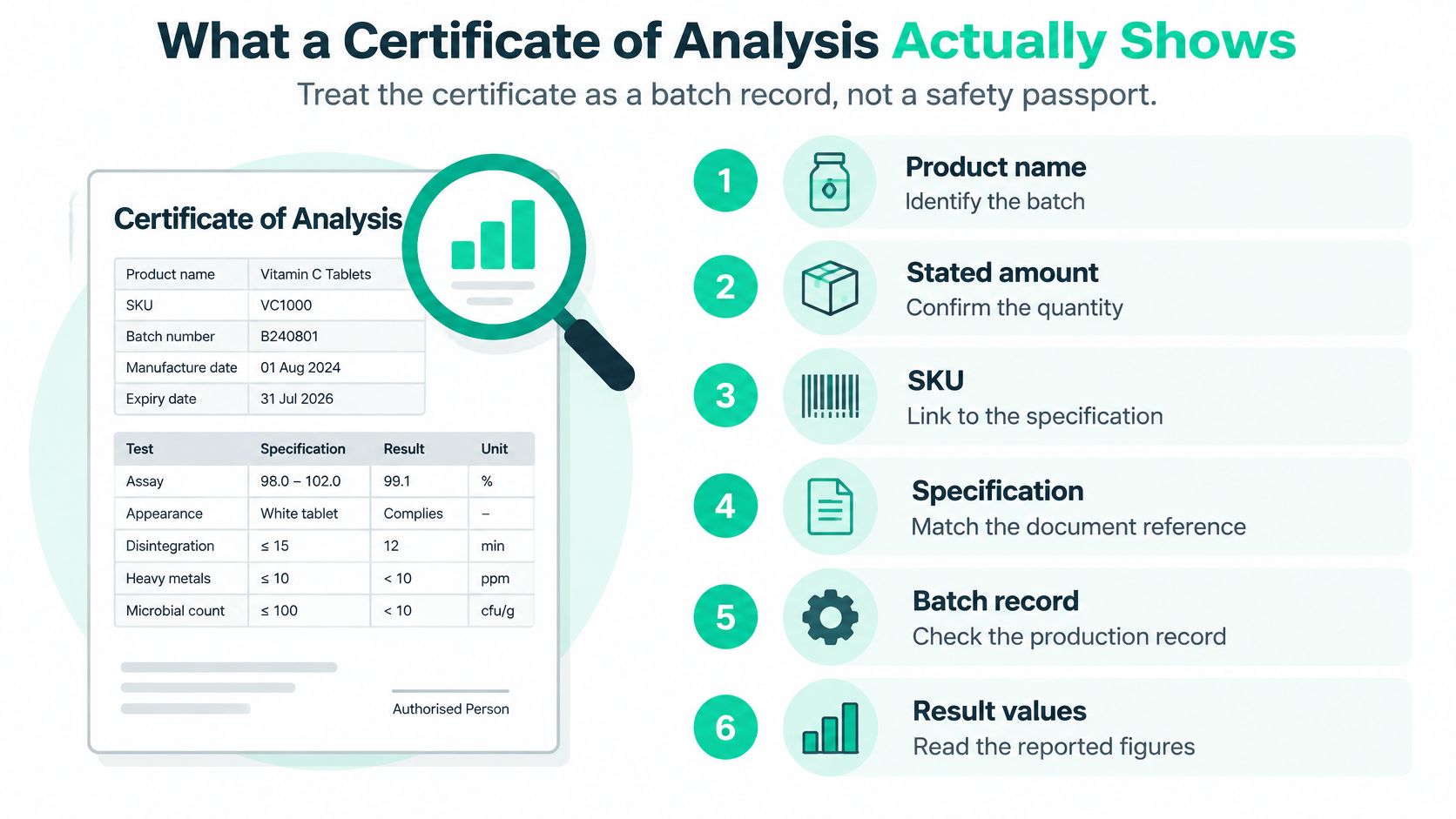
A Certificate of Analysis, or COA, is a batch record, not a safety passport. Its value comes from the match between the document, the material and the analytical question.
Start with the product name, stated amount and SKU. The SKU should connect to a specification sheet, while the batch number identifies the production run represented by the certificate.
The document-matching sequence is illustrated below.
Read the result and its method together
A useful report identifies what was tested, which method was used and what result was obtained. In peptide analysis, high-performance liquid chromatography, commonly called HPLC, can examine chromatographic purity, while mass spectrometry can provide evidence relevant to molecular identity.
Those methods answer different questions. A purity result doesn't automatically establish the stated amount per vial, and neither result alone establishes sterility or the absence of every possible contaminant.
Look for:
- Identity evidence: Results relevant to the named compound.
- Purity method: The analytical technique and reported result.
- Quantity information: What the stated amount represents and whether it was independently measured.
- Storage information: Conditions linked to the product specification.
- Document source: Clear identification of the manufacturer or independent laboratory.
A manufacturer-provided certificate and an independent laboratory report are different sources of evidence. Neither should be presented as the other, and a certificate from a different compound or production run isn't a substitute.
Follow the batch through the supply chain
Our online COA Library supports review of batch documentation linked from product pages. Where a batch is pending, the status should remain in testing, rather than implying that an unavailable report represents a completed pass.
The TGA's peptide information for health practitioners describes imported products in unmarked or inadequately labelled vials, including missing ingredient identity or concentration. It also makes clear that unapproved products haven't undergone the regulator's safety, quality and effectiveness assessment.
A certificate can support analytical traceability for a particular batch. It doesn't mean the TGA has evaluated that product's safety, quality or effectiveness.
Chain-of-custody records help connect the tested sample to the supplied material. They should identify the relevant batch and document transfers or handling that matter to the laboratory's acceptance decision.
Where a result determines whether a batch enters a study, plan independent confirmation. Uploading a PDF doesn't transfer responsibility for a quality judgement to the regulator, and an attractive certificate layout isn't analytical evidence.
How to Compare Australian Peptide Suppliers
Supplier checks before an Australian research-peptide order
| Check | Evidence to look for | Fail sign |
|---|---|---|
| Batch documents | COA or lab report matched to product name, SKU and batch number, or a clear in-testing status | One generic certificate reused across batches |
| Who tested it | File labelled manufacturer-provided or independent laboratory | Source of the PDF unnamed |
| Vial format | Sealed glass vial, lyophilised powder cake, stated amount, 10-pack or trial vial | Unmarked vial or no amount on the label |
| Price and tax | AUD price before checkout and a GST invoice for laboratory purchasing | Price only after signup, no tax invoice |
| Shipping | Australia-only supply, tracked express post and a stated dispatch window | Untracked freight or overseas-buyer checkout |
| Research positioning | Research-use-only wording and a specification sheet | Weight-loss, recovery or dosing claims |
| Support | Local team for specifications, returns and quotes | No way to match a document to a batch |
Apply these criteria before deciding whether a supplier's price is competitive. Some are quality checks, while others concern institutional purchasing preferences or service scope; a shipping preference isn't itself a legal test.
A failed batch match or therapeutic marketing claim deserves particular attention. Don't treat a discount as compensation for material you can't identify or a product page that contradicts its stated research purpose.
Apply the criteria to an actual purchase
For an illustration, our Australian-based team supports specification questions and returns enquiries, and we provide order tracking and quotes on request. Buyers should still inspect the relevant documents rather than relying on our ownership, support location or brand name.
Use the Australian research peptide supplier guide to structure a comparison. Record an unresolved item as unresolved, rather than interpreting silence as confirmation.
Shipping deserves a precise question: where does this particular item dispatch from? Australian ownership, an Australian customer base and an Australian returns contact describe different parts of the business.
Compare like-for-like AUD totals
Compare the same compound, SKU, stated amount per vial and pack size. A single-vial price and a multi-vial pack total aren't comparable until the buyer calculates the equivalent quantity.
Check whether GST is included or added at checkout, whether freight changes the total, and whether the institution needs a GST invoice. We can provide GST invoices for procurement records.
For larger quantities, our Request a Quote service lets the buyer obtain a defined offer rather than assume that a larger order automatically reduces the unit price. The quote should identify the material, quantity, documentation expectations and delivery arrangements.
Only compare price after the batch and claim checks pass. A lower total doesn't resolve an unnamed testing source, incomplete label or mismatched certificate.
A Procurement Path for Labs and Universities
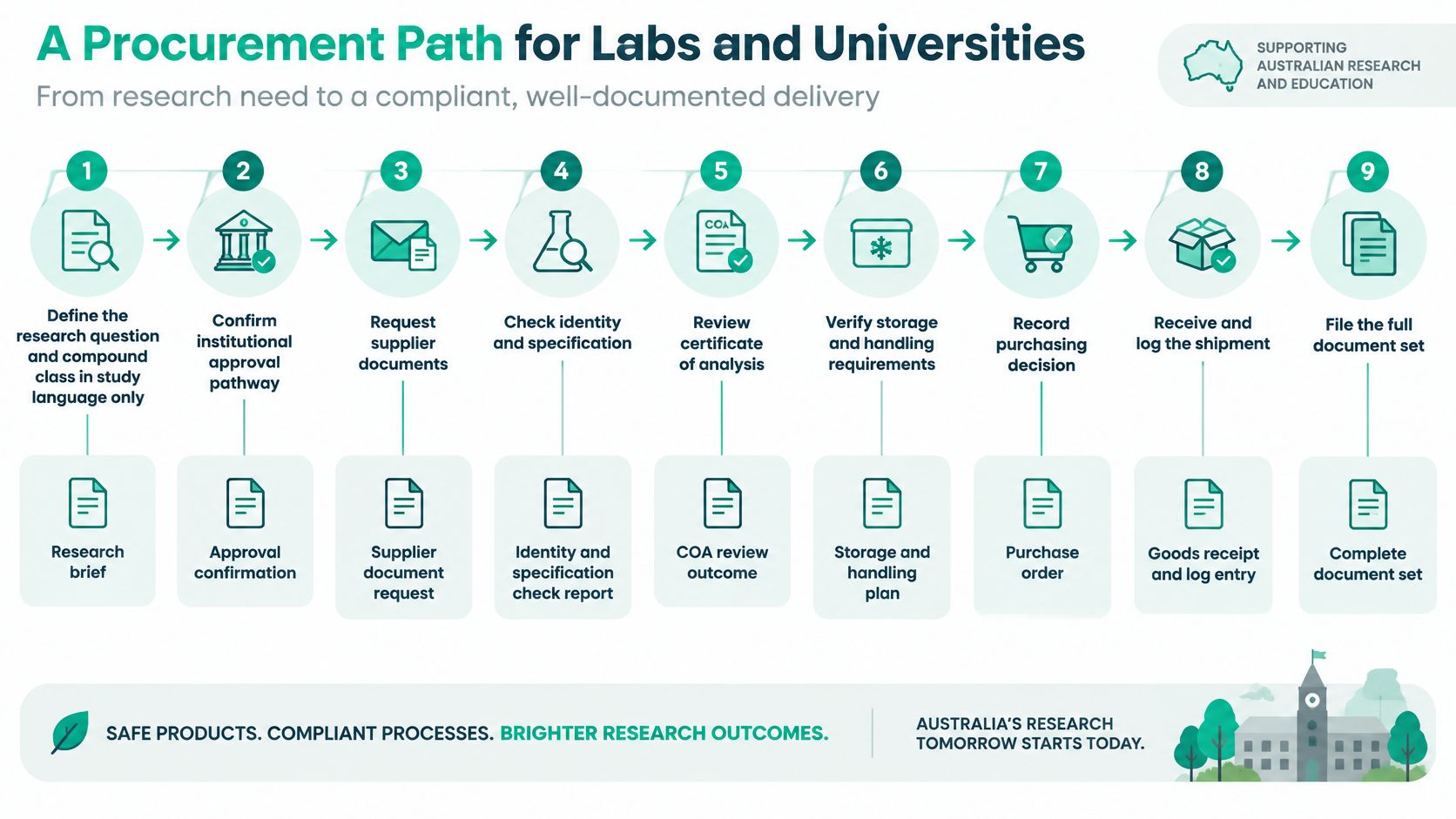
A purchase file should explain why the laboratory selected the material and what must happen before acceptance. Each step below produces a document or decision, rather than merely moving an item towards checkout.
The workflow can be adapted to an institution's purchasing and research-governance requirements.
Build the purchasing record
Define the research question. Record the compound class and experimental purpose in study language. Identify the intended research-supply context without assuming that a purchaser's description alone determines regulatory classification.
Confirm that the buyer may purchase the material under institutional policy and Australian law. The output is an approval decision or a referral to the institution's compliance team.
Create a shortlist. Record each candidate's SKU, stated vial amount and pack size. Choose stock quantities that fit the study plan rather than allowing a pack promotion to determine the experiment.
Review the specification before checkout. Save the identity requirements, storage conditions and acceptance criteria that the receiving laboratory will apply.
Review the batch file. Open the linked certificate and record its status, product match, batch number and laboratory source. An unavailable result remains an open procurement item.
Decide whether independent testing is necessary. Where acceptance rests on an analytical result, record who will conduct the check and who can authorise release into the study.
Obtain the commercial record. Use our Request a Quote service for custom bulk quantities and request a GST invoice where required. Keep the accepted quote with the purchasing approval.
Order for Australian delivery and track the shipment. We sell to customers in Australia only; if the received label and batch file disagree, contact our Australian-based support team before the material enters a study.
Close the receiving record. File the SKU, batch identifier, relevant document reference, receiving note and any discrepancy resolution with the study documentation.
Keep technical and purchasing decisions connected
Our procurement information pack can support the purchasing file. Our Australian-based team can also assist with product specifications and peptide selection for defined research needs.
A procurement officer may approve payment, while a laboratory manager decides whether material meets study requirements. Name both responsibilities so an administrative approval isn't mistaken for analytical acceptance.
Everyday readers can use the same document order when comparing products. That comparison doesn't establish eligibility to purchase or suitability for any non-laboratory purpose.
Questions to Settle Before You Order
What if a batch is still in testing?
In testing means no completed result is available yet. It isn't a pass, a purity grade or permission to infer a result from another batch.
Ask our support team to clarify the status and keep the acceptance decision open until the relevant file is available. If the study has a fixed start date, record that unresolved dependency before committing the budget.
Does a 10-pack change the legal position?
No. Pack size affects stock planning, not regulatory approval or buyer entitlement.
A standardised pack can simplify inventory by keeping a study allocation under one SKU and stated vial amount. The purchasing team must still assess the actual product, intended purpose and applicable requirements.
Can everyday readers use the same checks?
Yes, for understanding product descriptions and comparing documentation. The checks don't make personal use lawful or safe, and this guide doesn't provide personal-use advice.
A laboratory result also isn't a guaranteed outcome. Research material is for research, not human use, regardless of how familiar the compound name sounds.
What's the next step?
Choose a research category, open the relevant specification and inspect the linked lab-library file before comparing AUD pack pricing. Use glossary and comparison tools to clarify unfamiliar terms; use a calculator only for its stated arithmetic function.
Our catalogue contains 60+ peptides, supplied in 10-pack quantities with transparent AUD pricing, for Australian laboratories, universities and qualified researchers. Product-page documentation and the COA Library provide a starting point for verification, not a substitute for the buyer's acceptance decision.
Bulk Aussie Peptides offers research-peptide supply with specifications, batch documentation and Australian-based support for laboratory procurement. Visit Bulk Aussie Peptides to review the relevant product specification and certificate before requesting a quote or comparing an order. Start with the documents, then decide whether the material meets your research requirements.
- BAP