
What Is BPC 157? a Research Explainer

BPC-157 is a synthetic 15-amino-acid peptide studied mainly in preclinical tissue and gut models. In Australia, it is not an ARTG-approved medicine.
If a laboratory can buy a compound, does that mean its advertised healing benefits have been proved? That's the gap behind many searches for “what is BPC 157”. Research availability, clinical evidence and medicine approval are separate questions, and a clear answer needs to keep them separate.
Table of Contents
- What BPC 157 Is as a Research Peptide
- Proposed Repair Signals in Laboratory Models
- Preclinical Findings Versus Human Evidence
- Australian Regulatory Status for Research Peptides
- Batch Records Purity and Lab Documentation
- Typical Experimental Models and Study Designs
- Choosing a Documented Australian Research Supplier
What BPC 157 Is as a Research Peptide
BPC-157 stands for Body Protection Compound-157. It's a synthetic peptide, meaning a short chain of amino acids made through a manufacturing process, rather than a vitamin, a hormone replacement or a natural supplement.
Think of the chain as a 15-bead message. The beads are amino acids, and their order helps determine how the molecule behaves. Laboratories investigate whether that message changes biological signals in an experimental system, not whether a product name sounds relevant to an injury.
A review indexed on PubMed describes BPC-157 as a synthetic pentadecapeptide investigated in preclinical models of tissue repair, inflammation and gastrointestinal injury. It discusses experimental effects involving blood-vessel formation, collagen synthesis, fibroblast activity and nitric-oxide pathways, while stressing limited clinical validation and inconsistent preparation standards.
BPC-157 identity snapshot
| Feature | What published sources report |
|---|---|
| Common name | Body Protection Compound-157 (BPC-157) |
| Sequence class | Synthetic peptide, 15 amino acids (pentadecapeptide) |
| Main preclinical tissues | Gut, tendon, ligament, muscle, nerve and wound models |
| Human evidence level | A few small pilot studies only; no large controlled trial |
| Australian medicine status | Not an ARTG-approved medicine; research material is not a treatment |
The definition is straightforward. Interpreting it requires more care.
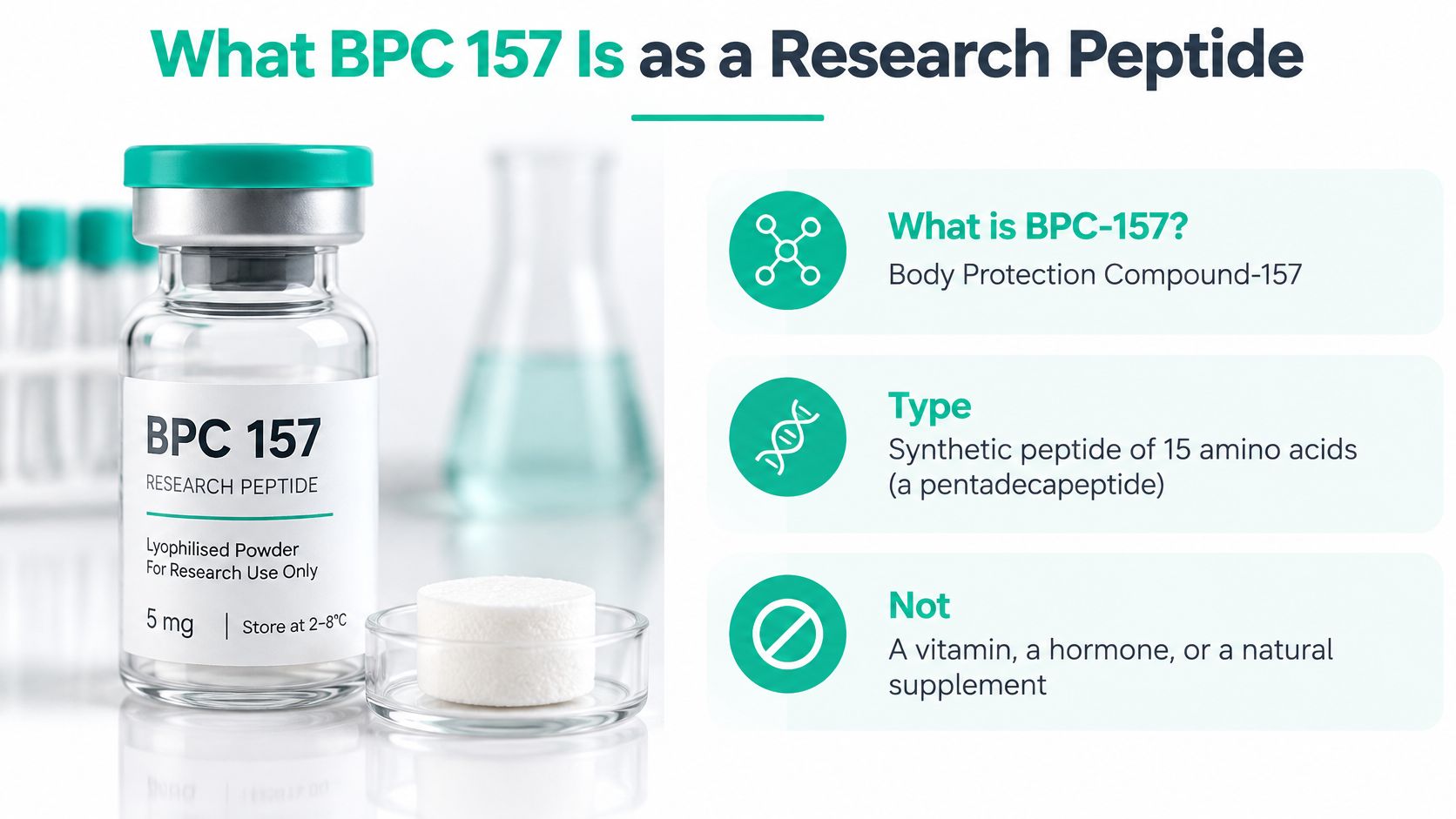
A named compound is not a demonstrated benefit
Say a university team is assessing a peptide for a tendon-cell experiment. The name on the vial helps identify the intended material, but it doesn't establish what's in that batch or whether the experiment can answer a useful question.
The team needs a defined comparison and a measurable endpoint. “Does this material change a repair-related marker under these conditions?” is more useful than “Does it heal tissue?” Thesis Book Project's research question advice for dissertation writers offers a helpful starting point for narrowing broad interests into testable questions.
Terminology matters too. Our research peptide glossary can help distinguish a peptide's identity from the biological response being investigated.
Reading rule: A result in an experimental model describes what happened in that model. It doesn't automatically establish a treatment benefit.
Preparation differences add another complication. Vials carrying the same compound name aren't automatically comparable, so a useful scientific description includes the material's identity and supporting analytical records.
Proposed Repair Signals in Laboratory Models
Researchers don't pin BPC-157 to a single biological switch. A mechanistic review available through PubMed Central describes the VEGFR2–Akt–eNOS axis, nitric-oxide signalling, ERK1/2 activity, VEGF expression and EGR-1-related repair responses as proposed pathways.
Those names describe connected cellular processes, not a settled explanation of clinical benefit. The concept map below groups the main signals without turning them into a promise.
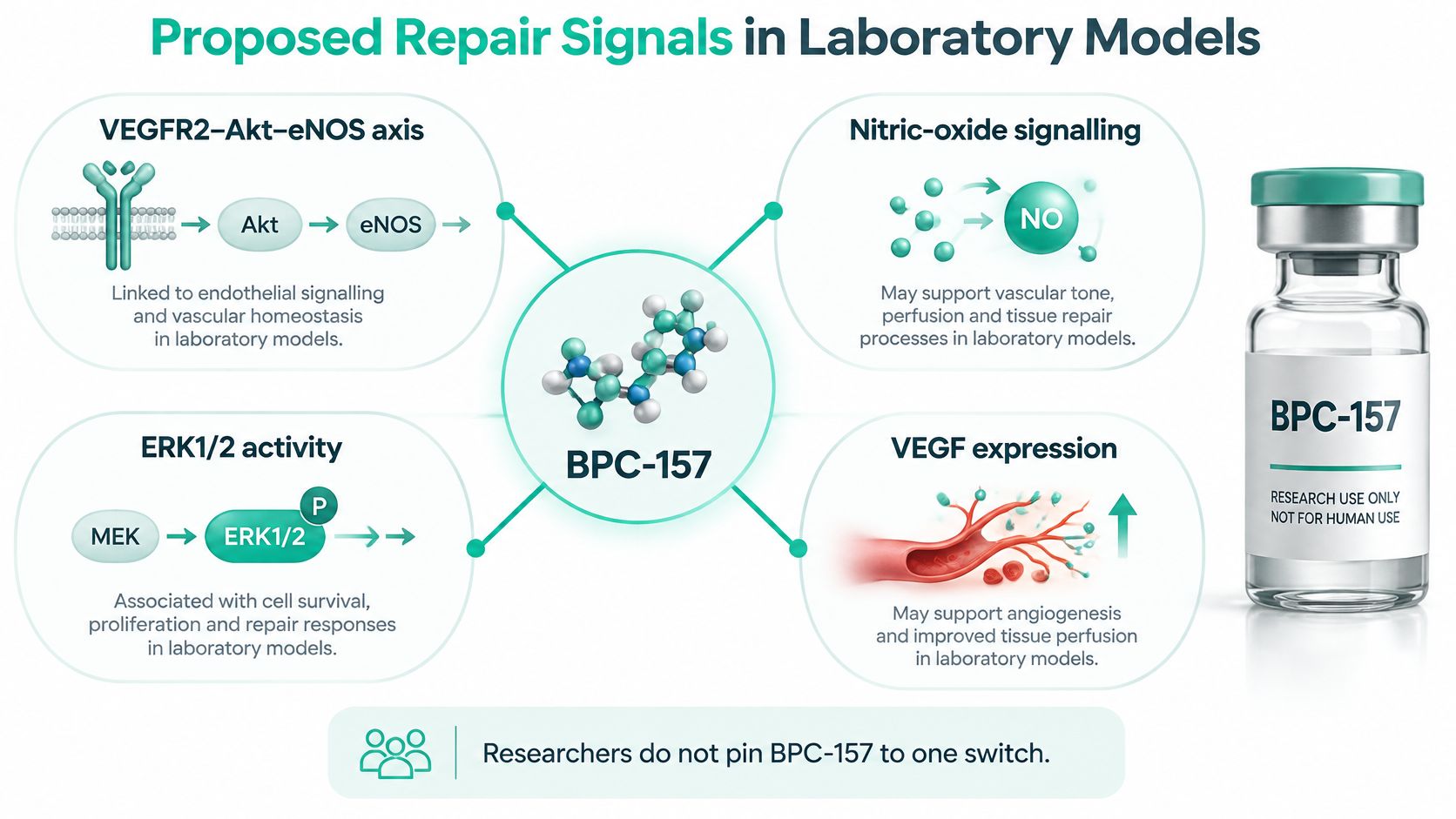
Translating the pathway names
VEGF is a signalling protein involved in blood-vessel development. VEGFR2 is a receptor that responds to this signalling, while Akt and eNOS are components of cellular pathways associated with vessel-lining activity and nitric-oxide production.
ERK1/2 belongs to a signalling system through which cells respond to their surroundings. EGR-1 is involved in regulating gene activity associated with cellular responses, including repair-related processes.
These terms connect to several easier-to-picture activities:
- Angiogenesis: The formation of new small blood vessels.
- Endothelial recovery: Changes involving the thin lining inside blood vessels.
- Fibroblast activity: The work of cells that produce parts of tissue's supporting structure.
- Collagen remodelling: Changes to an important structural protein during tissue repair.
- Perfusion: Blood moving through tissue.
A roadworks crew is a useful comparison. Vessel signals, scaffold-building cells and blood flow may all change together, just as workers, materials and traffic management appear together at a road repair site. Seeing the crew at work doesn't prove the road is finished or ready for every vehicle.
What isolated human tissue can show
A laboratory study of human internal mammary artery tissue reported concentration-dependent relaxation of contracted artery rings, with greater relaxation when the endothelium remained intact. The authors associated the response mainly with endothelial nitric-oxide signalling and said further molecular and in-vivo work was needed to establish clinical relevance.
Human tissue is not the same as a human clinical trial. An isolated artery ring can reveal a local response without representing the behaviour of an entire circulatory system.
The accompanying video provides another format for considering the topic.
Mechanistic plausibility helps researchers decide what to investigate next. It doesn't establish an appropriate dose, safety in people or a reliable recovery outcome.
Preclinical Findings Versus Human Evidence
The main evidence gap isn't a lack of proposed mechanisms. It's the distance between experimental biological activity and a reliable clinical result.
Animal and laboratory work has examined gastrointestinal and musculoskeletal injury models, alongside nerve and wound-related questions. Those studies can help identify possible effects, but a collection of encouraging experiments isn't equivalent to a controlled trial in people.
A review of the clinical evidence identified three pilot human studies, covering knee pain, interstitial cystitis and intravenous safety or pharmacokinetics. It characterised the evidence as minimal and concluded that BPC-157 should remain investigational until well-designed trials provide stronger evidence.
Three small pilots is a thin base. Each examined a different question, so their results can't be pooled into a clear picture of who might respond, at what dose or with what risks.
What each evidence tier can and cannot show
| Tier | Setting | Reported signal | Limit |
|---|---|---|---|
| Cell and isolated tissue | Artery rings and cell assays | Vessel relaxation linked to endothelial nitric oxide | Not a living-patient outcome |
| Animal models | Gut, tendon, ligament, muscle, nerve and wound | Repair-related biological activity | Not proof in people |
| Human pilots | Knee pain, bladder pain and intravenous safety | Early observations; the bladder pilot reported no side effects during observation | Small, uncontrolled groups; not an established safety finding |
The TGA's information on unapproved peptide products highlights that these products haven't been evaluated for safety, quality or effectiveness. The human studies published to date remain a handful of small, uncontrolled pilots, including a retrospective knee-pain review and a very small intravenous study, without a randomised, placebo-controlled trial establishing effectiveness or long-term safety.
A summary of the 2024 bladder pilot by Lee, Walker and Ayadi reports that no side effects were observed during that small study. That's a limited observation, not proof that adverse effects won't occur in a larger group or over a longer period.
Why a control group matters
Symptoms can change for reasons unrelated to the compound under investigation. Participants may receive other care, change their activity, improve naturally or report different expectations.
A comparison group helps researchers separate these possibilities. Random allocation and blinding can reduce other sources of bias, while longer follow-up helps investigators assess whether changes last and whether delayed problems emerge.
A positive rodent or tissue result is a reason for another study, not a recovery claim.
The same caution applies to broader wellness interests. An experimental repair signal does not establish benefits for weight management, skin, hair, or nails just because those subjects appear elsewhere in peptide marketing. Access to a research supply in Australia changes none of this: a supplier listing a vial for laboratory work is not evidence that any healing claim has been tested, let alone established, in people.
Australian Regulatory Status for Research Peptides
Schedule 4 classification is not medicine approval. According to Parallaxis's account of the Australian scheduling decision, the TGA reported 48 Australian Border Force import referrals involving BPC-157 between July 2022 and June 2024, contributing to its placement in Schedule 4 and Appendix D in June 2024.
Schedule 4 is a prescription-only classification. It does not mean a medicine containing the substance has received an ARTG listing, nor does it demonstrate effectiveness.
The earlier regulatory record makes the distinction clearer. A TGA scheduling briefing recorded that, as of August 2023, BPC-157 wasn't in the TGA Ingredient Database, no active ARTG medicine contained it as an active ingredient, and it wasn't permitted in listed medicines.
What research-use-only wording does not establish
A research-use-only label identifies a stated supply purpose. It doesn't turn an unapproved compound into an approved therapeutic good or settle every legal question about a transaction.
Keep these categories separate:
- Laboratory material: Holding material for a defined research activity raises questions about lawful possession, institutional controls and documentation.
- Therapeutic supply: Supplying an unapproved therapeutic good involves different regulatory obligations from supplying a laboratory reagent.
- Clinical investigation: Research involving people requires its own lawful and ethical framework. A retail label is not that framework.
The timeline below provides a historical snapshot, rather than a substitute for current official listings.
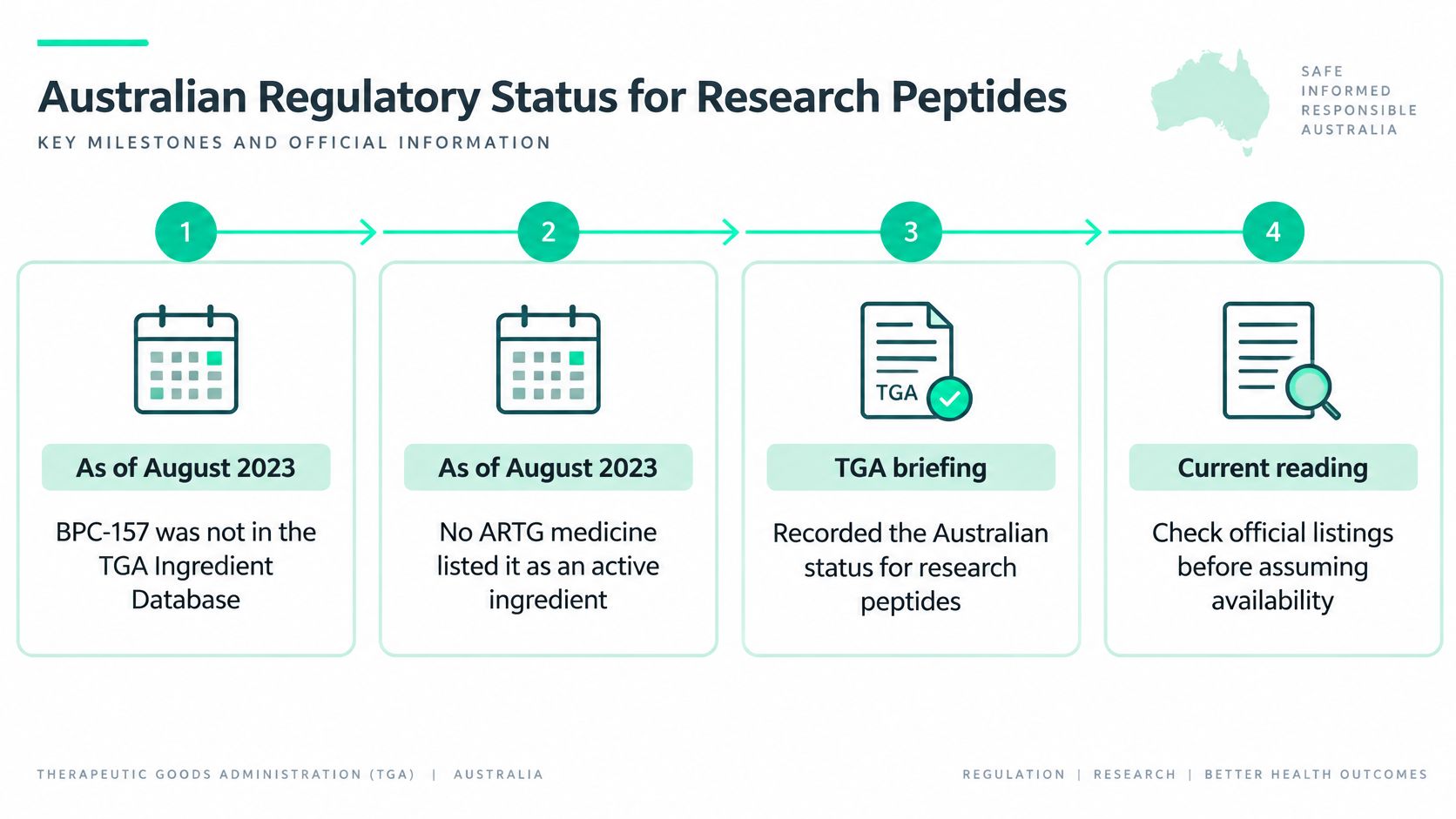
Sporting rules are a separate barrier
Sport Integrity Australia states that BPC-157 is prohibited at all times under the World Anti-Doping Code's S0 category for non-approved substances, and that no medicines regulator worldwide has approved it.
That prohibition isn't removed by local availability, a laboratory certificate or research-only packaging. Athletes need to consider anti-doping obligations separately from medicine regulation.
Our Australian research peptide regulation guide provides context, but current status should be checked directly with the TGA and the Poisons Standard. Don't infer permission from a supplier's checkout page.
Batch Records Purity and Lab Documentation
For a procurement officer, the most useful question is concrete: does the analytical report belong to the material being purchased?
A Certificate of Analysis, or CoA, should connect test results to an identifiable batch. A document carrying only a compound name offers weaker traceability than one that matches the lot on the pack label.
Identity and purity answer different questions
Identity testing asks whether the material matches the intended compound. Mass spectrometry can support an assessment of molecular mass, although a mass result alone doesn't answer every question about sequence or composition.
Purity testing, often using high-performance liquid chromatography, or HPLC, examines the target compound relative to other detected components. A chromatographic purity result isn't automatically a measurement of every possible contaminant, total peptide content or sterility.
This checklist separates the main documentation questions.
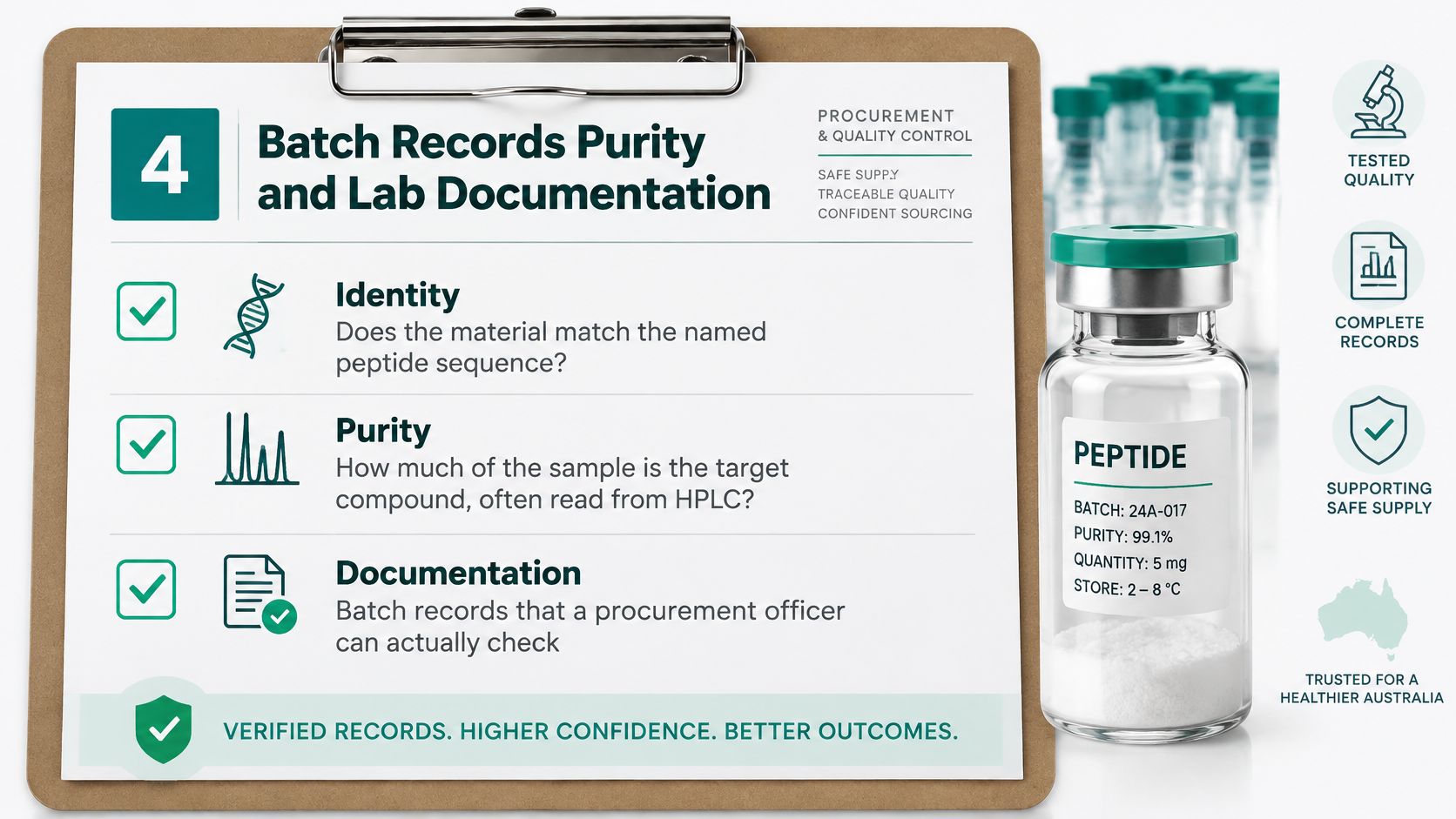
Match the report before filing it
A CoA for batch A must never be filed against batch B, even when both labels say BPC-157. Nor should a certificate for another peptide be accepted because the packaging looks similar.
Record the following in the laboratory file:
- Product details: Compound name, stated vial quantity and SKU.
- Batch reference: The lot number exactly as printed on the pack label.
- Report details: Document date, testing laboratory and analytical methods.
- Document origin: Whether the report is manufacturer-provided or independently issued.
- Status: Whether testing is complete or a report remains pending.
Our pack label is the reference point for batch identification. Independent certificates are available through the online CoA library and linked on product pages, with in testing shown where a report is pending.
Procurement check: Testing promised is not the same as a completed report available for review.
For organising files, version history and supporting records, Zemith's guide to managing research data offers useful context beyond peptide procurement.
Sealed glass vials containing a freeze-dried powder cake describe presentation, not analytical quality. Follow the stated storage conditions; opened or reconstituted vials aren't returnable stock under our policy. If identity, purity, batch and report origin aren't readable before checkout, the lot is a poor fit for a controlled study.
Typical Experimental Models and Study Designs
“Preclinical” covers several kinds of experiments. Each answers a narrower question than whether a compound delivers a useful clinical outcome.
Reading the methods section helps reveal that scope. Our research methodology resource supports this approach to assessing experimental claims.
Gastrointestinal injury models
In animal gastrointestinal models, investigators examine tissue changes after a controlled injury. They may compare tissue appearance and inflammatory markers between experimental groups.
The important details include the species, the type of injury, the comparison condition and the selected endpoint. A change in tissue appearance should be described as that measured change, not translated into a general claim about human gut health.
Tendon, ligament and muscle models
Musculoskeletal experiments may compare microscopic tissue structure, collagen organisation or a function score. These endpoints aren't interchangeable: a visually different tissue sample doesn't necessarily establish a stronger or more functional structure.
A useful methods section identifies what the investigators measured and when they measured it. It also explains how they allocated samples or animals and whether the person assessing the outcome knew which group they were examining.
Isolated tissue experiments
An isolated artery experiment can test whether tissue responds under controlled laboratory conditions. It removes many whole-body influences, making a local mechanism easier to examine while limiting conclusions about a living organism.
Across these designs, check for:
- Defined material: Analytical identity and batch information, not just a supplier name.
- Clear comparison: A control appropriate to the question.
- Specified endpoint: A measurement selected for a stated reason.
- Reproducible methods: Enough information for another qualified team to assess the work.
Inconsistent preparation standards can weaken comparisons between papers, even when their endpoints sound alike. Small, uncontrolled human pilots illustrate a different evidence stage, not a protocol to copy.
For Australian university and biotech teams, domestic supply can make document queries and procurement administration easier. It doesn't improve the scientific validity of an experiment by itself.
Choosing a Documented Australian Research Supplier
Choose a supplier on traceability and fit for the study. Specifications should be visible before payment, and the batch number on the pack should match the analytical report.
Bulk Aussie Peptides is Australian owned and operated. It lists 60+ research compounds, many in standardised 10-pack vial formats with AUD pricing, and BPC 157 is listed at AUD $80 for a 10 mg single vial. Orders typically dispatch within 1–3 business days with shipment tracking.
Compare the documents before the price
Supplier selection works like reading a methods section: the paperwork is part of the result. Use the BPC-157 product page for specifications, the tissue and cellular research category for catalogue context, and the BPC-157 versus TB-500 comparison to distinguish research subjects rather than infer equivalent effects. Institutional teams can also review the bulk and wholesale research supply pathway.
Our Australian research supplier guide provides a documentation-first checklist. A competitive price and a clear certificate still don't create an ARTG listing, because supplying a compound for research and registering it as a medicine are separate regulatory events.
Frequently asked questions
Is BPC-157 an approved medicine, and where should status be checked?
No. Check the TGA's official records and the current Poisons Standard rather than relying on historical screenshots or store descriptions.
Does animal repair research prove recovery benefits in people?
No. It can support a testable hypothesis, but it can't replace controlled clinical evidence.
Does research-only supply create a sporting exemption?
No. The sporting prohibition applies independently of how a product is labelled or supplied.
What should a laboratory retain?
Keep the batch label, matching CoA, product specifications and purchasing record together. Record whether the analytical report is independent or manufacturer-provided, since that distinction affects how much weight the document can carry.
Bulk Aussie Peptides offers research-only peptide supply, batch documentation, a CoA Library and Bulk Research Supply for laboratory procurement. Visit Bulk Aussie Peptides to review specifications and available batch records before assessing whether BPC-157 fits a defined research question.