
AU Peptides Explained for Australian Buyers
If one phrase can mean an approved medicine, a cosmetic, and a vial bought for a bench assay, how do you know which rules apply before you pay? For most readers, AU peptides is shorthand used in Australia for peptide products seen online, in clinics, and in research catalogues. That shorthand hides the decision that matters. You're not buying a word. You're buying either a therapeutic good with a lawful clinical supply path, or research use only material judged by laboratory paperwork.
Table of Contents
- What AU Peptides Means for Buyers in 2026
- Research Peptide Categories Australian Labs Use
- How Research Use Only Differs from a Medicine
- What a Batch Certificate of Analysis Should Show
- Records Australian Research Programs Must Keep
- Lead Times and Paperwork for Local Orders
- Choose a Supplier for the Study You Are Running
What AU Peptides Means for Buyers in 2026
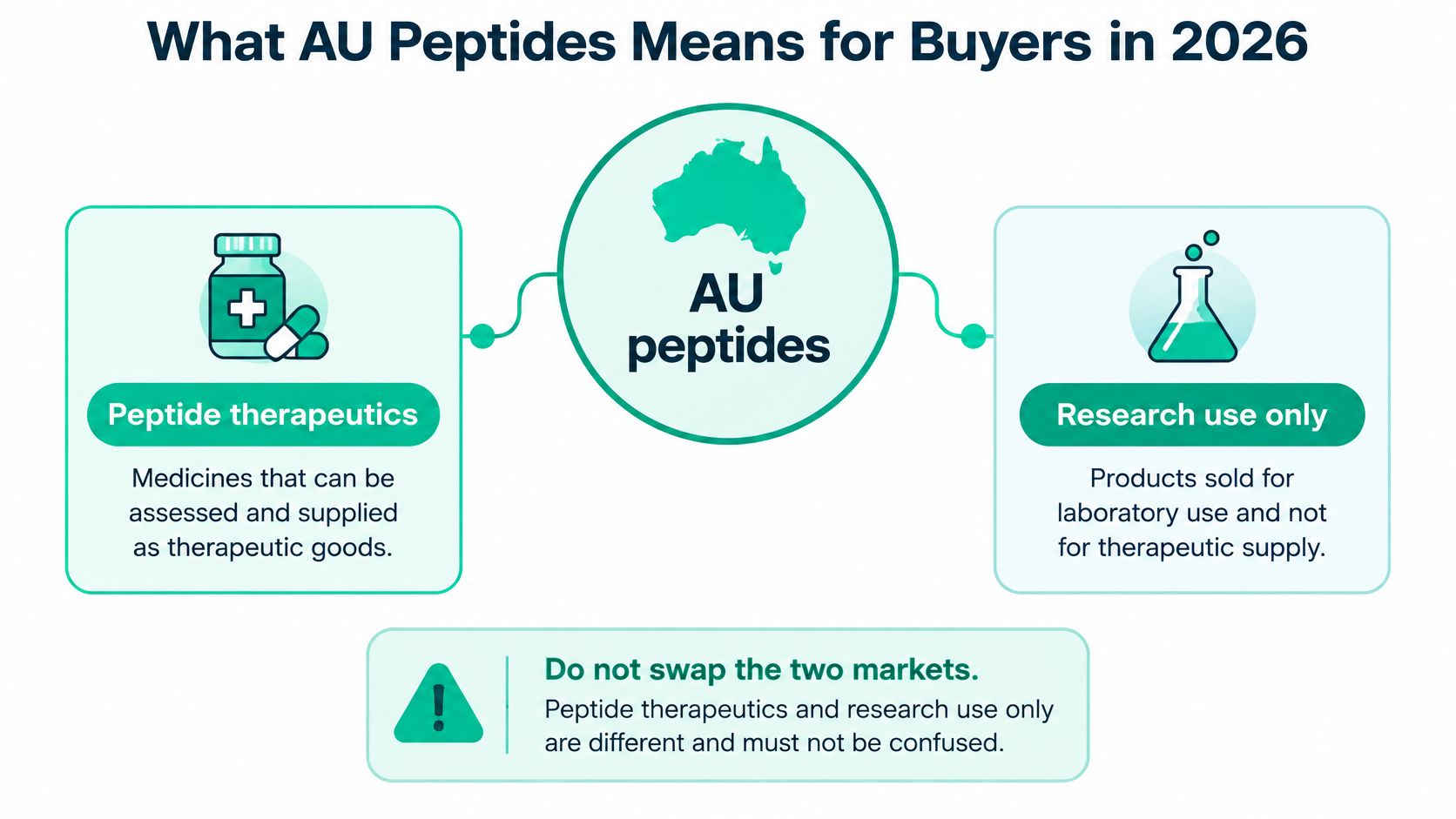
AU peptides covers two markets that share a word and must not be swapped. One market is peptide therapeutics, meaning medicines assessed and supplied as therapeutic goods. The other is research material, meaning a named amino acid sequence bought so a laboratory can investigate it under controlled conditions.
Those markets have different tests. A medicine is judged by its regulatory listing and clinical supply path. A research compound is judged by whether its identity, purity, and lot traceability hold up in a lab file.
The size of the medicines market explains why headlines get confused with catalogue listings. The Grand View Research outlook for Australian peptide therapeutics estimated revenue at US$1,906.3 million in 2025, rising to US$3,711.1 million by 2033. That's an increase of US$1,804.8 million, with a forecast 7.8% compound annual growth rate from 2026 to 2033. Those figures describe therapeutic peptide medicines, not research use only reagents.
Four Situations Buyers Must Not Mix Up
| Situation | What it is | Decision test | Paperwork to expect |
|---|---|---|---|
| Approved therapeutic | Peptide medicine for a clinical use | ARTG listing and lawful supply path | Regulator-facing product information, not a research COA |
| Research-use-only compound | Named sequence for laboratory investigation | Intended lab use, with no therapeutic claims | Batch COA, identity method, purity data, storage notes |
| Cosmetic-only presentation | Product whose claims stay cosmetic | Ingredients, presentation and intended use remain cosmetic | Cosmetic compliance records, not a research lot file |
| Unapproved promoted product | Item marketed for weight, recovery, injury or appearance | Claims and context can make it a therapeutic good | Do not treat marketing copy as evidence of quality or legality |
Read the table as a sorting exercise. If a seller promotes an outcome for weight, recovery, injury, or appearance, you're no longer looking at a plain catalogue description. If a product is presented as a medicine, a research certificate doesn't replace regulator-facing information.
For laboratory work, reverse the habit. Don't start with a result claim. Start with the sequence name, the lot number, and the documents that let another researcher trace what entered the experiment.
Buyer's rule: If the job is a lab file, judge the lot by identity, purity, and traceability, not by a promised result.
That distinction protects both audiences. Curious readers can follow study summaries without mistaking them for personal guidance. Procurement teams can compare suppliers on evidence they can file, audit, and reproduce.
Research Peptide Categories Australian Labs Use
A peptide is a short chain of amino acids. Think of it as a short sentence built from a limited set of letters. Change one letter, and you've changed the compound, even if the catalogue name looks similar at a glance.
Australian labs usually group peptides by the research question, not by a personal goal. A metabolic study asks different questions from a skin matrix study, so the sequence, assay, and supporting documents differ too.
Categories and What Studies Examine
| Category | Examples | What research has examined | Start-here document |
|---|---|---|---|
| Metabolic and incretin | Semaglutide, tirzepatide, retatrutide | Glucose metabolism, appetite signalling, receptor pharmacology | Sequence identity and batch COA |
| Tissue and cellular | BPC-157 | Tissue and cellular pathways in experimental models | Lot-matched purity data |
| Growth-factor related | TB-500 | Growth-factor-related signalling in laboratory models | Specification sheet plus COA |
| Skin and matrix | GHK-Cu | Copper binding and extracellular-matrix pathways | Identity confirmation for the copper complex |
| Longevity and neuroscience | Catalogue compounds in those groups | Senescence or neural signalling questions, compound by compound | Assay notes tied to that sequence |
Use study-summary language for every row. Research has examined semaglutide, tirzepatide, and retatrutide in relation to glucose metabolism, appetite signalling, and receptor pharmacology. That wording describes a field of investigation. It doesn't convert a catalogue entry into a weight management claim.
The same discipline applies elsewhere. Research has examined BPC-157 for tissue and cellular pathways in experimental models, TB-500 for growth-factor-related signalling, and GHK-Cu for copper binding and extracellular-matrix pathways. Each statement stays tied to one compound and one research theme.
Australian peptide science is also wider than metabolic pharmacology. The University of Queensland report on the ARC Centre of Excellence for Innovations in Peptide and Protein Science describes $35 million in Australian Research Council funding in 2019 for a centre led by UQ with Australian National University, Edith Cowan University, Monash University, Queensland University of Technology, and the University of Sydney. It reported $102 million in UQ-led research investment, with discovery examples including peptides from funnel-web spider venom and compounds from koala and Tasmanian devil milk.
That national example matters for catalogue reading. Australian work spans biodiversity discovery and bio-inspired technology as well as medicine, agriculture, animal health, engineering, and pest control. Our Peptide Glossary and Product Finder tool help you locate a name, and the research compound database helps you place that name in the right category before you request documents.
How Research Use Only Differs from a Medicine
State the rule before you read the label. In Australia, classification follows ingredients, promotion, supply, or intended use, not the word peptide and not the shape of the vial. If those signals point to a therapeutic purpose, the product sits in the therapeutic goods framework.
The image below sets out that claims-and-use test in plain terms.
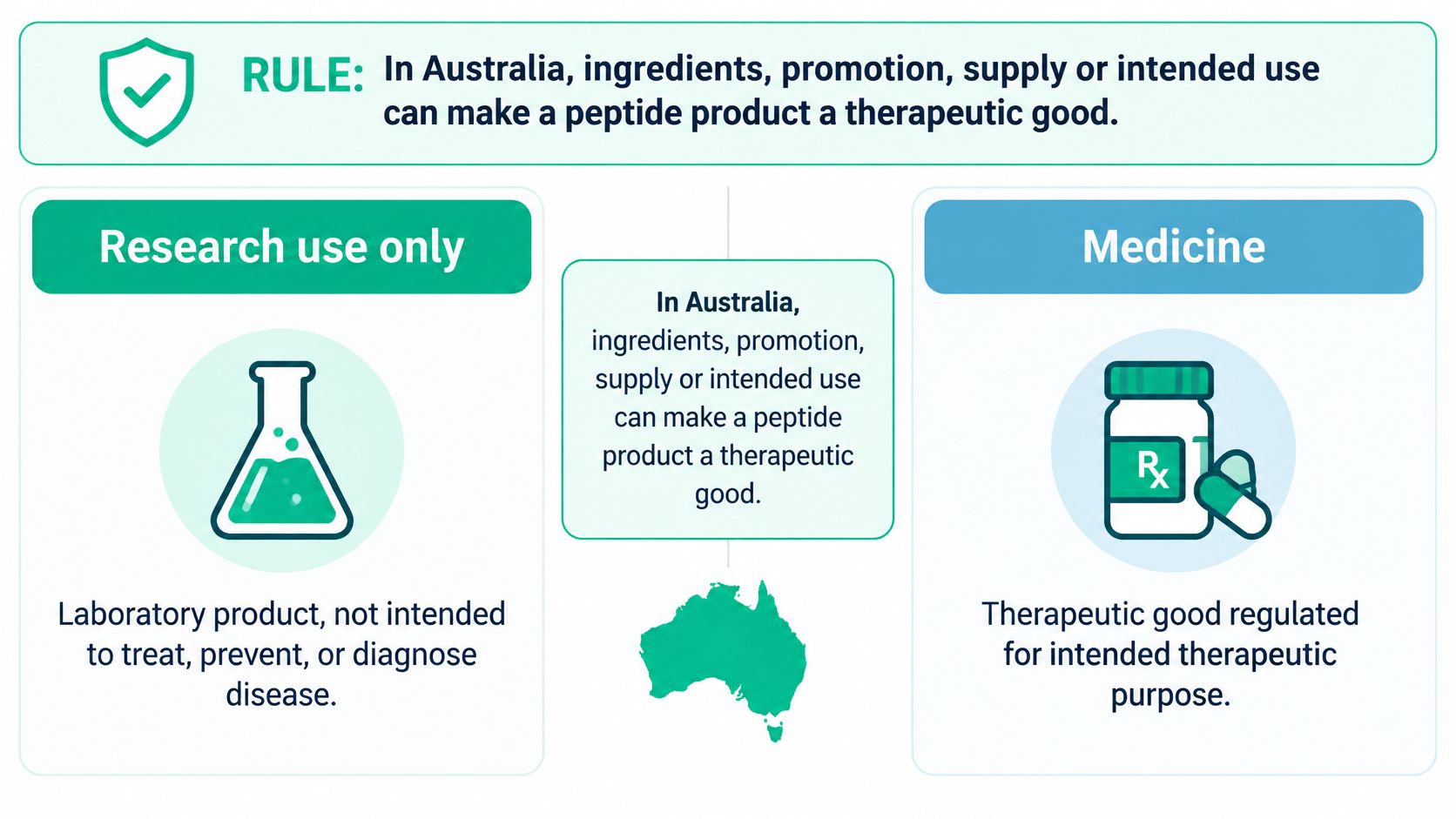
The TGA guidance on how therapeutic peptide products are regulated states that peptide products promoted, supplied, or generally used for therapeutic purposes, including managing diabetes, obesity, or cardiovascular disease, generally must be included in the Australian Register of Therapeutic Goods before they can be imported, manufactured, supplied, exported, or advertised. It also states that a "research use only" or "not for human use" label does not by itself remove those obligations if the actual presentation or use is therapeutic.
A TGA overview of peptide products adds that some products may instead fall within cosmetics regulation when ingredients, presentation, claims, and intended use remain limited to cosmetic purposes. That's why wording about weight, recovery, injury, skin, hair, or nails must stay in research language and must not promise treatment.
Marketing language can change regulatory status even when the label on the vial doesn't.
Four Controls for Research Buyers
- Record laboratory intent: Keep a written note of the study purpose with the order file.
- Keep claims out: Don't put therapeutic promises in purchase requests, briefs, or internal summaries.
- Separate the files: Store research certificates apart from clinical information so the two evidence types don't blur.
- Check the supply step: Confirm whether a proposed import or supply activity triggers ARTG or other TGA requirements.
The short video below is useful background for new staff who need to hear the distinction before they handle catalogue copy.
For a fuller Australian explanation, read our guide to research peptide regulation in Australia and apply it before an order is placed, not after a delivery arrives.
What a Batch Certificate of Analysis Should Show
Set a minimum evidence package rather than accepting a general claim of quality. A receiving officer needs documents that answer three questions in order. Is this the named sequence, how pure is this lot, and can we trace this vial to that result?
The checklist below shows the fields to look for before a vial is booked into a study.
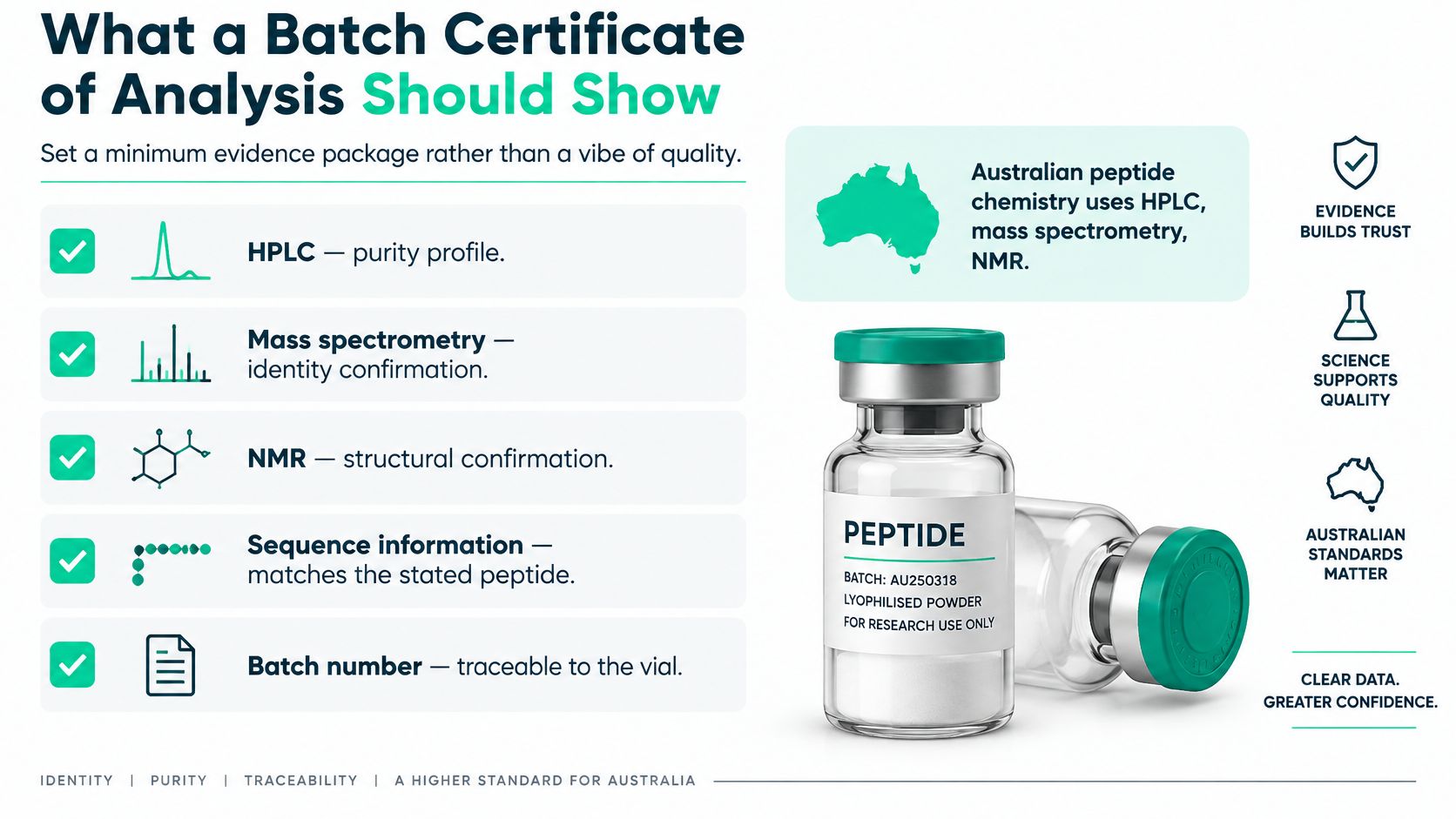
The Monash University peptide therapeutics research program identifies peptide chemistry, structural biology, NMR spectroscopy, mass spectrometry, HPLC, molecular modelling, expression and purification, cell-permeability testing, and cytotoxicity assays as core evaluation methods. Each method catches a different failure. Mass spectrometry helps confirm molecular mass, HPLC measures chromatographic purity, and structural work connects conformation to receptor binding.
You don't need every academic method on a routine purchase. You do need orthogonal evidence, meaning identity and purity aren't resting on one unchecked number.
The Receiving Bench Check
- Lot match: The manufacturer batch number on the vial must match the batch number on the certificate.
- Identity method: Look for an orthogonal method such as LC-MS so measured mass supports the stated sequence.
- Purity data: Check chromatographic purity from HPLC, not just nominal peptide content.
- Document metadata: Confirm product name, SKU, batch, document date, testing laboratory, and whether the file is manufacturer-provided or independent.
- Handling notes: Keep storage and handling conditions with the certificate so the next user sees the full lot record.
Most research peptides we sell are supplied as a lyophilised (freeze-dried) powder in sealed glass vials. The dry powder cake shows how material was dried and packed. It is not a purity result, and it should never be photographed or described as if appearance proves quality.
Our COA Library is the place to perform the match, with certificates linked from product pages and an "in testing" flag where a report is pending. Open the online COA library entry for the lot you received and confirm the batch number before the material enters an experiment. If a file isn't visible, use our request documentation and testing and documentation services rather than borrowing a certificate from another lot.
A clean certificate supports identity and purity checks for research. It doesn't establish a therapeutic result, and it doesn't transfer evidence from one sequence to another.
Records Australian Research Programs Must Keep
Reading a certificate is only half the job. Filing it so another person can reconstruct the work is the other half.
The Australian Code for the Responsible Conduct of Research 2018 contains eight principles and 29 specific responsibilities, and compliance is required for recipients of NHMRC and Australian Research Council funding. Responsibility R22 requires researchers to retain clear, accurate, secure, and complete records of all research, including research data and primary materials, and, where appropriate, allow interested parties to access and reference them.
Translate that duty into a procurement folder a grants office will recognise. The folder should let a reviewer move from purchase, to lot, to experiment without guessing.
A Practical R22 Folder
- Specification sheet: Product name, sequence identity, SKU, and pack format as ordered.
- Batch certificate: The COA for the exact lot received, saved as a stable file or library link.
- Laboratory report: Any additional identity or purity report supplied for that batch.
- Purchase record: Order confirmation, invoice, and internal approval showing laboratory intent.
- Sample trail: A simple log linking lot number to storage location and the experiment where material was used.
Two vials with the same catalogue name can come from different batches. They need two certificate links. Never cite an earlier lot file for a later delivery, even when the product page looks unchanged.
Institutional buyers can prepare this folder before delivery. State the laboratory purpose in the approval paperwork, attach the specification, and add lot documents on receipt. That sequence is cleaner than chasing paperwork after results are drafted.
Filing limit: A complete folder supports traceability and reproducibility. It does not show that a compound is suitable for human use.
Keep evidence compound-specific too. A certificate for one peptide doesn't support claims about a different sequence, formulation, or research question. When a manuscript, grant report, or audit asks what was used, the answer should point to one batch, one file set, and one traceable sample trail.
Lead Times and Paperwork for Local Orders
For an Australian order, separate dispatch time from time in transit. Bulk Aussie Peptides is 100% Australian owned and operated and sells to customers in Australia only. Orders are dispatched in one to three business days, followed by tracked transit. Tracking helps you follow the parcel, but it does not set a door-to-door delivery date.
Paperwork and Timing by Australian Buyer
| Buyer | Documents to secure | Timing to plan | Watch-out |
|---|---|---|---|
| Curious first-time reader | Specification and research-use description | One to three business days for dispatch, then tracked transit | A product page is not a personal protocol |
| Laboratory user | Batch COA matched to the vial lot | One to three business days for dispatch, then tracked transit | If the certificate is marked in testing, it is not ready yet |
| University or biotech procurement | Procurement Pack and lot file | Request a quote first for custom quantities | A quote is not a released, tested batch |
| Time-sensitive study | Confirmed batch documents before the start date | Allow for dispatch, tracked transit and receiving checks | Do not set the assay start date from dispatch timing alone |
Before checkout, readers new to research peptides can check the specification, confirm the research-use description, and see whether the COA entry is available or still marked in testing. If the certificate is not ready, account for that when planning the study.
For university and biotech orders, use the Procurement Pack or request a quote when the quantity is custom. Custom bulk quantities are subject to the same independent testing standards. A quote confirms a requested order, not that a batch has been released.
For a time-sensitive study, work backwards from the planned start date. Allow time for dispatch, tracked transit, receiving checks and matching the certificate to the lot before the first assay. Check the current details on the shipping information page before ordering.
Choose a Supplier for the Study You Are Running
Your next step depends on the job in front of you. Don't let one catalogue format answer every audience in the same way.
If you're an everyday Australian curious about weight, recovery, injury, or skin, hair, and nail research, stay with study summaries. Read what research has examined, compound by compound, and look for visible batch documentation before treating a listing as credible. You're not looking for a dose, a cycle, a stack, or a guaranteed outcome, and a responsible research catalogue shouldn't offer one.
If you're buying for a laboratory, university, or biotech program, choose the supplier that gives you a documented lot. You need a named sequence, transparent product information, a batch that can be matched to a certificate, and purchasing records your institution can file.
Where Bulk Aussie Peptides Fits
We supply synthetic research peptides in sealed 10-vial packs with transparent AUD pricing, across a catalogue of 60+ compounds including retatrutide, tirzepatide, semaglutide, BPC-157, TB-500, and GHK-Cu. We offer free express shipping on orders over $700 AUD. Some single-vial trial sizes exist as an alternative format, but format choice is a procurement decision, not a protocol.
Institutional readers should check the COA library before raising a purchase order, then use the bulk and wholesale pathway for quotes or custom quantities. Category readers should start from metabolic research or tissue and cellular research pages and move to the specification sheet for the exact compound.
Before you commit, run three checks. Does the product page state research use only without therapeutic promises? Can you see or request batch documentation for the lot you'll receive? Can your team file the invoice, specification, and certificate together?
Our guide to choosing a research peptide supplier in Australia gives procurement teams a structured way to make that comparison. Use it to separate suppliers who sell a story from suppliers who can support a reproducible lab file.
Certificates support identity and purity checks. They are not evidence of a therapeutic result, and they don't turn research material into a medicine. Keep that boundary clear, and the phrase AU peptides becomes manageable. You can sort the market, choose the right evidence, and buy for the study you're running.
- BAP
Browse Bulk Aussie Peptides to compare research peptide categories, open the COA library for batch documentation, and request a procurement pack or quote for Australian laboratory supply. Start with the compound specification and lot file, then place your order with the paperwork your research program needs already in hand.