
Peptides Aus: What Buyers Should Check
Peptides aus means research peptides specified, documented and supplied for Australian laboratories, not TGA-approved medicines. That single distinction decides everything that follows, from the wording a supplier can use to the paperwork you should open before you pay.
Many search results blur three different things, approved medicines, laboratory material, and online talk about health outcomes. Sorting them into lanes first stops you from reading a batch document as if it were an approval, or reading a disclaimer as if it settled Australian law.
Table of Contents
- Peptides Aus in Plain Language
- How Australia Separates Research Supply from Medicines
- Reading a Certificate of Analysis Without Overclaiming
- A Laboratory Procurement Path from Quote to Receipt
- Why Standardised 10-Pack Formats Help Studies
- Calculators Glossaries and the COA Library
- Buyer Questions Before You Place an Order
Peptides Aus in Plain Language
Peptides aus is how Australians look up research peptides that can be named, tested and shipped inside the country, not a class of approved medicine. A peptide is a short chain of amino acids built to a stated sequence. Think of the sequence as a recipe and one vial as a single weighed batch of dry ingredients made to that recipe.
Most compounds in this range arrive as a lyophilised, freeze-dried powder cake in a sealed glass vial, not as a ready liquid. That format matters for storage planning and for checking labels, because the name, stated strength and batch number on the vial are what you later match to paperwork.
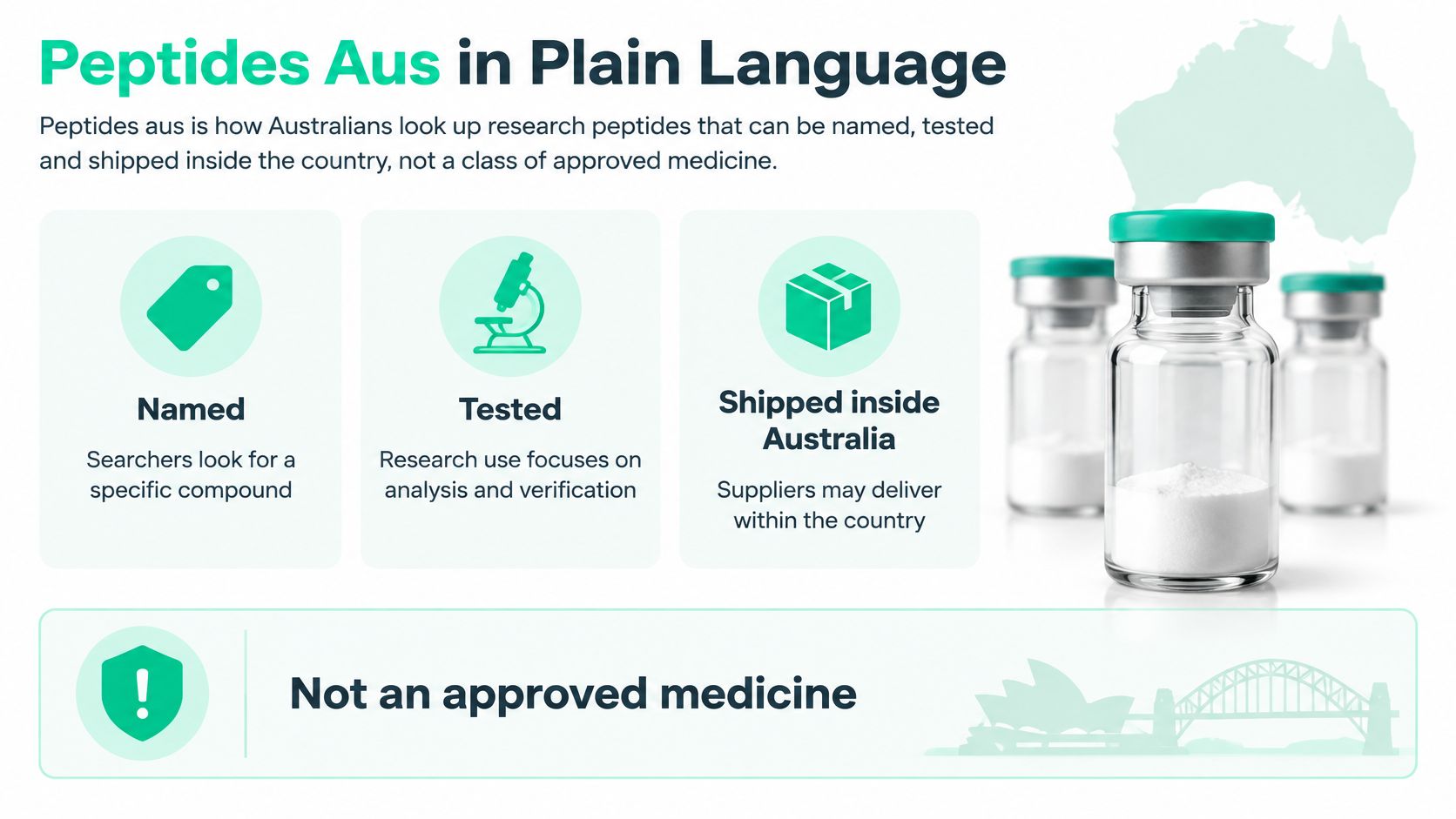
Three lanes people mix online
- Approved therapeutic good: A medicine assessed and entered through Australia's therapeutic goods system for a stated therapeutic purpose.
- Research-use-only material: Laboratory material specified by compound, strength and batch, supplied without a consumer health claim.
- Consumer talk: Forum and social discussion about weight, recovery, injury or skin, hair and nails, which doesn't change either of the first two lanes.
Say a procurement officer searches for a named metabolic compound. She's not buying an outcome. She's buying a specified sequence, in a stated vial strength, from a traceable lot, for a defined laboratory purpose. That framing keeps every later check honest.
Why the topic draws so much attention
Public interest sits against a large metabolic health burden. The RACGP newsGP report on weight-loss medicines notes the Australian Institute of Health and Welfare reported 32% of Australians were living with obesity in 2022, including 13% with severe obesity, defined as a body-mass index of at least 35.
The same report records that PBS-subsidised semaglutide prescriptions increased from 1,255,063 in 2022–23 to 2,397,521 in 2023–24, while government expenditure rose from approximately A$146 million to A$284.6 million. That's context, not a result and not a measure of research supply.
Those prescription figures concern subsidised semaglutide only. They don't measure all peptide use in Australia, private prescriptions or research-only compounds.
Against that backdrop, a catalogue of 60+ peptides is the practical range behind the keyword for many buyers. The useful questions stay narrow. What's the compound called, what strength is stated, which batch is it, and what document can you open for that batch?
How Australia Separates Research Supply from Medicines
Start with the lane test, not the label. Under the Therapeutic Goods Act 1989, products regulated as therapeutic goods generally must be included in the Australian Register of Therapeutic Goods, or ARTG, before they can be imported, manufactured, supplied, exported or advertised, subject to limited exemptions.
The TGA peptide products guidance states that classification depends on the product's ingredients, presentation, promotional claims, and intended use. A peptide promoted for weight loss, muscle growth, recovery, performance enhancement or another health outcome may be regulated as a therapeutic good even if it's described as a research product.
| Check | Research supply lane | Therapeutic goods lane |
|---|---|---|
| Intended user | Laboratory, university or procurement team | Patient or consumer |
| Purpose described | Laboratory material with no health claim | Weight, recovery, performance or other treatment claim |
| ARTG position | Not an approval and must not be described as one | Generally required before lawful supply |
| What a COA adds | Batch identity and test data for review | Does not replace registration or assessment |
| Advertising | Research-only scope and no consumer outcome | Consumer advertising of unapproved goods is generally unlawful |
| If the lane is unclear | Pause and seek regulatory advice | Use only a lawful practitioner pathway where one applies |
Why a disclaimer doesn't decide it
A research-use-only label describes intended scope. It doesn't override the rest of the page. If the same page pairs the compound with a consumer outcome, the TGA claim test looks at that wording, the presentation and the likely user, not just the small print at the bottom.
Peptide medicines the regulator points to as examples include insulin and insulin analogues, GLP-1 receptor agonists such as semaglutide, oxytocin, vasopressin analogues such as desmopressin, and somatostatin analogues such as octreotide. Those examples show that peptide chemistry alone doesn't place a product in the research lane. Purpose and claims do much of the work.
Read our fuller explainer on research peptide regulation in Australia if your team needs the boundary in one reference.
The practitioner pathway is a boundary, not a shortcut
Lawful access pathways can exist for health practitioners for patients under their care, under specific authorities and responsibilities. That's a medical pathway with its own duties. It isn't a shopper pathway, and it doesn't turn a research catalogue into a consumer medicine range.
Practical rule: Classify the purpose of the material first. Only then move to batch documents, because paperwork can't fix a product that's sitting in the wrong lane.
A certificate of analysis, or COA, is quality paperwork for a lot. It doesn't itself demonstrate TGA approval, clinical efficacy, sterility or lawful consumer use. Keeping those two ideas separate, regulatory status and batch test data, is the core skill for Australian buyers.
Reading a Certificate of Analysis Without Overclaiming
A PDF certificate answers part of the quality question and none of the approval question. Treat it as one document in a procurement file, not as a verdict on the product.
The image below sets out the fields to scan before you file anything.
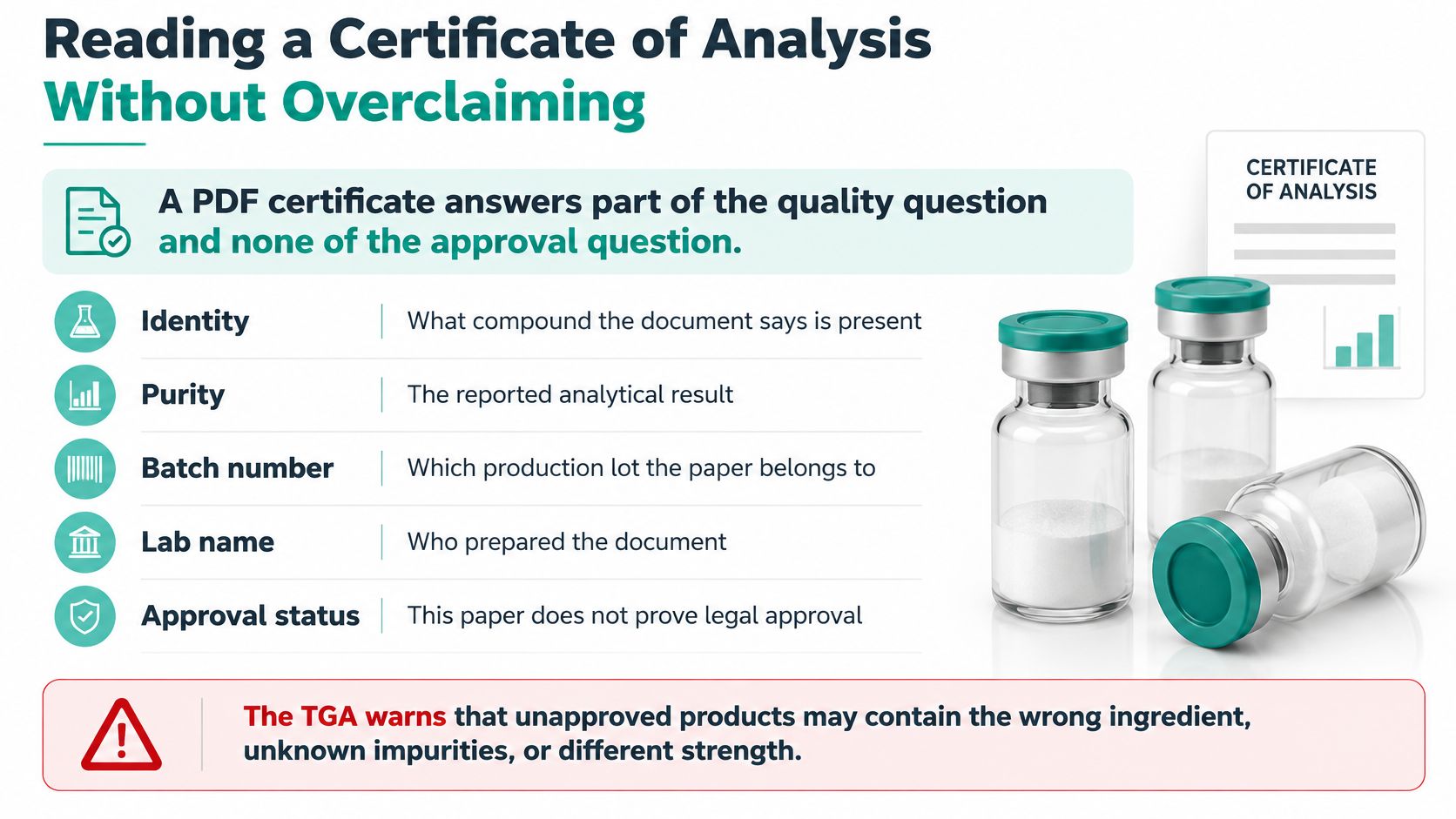
The TGA warning on importing unapproved peptide products says unapproved products may contain the wrong active ingredient, unknown harmful substances, materially different quantities from the label, or may not be sterile, particularly when supplied as injectables. It also reports imported products in unmarked or poorly labelled vials lacking information such as active ingredient identity and concentration.
| Check | What to look for | What it does not prove |
|---|---|---|
| Identity | Named compound, sequence or mass agrees with the label | That the vial is an approved medicine |
| Content | Assay or stated amount versus the label strength | That the amount is suitable for any use |
| Purity | Stated purity and any impurity notes | Sterility, safety or effectiveness |
| Method | Test method named on the report | That every risk has been assessed |
| Laboratory | Source labelled independent or manufacturer-provided | TGA evaluation |
| Lot match | Certificate batch number equals the batch on the vial | That a later batch is the same |
| Pending file | Page marked in testing when the report is not posted yet | That a missing file is a pass |
The lot-match habit
Use one concrete pair every time. If a certificate is for batch A of a named compound, don't file it against batch B, and don't file it against a different compound with a similar name. The batch number, compound name and stated strength need to line up across the vial, the product page and the report.
Some reports also note residual solvents, endotoxins or microbial controls, container integrity, or storage and transport conditions. Look for those items when a document includes them. Don't assume every file contains every field.
A high stated purity percentage is not equivalent to clinical safety or injectable sterility, and unapproved products have not been assessed for safety, quality, or effectiveness.
This short video walks through how batch documents are presented for review.
Our online COA library is the public shelf for these files, with the same document linked from each product page where it's available and marked in testing where a report is pending. Documentation transparency supports traceability and reduces procurement risk. It doesn't authorise use.
A Laboratory Procurement Path from Quote to Receipt
A clean order leaves a paper trail a finance officer and a lab manager can both follow. Each step below produces a document worth filing.
The flow below shows the path from first enquiry to receipt check.
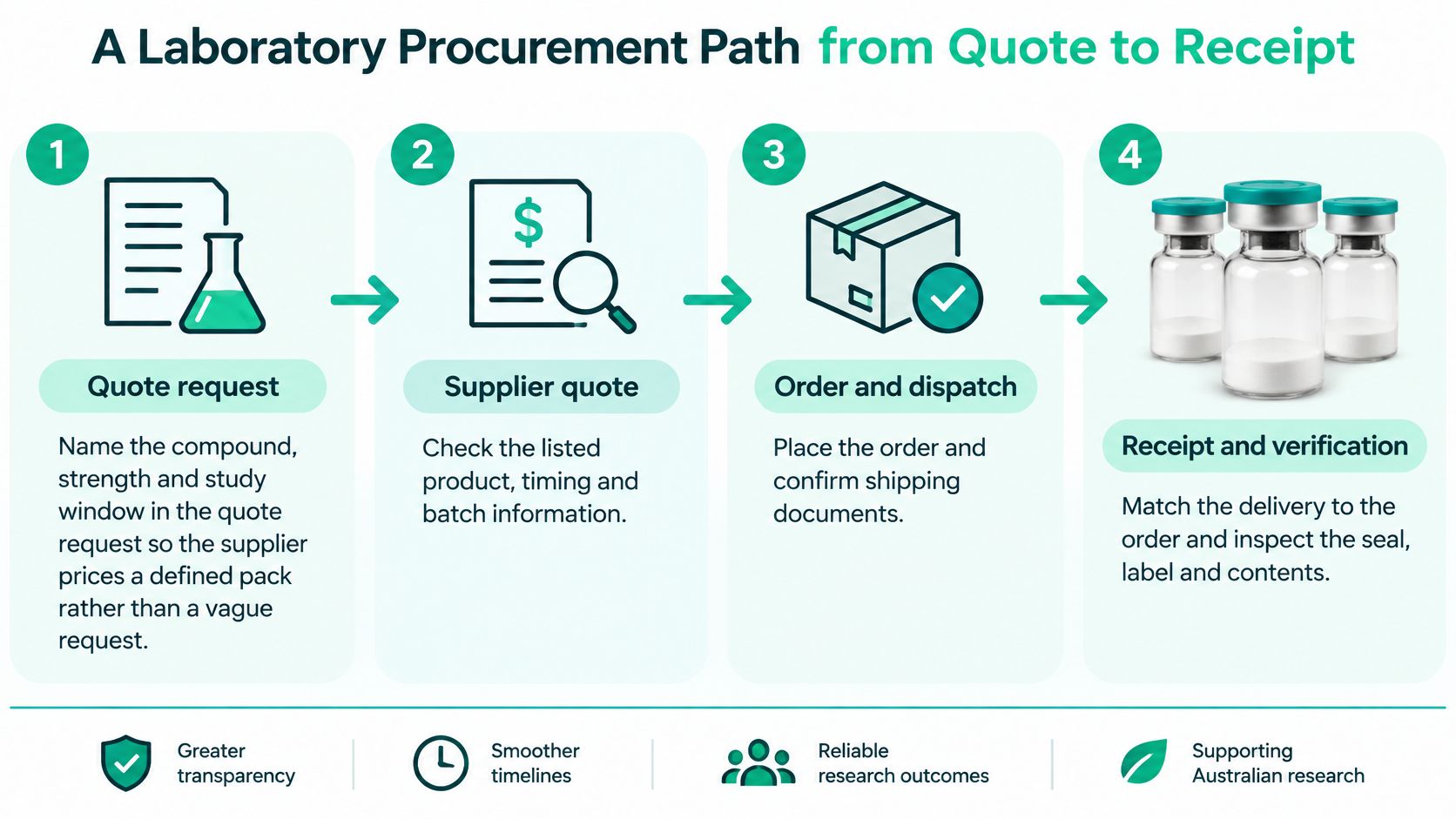
Six steps that keep the file tidy
- Name the specification: Put the compound, strength and study window in the quote request so the supplier prices a defined pack rather than a vague enquiry.
- Check document status: Ask for the specification sheet before checkout and note whether the batch certificate is already posted or marked in testing.
- Sort the invoice early: Request a GST invoice if your organisation needs one, and keep the quote, invoice and batch reference together.
- Scale without skipping paperwork: For a larger program, ask about custom bulk quantities and confirm they stay on the same independent testing standard.
- Record the order: Pay through the published checkout, then record the order number against your internal requisition.
- Verify on arrival: Match the vial batch to the certificate before booking material into storage, and quarantine anything that doesn't match.
Say a procurement officer is comparing two metabolic research compounds. She lines up strength, pack count, the AUD quote, GST treatment and document status side by side. She doesn't compare claimed outcomes, because those don't belong in a research purchase file. Teams formalising this habit may find better management of business purchases a useful general reference on purchase controls.
Our procurement information pack gathers the standard facts institutions usually request in one place. We sell to Australian customers only, with Australian-based support in AEST for specification questions. Delivery is tracked and typically takes around 1 week door to door, so plan study windows around that rather than a faster promise.
The TGA overview of supplying therapeutic goods in Australia notes the framework also covers manufacturing, presentation, labelling, advertising and evidence for claims, and that matters such as substance scheduling and safe storage may also involve state or territory legislation. Your invoice file is a control, not an authorisation. Once the lot matches, your scientific team works under its own protocol and ethics process.
Why Standardised 10-Pack Formats Help Studies
A 10-vial pack of the same stated strength is a planning unit. It gives a laboratory a repeatable quantity for one study block, instead of mixing single leftover vials from unknown lots across a program.
Most research peptides we supply are lyophilised (freeze-dried) powder in sealed glass vials. Storage planning therefore starts from a dry cake and the label strength, such as a 5 mg or 10 mg vial inside a 10-pack. Quantity and strength are known before the order, which helps both purchasing files and ethics paperwork that need defined materials.
Trial vials versus 10-packs
- Trial vial: A single vial for a first specification check, sent from Brisbane.
- 10-pack: The standard research quantity, picked and sent from our overseas facility.
- Custom bulk order: Larger quantities for ongoing programs, held to the same testing standard.
We sell to customers in Australia only. Orders are tracked, with dispatch commonly inside one to three business days and delivery of about one week door to door. Don't plan around anything faster.
Research areas in study-summary language
Metabolic research literature examines incretin-related compounds such as semaglutide, tirzepatide and retatrutide. Buyers compare the metabolic category pages and the linked batch file for each compound, rather than any regimen.
Tissue and cellular research has examined compounds such as BPC-157. Again, the buyer's job is narrow. Confirm the name, strength, pack format and batch document on the tissue and cellular category page.
Skin, hair and nail research has examined the copper peptide GHK-Cu. The GHK-Cu product page carries the specification and its batch file link, and the bulk and wholesale page covers programs that outgrow a single pack. None of those pages describes preparation, administration or an expected effect, and none should be read that way.
A standard pack doesn't make a study well designed. It removes one avoidable variable, unknown quantity from mixed lots, before your team applies its own method.
Calculators Glossaries and the COA Library
Tools help you read. They don't tell you how to use a compound, and they can't change a product's regulatory status. Give each one a single job.
One tool, one job
- Peptide glossary: Defines catalogue words you'll meet on a report, including amino acid, batch, certificate of analysis, HPLC, identity, lyophilised, mass spectrometry, purity, research use only and retention time.
- Peptide calculator: Handles laboratory concentration arithmetic once your team already has its own method. It isn't a preparation walkthrough and shows no procedure or volume for you to follow.
- Product finder: Narrows 60+ compounds by research category, including metabolic, growth-factor, fertility and reproductive, tissue and cellular, longevity and senescence, neuroscience and other research.
- COA library: Holds the independent laboratory certificates, with the same file linked from the product page when available.
Start with definitions before arguing with a report. Our research peptide glossary explains terms such as HPLC and retention time in plain language, so a first-time buyer can read a chromatogram heading without guessing. The Peptides in Australia blog and research library carry longer explainers, including how HPLC testing is reported.
A one-page supplier checklist
- Australian ownership: We're 100% Australian owned and operated, with support listed in AEST.
- Specification before payment: Compound, strength and pack count visible on the product page.
- Batch number match: Vial batch equals certificate batch.
- Laboratory source labelled: Independent or manufacturer-provided stated on the document.
- GST invoice available: On request for institutional finance teams.
- Tracked domestic delivery: Australia only, around one week door to door.
- Research-only wording: No consumer outcome claim attached to the material.
A calculator can standardise arithmetic and a glossary can standardise definitions. Neither converts an unapproved material into an assessed medicine.
Buyer Questions Before You Place an Order
Is a research-use-only label enough on its own? No. Classification turns on ingredients, presentation, promotional claims and intended use. Consumer-facing health claims can still place a product in the therapeutic goods lane.
Does a certificate mean the product is approved? No. A certificate can support identity and batch review for one lot. It doesn't show ARTG entry or assessment of safety or effectiveness.
The TGA peptide product information for health practitioners states approved therapeutic goods must generally be entered in the ARTG before lawful supply in Australia, while unapproved products have not been assessed by the TGA for quality, safety or effectiveness. It also notes established pathways let prescribers access some unapproved goods for patients under their care, after considering approved alternatives, risks and benefits, informed consent and the relevant Commonwealth and state or territory laws.
Can a laboratory get a quote and a GST invoice? Yes. Ask for both before checkout. We offer a Procurement Pack for institutions that need the same facts in one file, and our guide to choosing a research peptide supplier in Australia sets out the comparison points.
How long does delivery take? Orders are for Australia only and tracked, typically about one week door to door. We don't promise a faster window, so order against your study schedule.
Your next step
Confirm the compound and strength. Open the lab library link on the product page, or note in testing if the file is pending. On arrival, match the vial batch to the certificate before anything enters storage.
We supply research peptides in 10-pack quantities with transparent AUD pricing and no membership fee, with free express shipping on orders over $700 AUD. Programs that outgrow a single pack can move to the bulk and wholesale page. This is research supply, not medical advice and not a promised result.
If a specification is unclear, contact our Australian-owned support team before ordering rather than after. A two-minute question about strength or document status costs less than a quarantined delivery.
- BAP
For laboratories and procurement teams sourcing peptides aus with clear specifications, batch-matched certificates and standardised 10-pack formats, explore the catalogue and lab library at Bulk Aussie Peptides. Check the compound, strength and document status for your lot before you order, and use our Australian-based support if any specification needs clarifying.