
Australian Peptides Clinic Guide for 2026
An Australian peptides clinic isn't one legal category: distinguish ARTG prescription medicines, compounded GLP-1 products restricted from 1 October 2024, unapproved practitioner pathways, and research-use-only supply. The service name alone doesn't tell you which rules or evidence apply.
A clinic website, an approved medicine and a laboratory vial can all use the word peptide while referring to very different things. Start with the legal supply pathway, then ask what the evidence supports.
Table of Contents
- What an Australian Peptides Clinic Is and Is Not
- ARTG Status and the Compounded GLP-1 Rule
- How to Read Recovery Skin and Longevity Claims
- A Vetting Checklist Before You Book
- How Research Buyers Check a Certificate of Analysis
- Frequently Asked Questions About Australian Peptides Clinics
- Decide Between a Clinic and a Research Supplier
What an Australian Peptides Clinic Is and Is Not
An Australian peptides clinic is generally a private or telehealth practice discussing peptide-related services around weight management, recovery or appearance. It isn't the same as a research-peptide supplier, which supplies materials for laboratory work rather than medical appointments.
Clinic websites may group their services into medically supervised weight management, recovery consultations, skin, hair and nail programmes, or longevity and performance packages. Those labels describe the advertised purpose. They don't establish whether a particular product is approved, legally accessible or supported by relevant human evidence.
Population need isn't product evidence
The Australian Bureau of Statistics National Health Survey reported that 65.8% of Australian adults were overweight or obese in 2022, comprising 34.0% overweight and 31.7% obese, compared with 62.8% overweight or obese in 2011–12. The same survey reported overweight-or-obesity prevalence of 71.2% among males and 60.5% among females.
These figures explain why Australians seek weight-management information. They don't measure clinic attendance, prescribing, or the safety and effectiveness of a peptide product.
Four pathways behind an Australian peptides clinic search
| Pathway | Who is involved | Status in Australia | First check |
|---|---|---|---|
| ARTG prescription medicine | Registered prescriber and pharmacy | Evaluated medicine, often prescription-only; public advertising of prescription medicines is unlawful | ARTG entry, prescription and authorised supplier |
| Compounded GLP-1 analogue | Pharmacist compounding | Generally excluded from routine pharmacist compounding and supply under the restriction described below | Don't treat it as a routine clinic product |
| Unapproved peptide via a practitioner | Prescribing practitioner | Not evaluated by the TGA; practitioner carries quality and safety responsibility | Human evidence for that peptide and indication, plus consent records |
| Research-use-only peptide | Research supplier, not a clinic | Research material, not a therapeutic supply pathway | Batch certificate, laboratory method and laboratory-only intent |
Research-use-only labelling isn't a substitute for lawful classification. A seller can't resolve a therapeutic supply problem by adding research wording to a vial or website.
Overseas clinic information also needs geographical context. Restore Osteopathic Medicine's page on peptide therapy in Aurora is an example of an overseas service description, not a reference for Australian approval or supply requirements.
Before judging a weight, recovery or skin claim, name the pathway. Otherwise, you may end up comparing a regulated medicine with a laboratory material as though they were interchangeable.
ARTG Status and the Compounded GLP-1 Rule
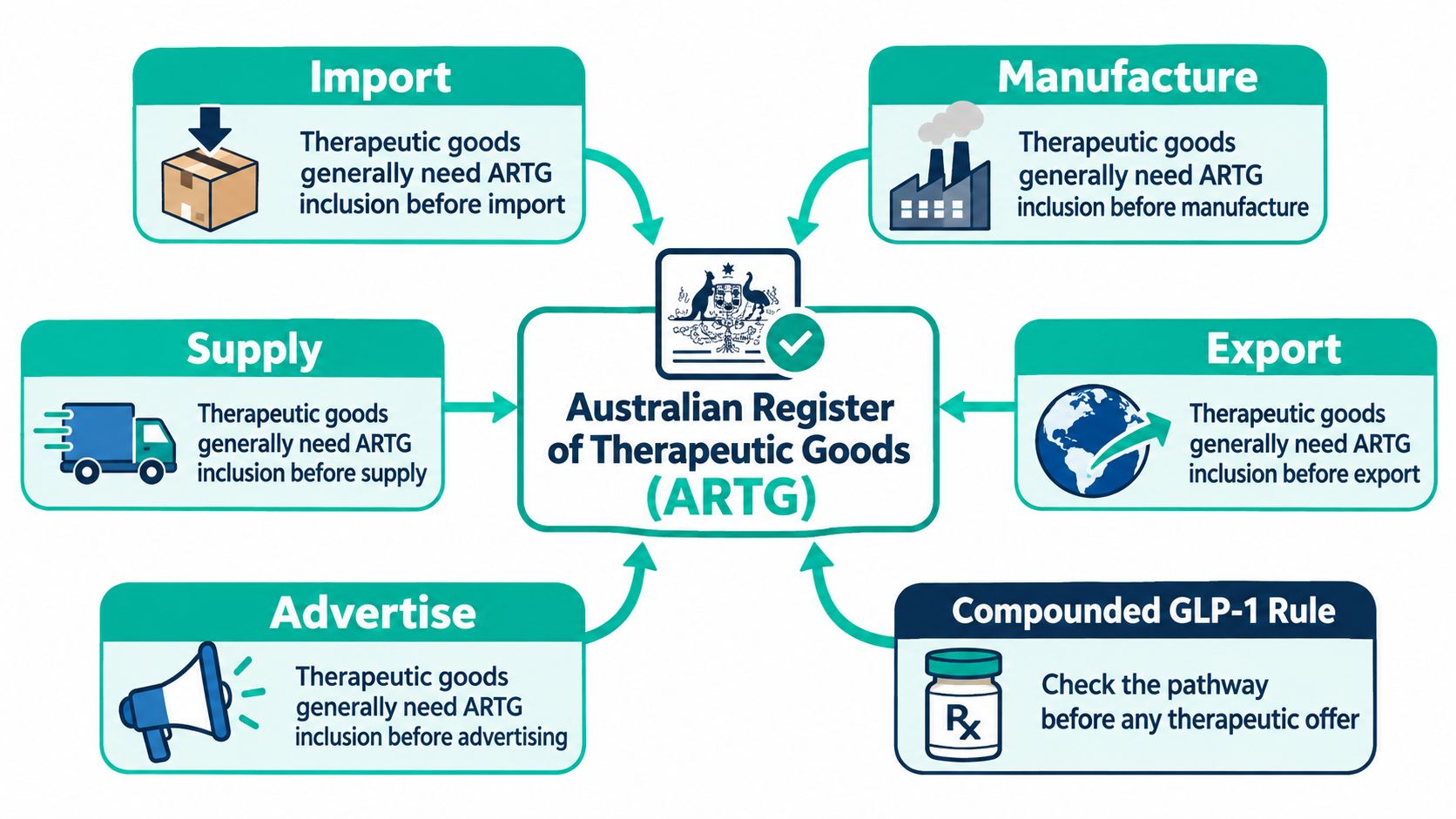
ARTG status comes before the marketing name. The Therapeutic Goods Administration's guidance on therapeutic peptide products explains that therapeutic goods generally need inclusion on the Australian Register of Therapeutic Goods before import, manufacture, supply, export or advertising.
Approved peptide medicines such as semaglutide undergo assessment for quality, safety and effectiveness. Many peptide medicines are prescription-only. An approval relates to the particular medicine and its regulatory conditions, not everything containing a similarly named compound.
The register provides the regulatory starting point for these activities.
What an unapproved pathway changes
An unapproved peptide hasn't undergone the TGA's evaluation. Where a practitioner considers an unapproved access pathway, that practitioner carries responsibility for assessing product quality and safety.
The supporting evidence needs to match the actual product and proposed indication. A paper about a different formulation or research setting doesn't automatically answer the relevant question.
For a clinic, useful compliance records include:
- Product status: The ARTG entry or basis for lawful unapproved access.
- Supply accountability: The prescriber, authorised supplier and relevant storage controls.
- Patient-specific records: Prescription and consent documentation.
- Public communications: Review of website content and promotional claims.
An ARTG entry represents regulatory assessment. A trade name is a label, and a laboratory identity result is an analytical finding. Neither replaces the other.
The specific GLP-1 compounding restriction
Under the TGA's guidance on lawful compounded medicines, from 1 October 2024 pharmacists generally cannot compound and supply medicines containing GLP-1 receptor agonist analogues, including compounded semaglutide-like products.
That guidance also identifies semaglutide and tirzepatide as prescription-only medicines and states that advertising prescription medicines directly to the public is unlawful, including compounded versions. Promoting a compounding service in general is different from publicly promoting a prescription medicine.
This distinction matters when reading a clinic menu. A general explanation of consultation services isn't the same as a standing product offer designed to encourage demand for a named prescription medicine.
Practical rule: Ask what lawful pathway supports the actual offer, not whether the website describes it as personalised.
A page presenting compounded GLP-1 products as ordinary catalogue stock warrants scrutiny. It shouldn't be accepted as compliant merely because the business also offers a consultation.
For a research-focused explanation of the boundary, see our guide to research peptide regulation in Australia.
The following video is supplementary context, not a substitute for checking current regulatory guidance.
How to Read Recovery Skin and Longevity Claims
Evidence for one peptide doesn't transfer to another. Formal evaluation of an approved incretin medicine doesn't establish a recovery, skin or longevity benefit for an unrelated compound.
The RACGP's coverage of the TGA warning about unapproved peptides distinguishes evaluated medicines such as semaglutide and tirzepatide from products promoted online without comparable evidence. It also describes uncertainty about the labelled concentration, identity, sterility and manufacturing quality of unapproved products, alongside reports of severe allergic reactions requiring adrenaline and hospitalisation.
Separate the research question from the advertised result
BPC-157, GHK-Cu, growth-hormone-related peptides and longevity compounds shouldn't be treated as one evidence category. For each, ask what researchers examined, which model they used and what outcome they measured.
Research has examined mechanisms relevant to tissue, skin and other biological processes. A finding in cells or animals, however, doesn't establish a human treatment effect. Even a human study may address a population or outcome different from the clinic's claim.
Our GHK-Cu and AHK-Cu comparison provides compound-specific reading. Comparisons are useful for defining questions, not for assuming that related names mean equivalent evidence.
Evidence levels for peptide claims
| Claim level | Typical example | What it can support | What it cannot prove |
|---|---|---|---|
| Formally evaluated medicine | Semaglutide or tirzepatide | Quality, safety and effectiveness were assessed before approval | That a different peptide shares the same evidence |
| Human studies on a different question | A study in another population or indication | A reason to read the actual paper | A result for this reader or this clinic programme |
| Animal or cell research | Many recovery, skin or longevity research questions | That research has examined a mechanism | A human treatment effect |
| Certificate of analysis only | Any labelled vial | Reported identity or purity for a matched batch | Clinical effectiveness, sterility without relevant testing, or lawful therapeutic supply |
Symptom research also needs careful wording. Measuring a change in an experimental outcome isn't equivalent to establishing treatment for an underlying disease.
A certificate describes tested material. It doesn't describe what will happen to a person.
For an unapproved practitioner pathway, responsibility for assessing quality and safety remains with the practitioner. The existence of a supplier certificate doesn't transfer that responsibility to the laboratory.
Place each clinic claim on a row of the table. If the advertisement promises a human outcome but supplies only a laboratory mechanism or certificate, the supporting material hasn't established the advertised conclusion.
A Vetting Checklist Before You Book
A polished website isn't a substitute for an identifiable practitioner and a clear supply pathway. Before paying a booking fee, establish who is responsible and what the appointment covers.
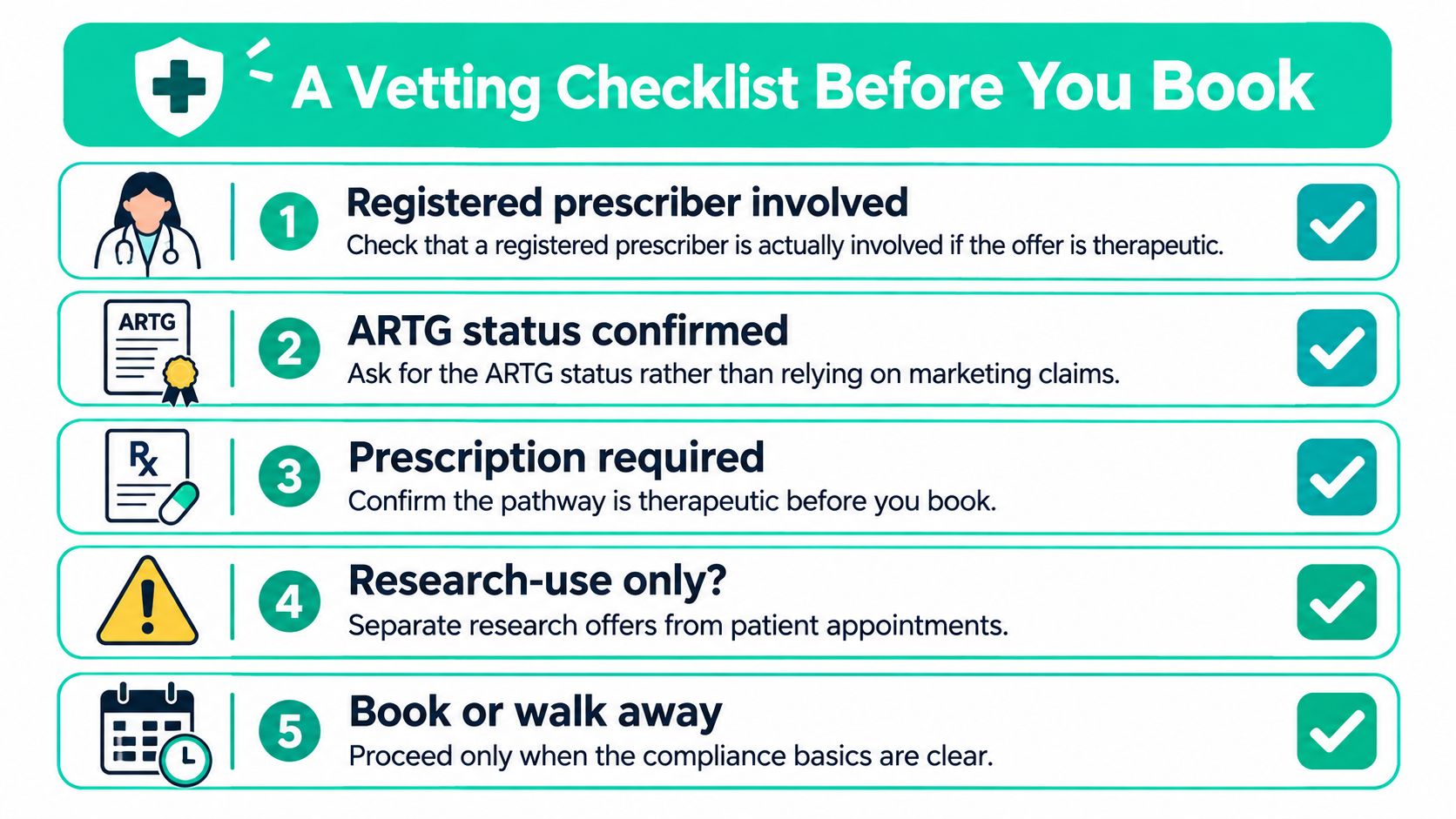
This checklist helps separate a medical consultation from a research-material offer.
Checks that change the decision
- Identify the prescriber. For a therapeutic offer, confirm that a registered practitioner is involved. A booking coordinator's name isn't enough.
- Request product status. Ask for the ARTG status or the basis for an unapproved pathway, rather than accepting a brand story.
- Examine the promotion. Public product offers involving prescription medicines need regulatory scrutiny. A medicine name appearing in neutral educational material isn't automatically equivalent to advertising.
- Question compounded GLP-1 offers. Don't assume a standing offer is lawful. Request the specific legal basis rather than accepting claims about customisation.
- Match the evidence. Reject a citation about a different compound as proof of the proposed product's effect.
- Name the quality assessor. Establish who assessed the supplier, product quality and sterility, and what documentation supports that assessment.
- Flag promised outcomes. Guaranteed weight, recovery or skin results, before-and-after claims and fixed public packages deserve careful examination.
- Separate the charges. Clarify the consultation fee, any product charge and what happens if no prescription is appropriate.
- Stop at category confusion. If a seller frames research vials as personal treatment without a prescriber, don't proceed on that basis.
A website with professional photographs but no named practitioner and no traceable product records leaves important questions unanswered. Presentation can help explain a service; it can't establish accountability.
Questions to send before booking
Send a short written enquiry so the answers can be assessed together:
- Status: Is the proposed product on the ARTG, or is an unapproved pathway involved?
- Accountability: Who is responsible for the clinical and product-quality assessment?
- Advertising review: Has the public offer been checked against applicable advertising requirements?
- Documentation: Can the batch documents be matched to the proposed supply?
- Individual supply: Where relevant, is the supply tied to an individual prescription?
For procurement rather than appointments, our Australian research peptide supplier guide addresses supplier evaluation. Don't use a laboratory purchasing checklist as a replacement for checking a medical practitioner.
How Research Buyers Check a Certificate of Analysis
Laboratories, universities, biotech teams and procurement staff need a research-use-only compound with a documentation file, not a clinic appointment. Their first question is whether the supplied material meets the study's specification.
NATA's explanation of ISO/IEC 17025 laboratory accreditation describes accreditation as evidence of technical competence for specified testing, calibration or sampling. Assessment covers method validity, staff competency, measurement traceability, equipment, test-item handling, quality control and reporting; suppliers and regulatory authorities may not accept results from laboratories without accreditation.
Read the report in procurement order
| Certificate field | What to verify |
|---|---|
| Testing laboratory | Named, with ISO/IEC 17025 accreditation covering this test |
| Test method | Appropriate and validated for peptide identity or purity |
| Traceability | Measurements linked to national or international standards |
| Accredited scope | Reported work sits inside the laboratory's scope; a logo alone isn't proof |
| Batch match | Batch number matches the vial batch, not another batch with the same compound name |
| Lab library status | Retained record in the online lab library, or marked in testing if pending |
The workflow should follow the material from specification to documented acceptance.
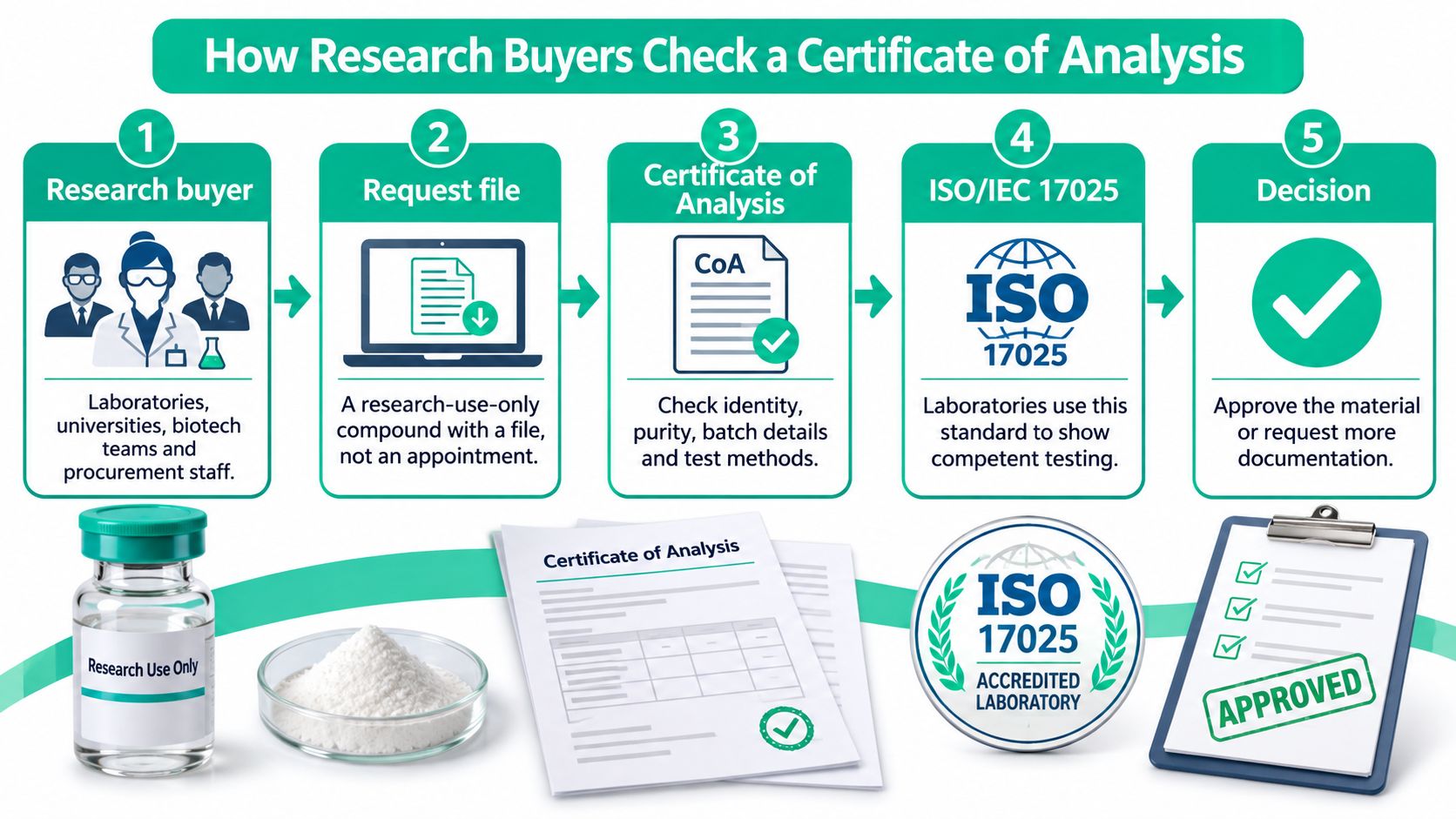
A common filing error is attaching a certificate for one batch to another batch of the same compound. The product name may match perfectly while the document still fails to identify the material received.
Accreditation also has boundaries. NATA's Brisbane laboratory listing illustrates that accredited activities are defined in a stated scope, including particular research analyses. A logo doesn't establish competence for every possible assay.
Keep the documentation accessible
Our COA Library supports batch-document review. Independent laboratory certificates are linked from product pages, with pending files identified as in testing; a pending file shouldn't be treated as a completed result.
For a general introduction to the document, supplement testing explained by GutRx provides related reading. Peptide procurement still requires checking the actual laboratory, method, scope and batch.
Procurement check: File the specification, certificate and received batch identifier together before releasing material into a study.
Our reference resources also include a reconstitution calculator, peptide glossary, product finder and product comparisons. These are research resources, not clinical authorisation or evidence of an expected personal outcome.
Frequently Asked Questions About Australian Peptides Clinics
Can a clinic advertise semaglutide or tirzepatide to the public?
No. Both are prescription-only medicines, and public advertising of prescription medicines is unlawful, including compounded versions. A clinic may promote a compounding service generally, but that doesn't permit promotion of the prescription medicine itself.
Does a certificate of analysis make a research peptide an approved medicine?
No. A certificate reports analytical findings, such as identity or purity, for the identified batch and tests performed. It doesn't confer medicine approval, authorise personal treatment or establish clinical effectiveness.
Do national overweight and obesity figures show whether a clinic service is safe or effective?
No. They describe population health, not the performance of a particular service. Assessing a clinic offer requires product-specific evidence and an appropriate legal pathway, not a large potential audience.
What should someone ask about an unapproved peptide pathway?
Ask who is accountable, which human evidence applies to the specific peptide and indication, and whether the product is on the ARTG. For an unapproved product, the prescribing practitioner carries responsibility for assessing quality and safety. Consent documentation should make the uncertainty clear rather than presenting an experimental proposition as an established result.
Decide Between a Clinic and a Research Supplier
Personal medical care and laboratory procurement require different decisions. If your aim is medical assessment, choose a registered practitioner who can explain a lawful pathway, rather than treating a research vial as an alternative appointment.
If your aim is laboratory work, define the material specification and documentation requirements before ordering. A useful procurement file identifies the compound, batch, certificate, testing laboratory and acceptance criteria.
What Australian supply does and doesn't establish
We're 100% Australian owned and operated, supplying research peptides to Australian laboratories, universities and qualified researchers. Our catalogue includes 60+ peptides, with 10-pack quantities, transparent AUD pricing and GST invoices available.
The materials are supplied in sealed glass vials containing freeze-dried powder cake. This format supports research procurement, not a programme for weight management, recovery or appearance.
Australian ownership shouldn't be confused with every order leaving an Australian warehouse. Our 10-packs ship from our overseas facility, while trial vials ship from Brisbane; tracked express shipping supports order monitoring, with delivery around a week door to door rather than a guaranteed arrival date.
Our research disclaimer sets out the research-only boundary. Local support and accessible records can help procurement teams resolve specification questions, but they don't change a material's regulatory status.
Choose the next check that fits your purpose
- For a named medicine: Search the ARTG and match the exact product, not just the compound name.
- For a medical appointment: Check the practitioner's registration with AHPRA.
- For laboratory testing: Confirm the laboratory's NATA accreditation and relevant scope.
- For a research order: Request the batch certificate and match it to the received vial batch.
For institutional quantities, our Request a Quote service supports specification and documentation enquiries. Continue only when the records answer the question you're asking, whether that's lawful clinical access or suitable research material.
Bulk Aussie Peptides offers research-only supply with product specifications, batch documentation and procurement support, separate from clinic services. Visit Bulk Aussie Peptides to review the research catalogue and request the documentation needed for your laboratory's specification checks.
- BAP