
Bulk Peptides in Australia: A Research Buyer's Guide
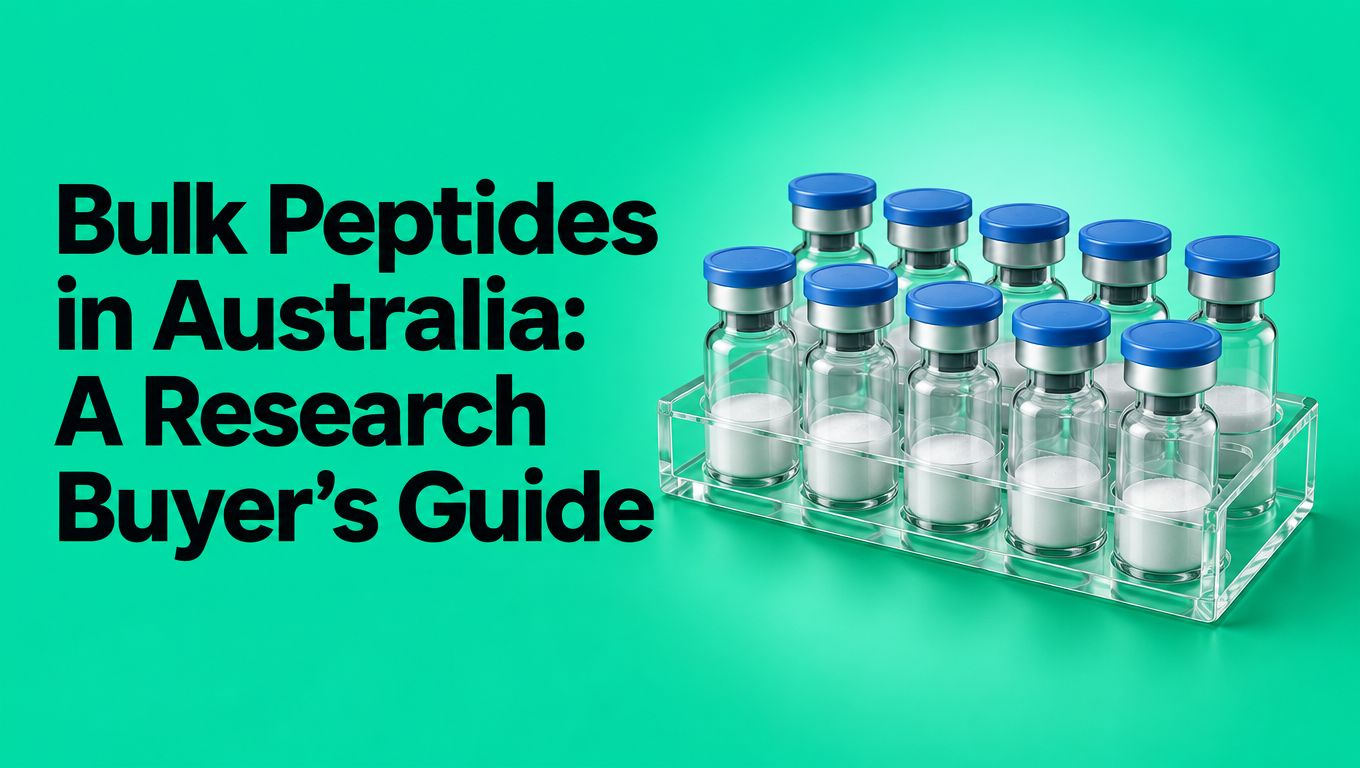
The most common advice about bulk peptides is that a “research use only” label and a high purity percentage are enough to make a purchase straightforward. They aren't. In Australia, a laboratory buyer needs to check the intended-use context, match batch documents to the material received and decide whether the evidence is adequate for the proposed study before placing an order.
Bulk peptides are research materials supplied in multi-vial lots, often as sealed glass vials containing freeze-dried powder. They're not medicines, personal products or study protocols. The guide below shows how to compare formats, review records and make a documented go-or-no-go decision.
Table of Contents
- What Bulk Peptides Mean for a Laboratory Order
- Australian Law, Claims and the Lab File
- How to Read a Certificate of Analysis
- Supplier Evaluation Before You Request a Quote
- Shipping and Storage for Lyophilised Vials
- Frequently Asked Questions About Bulk Peptide Orders
- Go or No-Go Before You Place a Bulk Order
What Bulk Peptides Mean for a Laboratory Order
A bulk peptide order is a quantity of research material organised around a stated per-vial amount and a batch identity. In a standard pack, the vials share a stated lot and contain lyophilised, or freeze-dried, powder rather than a ready-made solution. That shared lot matters when a study needs repeated assays using material with consistent provenance.
The right format follows the laboratory question. A trial vial can help a team check that the product name, stated quantity and paperwork fit the planned method. A 10-pack is suited to repeat assays where the team wants vials from one stated lot. A custom quantity may suit a longer program, but its batch documentation should still be tied to the same testing standard. Larger quantities can also draw more scrutiny about whether the supply is for research, so keep the intended purpose clear in the purchase record.
| Format | What arrives | Documentation to expect | Fits when |
|---|---|---|---|
| Trial vial | One sealed vial of lyophilised powder | Specification sheet and batch identity where issued | The team is checking naming and paperwork before a larger order |
| Standard 10-pack | Ten sealed vials from the same stated lot | Specification plus batch certificate of analysis, or an in-testing note if pending | Repeat assays need one lot and predictable vial counts |
| Custom bulk quantity | A quoted number of vials under the same testing standard | Batch-level analytical records before release | A program outgrows a catalogue 10-pack |
| Associated lab consumable | Separate consumable pack, not the peptide | Its own product specification | The method needs a listed reagent recorded apart from the peptide lot |
Choose the row that matches the question your team is funding. For example, research has examined metabolic peptides in relation to metabolic pathways, tissue and cellular compounds in relation to cellular processes, and other research compounds across a range of study questions. These are study areas, not claims about outcomes for people.
Bulk Aussie Peptides organises its catalogue into categories including metabolic, tissue and cellular, and other research compounds, alongside sealed 10-pack formats and some trial sizes. The procurement information pack can help purchasing teams organise the records they need before ordering. Review any batch certificate separately before deciding whether the material fits a study.
Australian Law, Claims and the Lab File
A label can sit on a vial; it cannot decide the law. Peptide supply in Australia is tied to therapeutic-goods law, and the Therapeutic Goods Administration says therapeutic peptide products generally need to be included in the Australian Register of Therapeutic Goods (ARTG) before they can be imported, manufactured, supplied, exported or advertised. Approved peptide medicines exist, many are prescription-only, and many generally can't be advertised directly to the public.
A “research use only” sentence does not, by itself, change a product's regulatory status.
The TGA explains that a peptide's nature, presentation, intended use and associated claims can indicate therapeutic application, even where a research-use disclaimer appears. Its examples of health-related promotion include claims about weight loss, muscle growth, recovery and performance. Some products may fall under cosmetic regulation when ingredients, claims, presentation and intended use stay within cosmetic purposes, but a buyer shouldn't assume that pathway applies. The TGA's explanation of therapeutic peptide regulation sets out why context matters.
Build a file that records the decision
Before ordering, write down the intended research use in plain terms: the study question, the material requested, the lot required and who approved the purchase. Check who carries supplier and importer obligations, then keep the specification, batch certificate or “in testing” status, receipt log, storage-deviation notes and any request-for-documentation emails together. A certificate can help trace a material in a research file, but it does not establish ARTG inclusion or authorise therapeutic supply or personal use. For a local frame of reference, a practical summary of research peptide regulation in Australia can help a team phrase the questions before it requests a quote.
This distinction has practical consequences. The TGA has taken enforcement action over unlawful advertising of peptide products, so keep internal requests and public-facing wording free of therapeutic promises. “Research has examined a pathway” is a different claim from “this produces a result for a person.”
Australian universities and research organisations also need purchasing records that can stand up to internal review. The Australian Bureau of Statistics reports that 44% of higher-education R&D expenditure was in health and medical research fields, and that higher-education R&D expenditure was $16.4 billion in 2024, up 17% from 2022, in its higher-education research and development release. Send scientific questions to the study investigator and regulatory questions to the institution's compliance contact, then record a clear go or no-go before any bulk order is placed.
How to Read a Certificate of Analysis
A purity percentage is only one line in a larger batch record. Treat a certificate of analysis (COA) as evidence to review line by line, alongside the study's documented research use. A research-use label and a high purity result still leave regulatory status and protocol suitability unresolved. The TGA says unapproved peptide products have not been assessed for quality, safety or effectiveness; its guidance for health practitioners on peptide product information also describes the need for technical review and traceable records.
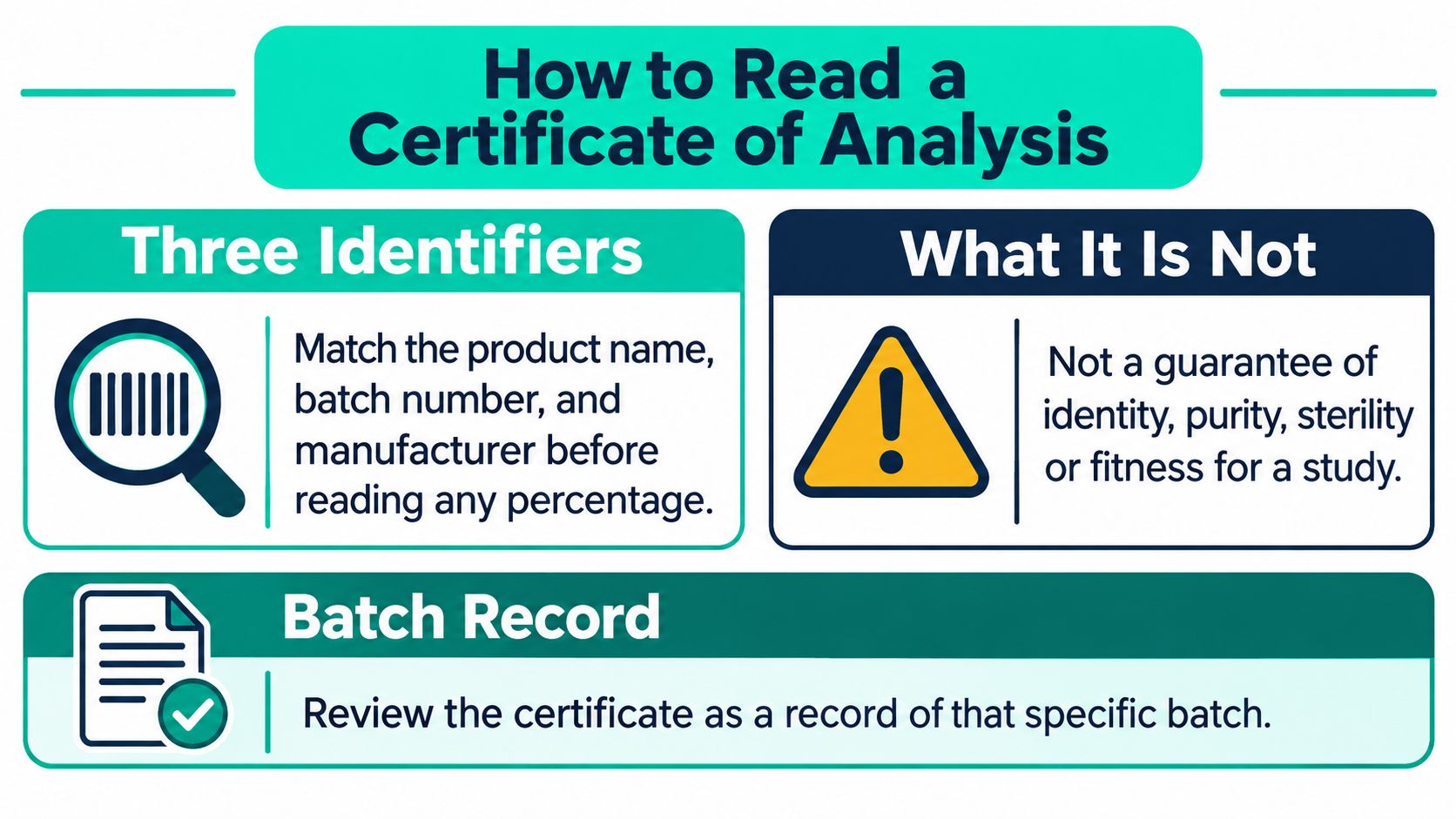
Start with the three identifiers before interpreting any result: product name, stated strength and batch or lot number. Check each one against the vial received. A report for a different lot belongs with that lot, so it cannot serve as batch evidence for the material in hand.
Read each test according to the question it can answer. Chromatographic purity testing can identify related impurities and degradation products in the sample tested. Liquid chromatography mass spectrometry (LC-MS) can support molecular-mass and identity confirmation. Water, residual-solvent, endotoxin or microbial results support only the specific measurements shown; a blank or absent row means the file has no reported result for that test.
| COA item | Can support | Does not support |
|---|---|---|
| Product name, strength and batch number | Traceability of this lot to the vial in hand | Quality of any other batch |
| HPLC or chromatographic purity | Related impurities in the tested sample | Sterility, endotoxin or transport stability |
| LC-MS or LC-MS/MS identity | Molecular mass and identity confirmation | A correct study concentration or human suitability |
| Residual solvent or water, if reported | Those named analytes only | Tests that are absent from the page |
| Endotoxin or microbial result, if reported | The microbial question that was actually run | A clinical-grade or ARTG assessment |
| Laboratory name and document source | Whether the report is manufacturer or independent | Regulatory approval or efficacy |
Orthogonal testing uses different methods to answer different questions. It works like checking the label against one record and the contents against another: LC-MS can support identity, while chromatographic testing can assess purity. Neither result alone establishes sterility, transport stability or whether the material suits a particular protocol.
A single purity figure also leaves out the method, reference standard, reporting limit, sample preparation, laboratory independence, vial-to-vial uniformity and transit conditions. Record what was tested, what was not tested and what additional verification the protocol requires before the purchase file can support a decision. Bulk Aussie Peptides provides batch documentation through its COA library, where each document's source is labelled as manufacturer-provided or independent laboratory.
Supplier Evaluation Before You Request a Quote
A supplier can have a polished catalogue and still leave a laboratory unable to match the delivered vial to its records. Use these pass-or-fail checks before requesting a quote. A failed check is a reason to pause, not a detail to resolve after the order arrives.
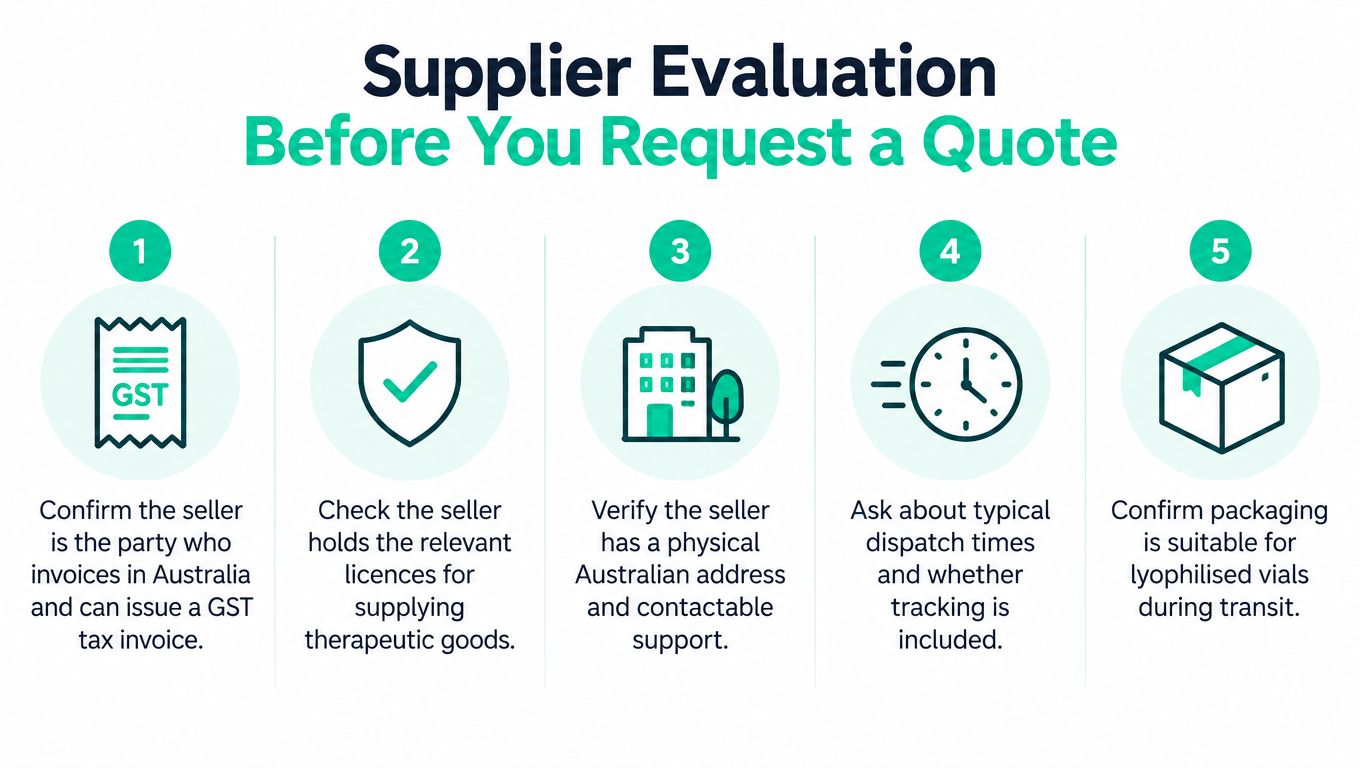
Australian invoice. Pass if the seller is the party invoicing in Australia and can issue a GST invoice. That gives your purchasing office a clear local transaction record.
Research-focused catalogue. Pass if descriptions state the research context and avoid promises about weight, recovery, skin, hair or performance outcomes. Outcome claims can move product material toward therapeutic advertising.
Visible specifications. Pass if specifications are available before checkout and the document source is labelled as manufacturer-provided or independent. Unnamed documentation makes it harder for an ethics or procurement office to assess provenance.
Batch matching. Pass if the batch number can be matched to the vial after dispatch, and pending certificates are marked “in testing” rather than implied to be available. A missing link in that chain leaves the purchase file incomplete.
Quantity and testing. Pass if the quote distinguishes a standard 10-pack from a custom quantity and states that the custom order follows the same testing standard.
Delivery and contact. Pass if the seller explains tracked Australian delivery and a stated processing window without promising overnight arrival, and names a contact for documentation requests.
No pressure or administration material. Fail any offer involving membership lock-in, an unnamed reseller or administration instructions alongside a peptide. Those features don't belong in a research procurement record.
A practical way to formalise the review is to compare suppliers with an evaluation matrix, so the purchasing team applies the same criteria to each quote. Local supply also gives Australian buyers a domestic invoice, delivery and documentation chain to verify. Bulk Aussie Peptides is Australian owned and operated and offers a research supplier guide. A product finder can help shortlist compounds; the quote step is where quantity, documentation and institutional paperwork should be confirmed.
Shipping and Storage for Lyophilised Vials
Plan receipt around the study schedule rather than an assumed express service. Bulk Aussie Peptides ships 10-packs from its overseas facility and trial vials from Brisbane, with dispatch typically within 1–3 business days and tracking on Australian deliveries, so plan receipt around the delivery window stated at checkout. Orders ship in plain, discreet packaging, and free express shipping applies over $700 AUD. Check the live cart for current shipping costs rather than relying on a remembered rate.
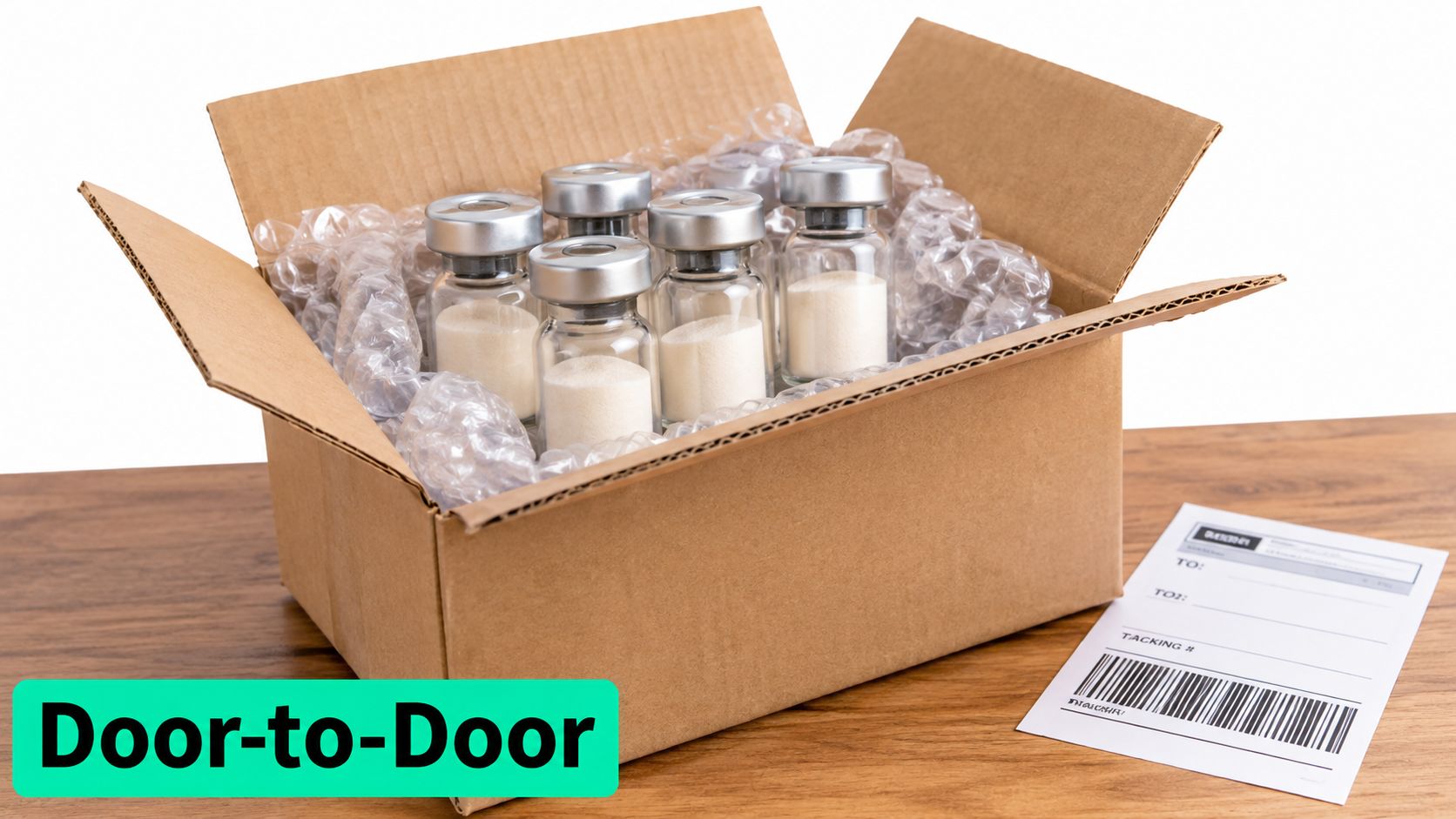
When a parcel arrives, log the order against the study file before anything else. Photograph the seal if your local standard operating procedure (SOP) requires it, keep vials sealed and dry, follow the temperature on the product specification, and store them away from reagents. A lyophilised cake is a stable powder rather than a ready solution, but heat, moisture and a broken seal can still compromise it. Record any out-of-range delay or storage deviation in the study file so the receiving record stays complete.
| Field | Record | Why it matters |
|---|---|---|
| Date received | Day logged against the order | Starts the chain of custody |
| Tracking number | Carrier reference from dispatch | Shows the delivery route |
| Product name | Exact name on the label | Matches the COA name line |
| Stated per-vial quantity | As printed on the specification | Matches the order |
| Batch number | Lot on the vial and the COA | Links the vial to its report |
| Seal and condition | Intact, or noted with a photo if required | Starts the storage deviation check |
| Lab status | Released or in testing | Blocks use of pending lots |
A batch marked “in testing” stays out of the study record until its certificate arrives. For a custom shipment, compare the quoted documents with the batch on the label before the material is logged in, because a custom quantity still follows the same independent testing standard as a standard 10-pack. Any concentration record should follow the laboratory's approved SOP; a calculator, if that SOP permits one, is only an arithmetic aid within it. The peptide storage and stability guide can support planning, but the product specification and local SOP govern storage decisions.
Frequently Asked Questions About Bulk Peptide Orders
Does a certificate of analysis mean a peptide is on the Australian Register of Therapeutic Goods? No. It supports only the tests printed on that batch report, for the sample tested.
Is a research-use-only label enough under Australian law? No. Status follows the product's nature, presentation, intended use and claims, so the label alone doesn't settle it.
What does a standard 10-pack contain? A sealed 10-vial pack in the format stated on the listing, with batch documentation or an “in testing” note. Most research peptides are supplied as lyophilised powder, but check the product specification and batch record for the particular listing.
How long does delivery take? Delivery times depend on the carrier and destination, and each order includes tracking; the live cart shows current shipping costs.
Are GST invoices available to universities? Institutional buyers can request a quote through the bulk research supply route to confirm invoicing and documentation requirements.
What should be settled before a bulk order? A documented intended-use check, a line-by-line COA review against the stated batch, and a clear go or no-go decision.
Go or No-Go Before You Place a Bulk Order
A purity figure and a research-use label still leave two questions open: whether the purchase fits Australian requirements for the way it will be used, and whether this batch belongs in this study. Make the order a recorded go or no-go against four points.
- Format: The trial vial, sealed 10-pack or quoted custom run matches the study's planned requirements.
- Batch record: The COA or “in testing” status is batch-specific and linked from the product page's lab library.
- Intended use: The purchase record documents laboratory research, without therapeutic claims.
- Receipt plan: The team can log shipping, vial condition and storage on arrival.
If one point fails, pause the order. If all four pass, Bulk Aussie Peptides offers a Procurement Pack and a Request a Quote service, is 100% Australian owned and operated, and sells to customers in Australia only. Universities can start with the bulk research supply route and file the batch document from the lab library with the purchase order. Its catalogue of 60+ compounds is a starting point for a shortlist, not a substitute for the study's procurement review.
For institutional buyers, treat the sign-off like investigating an acquisition before signing: confirm that the documents and purchase terms support the decision you are recording.
- BAP
Bulk Aussie Peptides offers sealed 10-pack formats, batch documentation and a Procurement Pack to support research procurement. Review the records against your study requirements, then visit Bulk Aussie Peptides to shortlist research compounds or request a quote for institutional quantities.