
Buy Australian Peptides: A Buyer's Guide for Labs in 2026

“Choose an Australian supplier with a COA” is common advice, but it leaves the hardest checks undone. To buy Australian peptides for laboratory research, you need to connect the exact batch to its test report, vial label, invoice and project records. Then compare the cost per milligram and GST treatment, not just the pack price. An Australian-owned business and a polished certificate are useful starting points, not proof that a purchase meets your institution's requirements.
Table of Contents
- Work Out Your Paperwork Before You Shop
- Verify a Supplier Before You Add to Cart
- Confirm Legal and Institutional Compliance First
- Check a Batch COA Against Your Vial and Invoice
- Compare Pack Sizes and Per-Vial Prices in AUD
- Place the Order and Confirm Before You Pay
- Frequently Asked Questions
Work Out Your Paperwork Before You Shop
This guide is for laboratories, universities, biotech and procurement teams, not personal use. The paperwork gap often starts before anyone opens a product page: the researcher knows what they want, but finance hasn't agreed how the purchase will be recorded.
Settle three things first: the written research purpose, the documents available from the supplier and the invoice format your institution accepts. A purchasing officer should be able to identify the project and reconcile the delivery without relying on an email explanation from the researcher.
Paperwork to request by buyer type
| Buyer | Typical purchase | Paperwork to request before ordering |
|---|---|---|
| University research lab | Small pack for a funded study | Batch COA, GST tax invoice, purchase order |
| Biotech or contract research team | Repeat 10-pack orders | Batch COA, specification sheet, supplier ABN |
| Hospital or institutional procurement | Standing bulk supply | Written quote, GST tax invoice, supplier details for vendor onboarding |
| Independent researcher | Single trial vial | Batch COA, GST tax invoice if the purchase is for business use |
Australia has a substantial institutional research base. The Australian Bureau of Statistics reports higher-education research expenditure of AUD 16.4 billion in 2024, up 17% from 2022, with health and medical research accounting for 44%.
At that scale, standard pack formats, batch-level records and predictable fulfilment help teams manage purchasing and inventory. Those figures say nothing about any individual supplier's quality.
Bulk Aussie Peptides supplies Australian laboratories, universities and qualified researchers, and sells to customers in Australia only. Use our procurement information pack to organise the purchasing discussion before placing an order.
Gather these details before requesting approval:
- Purchase order number and the person authorised to approve it.
- Budget code for the relevant project or cost centre.
- Project or ethics approval reference, where applicable.
- Supplier ABN for finance and vendor onboarding.
Verify a Supplier Before You Add to Cart
A “research use only” label and a polished certificate of analysis (COA) do not establish that a purchase is sound. Check whether the supplier's records connect the product, batch, invoice and your institution's purchasing file.
Use this checklist for the supplier review.
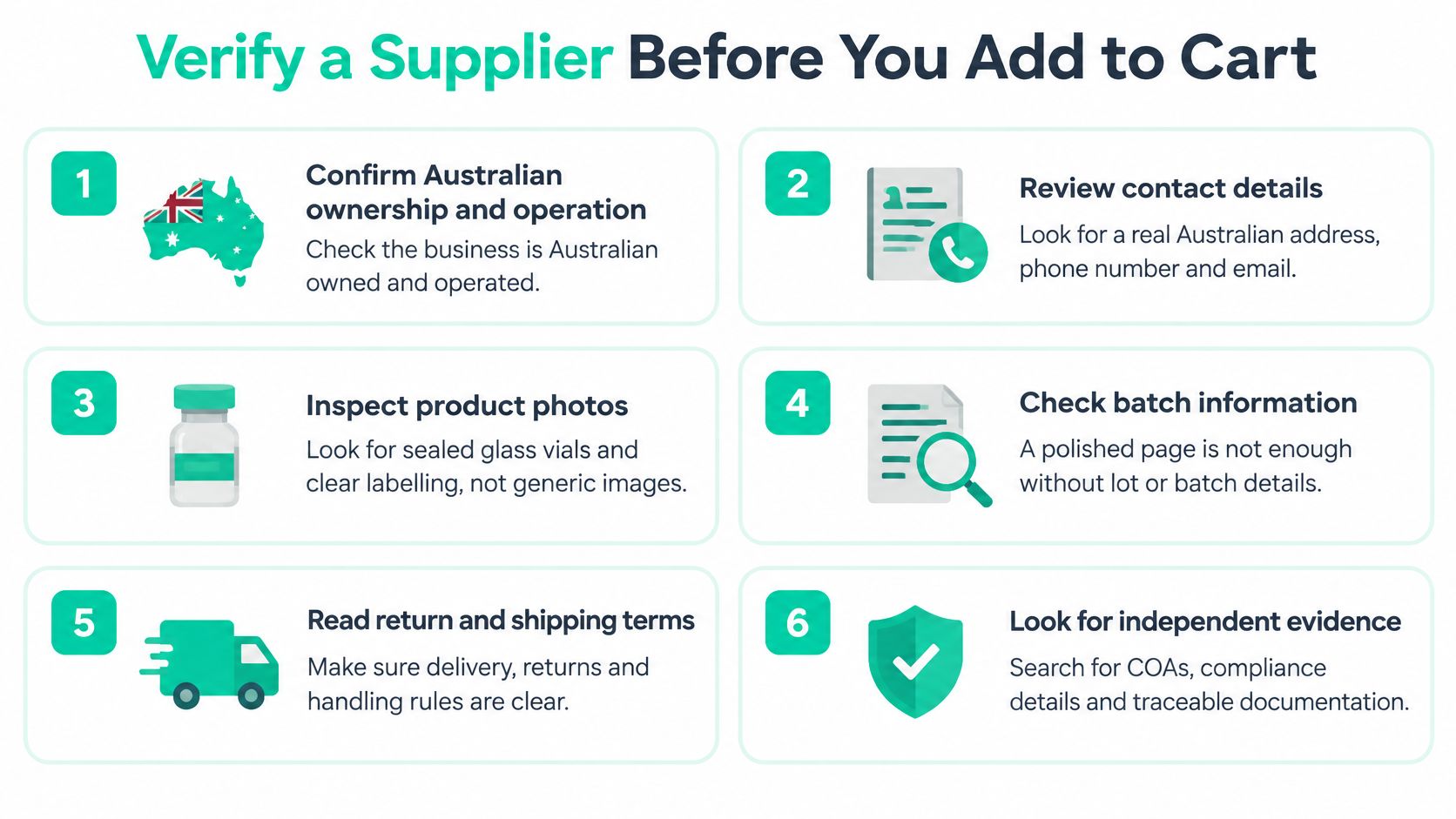
Checking an Australian research peptide supplier
- Confirm the business details. Check the supplier's ABN against the Australian Business Register. Bulk Aussie Peptides is 100% Australian owned and operated. Ownership does not, by itself, confirm where an order will be dispatched from.
- Match the specification to the listing. Check the compound, pack format and stated mass per vial. A product photo cannot replace a written specification.
- Check the COA's batch reference. Confirm which batch the certificate covers. An “in testing” status means results are pending, not that testing has passed.
- Identify who produced the evidence. Manufacturer documentation and an independent laboratory report are different forms of evidence. Check the stated source and laboratory identity.
- Confirm the support route. Bulk Aussie Peptides provides an Australian-based support team for returns and refund enquiries. Read the stated return conditions before ordering.
- Get custom supply details in writing. Bulk Aussie Peptides offers custom orders for bulk quantities subject to the same rigorous independent testing standards. The quote should specify the quantity, product and documentation supplied.
The Australian research peptide supplier guide provides a further purchasing reference. If a listing leaves the batch, specification or acceptance conditions unclear, ask the supplier before ordering.
Keep supplier verification separate from unrelated testing services such as biomarker testing for athletic performance. It does not establish what is in a supplied vial.
The accompanying video is available below.
Treat these as warning signs:
- Missing identifiers, including an absent batch number.
- Anonymous certificates that do not name the testing laboratory.
- Health-outcome promotion attached to research stock.
- Unclear pricing that does not state GST treatment.
Confirm Legal and Institutional Compliance First
A research-use-only label doesn't settle compliance. The product's presentation, intended purpose and supply circumstances matter, not just the disclaimer printed beneath the purchase button.
The Therapeutic Goods Administration's peptide guidance explains that, under the Therapeutic Goods Act 1989, peptide products are regulated as therapeutic goods when promoted, supplied or generally used to prevent, diagnose, cure or alleviate disease, or modify a physiological process. This includes promotion for weight loss, muscle growth, recovery and performance enhancement.
Products classified as therapeutic goods generally require entry in the Australian Register of Therapeutic Goods before import, manufacture, supply, export or advertising, unless an applicable exemption, approval or authority exists. A laboratory purchase therefore needs a properly defined purpose, not an assumption that research wording creates an exemption.
TGA research peptide compliance
The regulator distinguishes approved products from unapproved products. Approved peptide medicines include insulin and insulin analogues, semaglutide-class GLP-1 receptor agonists, oxytocin, desmopressin and octreotide; many are prescription-only and generally can't be advertised directly to the public.
A compound name shared with an approved medicine doesn't establish that a particular research product has the same regulatory status. Nor does a research catalogue listing establish permission for every proposed project.
Compliance rule: Match the proposed purchase to the institution's approved work, rather than adapting the project description to fit a supplier's disclaimer.
Before approval, complete these checks:
- Record the purpose. Put the intended research use in the project file in language the approving officer can assess.
- Review supplier claims. Research descriptions shouldn't promise health outcomes.
- Confirm institutional coverage. Check biosafety requirements and applicable ethics or project approvals.
- Check purchaser eligibility. Our purchasers must be 18 years of age or over.
- Escalate conflicting language. Treat promotion inconsistent with research-only supply as a reason to stop and seek review.
Use our Australian research peptide regulation reference as a starting point for that discussion. This is general information, not legal advice; your institution's compliance office should decide uncertain cases before anyone commits funds.
Check a Batch COA Against Your Vial and Invoice
A specification sheet describes what the supplier intends to supply. A batch-specific Certificate of Analysis, or COA, records reported findings for a particular sample. Neither replaces your laboratory's acceptance process.
The TGA's peptide products guidance states that unapproved peptide products haven't been assessed for quality, safety or effectiveness, and warns there's no assurance they're correctly labelled or manufactured to appropriate quality standards. That makes traceability and independent verification purchasing controls, not optional extras.
Use this workflow when reviewing a proposed batch.
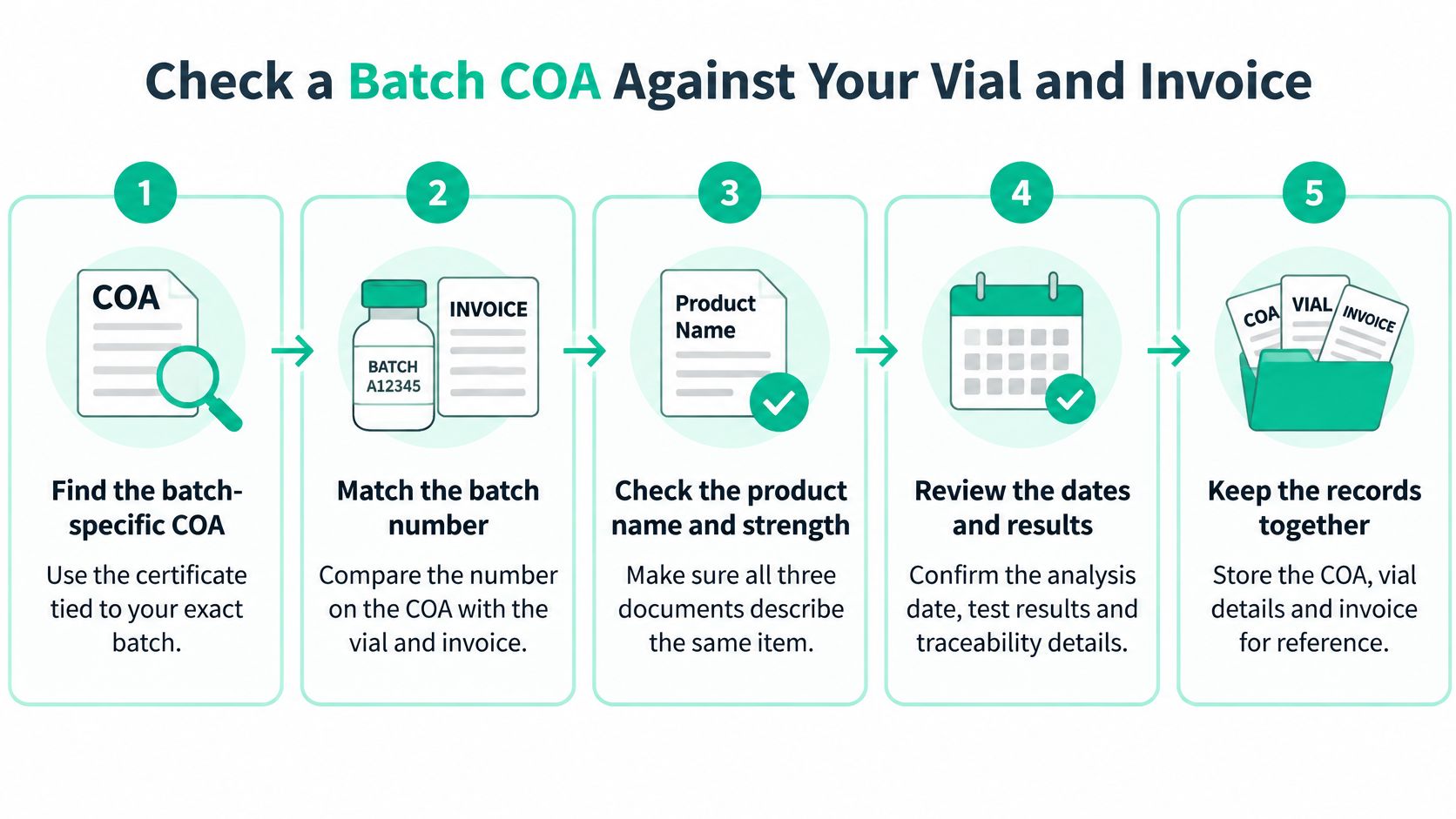
Build a traceable batch record
- Obtain the exact batch number before ordering. A certificate for another batch doesn't establish the properties of the stock allocated to your order.
- Read the analytical details. Require the tested analyte, assay method, result, acceptance limit, laboratory and sample relationship. A purity percentage without a method or clear sample identity is incomplete evidence.
- Reconcile the records. Match the vial label, COA, invoice and packing slip. Where the invoice doesn't carry the batch identifier, obtain an allocation record that connects the invoiced goods to the supplied batch.
- Confirm identity and content independently. Use an appropriately validated laboratory method suitable for the study's acceptance requirements. Don't assume an identity test also establishes quantity or purity.
- Quarantine exceptions. Hold material with mismatched identifiers, missing methods, unexplained results, damaged packaging or uncertain storage history until the responsible laboratory officer resolves the issue.
Our online COA library is linked from every product page and provides independent laboratory certificates, with in testing shown where results are pending. If your acceptance criteria require completed results, don't treat pending stock as released material.
Keep the evidence with the goods
For physical receiving records, document sleeves such as packing envelopes from Material Handling USA can keep paperwork attached to the outer shipment. Save a digital copy in the purchasing system as well, so the audit trail survives disposal of the packaging.
A COA documents a reported batch result. It isn't regulatory approval, sterility assurance or evidence of clinical-grade manufacture; identity and stated mass also don't establish endotoxin, particulate, residual-solvent or container-integrity controls.
Quarantine first when identifiers disagree. Resolve the discrepancy before releasing material into a study.
Our peptide concentration calculator supports laboratory concentration arithmetic only. The protocol and input values must come from the institution's approved study design; this guide supplies neither. Keep the COA and acceptance decision with that study file.
Compare Pack Sizes and Per-Vial Prices in AUD
A 10-pack price tells you little until you divide it by vial count and stated mass. Start with the arithmetic, then assess whether the compound, format and documentation meet the project specification.
Buy Australian peptides with a fair price comparison
10-pack prices, per-vial and per-mg cost in AUD
| Compound | Pack format | 10-pack price (AUD) | Per vial (AUD) | Per mg (AUD) |
|---|---|---|---|---|
| Melatonin | 10 mg × 10 vials | $622.00 | $62.20 | $6.22 |
| MOTS-c | 10 mg × 10 vials, lab COA | $607.00 | $60.70 | $6.07 |
| MT-1 | 10 mg × 10 vials | $599.00 | $59.90 | $5.99 |
| MT-2 (Melanotan 2) | 10 mg × 10 vials | $584.00 | $58.40 | $5.84 |
| LL-37 | 5 mg × 10 vials | $659.00 | $65.90 | $13.18 |
These prices reflect the listings at the time of writing. Confirm the live product listing before ordering.
Calculate per-vial cost = pack price ÷ vial count. For per-mg cost, divide the pack price by the total stated mass across all vials.
For example, LL-37 at $659.00 over 50 mg gives $13.18 per mg, while MOTS-c at $607.00 over 100 mg gives $6.07 per mg. That exposes a price difference, but it doesn't make different compounds scientifically interchangeable.
Choose the format before chasing a lower unit cost
Ten-packs suit repeat work when the study needs the quantity. Some single trial vials are available for smaller pilot checks of format and documentation, without committing to a full pack.
Our Product Comparison tool supports side-by-side checks, while the Product Finder helps narrow the catalogue. Most stock is supplied as freeze-dried powder in sealed glass vials, so include the required physical format in your comparison.
GST treatment matters too. The ATO's taxable-sales guidance explains that suppliers making taxable sales generally include GST in the price and issue a tax invoice, while eligible buyers may claim credits subject to the normal rules.
Compare quotes on the same GST basis. A lower headline price isn't a saving if one quote excludes tax or omits required documentation.
Place the Order and Confirm Before You Pay
A cart total is not a complete purchasing record. Before payment, assign responsibility for the quote, receiving arrangements, acceptance decision and finance handover.
Turn the approved specification into an order
- Request a written quote for bulk or repeat supply. Bulk Aussie Peptides offers a Request a Quote service and Procurement Pack. Specify quantities, pack formats and the GST presentation your finance team requires.
- Match every line to the listing. Check the compound, stated mass, vial count and AUD price. Do not accept an undocumented substitution because the total looks similar.
- Read the checkout terms. Use the secure checkout and review the shipping and return conditions shown before paying.
- Plan receiving arrangements. Bulk Aussie Peptides uses tracked express shipping. Check the delivery window stated at checkout and do not treat it as a guaranteed arrival date.
- Confirm the shipment route. 10-packs ship from an overseas facility, while trial vials ship from Brisbane. Ask your institution whether import or biosecurity review is required before approving the order.
- Assign a records owner. Store the invoice, batch allocation and COA together in the purchasing system. Record who accepted or quarantined the delivery.
Australian ownership does not mean every parcel is dispatched domestically. Confirm the route before scheduling laboratory work around an expected arrival.
Give finance a usable invoice
The ATO's tax invoice guidance says a tax invoice is generally required to claim GST credits on purchases over A$82.50 including GST. A supplier generally has 28 days to provide one when requested. For taxable sales under A$1,000, the invoice must identify itself as a tax invoice and state the seller's identity, issue date, goods description and quantity, price, GST amount or GST-inclusive status, and taxable status.
Ask the supplier to confirm the GST invoice details before ordering so your finance team can match them to the approved order. Check that the product description is specific enough for that match.
The ATO's GST credit guidance says to retain GST records for five years and claim only the eligible business-use portion of mixed-use purchases.
A COA reports a batch result. It does not approve a use.
Release payment only when the batch allocation is recorded, the certificate status is acceptable to the project, the research purpose is documented, and finance has agreed how the invoice will be received.
Frequently Asked Questions
Can an individual buy these for personal use?
No. This guide is for laboratory and procurement buyers, and Bulk Aussie Peptides supplies research-use-only products. Personal interest in weight management, recovery, or skin, hair and nail research does not establish a qualified research purpose.
Does a research-use-only label make a purchase compliant?
No. The label does not establish that a proposed supply or project is permitted. Ask your institution to assess the research purpose, product status and applicable approvals before purchasing.
Should I order a 10-pack or a trial vial first?
A trial vial, where available, can help assess the supplied format and accompanying paperwork for a small pilot. Choose a 10-pack when that quantity fits the approved project, rather than relying on a lower unit price alone.
What should I review before requesting bulk supply?
Review the bulk research supply information, the relevant product pages and the lab library. For a useful quote, specify quantities, product requirements and the documents your institution will accept.
Bulk Aussie Peptides offers a catalogue of 60+ research peptides, sealed 10-vial packs, some single-vial trial sizes and bulk supply options for Australian laboratories, universities and qualified researchers. Visit Bulk Aussie Peptides to compare product specifications, review the lab library and request a quote suited to your institution's purchasing requirements.