
Australian Peptides Guide: Supply, Quality and Procurement
The advice to compare Australian peptides by price and a purity percentage misses the most important question: can you trace the product to evidence that supports its stated identity and specification? For laboratory procurement, local availability isn't enough. You need a documentation trail covering regulatory status, batch testing, laboratory competence and receipt records. For Australians exploring weight management, recovery or skin, hair and nail research, that distinction also helps separate research supplies from approved medicines.
Table of Contents
- How Australian Peptide Supply Is Regulated
- Product Categories and Standard Vial Formats
- Reading a Certificate of Analysis Line by Line
- Supplier Checks and Documents to Request
- Bulk, Wholesale and Institutional Buying Routes
- How Ordering and Domestic Fulfilment Work
- Using the Calculator and a Receiving Workflow
- Confirm Your Supplier Before You Order
How Australian Peptide Supply Is Regulated
A research-use-only label doesn't settle compliance. The Therapeutic Goods Administration's peptide guidance explains that ingredients, presentation, promotion, supply and intended purpose can bring a product within therapeutic-goods regulation, generally requiring entry in the Australian Register of Therapeutic Goods (ARTG).
Regulatory status and research documentation answer different questions. A university purchasing a compound for in-vitro work has a different intended-use case from a seller promoting it for obesity, diabetes or muscle recovery. Keep laboratory claims separate from therapeutic claims, and retain records that document the study's intended use.
Availability also differs from approval. PBAC's GLP-1 access advice states that semaglutide and dulaglutide are PBS-listed for type 2 diabetes, not every indication. Research peptides are not substitutes for approved medicines.
Supplier identity is another part of the documentation trail. Bulk Aussie Peptides is 100% Australian owned and operated. Its Australian peptide regulation guide provides a reference for assessing Australian peptide regulation and procurement.
Product Categories and Standard Vial Formats
Research peptide categories and standard formats
| Category | Example compounds | Typical research focus |
|---|---|---|
| Metabolic (incretin agonists) | Semaglutide, tirzepatide, retatrutide | Metabolic and appetite signalling studies |
| Growth-factor related | Select by specified signalling target | Growth-factor signalling studies |
| Tissue and cellular | BPC-157 | Tissue and cell models |
| Longevity and senescence | Select by ageing pathway | Ageing biology models |
| Neuroscience | Select by neural target | Neural pathway studies |
| Fertility and reproductive | Select by reproductive pathway | Reproductive biology studies |
| Laboratory consumables | Bacteriostatic water, 10 mL x 10 | Diluent for laboratory workflows |
Our catalogue covers 60+ peptides, with standard 10-pack formats, transparent AUD pricing and per-vial quantities on product pages. Most peptides are lyophilised powder cakes in sealed glass vials.
Standard formats help researchers maintain consistent purchasing records, but don't establish equivalence between batches. Check each research-use label, specification and batch documentation before adding an item to a procurement list.
Reading a Certificate of Analysis Line by Line
Verification happens at batch level, not brand level. Start with the product and sample identifiers, then examine the analytical results.
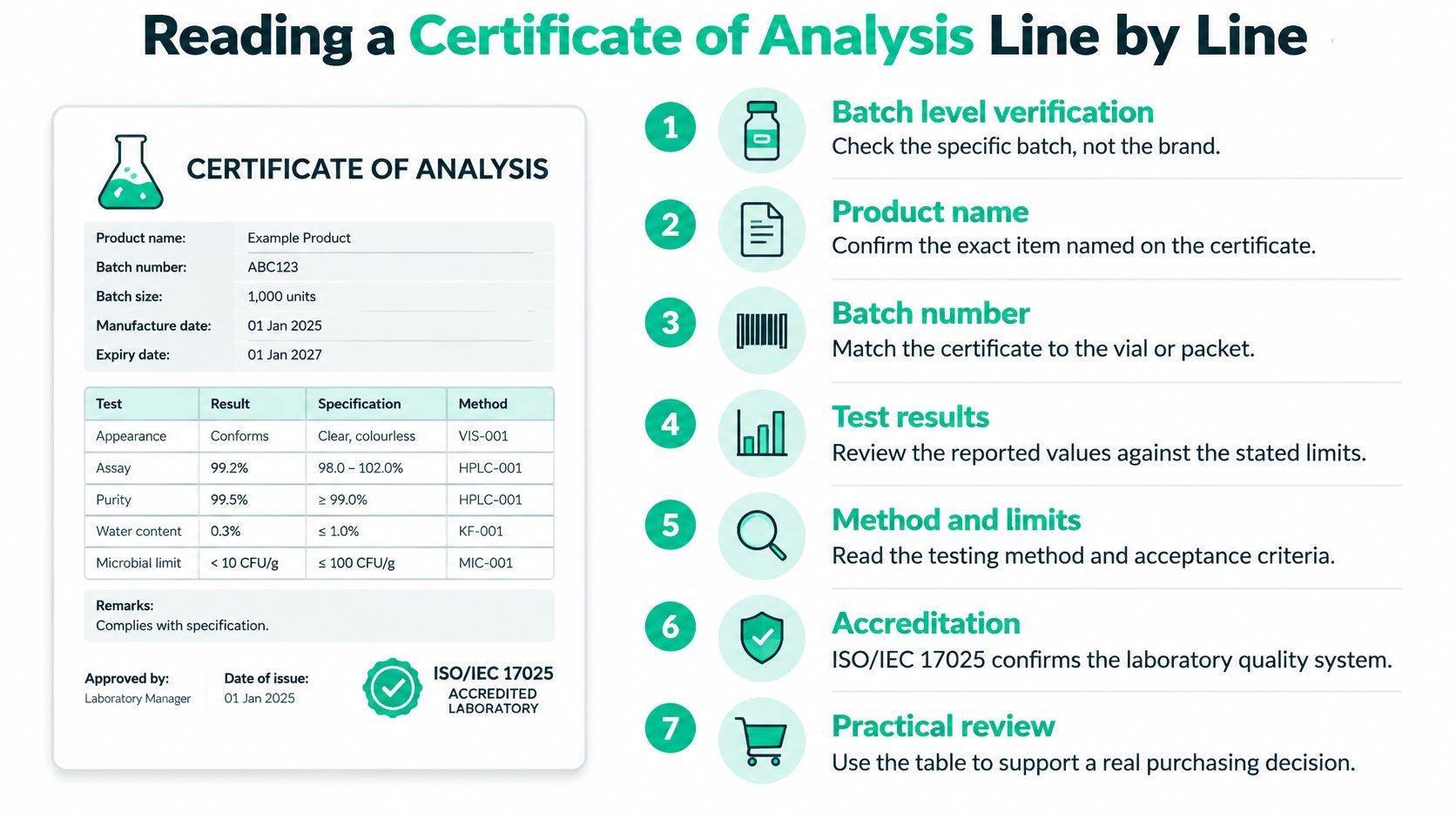
COA fields to check before accepting a batch
| Field | What to confirm | Red flag |
|---|---|---|
| Testing laboratory | Named, independent laboratory | Unnamed or unclear laboratory |
| Accreditation | Scope covers reported method | No accreditation statement |
| Test method | HPLC for purity; mass spectrometry for identity | Method absent |
| Batch number | Matches label and order | Missing or mismatched |
| Report date | Belongs to the batch and sample | Undated or unrelated |
| Result units | Clearly labelled for each result | Inconsistent or absent |
| Document source | Manufacturer or independent laboratory identified | Source unclear |
NATA explains that ISO/IEC 17025 assesses technical competence for methods within a laboratory's scope, not every possible test. The NATA accreditation register identifies accredited sites through accreditation numbers, site numbers and defined scopes.
Our online lab library holds independent certificates linked from product pages, with in testing shown where results are pending.
Review rule: An untraceable field makes the document incomplete, not automatically false. Resolve it before release.
Supplier Checks and Documents to Request
Use these yes-or-no questions before approving a supplier:
- Regulatory position: Is each product's status clear, with laboratory and therapeutic claims separated?
- Document origin: Are manufacturer documents distinguished from independent reports?
- Laboratory competence: Can the supplier identify the laboratory and relevant accreditation scope?
- Lot traceability: Can you connect the vial, COA and order record?
- Transport controls: Are storage and transport conditions available in writing?
The TGA's peptide product information warns that unapproved products haven't been assessed for safety, quality or effectiveness. ARTG status and batch verification answer different questions.
Request the specification sheet, batch COA, independent report, storage and transport statement, lot identifier, intended-use statement and GST invoice. For sterile laboratory work, request independent sterility and endotoxin controls; these don't confer medicine approval.
We trade as PMA, ABN 21 102 515 841. Use our Australian peptide supplier checklist to organise enquiries. An unnamed laboratory or unmatched batch fails a basic documentation check.
Bulk, Wholesale and Institutional Buying Routes
Buying routes for research and procurement teams
| Route | Best for | What to request | Documentation to expect |
|---|---|---|---|
| Standard 10-pack | Repeat work on one product | Product specification | Batch COA on product page |
| Custom bulk order | Larger programmes | Quantities and quote | Same independent testing standard |
| Request a quote | Itemised procurement pricing | Written quote | Specifications and batch documents |
| Institutional supply arrangement | Ongoing university or biotech needs | Procurement information pack | Documentation pack and GST invoices |
Choose by programme size and document requirements, not pack price alone. Request AUD itemised pricing so purchasing staff can reconcile the quote with the specification.
Our Australian-based support team assists with research specifications before a quote is issued. GST invoices can be requested through any route; programme enquiries can use the bulk and wholesale research supply pathway.
Standardise the product format where practical, but preserve separate batch records.
How Ordering and Domestic Fulfilment Work
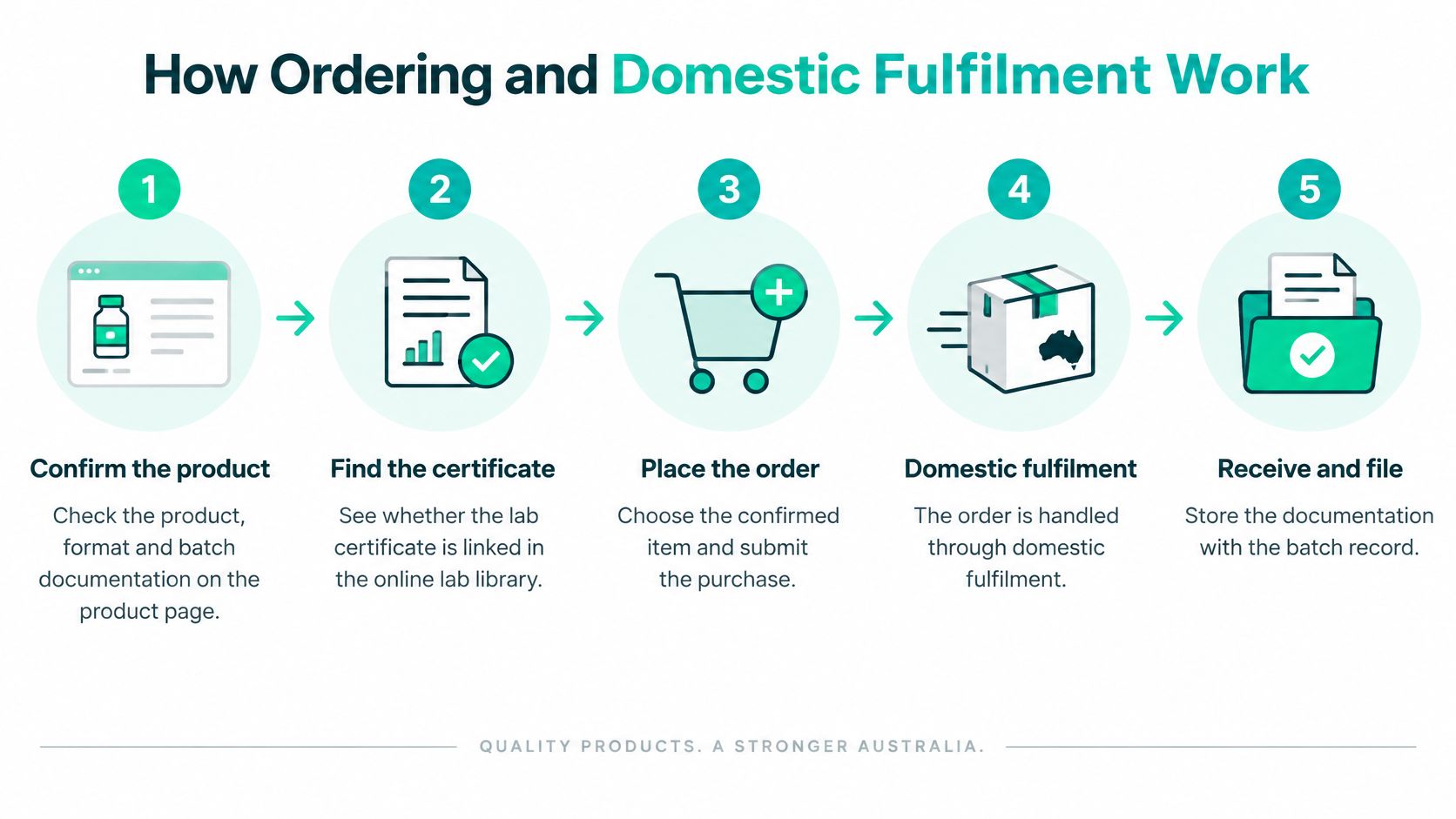
- Confirm the item. Review its format, specification and certificate status.
- Save the batch identifier and specification with the purchase record.
- Complete checkout and request a GST invoice if needed.
- Check the dispatch origin and shipping information. We use express post with tracking; delivery is typically around one week door to door, not guaranteed.
- Keep the tracking record, COA and order confirmation together for receipt checks.
We sell to Australian customers only. Australian ownership doesn't mean every parcel originates domestically: 10-packs ship from our overseas facility, while trial vials ship from Brisbane. Procurement teams should account for the actual dispatch origin when scheduling work.
Using the Calculator and a Receiving Workflow
Treat the concentration calculator as a record-checking aid, not a preparation guide. It can cross-check the stated vial quantity and a volume already documented in an approved laboratory protocol against an inventory entry. It doesn't recommend volumes or replace protocols or ethics approval.
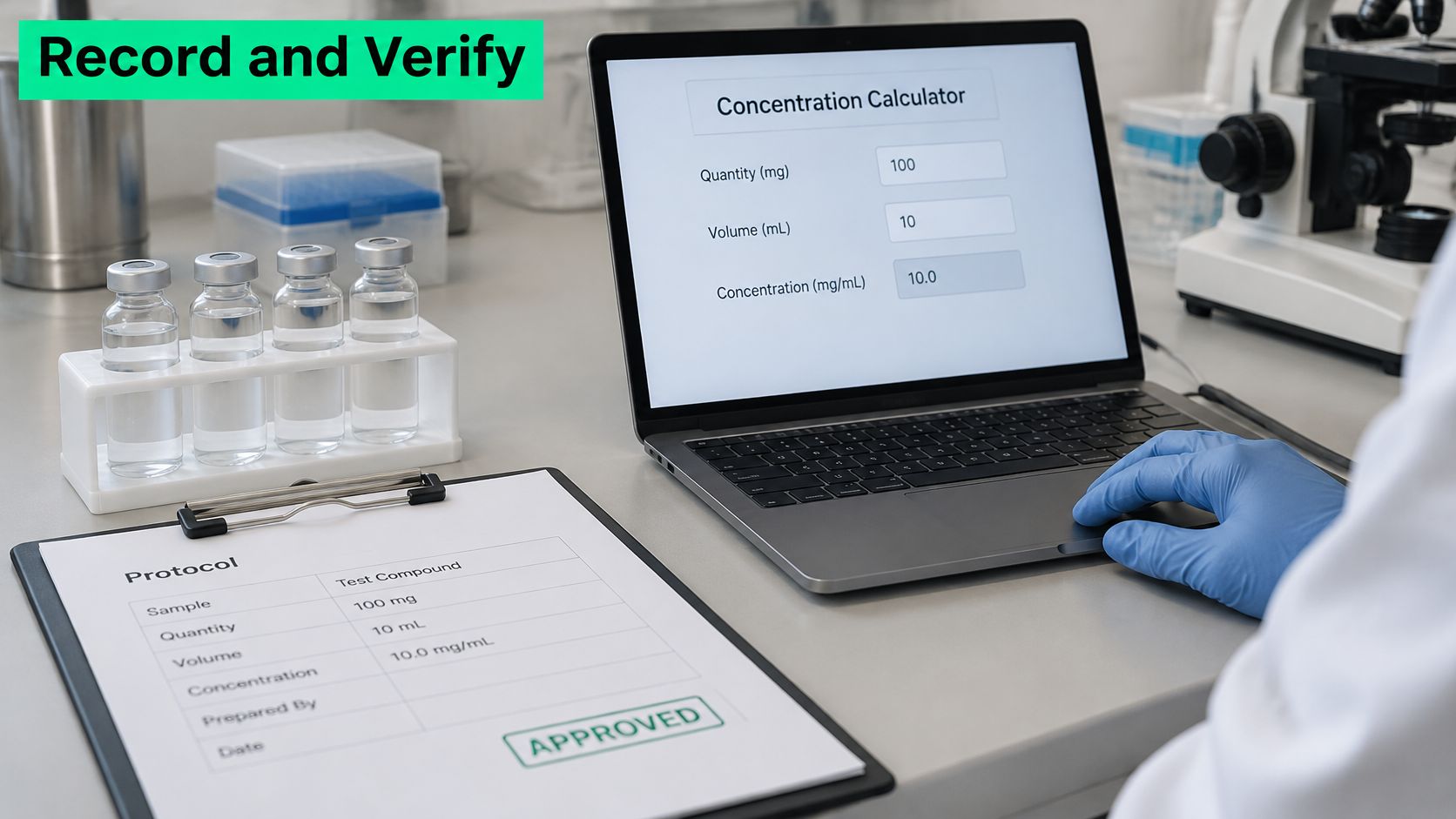
- Compare the delivery with the order: product name, SKU and batch.
- Match the received batch to its COA.
- Check stated vial quantity and format against the specification.
- Log receipt date, storage condition and lot.
- Quarantine discrepancies, including unlabelled or mismatched vials, and contact support.
- Release material for study only after the responsible reviewer signs off.
This creates a receiving record that another person can audit without reconstructing the purchase from emails.
Confirm Your Supplier Before You Order
Before committing funds, review the supplier's regulatory position, batch evidence and laboratory scope. Use the product finder, glossary and comparison tools to clarify terminology, then request a quote or procurement information pack for programme-level needs. The Australian-based support team replies to enquiries within 24 hours.
Does a research-use-only label establish compliance?
No. Intended purpose and promotion also matter.
What does ISO/IEC 17025 establish?
Competence within the accredited scope. Check whether that scope covers the reported test.
What if the certificate says “in testing”?
Request the completed report before recording the batch as released.
Can I request a GST invoice?
Yes. Ask when ordering.
Bulk Aussie Peptides supplies research products and offers procurement support for Australian buyers. Visit Bulk Aussie Peptides to review specifications and request batch evidence or an itemised quote.