
Peptides and Polypeptides: A Research Guide for Australia
A peptide is a short chain of amino acids, usually up to about 50 units, and a polypeptide is a longer chain. That cut-off is a convention in the research literature, not a line set by law.
If a certificate shows a high purity figure, have you learned what the vial holds, or whether anyone approved the compound? Most buyer guides blur those answers. A tested batch, a labelled mass and a regulatory status are separate questions, and peptides and polypeptides are easier to judge once you keep them apart.
Table of Contents
- Peptides and Polypeptides Compared by Length and Shape
- How Amino Acid Chains Do Their Work in the Body
- How Peptides Are Made and Tested for Identity and Purity
- Where Peptides Are Studied in Research
- What Research-Only Labels Do and Do Not Cover
- Reading a Certificate of Analysis and Checking Batches Before You Order
- Frequently Asked Questions
Peptides and Polypeptides Compared by Length and Shape
Read the stated length, then classify the compound. Oxytocin is 9 amino acids and BPC-157 is 15, so both are peptides. Insulin is the classic polypeptide: the Medical Journal of Australia describes it as 51 amino acids in two chains linked by disulfide bonds.
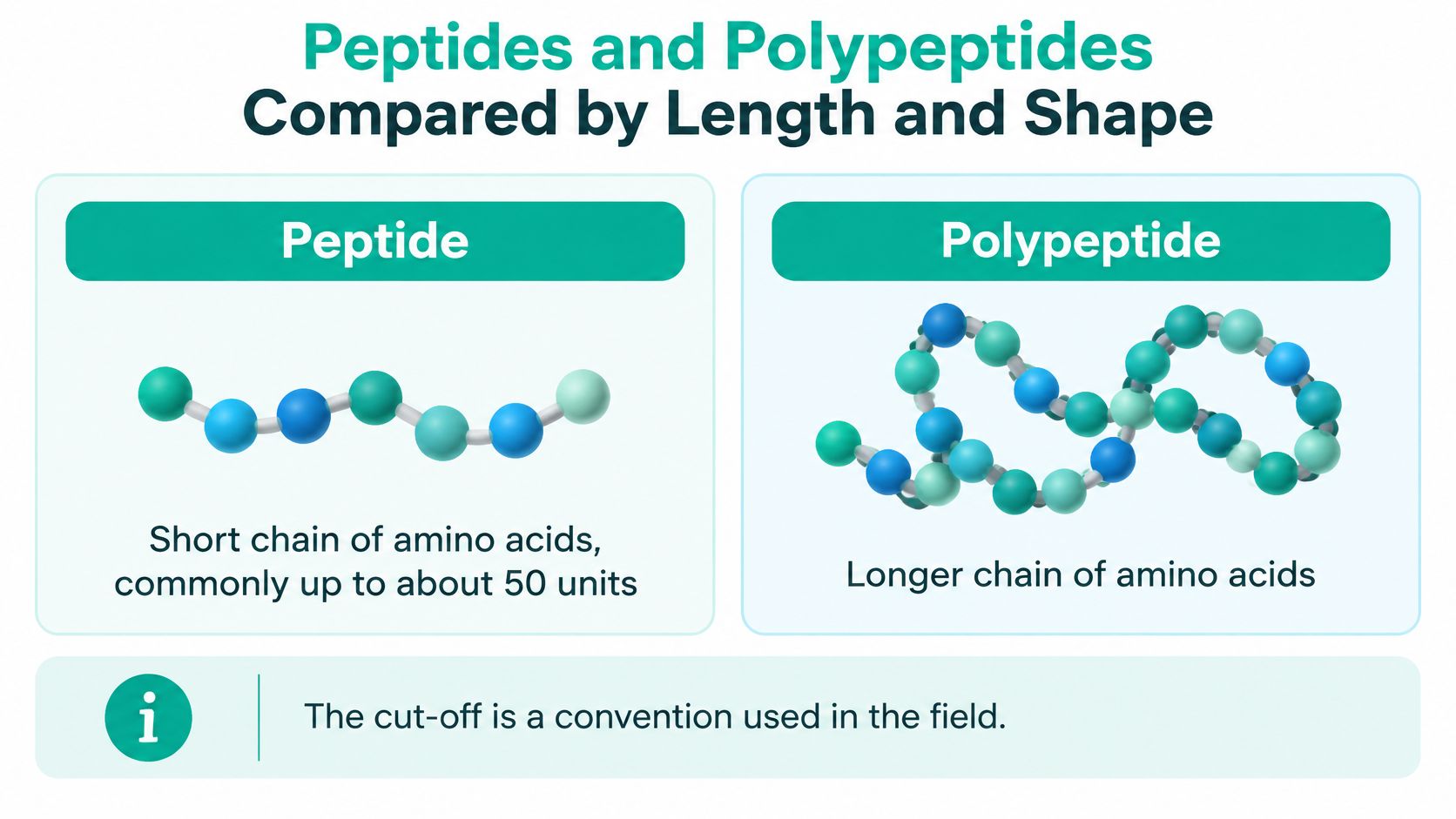
Peptide versus polypeptide at a glance
| Feature | Peptide | Polypeptide |
|---|---|---|
| Typical chain length | Commonly up to about 50 amino acids | Longer than that conventional cut-off |
| Example molecules | Oxytocin (9), BPC-157 (15) | Insulin (51 amino acids in two chains linked by disulfide bonds) |
| Shape | Often flexible; little stable folding on its own | Can fold into a defined three-dimensional shape |
| Lab characterisation | Purity by HPLC; identity by mass spectrometry | Same methods, plus checks for folding and aggregation |
| Typical research focus | Signalling and receptor binding | Hormone and protein structure, folding and larger biological function |
A peptide is a short sentence. A polypeptide is a paragraph that can fold into a three-dimensional shape. Identity and molecular-mass checks apply to both. Longer chains also need folding and aggregation checks. Lengths are listed in our research peptide glossary, and peptide basics for wellness and performance adds plain context for short chains.
How Amino Acid Chains Do Their Work in the Body
Amino acid order sets shape, and shape decides which receptor or enzyme a chain can meet. Think of beads on a string, then a key in a lock. Swap two beads and you have a different key.
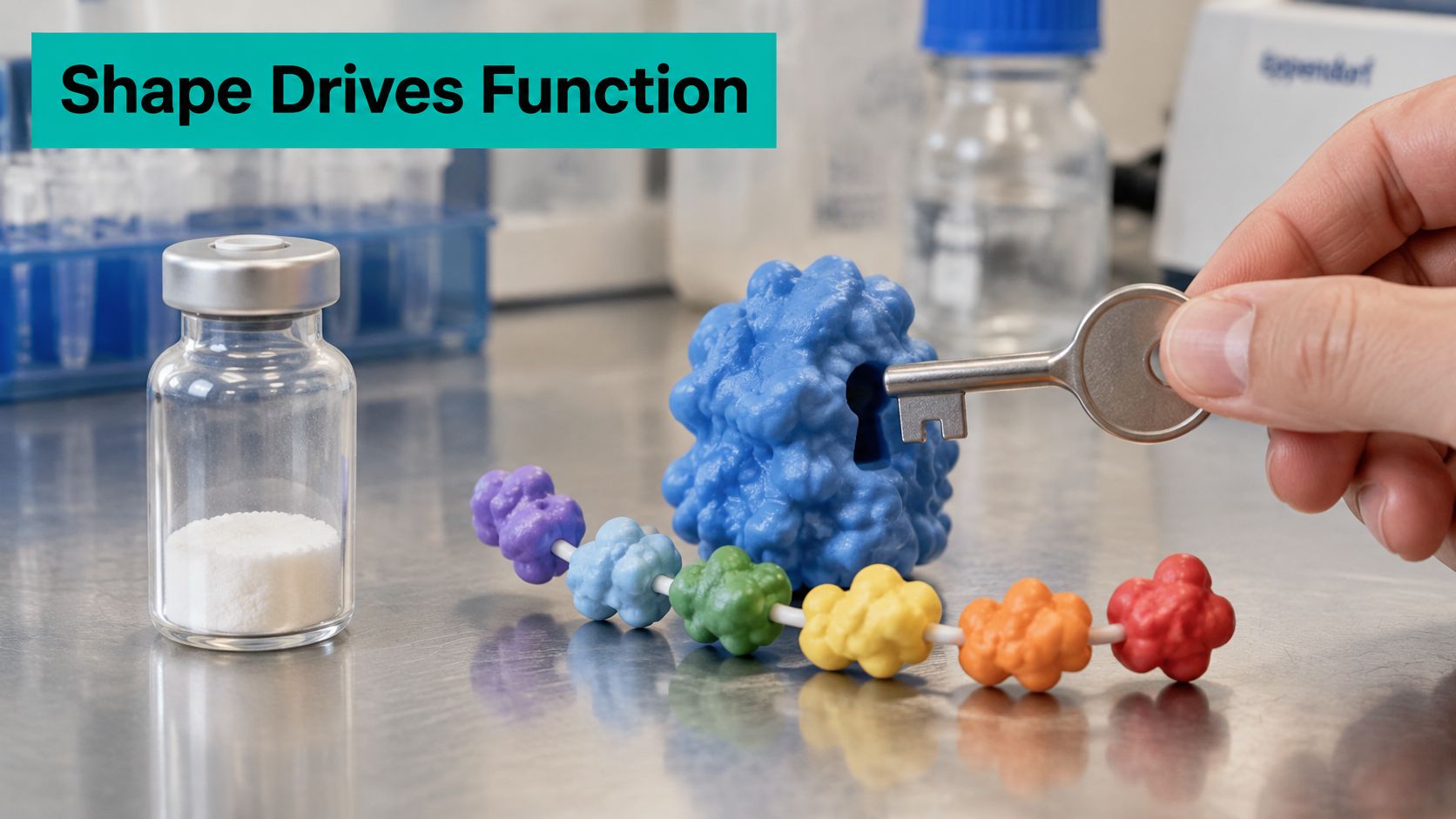
Hormone signals such as oxytocin and insulin carry messages between organs. Short peptides are studied for local tissue-signalling pathways in cells and animals. Larger polypeptides fold, hold structure, or speed a reaction as enzymes.
Ribosomes read the genetic code, join amino acids in that order, then the chain is trimmed and folded. The same amino acids in a new order are a different molecule, so the sequence claim is the first check a lab makes.
A result in cells or animals does not transfer on its own to another formulation, route or species.
Researchers confirm sequence and molecular weight before an experiment starts. This clip shows how a binding site recognises a chain.
How Peptides Are Made and Tested for Identity and Purity
Solid-phase synthesis and recombinant routes
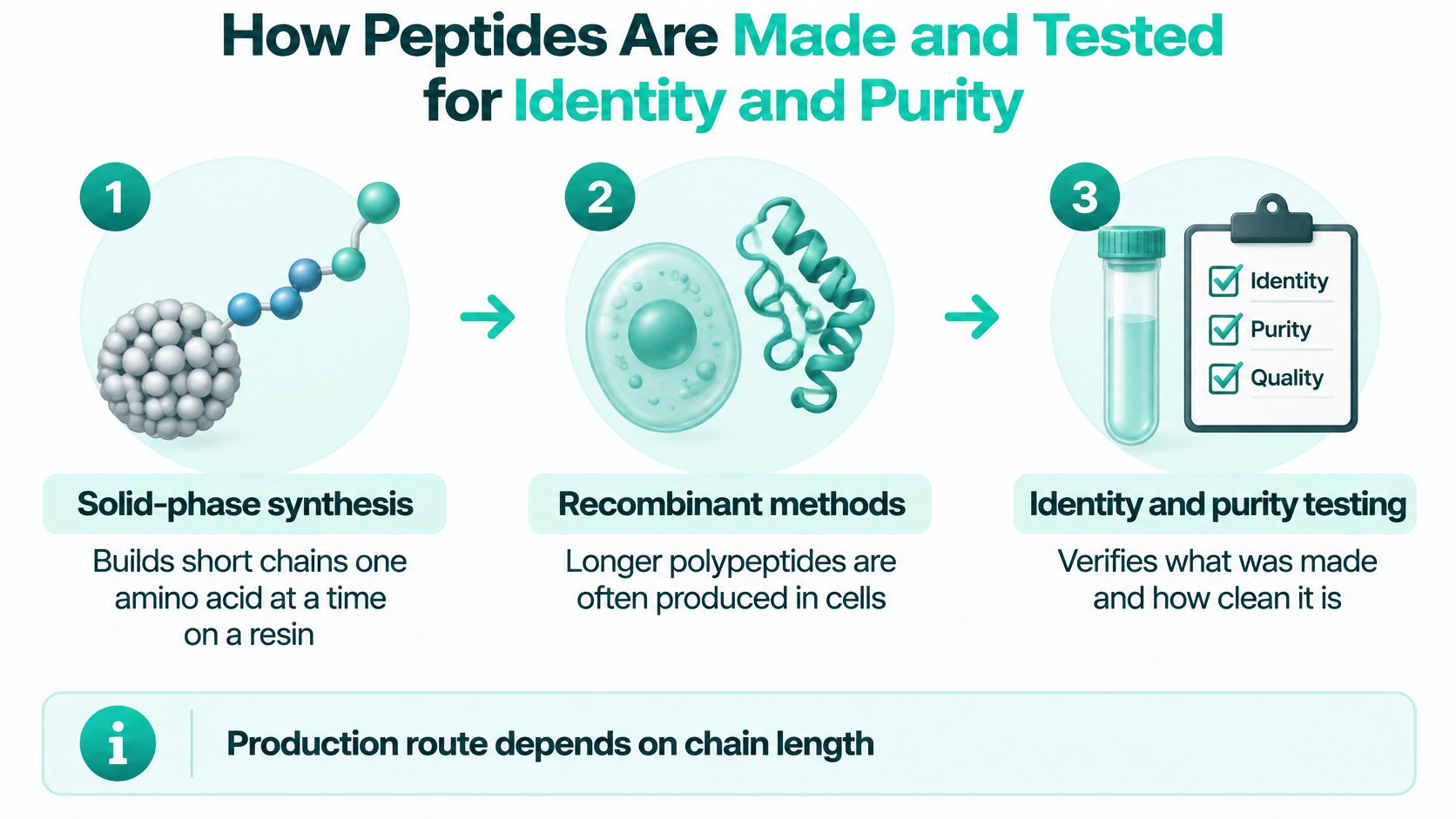
Solid-phase synthesis builds a short chain one amino acid at a time on a resin. Longer polypeptides are often made by recombinant methods in cells. Preparative HPLC cleans the material, then freeze-drying leaves the powder cake.
Grand View Research estimates Australia's peptide synthesis market generated USD 12.6 million in revenue in 2024, with a forecast of USD 25.2 million by 2033.
Analytical methods and what each one proves
| Method | Question it answers | Typical result | Limit |
|---|---|---|---|
| HPLC | How pure is the sample? | Peak-area percentage | Does not confirm sequence on its own |
| Mass spectrometry | Is the molecular mass as expected? | Observed mass against expected mass | Does not show how much peptide is in the vial |
| Amino acid analysis | How much peptide content is present? | Amino acid ratios and quantity | Needs a specialised laboratory |
| Endotoxin testing | Are bacterial endotoxins present? | Endotoxin units per amount | Separate from purity and identity |
| Residual solvent testing | Are manufacturing solvents left behind? | Solvent levels against limits | Does not show identity |
Purity, identity and content are three results. A high purity figure doesn't show how much peptide the vial holds, and a correct mass doesn't show the vial is free of endotoxins. Check every line on the certificate, including on synthetic peptides, and open the linked certificate in the online lab library.
Where Peptides Are Studied in Research
Different peptides are studied for different questions. Results for one compound do not establish effects for another, and findings in cells or animals do not by themselves show what happens in people.
Research areas, example compounds and evidence to check
| Research area | Example compounds | What studies examine | Evidence to check |
|---|---|---|---|
| Metabolic | Semaglutide, tirzepatide, retatrutide | Glucose handling and appetite signalling in preclinical models | Whether human studies used the same molecule, formulation and route |
| Tissue repair | BPC-157, TB-500 | Tissue signalling pathways in cell and animal models | Whether findings come from animal studies only |
| Skin, hair and nail | GHK-Cu | Copper-binding activity in cell-based work | Whether the study used the same delivery form |
| Hormone research | Insulin | Glucose regulation and cell signalling | The medicine's approval status and approved uses |
A study result and a batch record answer different questions. Use the research compound database to explore compound names and study types. For a product batch, match the relevant result in the COA Library to the vial you plan to order. A batch result documents what was tested; it does not establish approval or guarantee what a vial will reliably contain.
What Research-Only Labels Do and Do Not Cover
Research-only peptide labels
A common assumption is that a research-only sticker makes a product low-risk. It doesn't. Classification follows ingredients, intended use, presentation and promotional claims, so a peptide promoted for weight loss, recovery or performance can still be treated as a therapeutic good.
The TGA safety alert on unapproved peptide products says those products have not been assessed for quality, safety or effectiveness. Some peptide medicines, including insulin products used to manage diabetes, are approved and listed on the ARTG for specified purposes. Many approved peptide medicines are prescription-only and generally can't be advertised to the public. Applications involving an unapproved good should be supported by human studies on that peptide, dosage form, route and indication. More detail sits on our page about research peptide regulation in Australia.
Most of our research peptides are a lyophilised (freeze-dried) powder. Keep vials sealed, store them as the specification sheet states, and record receipt date, batch and storage. Vial mass isn't peptide content. Water, counterions and leftovers can add weight.
A Certificate of Analysis documents a batch's tested characteristics. It doesn't turn an unapproved compound into an approved medicine.
This is general information, not medical advice, and it gives no instructions for use.
Reading a Certificate of Analysis and Checking Batches Before You Order
A Certificate of Analysis records tested identity, purity and content for a named batch. It doesn't show regulatory approval or a clinical effect.
The Alcohol and Drug Foundation, summarising Australian regulatory warnings, reports that testing of three retatrutide products sold online found peptide content from approximately half to almost twice the labelled amount. That spread is roughly fourfold between the lowest and highest measured content relative to the label. Treat the label as a claim to verify.
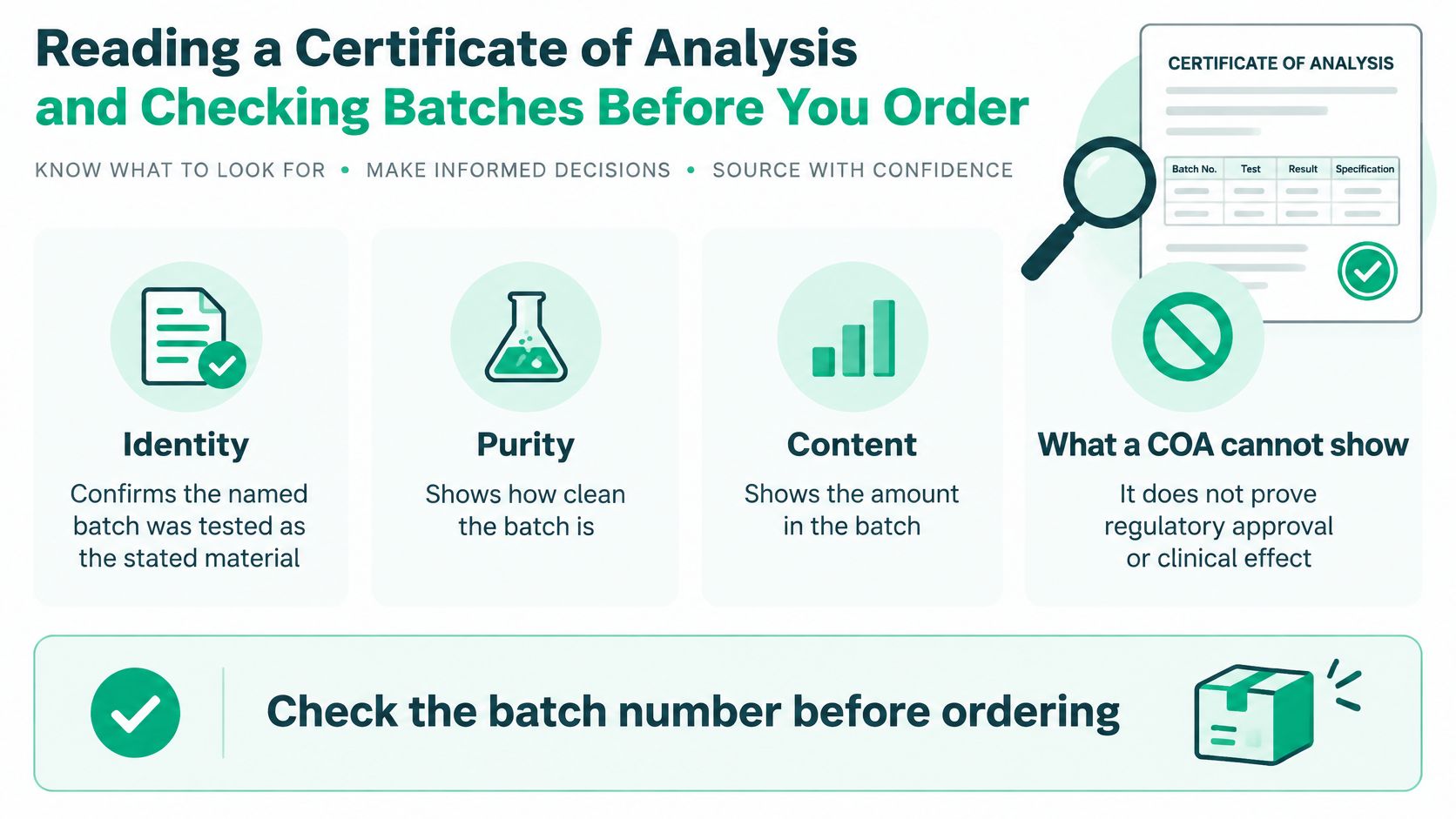
What each batch document can and cannot show
| Document | What it can show | What it cannot show |
|---|---|---|
| Certificate of Analysis | Tested identity, purity and content for a named batch | Regulatory approval or clinical effect |
| Manufacturer documentation | Production and specification details | Independent verification unless also tested externally |
| Independent laboratory report | Results from a third-party laboratory for a named batch | Safety for human use |
| Batch number match | Links a test result to a specific vial | Quality of a different batch or product |
- Match the batch number on the certificate to the vial.
- Confirm the source of the results, manufacturer or independent laboratory.
- Check identity and content, not purity alone.
- Note the storage conditions on the specification sheet.
- File the records against the product and batch.
Confirm the stated molecule and length, then open that batch in the COA library. Pending results show as in testing. Send a documentation request with the batch number. We're Australian owned and operated, with tracked Australia-wide shipping.
- BAP
Frequently Asked Questions
What does “in testing” mean on a product page?
It means the batch result is pending. Check the available batch documentation before ordering, and treat a result that has not been published as unverified.
How do I request documents for a batch I already hold?
Provide the product name and batch number when requesting documentation. Ask for the report for that specific batch, since a general specification sheet does not confirm results for the batch you have.
How can I request a bulk quote or procurement pack?
Bulk Aussie Peptides offers bulk research supply, quotes on request and a Procurement Pack. Contact the Australian-based support team with your research or procurement requirements.
Why are most products sold in 10-packs?
Bulk Aussie Peptides offers 60+ research peptide products, usually in sealed 10-vial packs. Some products are also available as single-vial trial sizes.
For research procurement, check the product specifications and batch documentation relevant to the material you are considering. Bulk Aussie Peptides supplies research-use-only peptides and provides documentation to support laboratory review. Visit Bulk Aussie Peptides to view the catalogue and procurement options.