
CJC 1295 Side Effects: What Research Reports Show

Popular online advice often presents CJC-1295 side effects as a short list of mild, temporary reactions. That framing goes further than the evidence allows. CJC-1295 isn't approved in Australia, the TGA hasn't evaluated its safety, quality or effectiveness, and no reliable Australian percentage shows how often particular side effects occur. Early human findings, regulator reports and a single serious trial event answer different questions, so they shouldn't be treated as interchangeable evidence.
Table of Contents
- Reported CJC-1295 Side Effects at a Glance
- What CJC-1295 Is and How DAC Changes Exposure
- Why Growth Hormone Signalling Drives Common Effects
- Serious Events and What the Evidence Cannot Show
- Risk Factors and Product Questions to Ask
- Monitoring, Reporting and Research Ethics Steps
- Check Batch Documentation Before You Source
- Frequently Asked Questions About CJC-1295 Side Effects
Reported CJC-1295 Side Effects at a Glance
The table separates early human observations from regulator reports and a single trial event. “Low” evidence here means the information doesn't establish how often an effect occurs; a regulator report can identify a concern without measuring its frequency.
| Reported effect | Where it has been reported | Evidence level | What to record |
|---|---|---|---|
| Injection-site pain, swelling, induration and redness | Early human data summaries and TGA reports | Low, no numerical rates | Site, timing and duration |
| Headache, nausea and diarrhoea | Short human study as summarised by Healthy Male | Low, no numerical rates | Onset relative to each exposure |
| Flushing, rash, oedema and fatigue | Regulatory review of early human data | Low to moderate | Fluid changes, skin findings and energy levels |
| Joint or muscle pain, anxiety and irritability | Regulatory review of early human data | Low | Location, severity and trend over time |
| Insomnia, blurred vision and extreme tiredness | TGA reports on unapproved peptide products | Case reports only | Sleep and vision changes, and whether they persist |
| Severe allergic reaction or hypersensitivity | TGA reports, including adrenaline use and hospitalisation | Case reports only | Symptoms, time to onset and treatment given |
| Myocardial infarction, one death | Phase II trial in HIV-associated lipodystrophy | Single event, attributed to coronary artery disease | Cardiac history and timing relative to exposure |
| Contamination, infection or local tissue damage | TGA warnings on injectable unapproved peptides | Product-quality risk | Batch number, product source and storage conditions |
New, persistent or severe effects need medical assessment, not guesswork.
What CJC-1295 Is and How DAC Changes Exposure
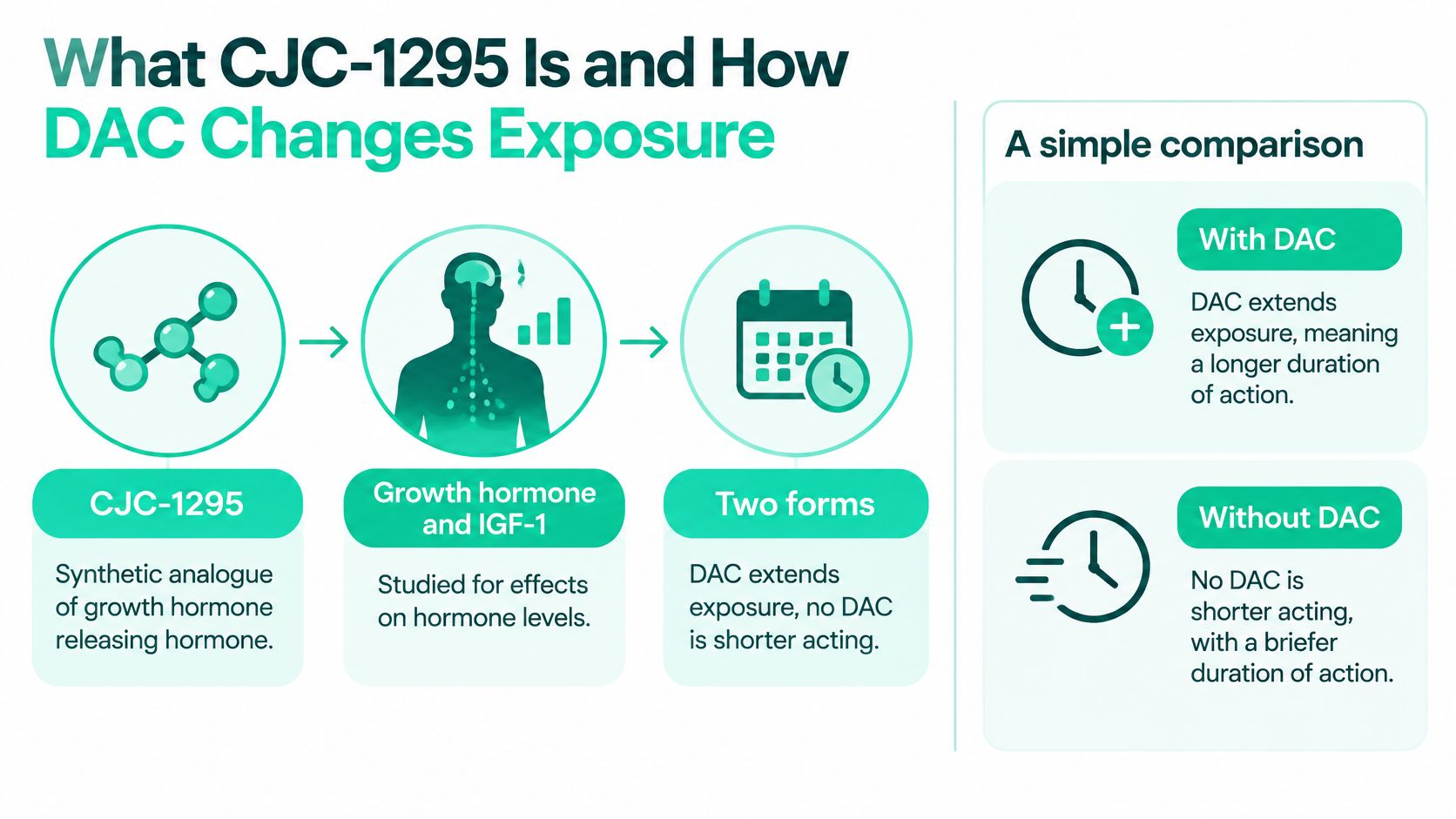
CJC-1295 is a synthetic analogue of growth hormone-releasing hormone, studied for its effects on growth hormone and insulin-like growth factor 1 (IGF-1). Think of non-DAC CJC-1295 as a single bell ring: a shorter signal. The DAC form binds to albumin in the blood, more like a bell that keeps ringing for days. The TGA identifies the compound as CAS 863288-34-0 in its Australian public-health warning.
| Feature | Non-DAC CJC-1295 | DAC CJC-1295 | Why it matters for side-effect research |
|---|---|---|---|
| Structure | Core peptide without albumin binding | Core peptide with a drug-affinity complex that binds albumin | Albumin binding changes exposure |
| Duration in the body | Short, measured in minutes | Several days | Longer exposure allows more time for effects to develop |
| Stimulation pattern | Brief pulses of growth hormone release | Sustained elevation of growth hormone and IGF-1 | Sustained elevation is linked to fluid, glucose and joint effects |
| Human safety data | Limited published human data | Healthy-adult study and Phase II trial in HIV-associated lipodystrophy | Findings for one form may not transfer to the other |
Longer exposure gives more time for fluid, glucose and joint effects to develop, but the available evidence doesn't quantify that difference as a side-effect rate. Check which form a source describes before comparing claims. For a side-by-side overview, see CJC-1295 DAC versus non-DAC.
Why Growth Hormone Signalling Drives Common Effects
The proposed chain is straightforward: CJC-1295 signals the pituitary, growth hormone and IGF-1 rise, and the body responds through systems including fluid balance, blood-vessel tone, glucose handling and local inflammation. It's like changing a thermostat's set point: the whole house responds, not just one room. Subcutaneous administration can also trigger inflammation at the local site.

Regulatory-review material describes local reactions and systemic effects in early human data, while noting that hormone changes can affect vascular tone and fluid balance. The review of early CJC-1295 safety findings also records a myocardial infarction during a Phase II programme, with the trial physician attributing it to coronary artery disease. That attribution doesn't make the event irrelevant to safety monitoring.
Healthy Male's summary of a short human study reports injection-site reactions, headache, nausea and diarrhoea, but gives no numerical rates. Short studies can describe early tolerability; they can't establish long-term safety or quantify whether effects rise with longer or continuous exposure. Researchers reviewing measurement options can consult this guide to blood biomarkers for monitoring growth hormone. For a comparison with another research peptide, see CJC-1295 versus Ipamorelin.
Serious Events and What the Evidence Cannot Show
Early trial findings cannot establish safety across longer or broader use. CJC-1295 is not included in the Australian Register of Therapeutic Goods, and its safety, quality and effectiveness have not been evaluated by the TGA. No reliable Australian incidence percentage exists for CJC-1295-specific side effects. Reports about unapproved peptides as a category cannot provide that rate. The TGA safety alert on unapproved peptide products describes reports of severe allergic reactions requiring adrenaline and hospitalisation, and systemic inflammatory response requiring hospital care.
A regulatory review records a myocardial infarction and death in a participant in a Phase II CJC-1295 trial. The trial physician attributed the event to previously asymptomatic coronary artery disease and judged it unrelated to CJC-1295. That assessment is relevant context, not proof that the compound played no role. A single event cannot establish causation or estimate incidence. Suspected serious reactions warrant urgent medical care. Research teams can consult the research methodology guidance when assessing how study design affects what safety findings can show.
Risk Factors and Product Questions to Ask
Before research begins, put these questions to the ethics committee and document the answers. Available trial evidence doesn't describe every health group, so don't assume its findings apply to people with diabetes or altered glucose handling, cardiovascular disease, sleep apnoea, pituitary disorders or cancer history.
- Existing conditions: Which baseline glucose, fluid, heart-rate and symptom observations are relevant to the approved study?
- Exposure: Is the material DAC or non-DAC, and how will the duration and continuity of exposure be recorded? The trial death involved a participant with previously asymptomatic coronary artery disease, which makes cardiovascular history important context, not proof of cause.
- Medicines and source: Could concurrent medicines affect glucose, blood pressure or growth-hormone signalling? Does the product have known composition and traceable batch records? The TGA warns that unapproved peptide products can carry contamination and unknown long-term risks.
Flag each relevant factor before work begins. The Australian research-peptide regulation overview provides further context for sourcing decisions.
Monitoring, Reporting and Research Ethics Steps
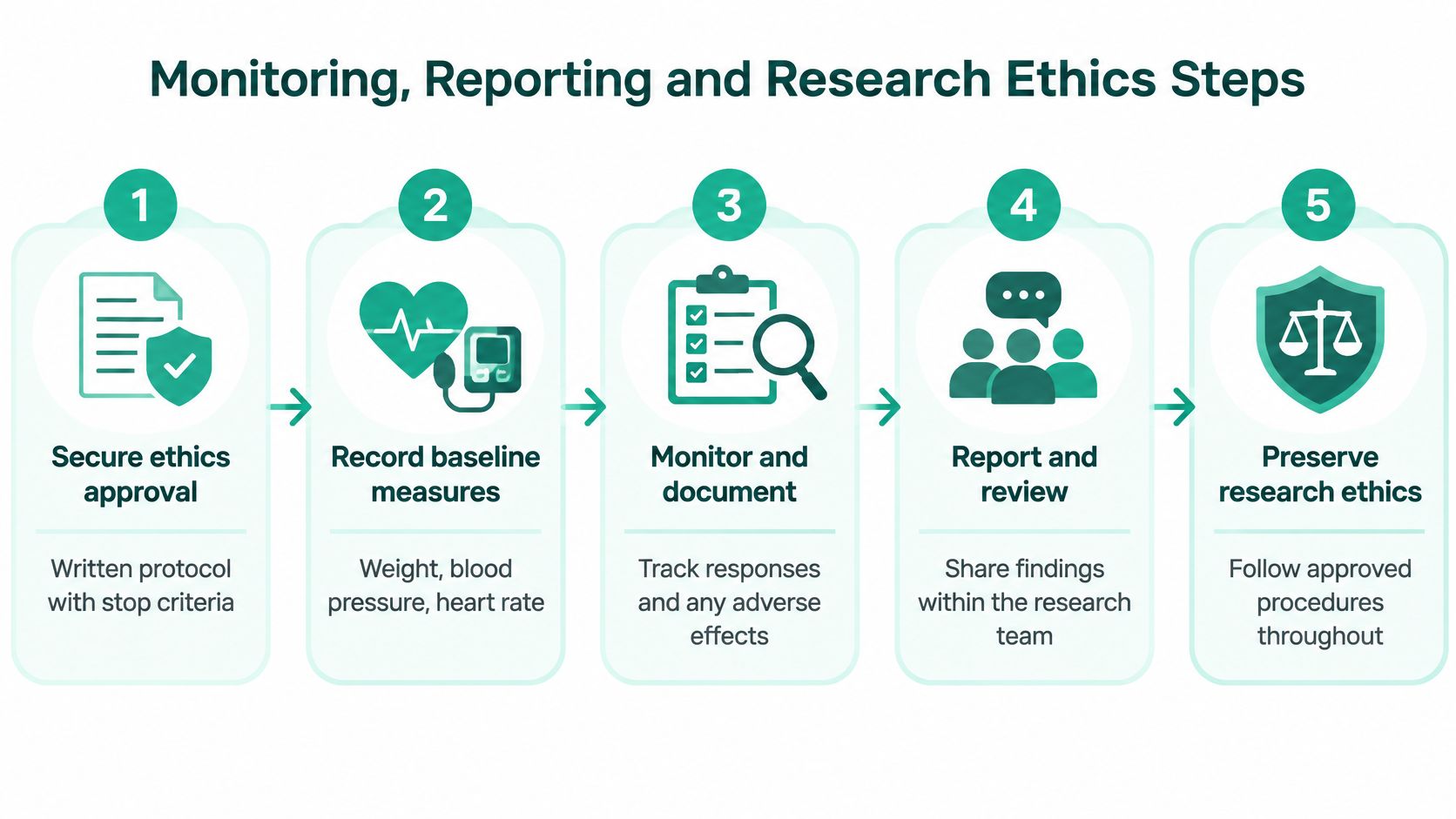
A written record makes it possible to assess timing and identify a batch-specific pattern. Use the approved protocol and its stop criteria; these steps are for research governance, not personal-use instructions.
- Secure ethics approval and define written stop criteria before work begins.
- Record baseline measures such as weight, blood pressure, heart rate, fasting glucose, sleep and skin or joint observations.
- Set endpoints for fluid changes, glucose, local reactions and cardiac symptoms.
- Log onset and duration relative to each exposure.
- Escalate symptoms using the triage table and seek emergency care where indicated.
- Report serious or unexpected reactions to the TGA and the institution's ethics committee.
- Review the log at set intervals and stop the work if a stop criterion is met.
| Symptom | Action | Reporting |
|---|---|---|
| Hives, facial swelling or breathing difficulty | Emergency medical care immediately, then stop the work | Report to the TGA and ethics committee |
| Chest pain or palpitations | Urgent medical assessment, then stop the work | Report to the TGA and ethics committee |
| Persistent headache, insomnia or visual change | Clinical review and pause the exposure | Log in study records and report to the ethics committee |
| Persistent local swelling or redness | Document, review and pause if it persists | Log in study records |
| Joint pain, oedema or extreme fatigue | Record the trend and review against stop criteria | Log in study records |
A complete record includes the product name, batch number, onset, duration and outcome. For practical context on consistent measurement, see Lola's essential biomarker tracking tips.
Check Batch Documentation Before You Source
Batch documentation can help establish what a research product is represented to contain, but it cannot establish clinical safety. Bulk Aussie Peptides supplies sealed 10-vial packs labelled with the product name, quantity per vial and batch reference. Individual glass vials are unlabelled, so retain the pack label with the study records.
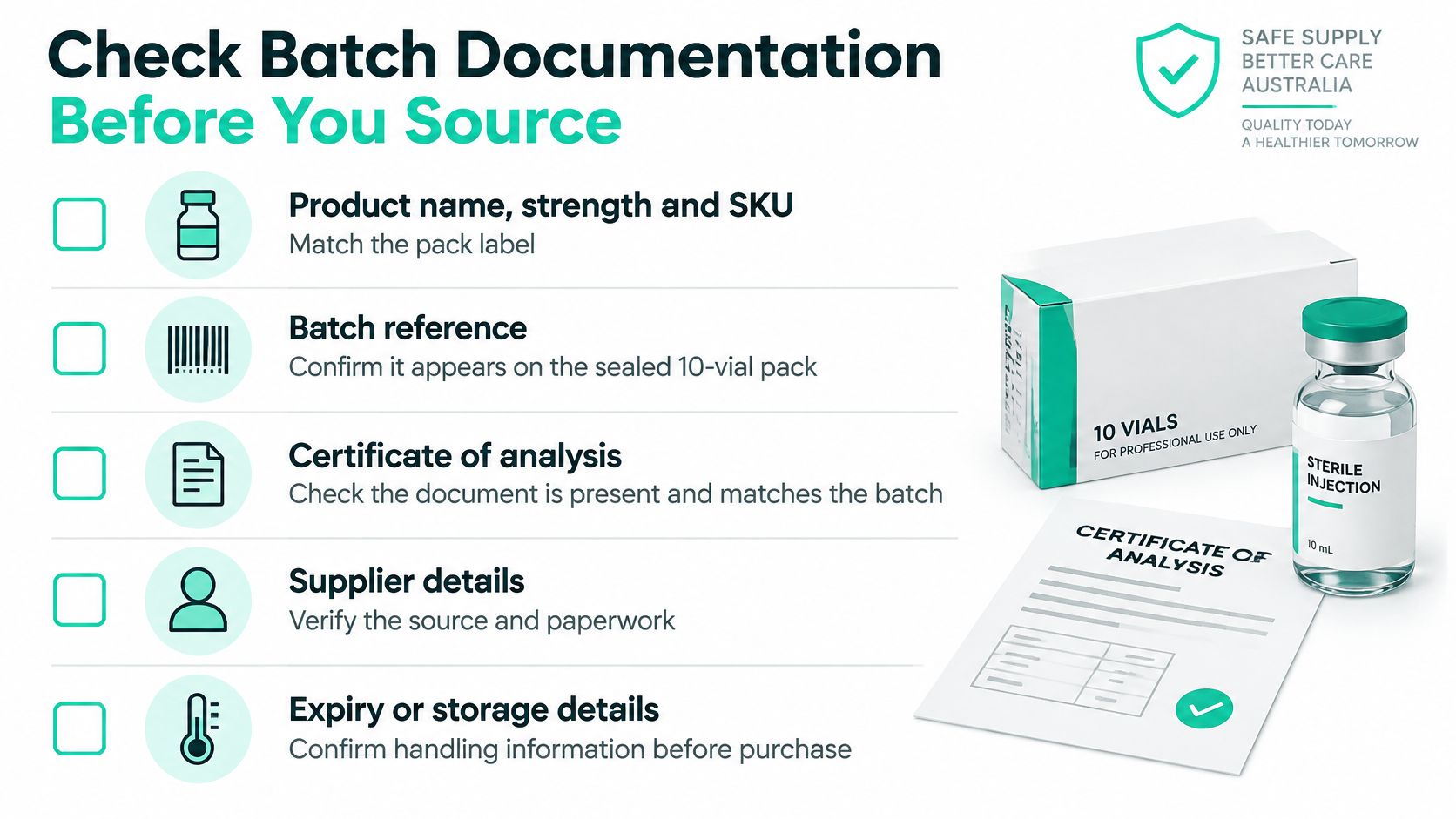
Before sourcing, check that:
- The product name and quantity per vial on the pack match the product specifications.
- The batch reference on the sealed pack matches the batch record and its Certificate of Analysis (COA).
- The COA reports identity and purity results, and clearly identifies whether the documentation is manufacturer-provided or from an independent laboratory.
- The batch record is available in the Bulk Aussie Peptides COA library and corresponds to the pack's batch reference.
- Storage instructions in the product documentation are consistent with the conditions planned for the study.
Keep the pack label and batch record with the study file so the materials used can be traced to their documentation. For procurement information, consult Bulk Aussie Peptides' bulk and wholesale supply options. Proceed only when the batch documents match the pack and the planned work has ethics approval.
Frequently Asked Questions About CJC-1295 Side Effects
Is CJC-1295 approved in Australia?
No. It isn't included in the Australian Register of Therapeutic Goods, so the TGA hasn't evaluated its safety, quality or effectiveness.
What side effects have been reported most often?
Early studies and summaries describe local reactions, headache and nausea, but they don't provide reliable rates. Reported effects shouldn't be read as a ranked frequency list.
Does a clean early trial mean the compound is safe?
No. Short, small studies can show early tolerability, not long-term safety; a fatal myocardial infarction was recorded in a Phase II trial.
What should happen after a suspected serious reaction?
Seek urgent medical care rather than waiting to see what happens. Research teams should also report the event to the TGA and their ethics committee.
Bulk Aussie Peptides is an Australian-owned and operated research-peptide supplier offering sealed 10-vial formats, with batch documentation and independent lab certificates in its online library. Visit Bulk Aussie Peptides to review available documentation and procurement information before making a research-sourcing decision.
- BAP