
BPC 157 10mg Research Vials and Batch Verification
You're comparing two listings side by side, both labelled BPC 157 10mg, and the vial photos look almost identical. One page links to a batch report. The other gives you a price and little else. That gap is the procurement problem. A nominal quantity tells you what a supplier says is in the vial. It doesn't tell you whether the material's been identified correctly, which batch you'll receive, or what records you can file if an auditor asks.
Table of Contents
- BPC 157 10mg Research Vials at a Glance
- Understanding Nominal Quantity and Pack Format
- Comparing BPC-157 10-Pack Specifications
- Trace COAs Through Batch Documentation
- Read BPC-157 COA Evidence Correctly
- Reconstitution Basics Without Usage Instructions
- Work Through a Research Procurement Example
- Key Findings for Australian Research Buyers
BPC 157 10mg Research Vials at a Glance
A BPC 157 10mg research vial is a laboratory supply format with a stated nominal content of 10 mg per vial, commonly sold within a 10-pack. That's a packaging specification. It helps a buyer plan inventory and compare listings, but it isn't evidence of identity, purity, sterility, clinical effectiveness, or regulatory approval.
That distinction matters in Australia. BPC-157 isn't registered on the Australian Register of Therapeutic Goods for any therapeutic indication, and its Schedule 4 status from 1 June 2024 means prescription-only supply, not approval as a medicine, as set out in Australia's peptide scheduling background. A Schedule 4 listing and an ARTG registration are different things, and confusing them is a common procurement error.
What the Label Can and Can't Tell You
Think of the label as a claim awaiting a paper trail. You can read the compound name, the nominal quantity, and the pack count straight off the listing. You can't read analytical results, manufacturing conditions, or suitability for a particular study from those three fields alone.
| Feature | What a buyer can assess | What it does not establish |
|---|---|---|
| Nominal 10 mg quantity | Stated vial content for inventory planning | Verified mass, purity, or potency |
| 10-pack format | Number of vials supplied per order unit | That each vial was individually tested |
| Compound name BPC-157 | Intended material identity on the listing | Confirmed molecular identity |
| Batch or lot number | Link to a specific production run | Quality without a matching analytical record |
| Physical presentation | Sealed vial and powder appearance | Sterility or manufacturing standard |
This is a neutral research explainer for Australian laboratories, universities, biotech teams, procurement staff, and curious readers comparing suppliers. It doesn't provide human-use, dosing, or administration guidance, and it doesn't treat research interest in recovery, weight, or skin topics as evidence of outcomes. The practical sequence is simple: interpret the label, check the specification, trace the batch, then decide whether the documentation meets your own acceptance criteria before money changes hands.
Understanding Nominal Quantity and Pack Format
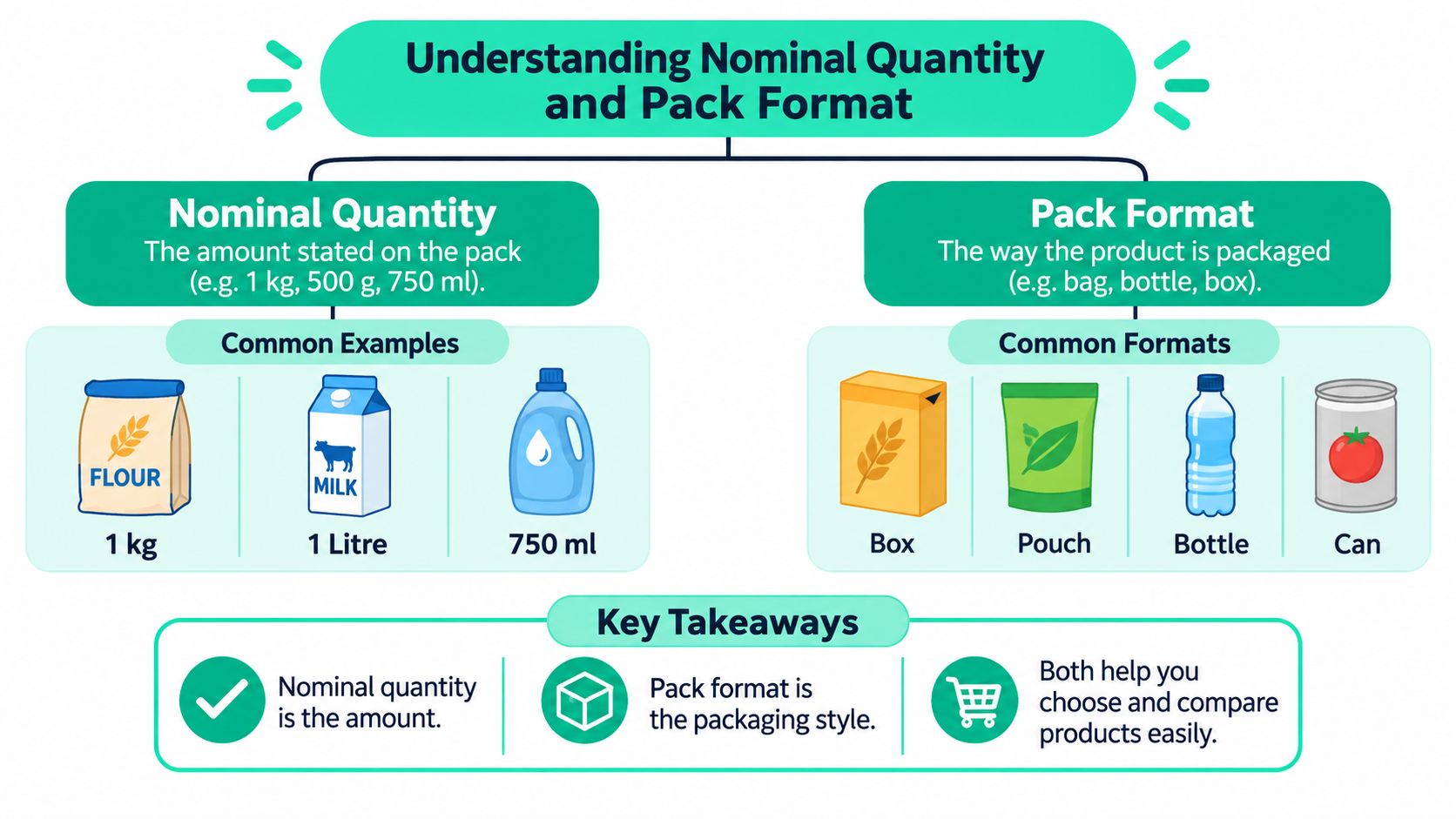
Three numbers get blurred together on product pages, and they're not interchangeable. Nominal vial quantity is the stated content of one vial. Pack quantity is how many vials arrive in one order unit. Total supplied quantity is those two multiplied together. None of them describes the concentration of a solution once a laboratory prepares the material, because that's determined later under the laboratory's own procedures.
A warehouse analogy helps. A carton labelled with a weight tells you what the sender claims is inside. A weighbridge ticket, a packing list tied to a lot number, and an inspection record are what let a receiver check whether the contents match the description. The label starts the conversation. Independent records finish it.
Why Concentration Is a Separate Variable
A stated 10 mg quantity describes nominal content only. It doesn't establish a validated human dose, a clinical concentration, sterility, or a demonstrated outcome, a point made clearly in the Australian BPC-157 research summary. Concentration depends on preparation variables that sit outside the vial label entirely, so treating the printed mass as a ready-made strength figure skips a step a careful analyst wouldn't skip.
The 10-pack format serves a different purpose. It supports inventory forecasting, lets a team reserve material from one batch for a controlled program, and reduces reorder frequency. It doesn't, by itself, establish that the material suits any particular experiment. Suitability comes from the study design, the specification, and the acceptance testing your institution requires.
Physical Presentation Versus Verification
Research vials in this category are typically supplied as sealed glass vials containing a freeze-dried powder cake. That presentation is a handling and storage characteristic. A tidy, intact cake tells you the vial survived transit. It tells you nothing analytical. Appearance can't confirm which molecule is present, how pure it is, or whether contaminants are absent.
So when you read a listing, separate the fields. Note the per-vial quantity, the vial count, the storage requirements, and the batch identifier as distinct data points. Then ask which of those fields you can verify independently, and which you're being asked to take on trust.
Analyst's rule: A quantity you can't trace to a batch record is a marketing figure, not a specification you can defend in an audit.
Comparing BPC-157 10-Pack Specifications
Buyers often sort listings by vial count and price, then stop. A procurement analyst sorts by something else: how many fields on the specification can be checked against a document. Standardised examples such as 10 mg ×10 and 5 mg ×10 make the per-vial amount and the pack count distinct variables, and mixing them up produces ordering errors that only surface when the goods arrive.
The short video below gives general background on how this compound is discussed in research contexts. Treat it as orientation, not as product evidence.
A Repeatable Screening Method
A 10 mg ×10 format makes forecasting easy, but it shouldn't be mistaken for ten independently verified samples. Batch testing generally characterises material from a production run, so the meaningful unit of evidence is the batch, not the individual vial. That's why the batch linkage field matters more than the pack count when you're assessing risk.
| Specification field | Procurement question | Documentation to locate |
|---|---|---|
| Named compound | Is the material identified unambiguously? | Product specification sheet |
| Per-vial quantity | Does nominal content match study requirements? | Listing and specification sheet |
| Vial count per pack | How many order units does the program need? | Pack configuration on the listing |
| Physical presentation | Does the format suit storage and handling? | Specification and storage notes |
| Batch linkage | Can this stock be tied to one production run? | Batch or lot number on the vial and invoice |
| Analytical support | What was tested, by whom, and when? | Certificate of Analysis in the lab library |
| Related consumables | Are compatible laboratory supplies listed? | Category pages for laboratory consumables |
Catalogue breadth raises the stakes on consistency. When a supplier carries 60+ compounds in 10-pack formats, a buyer who screens each listing the same way builds a comparable evidence file across the whole order, rather than a patchwork of screenshots and assumptions. The method is dull, and that's the point.
Work through it in order. Identify the nominal quantity. Confirm the pack configuration in writing. Locate the specification sheet. Then determine which batch records you can review before the order is placed, not after the invoice is paid. If a listing can't answer those four questions, the gap itself is useful information about the supplier.
- Start with identity: Confirm the compound name matches across the listing, specification, and any report.
- Check the arithmetic: Separate per-vial quantity from pack count before comparing prices in AUD.
- Demand the batch path: Note whether you can reach a batch record from the product page itself.
Trace COAs Through Batch Documentation
Several production batches can sit behind one catalogue description. The product name stays constant while the underlying material changes, which means a generic quality statement on a product page may describe a batch you'll never receive. Traceability is what closes that gap.
The Three Links in the Chain
The chain has three links, and each does a different job. The SKU or product listing identifies the material in commercial terms. The batch number ties physical stock to one production run. The Certificate of Analysis records what was measured on material from that run. Break any link and the remaining documents float free of the vials in your store room.
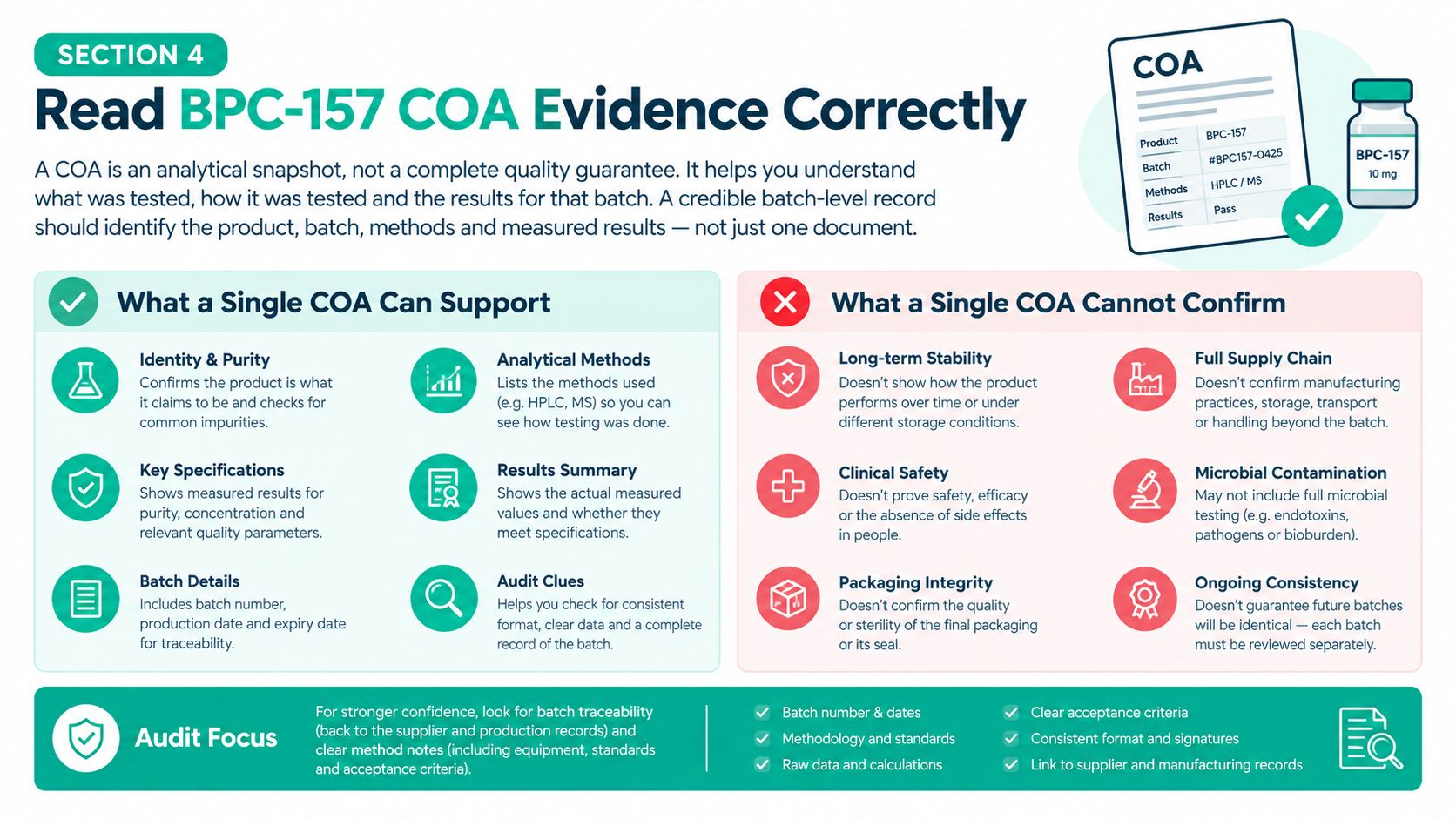
Source matters as much as content. A manufacturer-provided certificate comes from the party that made the material, so it carries an obvious interest. An independent laboratory report comes from a third party with no stake in the sale. Neither is automatically worthless or automatically sufficient, but a buyer who doesn't know which type they're reading can't weigh it properly. Look for the laboratory's identity on the document itself, not just a logo.
Using the Online Lab Library
An online lab library makes this check practical before purchase. Every product page links to the online lab library, with "in testing" shown where a batch's documentation is still pending. That pending status is honest signalling. It tells you the record isn't ready, which is more useful than silence. It also means a study with a fixed start date shouldn't assume the paperwork will land in time.
You can see the structure on a specific BPC-157 batch testing record, where the batch identifier is part of the reference itself. That naming discipline is what lets a buyer match a delivered vial to a record months later, when the original order confirmation is buried in someone's inbox.
Documentation visibility supports procurement review. It doesn't replace your laboratory's own acceptance criteria or your institution's regulatory assessment.
Adopt a chain-of-custody mindset. Every record you file, from quote to invoice to COA, should point back to the same named compound, the same nominal strength, and the same batch. Where two documents disagree on any of those fields, stop and resolve the discrepancy before the material enters a study. Discrepancies found at goods-in are cheap. Discrepancies found during a publication review are not.
Read BPC-157 COA Evidence Correctly
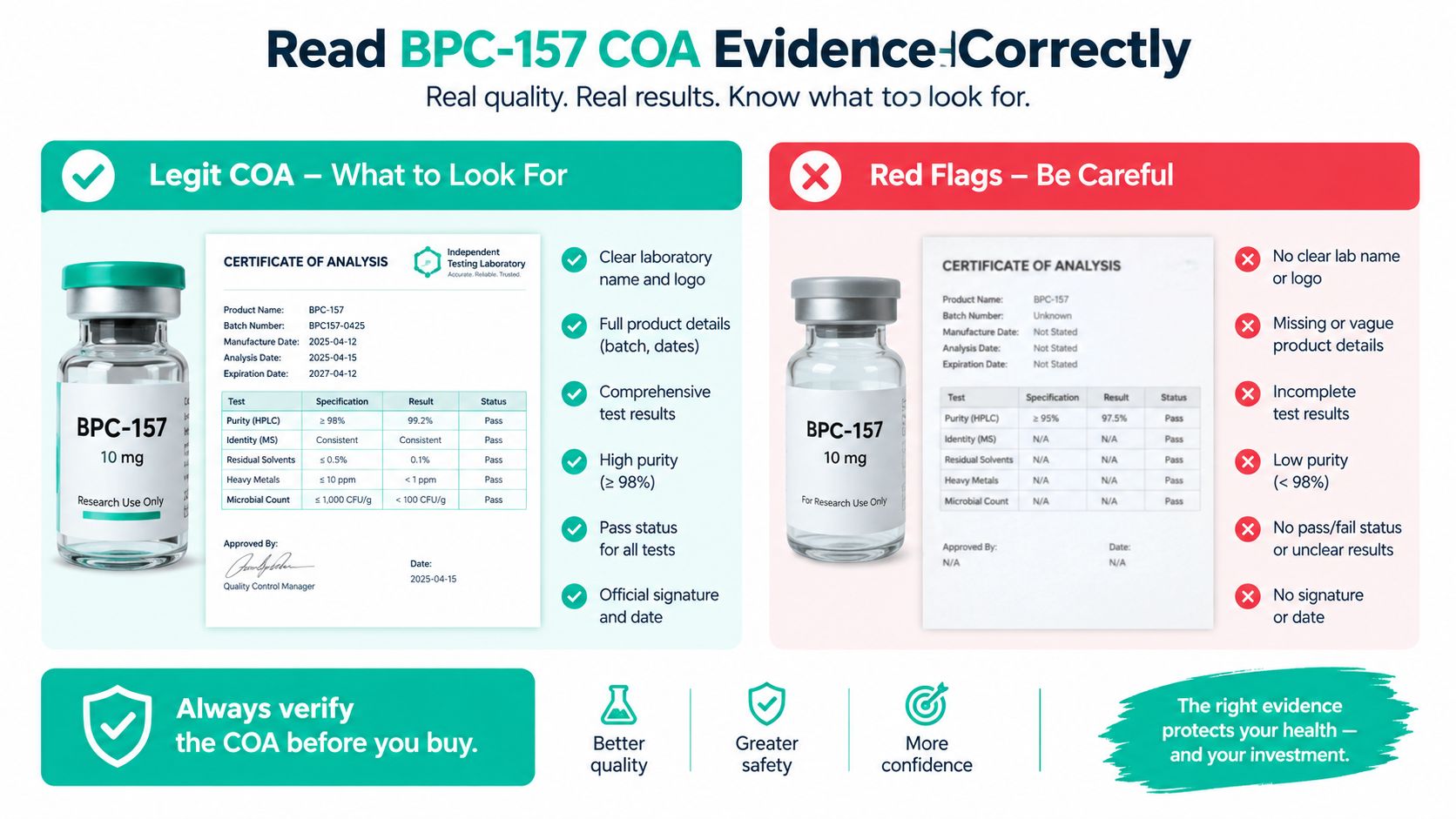
A COA is a measurement record, not a verdict. Reading one well means knowing what each method can show and what it cannot. A credible batch-level record identifies the tested material, the active compound, the nominal strength, the testing laboratory, and the test date, and it states clearly where the information came from.
Two Methods and Two Different Questions
Think of a mixed bag of coins tipped through a sorting machine. High-performance liquid chromatography, or HPLC, separates the components in a sample so an analyst can estimate chemical purity by seeing how much of the total signal belongs to the main component. It answers the question, how much of this sample is one thing?
Mass spectrometry, or MS, asks a different question. It compares the observed mass of a molecule against the expected mass, which supports molecular identity. In the coin analogy, it's weighing a single coin to check it's the denomination it claims to be, rather than counting how many coins in the bag match.
The limitations follow directly. A dominant HPLC peak shows one component predominates, but it doesn't prove that component is BPC-157. A matching mass supports identity, but it doesn't tell you how much of the sample that molecule represents. As guidance on choosing an Australian peptide supplier explains, HPLC can estimate chemical purity while mass spectrometry can support molecular identity, and neither method should be treated as a complete substitute for complementary batch-level evidence.
Questions a Non-Specialist Can Ask
You don't need a chemistry degree to interrogate a COA. You need the right questions, asked in writing.
- Batch match: Does the batch number on the certificate match the batch number on the vials quoted?
- Method transparency: Are the analytical methods named, or does the document just assert a purity figure?
- Laboratory identity: Is the testing laboratory named, and is it independent of the manufacturer?
- Date and scope: When was the test performed, and which characteristics were measured?
Browsing the online COA library lets you compare documents across batches and compounds before committing. Consistency in format, method naming, and laboratory identification across many records is a stronger signal than one polished certificate. Keep three categories separate in your file: manufacturer statements, independent test results, and your own institution's acceptance criteria. Blending them into a single impression of "tested" is how weak evidence acquires a strength it never earned.
Reconstitution Basics Without Usage Instructions
Search traffic around this compound leans heavily on preparation questions, so the concept needs addressing without turning into a protocol. This article doesn't provide preparation steps, amounts, routes of administration, or human-use guidance of any kind.
At a conceptual level, a freeze-dried powder cake has to become a solution of reproducible concentration before it can be handled in compatible laboratory workflows. The nominal vial quantity alone doesn't reveal that final concentration. Concentration is a relationship between the amount of material and the volume it's prepared in, and only one side of that relationship is printed on the vial.
A Kitchen Scale Analogy and Its Limits
Weighing flour tells you the mass on the bench. It doesn't tell you the proportions of the finished mixture, because that depends on what it's combined with and in what volume. The starting mass and the final solution are separate variables. The analogy stops there deliberately. A kitchen comparison explains arithmetic, and arithmetic is all it can explain.
A concentration calculator belongs in the same category. It's a planning aid for qualified laboratory personnel working within approved procedures, and its output is a mathematical result. A correct calculation says nothing about safety, sterility, bioavailability, or effectiveness. Treating a calculator output as clinical validation is a category error.
Diluent selection, material compatibility, calculation method, and handling all sit inside the researcher's own standard operating procedures and institutional approvals. General background reading, such as a guide to reconstituting research peptides, can explain terminology, but it can't substitute for those approvals.
The regulator's position frames why this caution matters. The TGA states that unapproved peptide products have not been assessed for safety, quality, or effectiveness and may not be correctly labelled, sterile, or manufactured to appropriate standards, as set out in its guidance on unapproved peptide product responsibilities. If the input material itself carries no such assurance, then no calculation performed downstream can manufacture that assurance. A 10 mg label must never be converted into a treatment claim.
Work Through a Research Procurement Example
Consider two hypothetical listings for the same nominal product. This is a comparison exercise, not a record of an actual transaction, and it doesn't reproduce any specific certificate.
Listing A names BPC-157 and a nominal 10 mg quantity. There's a price, a stock indicator, and no visible path from the product page to a batch record. A buyer can order it, but can't determine in advance which batch will arrive or what was measured on that batch. Any quality question has to be asked after delivery, when influence is gone.
Listing B presents the same nominal quantity inside a defined 10-pack specification. The product page links to an online lab library. The buyer can match the batch, inspect who produced the COA, note the analytical methods named, and save the documents alongside the purchase order. Nothing about that process guarantees quality. It does make the quality question answerable.
The Traceable Workflow Step by Step
- Review the 10-pack specification and confirm per-vial quantity and vial count separately.
- Open the lab library link from the product page and locate the relevant batch entry.
- Match identifiers across the listing, the batch record, and the quoted stock.
- Inspect the documentation source and distinguish manufacturer material from independent reports.
- Retain the records with the purchase file, including the invoice and delivery tracking.
Australian procurement context sits around that workflow rather than inside it. AUD pricing, GST invoices, quotes on request, and direct bulk supply arrangements help finance teams process an order cleanly. As one available option, Bulk Aussie Peptides supplies research peptides in standardised 10-pack formats with product specifications and batch documentation accessible online. Price discussion stays qualitative here because no product-specific amount is being quoted, and a lower unit price doesn't compensate for an absent batch record.
Fulfilment facts support planning without substituting for review. Secure checkout, order processing and dispatch within 1 to 3 business days, tracked Australia-wide delivery, GST invoices, and a free shipping threshold over $500 AUD all help a team schedule around an order. A tracked parcel that arrives on time still needs its batch checked at goods-in. Speed and evidence answer different questions.
Institutional buyers can formalise this through a procurement information pack, which suits universities and biotech teams that need supplier details on file before a purchase order can be raised. Keep three questions separate at sign-off: what was ordered, what evidence supports that batch, and which delivery and invoice records your institution requires. If any answer is missing, the order isn't ready.
Key Findings for Australian Research Buyers
The central finding is unfashionable but useful. Pack format is a logistics decision. Evidence is a documentation decision. A 10 mg vial in a 10-pack helps with purchasing and inventory planning, while identity, purity, and acceptable laboratory quality depend on matched batch records and suitable analytical evidence.
Regulatory context reinforces the point. BPC-157 became prescription-only under Schedule 4 from 1 June 2024, yet it holds no ARTG registration for a therapeutic indication, and research-use labelling doesn't convert a product into an approved medicine. For sport, Sport Integrity Australia states that BPC-157 is not ARTG-approved and is prohibited at all times under the World Anti-Doping Code, as explained in its BPC-157 substance education guidance. Athlete-facing research programs need to screen for that conflict before handling the material.
A Short Buyer Checklist
- Inspect the specification and separate per-vial quantity from pack count.
- Identify the batch before ordering, not on delivery.
- Review the relevant COA and note whether it's manufacturer-provided or independent.
- Retain purchase records with the batch documents in one file.
- Follow institutional procedures for handling, acceptance, and storage.
A nominal quantity is a product attribute, not proof of clinical benefit or human suitability.
Buyers comparing the wider catalogue of peptides in Australia can apply the same checklist to every compound, which is where its value compounds. Consult a qualified Australian health professional for any health question, and keep research material clearly separated from therapeutic use.
- BAP
If you're sourcing BPC 157 10mg research vials for a laboratory program, Bulk Aussie Peptides offers Australian owned and operated supply in standardised 10-pack formats, with sealed glass vials, batch documentation and independent lab certificates in an online lab library linked from every product page. Orders are tracked Australia-wide with GST invoices available, so visit the store to review specifications and batch records before you place your next research order.