
Supplier Audit Checklist Template for Peptide Labs
A peptide shipment has arrived, the purchase order looks right, and the vials are sealed. Before the lab accepts the delivery, someone still needs to confirm that the product, batch records and supplier claims match. A supplier audit checklist template makes that review consistent: it gives procurement and laboratory teams a record of what they checked, what evidence they saw and whether the supplier is approved for the intended research use.
For peptide and laboratory-supply procurement in Australia, the checklist needs to go beyond a general vendor questionnaire. It should connect supplier identity and risk to batch-specific documentation, storage and traceability, intended use, findings and follow-up. The template below gives you practical fields to adapt for new suppliers and ongoing reviews.
Table of Contents
- Why a Supplier Audit Checklist Matters for Peptide Procurement
- Core Checklist Fields for Australian Supplier Verification
- Certificate of Analysis and Documentation Checks
- Storage, Labelling and Traceability Requirements
- Regulatory Classification and Intended-Use Verification
- Risk-Based Proportionality for Small Australian Suppliers
- Continuous Monitoring and Remediation After Approval
- How to Score and Record Audit Findings
- Quick-Reference Checklist Template
- Frequently Asked Questions
Why a Supplier Audit Checklist Matters for Peptide Procurement
A delivery can look complete and still leave important questions unanswered. The product name may match the order, but does the batch number on the vial match the certificate? Does the certificate report results for that individual batch, or does it cover a broader product family? Can the supplier substantiate the product's identity, provenance and stated research-only purpose?
A checklist makes those questions part of the acceptance process rather than an improvised check after something goes wrong. It also helps procurement, quality and laboratory staff use the same evidence standard, even when different people handle ordering, receiving and review.
Start with the evidence that affects acceptance
For research peptides, a useful audit trail links the supplier's legal identity and manufacturing site to the product specification, purchase order, delivery record and batch documentation. The receiving team should be able to follow that chain without relying on a verbal assurance or a generic document stored separately from the shipment.
The checklist should record the audit's scope and criteria, who reviewed the evidence, any exceptions, the risk decision and what needs to happen before approval. If a document is missing or a batch identifier doesn't match, the record should show whether the shipment is held, accepted conditionally or rejected under the organisation's process.
Practical rule: If a claim matters to product acceptance, identify the document or observation that proves it.
This isn't about making every order burdensome. A structured form can make routine reviews faster by capturing core supplier details once, then directing the team to product-specific checks where the risk calls for them. The same record also supports a defensible decision when a supplier changes a manufacturing site, documentation source or product specification.
Use the checklist as a working control, not a form to file and forget. Record evidence, assign actions and revisit approval when relevant changes arise.
Core Checklist Fields for Australian Supplier Verification
A supplier audit checklist should start with the supplier, not the product catalogue. Confirm the legal entity you're buying from, where it operates and which parts of the supply chain it controls. A local dispatch address is useful, but it doesn't establish where a product was manufactured or where its raw materials originated.
Australian Government procurement data illustrates why structured supplier records matter. In 2024–25, Commonwealth entities awarded 86,926 contracts worth AUD 104.9 billion, the highest annual value in the reported AusTender series. Australian-addressed businesses received 93.8% of contracts by volume and 88.3% by value, while small and medium-sized enterprises received 45,556 contracts, or 52.4% of contract volume. These figures are reported in the Australian Government procurement statistics.
For a laboratory buyer, the practical lesson is to record location, supplier capacity and engagement value consistently. Those fields help reviewers judge whether the supplier and controls fit the work, rather than treating every vendor as interchangeable.
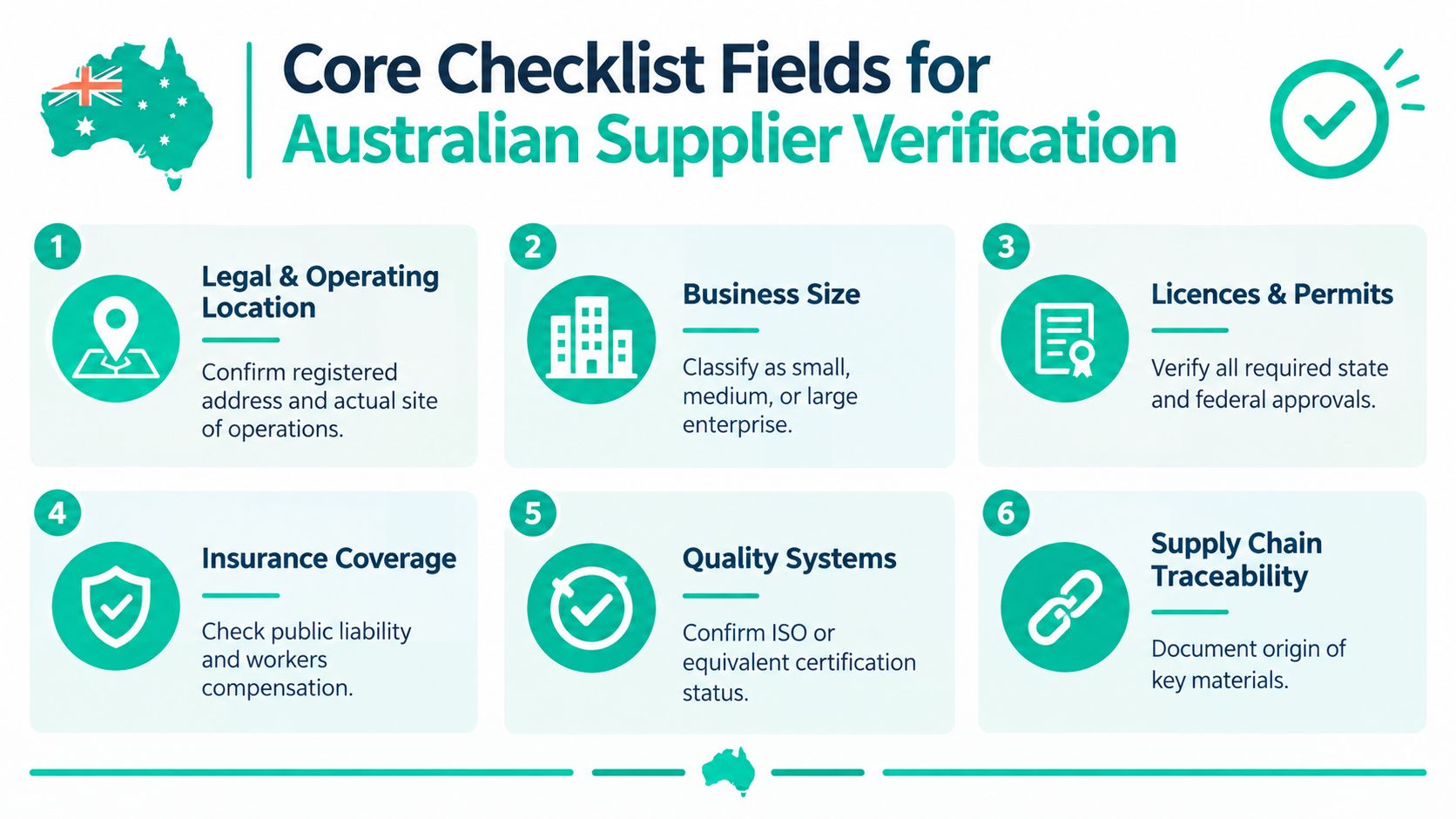
Minimum supplier record
Capture these fields before moving to product-specific review:
- Legal identity and ownership: Record the registered business name, trading name, ownership information and Australian Business Number or equivalent registration details.
- Location and scope: Note the registered and operating addresses, manufacturing site where relevant, services provided, products supplied and any subcontractors.
- Business capability: Classify the supplier by size and document whether it can meet the required scope, supply conditions and record-keeping expectations.
- Commercial and insurance details: Record quoted value, contract terms, relevant insurance coverage and any conditions that affect the engagement.
- Quality and delivery controls: Document quality systems, delivery performance, records management, complaints handling and current corrective-action status.
- Supply-chain evidence: Ask for the origin of key materials and the supplier's ability to trace products and supporting records to a specific batch.
Use the procurement information pack to support your organisation's supplier review and purchasing records. Keep the supplier profile separate from the product approval decision, so a strong general profile doesn't substitute for missing batch evidence.
Certificate of Analysis and Documentation Checks
A Certificate of Analysis (COA) needs to relate to the material delivered. The TGA defines a release-for-supply COA as a certified statement of tests and results for an individual manufactured batch of a particular finished product. Its quality guidance also distinguishes batch-release specifications from expiry or end-of-shelf-life specifications, and notes that specifications should include critical parameters such as assay when variation could affect quality. See the TGA guidance on quality requirements for listed medicines.
Match the certificate to the shipment
Start with the product and batch identifiers. Compare the COA against the vial label, purchase order and delivery record. If the identifiers don't align, don't treat the document as proof for the supplied material until the discrepancy is resolved and recorded.
Then check whether the document states the test methods or standards, numerical results, acceptance criteria, test date and laboratory identity. Confirm what the results represent. A list of tests without results or limits doesn't let your reviewer determine whether the batch met its stated specification.
| Check | What to Look For | Red Flag |
|---|---|---|
| Product identity | Product name and relevant specification match the order | Certificate describes a product family without identifying the supplied product |
| Batch match | Batch or lot identifier agrees with vial labels and delivery records | No batch identifier, or a mismatch that the supplier hasn't explained |
| Test results | Methods, numerical results and acceptance limits are stated | Test names appear without results or criteria |
| Laboratory identity | Testing laboratory is identifiable, with a way to verify the document source | No laboratory named, or the source cannot be confirmed |
| Specification stage | The document makes clear whether criteria apply at release or at expiry | Release results are presented as proof of end-of-shelf-life performance |
| Document traceability | Certificate can be linked to the purchase order and physical batch | Generic certificate with no clear connection to the supplied lot |
Store reviewed documents with the purchase record, and note who verified the match. The COA library can serve as a reference point for document access; your own acceptance process should still confirm that the certificate matches the specific batch received.
Storage, Labelling and Traceability Requirements
A complete documentation pack won't resolve a physical mismatch. At receipt, inspect the vial and packaging against the supplier's product specification and the documents already reviewed. Record condition, identifiers and any visible discrepancy before the product enters the lab's controlled storage.
Follow one batch through the records
Trace the product from the purchase order to the delivery record, then to the container label and batch-specific COA. The batch or lot identifier is the link between what was ordered, what arrived and what the supplier tested. If one record uses a different identifier, pause the acceptance decision until the relationship is documented.
For a research peptide supplied in a sealed glass vial, note whether the seal appears intact and whether the labelled product and batch details match the order. If the product is described as a freeze-dried powder cake, record whether its visible condition is consistent with the supplier's stated product description. These observations don't prove identity or purity; they help detect handling or identification issues that need investigation.
Check that the label or accompanying documentation states the relevant storage conditions and expiry or retest date. Where stability depends on transport conditions, request the applicable shipping or temperature records and document whether they meet the supplier's stated requirements. Don't assume that a parcel's arrival in good external condition establishes that every relevant transport control was met.
The receiving record should identify who inspected the shipment, when the check occurred, which documents were reviewed and whether any exceptions remain open. A clear record is especially useful when the shipment is split across multiple containers or when the lab needs to retrieve information about a batch later.
For additional handling context, consult the peptide storage and stability guidance. Use the supplier's documented conditions and your laboratory's procedures to determine the appropriate storage and acceptance controls.
Regulatory Classification and Intended-Use Verification
“Research use” on a label doesn't answer every regulatory question. The buyer needs to determine how the specific product is classified, what claims the supplier makes and whether the intended application fits the product's stated purpose.
The Therapeutic Goods Administration says therapeutic peptide products regulated as therapeutic goods must be included in the Australian Register of Therapeutic Goods (ARTG) before they can be imported, manufactured, supplied, exported or advertised. Products not included in the ARTG are generally considered unapproved, which means the TGA hasn't assessed their quality, safety or effectiveness. The TGA explains this position in its guidance on how therapeutic peptide products are regulated.
Make the regulatory check specific
Record the product's classification, ARTG status where applicable, and any supplier authorisation or exemption relevant to the proposed supply. Check the label, packaging and product information for consistency with the supplier's stated intended use. Flag clinical, therapeutic or diagnostic claims for review rather than assuming a research label resolves them.
For research-use-only (RUO) procurement, distinguish documentation review from clinical or therapeutic authorisation. TGA material states that RUO, IUO and ASR products aren't intended for in-vitro diagnostic use and aren't included on the ARTG. Using these products to develop a test that reports patient clinical results can trigger in-house IVD requirements. A supplier approval should therefore record any proposed diagnostic, human-use or clinical-trial application and route it through the organisation's appropriate regulatory review.
The checklist should also capture whether an import or supply authority applies. If the classification or intended use is unclear, don't replace the missing assessment with a general tick-box. Keep the supplier or product conditional until the relevant reviewer has documented the decision.
For background on the Australian context, consult the research peptide regulation guide. The checklist should preserve the actual decision and its evidence, not just the link to general information.
Risk-Based Proportionality for Small Australian Suppliers
A two-person peptide reseller in Adelaide can look simple until its COA points to a contract manufacturer that will not name the testing lab. Audit depth should follow that kind of exposure: product criticality, subcontracting, imported raw materials, batch traceability and the supplier's willingness to evidence each claim. Low spend can still carry high risk, and a local dispatch address leaves upstream manufacture unverified.
For example, the reporting entity in this Modern Slavery Statements Register statement describes combining onboarding questionnaires, public-information checks and targeted site-level verification according to supplier risk and materiality. The same logic fits lab-supply procurement: match the review to the harm a wrong batch, false RUO claim or missing COA could create.

Set three review paths and record why one was chosen.
| Risk signal | Minimum review | Escalate when |
|---|---|---|
| Low-impact consumables, clear specs, stable origin | Legal identity, specs, COA sample, policy check | COA is generic, origin changes or traceability stops at reseller |
| Critical reagent, subcontracted manufacture or imported inputs | Remote interview, upstream documents, batch identifiers, evidence sampling | Supplier cannot link certificate, lot and shipment |
| Opaque ownership, weak traceability, clinical-adjacent claims | Independent verification or site audit where proportionate | Any refusal, mismatch or high-consequence intended use |
Record reviewer, evidence date, residual risk, rationale and next review date. That lets a second buyer see why a small supplier was cleared quickly, or why a modest account still triggered deeper checks.
Continuous Monitoring and Remediation After Approval
A supplier can pass onboarding in March and ship a materially different peptide by September. The manufacturer changes, a subcontractor starts running the synthesis, or the testing lab swaps a method, and the original questionnaire no longer describes the batch in front of you. For lab-supply buying, ongoing screening, periodic reassessment and corrective-action tracking are normal practice; the value comes from applying them to the actual COA, lot code and shipment rather than filing them away after approval.
Write the change-notification duty into the checklist. Ask for advance notice of moves in manufacturing site, synthesis route, product origin, specifications, authorised subcontractors and testing laboratory. At receipt, match the delivered label, lot number and COA identifiers to the purchase record, then keep deviations, complaints and recall correspondence with the supplier file. A published statement such as Bulk Aussie Peptides' testing and quality information can support document review, but your own batch evidence still decides acceptance.
I set calendar reassessment for routine accounts, and event triggers override the calendar. Bring a review forward when the risk answer could change: a new factory or reseller appears, results drift without explanation, a certificate is generic or cannot be traced to a lot, the delivery origin changes, a serious complaint lands, or the supplier refuses to clarify a discrepancy.
Close actions with audit discipline. Give every follow-up an owner, severity, due date and the evidence that would satisfy closure. Read the returned proof and decide whether it shows both the fix and control of the cause. If a peptide supplier can name indirect suppliers and subcontractors and show how upstream lots connect to its release certificate, routine reviews stay proportionate; if it cannot, treat the gap as a reason to pause approval or sample harder.
How to Score and Record Audit Findings
A supplier with one missing signature and a supplier with unverified batch results should not receive the same audit score. Set severity by the potential effect on product identity, data reliability, regulatory fit and your ability to make a defensible purchasing decision. Record the evidence behind each rating so another reviewer can follow the reasoning.
Rate findings by risk and consequence
Use three levels, with response rules written into your audit procedure:
- Critical: A gap makes approval or batch acceptance indefensible under your criteria. Examples include no traceable batch identity, analytical results that cannot be checked, or a proposed use inconsistent with the product's stated research-only purpose. Hold approval or the affected batch while the responsible reviewer assesses the risk.
- Major: A significant control weakness needs a corrective-action plan and follow-up before the approval decision is considered resolved.
- Minor: A limited issue needs an owner and a closure date, but does not present the same immediate risk as a critical or major finding.
A score can help compare suppliers, but it should not override a critical failure. For example, strong delivery performance cannot compensate for a COA that cannot be linked to the lot under review. Define scoring rules before the audit so reviewers apply them consistently.
For each finding, keep a concise record of the evidence examined, the requirement that was not met, the potential consequence, any immediate containment, and the action owner and due date. Note the supplier's stated cause, then specify what evidence would demonstrate that the corrective action worked.
The audit record should also identify its scope, criteria, reviewer competence, independence and sampling approach. At closure, document the approval decision and any unresolved actions. AS/NZS ISO 19011:2019 sets out guidance for audit programmes, planning, auditor competence, evidence evaluation and reporting; apply its principles to the products, processes and requirements in scope.
Quick-Reference Checklist Template
Copy these fields into your procurement system, then tailor the product and risk questions to the supplier. Use the same core fields for onboarding and re-audit; add product-specific evidence where the material or intended use needs it.
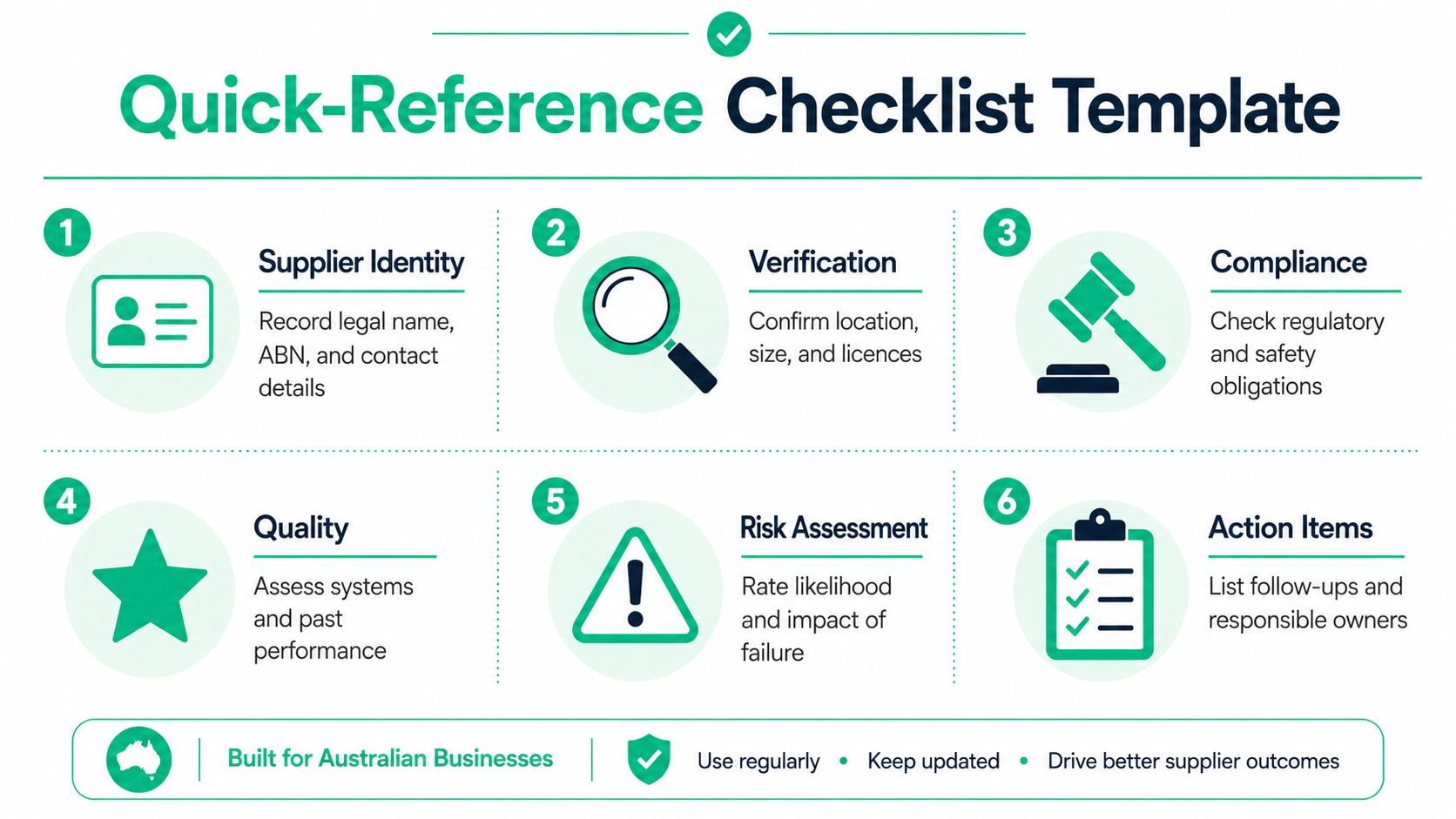
Copy-ready audit record
Supplier and engagement
- Legal business name, trading name, ownership and ABN or equivalent registration.
- Registered address, operating location, manufacturing site and Australian contact details.
- Scope of supply, quoted value, contract conditions and relevant insurance.
- Supplier size, capability, key subcontractors and upstream-origin information.
Quality and product evidence
- Quality controls, records management, delivery performance, complaint handling and corrective-action status.
- Product identity, approved specification, lot or batch number and change-notification obligations.
- Batch-specific COA, analytical method, laboratory identity, numerical results and acceptance criteria.
- Certificate-to-batch match confirmed against vial labels, purchase order and delivery record.
- Storage conditions, expiry or retest date, transport requirements and supporting records where relevant.
Regulatory and risk review
- Product classification, ARTG status where applicable, supplier authorisations or exemptions.
- Intended-use statement, label and packaging consistency, claims review and escalation route for proposed clinical or diagnostic use.
- Risk triggers: manufacture location, subcontractors, imported raw materials, labour-hire use, product criticality, spend and traceability.
- Review depth selected, rationale, reviewer, evidence date, residual risk and next review date.
Findings and decision
- Objective evidence, requirement breached, severity and risk.
- Containment, responsible owner, due date, root cause and effectiveness evidence.
- Approval status, conditions, unresolved actions and closure verification.
- Re-audit triggers, including material changes, complaints, documentation concerns or refusal of access to records.
A template shouldn't force identical evidence from a low-risk consumables vendor and a supplier whose product needs batch-specific analytical review. Keep the common identity and governance fields, then add controls that match the product, supply chain and intended use. Use an approval status that makes open conditions visible, and retain the evidence that supports the decision.
For a short visual walkthrough of the review process, use this video:
Frequently Asked Questions
How often should a supplier be re-audited?
Set the review frequency according to risk, performance, product criticality and change history. Reassess sooner when a material change, serious complaint, documentation gap or unresolved corrective action affects the original approval decision.
What if the supplier can't provide a batch-specific COA?
Don't treat a generic certificate as proof for the delivered batch. Record the gap, request traceable evidence and keep the affected product conditional or unapproved until the evidence is reviewed against your acceptance criteria.
What should we do if a supplier fails a critical check?
Hold approval or the affected batch under your organisation's process, document the evidence and risk, and assign a responsible reviewer. Require a corrective response where appropriate, then verify the supporting evidence before changing the decision.
Can a checklist replace a quality agreement?
No. A checklist records an assessment; it doesn't by itself define all ongoing responsibilities, change notifications, complaint handling or document access. Use a suitable quality agreement where the relationship and product risks require one, and keep it consistent with the checklist.
Bulk Aussie Peptides offers research-use-only peptides and laboratory supplies in standardised 10-pack formats, with product specifications and batch documentation available for procurement review. Use your checklist to verify each supplier and batch against your laboratory's requirements, then visit Bulk Aussie Peptides to review its research supply and documentation options.
- BAP