
BPC 157 for Sale: Sourcing Responsibly in Australia 2026
You've probably landed on BPC 157 for sale after comparing supplier pages, checking lab files, and trying to work out which listings are suitable for research procurement in Australia. The first issue isn't price, it's whether the product can be treated as a controlled, unapproved peptide under Australian law, and whether the paperwork is strong enough to justify purchase review. That's where the 2024 TGA scheduling change, and a proper COA authentication check, become the key filters.
Table of Contents
- Understanding the Australian Regulatory Context
- Verifying Research-Grade Supply and Documentation
- Purchasing Pathways for Institutions and Researchers
- Real-World Verification Scenarios in Australian Labs
- Ethical and Regulatory Compliance Guidelines
- Practical Checklist for Responsible Purchasing
Understanding the Australian Regulatory Context
An Australian purchase review starts with the 2024 TGA scheduling change. BPC-157 moved from a substance not captured in the Poisons Standard in 2023 to a Schedule 4, prescription-only medicine, and Appendix D, clause 5 makes possession without appropriate authority unlawful. The TGA's record also notes 48 referrals about BPC-157 importation received since 1 July 2022, which shows sustained regulatory concern about its availability and use in Australia. TGA peptides and social media update
What that means for buyers
A listing that says “research use only” does not create a lawful pathway for importation, possession, advertising, manufacture, or supply. Legal status depends on the relevant therapeutic-goods and poisons-law pathways, not on how a supplier describes the vial. The ARTG does not list BPC-157 as an approved human medicine, so an online product page is not evidence of TGA approval.
Practical rule: availability for purchase is not proof of approval, lawful supply, safety, quality, or clinical effectiveness.
The TGA's August 2023 public notice said no active ARTG medicines contained BPC-157 as an active ingredient, and described claims about healing and performance as unsubstantiated. For Australian procurement, that means a compound can look commercially ordinary while still sitting outside the approved-medicine framework. TGA final decisions notice
Verifying Research-Grade Supply and Documentation
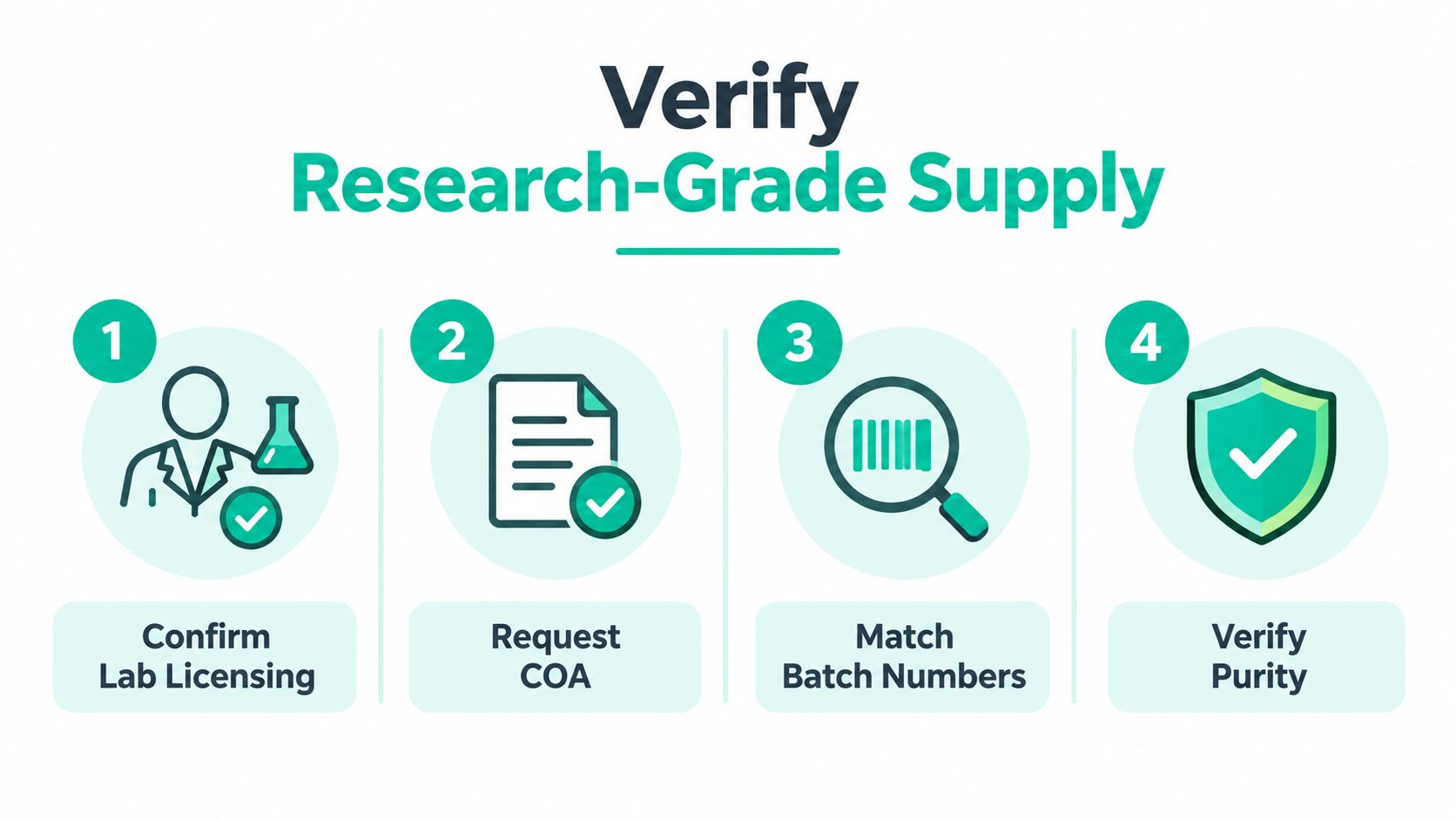
A supplier page can look polished while omitting the safety-critical details. What matters is whether the batch traces back to a specific analytical record that matches the product being purchased. A certificate of analysis should be treated as procurement evidence, not as a marketing badge.
What a COA can prove
A COA may identify the batch, assay, purity, or selected contaminants for one lot. It does not automatically establish sterility, endotoxin control, transport stability, accurate concentration in every vial, compliant manufacture, or suitability for human use. The TGA warns that unapproved peptide products may be mislabelled, non-sterile, or made to standards that do not support safe handling, so buyers cannot assume the label reflects what is inside. TGA peptide products guidance
Buyer-facing checklist
Before any purchase review, check the following:
- Batch specificity: confirm the report names the exact batch or lot number that matches the vial.
- Lab independence: confirm whether the report comes from an independent laboratory or the manufacturer.
- Methods and acceptance criteria: look for the test method, the result, and the pass or fail threshold.
- Sterility and endotoxin testing: do not treat high purity as a substitute for microbiological evidence.
- Storage and chain of custody: ask whether the sample's handling history is documented from testing to shipment.
The TGA also advises caution with online peptide products because many have not been assessed for safety, quality, or effectiveness. A useful file separates manufacturer paperwork from independent lab reports and makes the chain of evidence easy to review. For teams comparing suppliers, the COA library is a practical starting point, because traceability matters more than presentation.
Bottom line: a COA supports traceability, but it does not convert an unapproved research compound into an approved medicine.
Purchasing Pathways for Institutions and Researchers
Institutional buyers usually need the cleanest paper trail, not the flashiest product page. University teams, biotech groups, and procurement officers often work from quotes, GST invoices, and formal supply records, while individual researchers have to be more careful about whether a purchase fits the applicable Australian legal pathway. The difference isn't cosmetic, it affects how the file survives audit, ethics review, and internal sign-off.
Comparing common buying routes
A direct-supply model is often easier to review because fewer reseller layers usually mean fewer places where documentation can go missing. Standardised 10-pack vial formats also help research teams keep ordering consistent across projects, especially when they want the same product specification across multiple batches. For bulk and wholesale purchasing, the bulk research supply page gives a clearer view of institutional ordering pathways and quote-based procurement.
| Buyer type | What matters most | Documentation focus |
|---|---|---|
| University or lab procurement | Internal approval, traceability, invoice control | GST invoice, batch file, product specs |
| Independent researcher | Legal pathway, supplier transparency | COA, batch number, declared use |
| Bulk buyer | Consistency across orders | Standard format, quoted supply, lab records |
Australia-wide delivery, tracked dispatch, and visible product documentation all help teams plan around study timelines. Bulk Aussie Peptides operates as an Australian-owned supplier with sealed glass vials, freeze-dried powder cake formats, online lab documentation, and GST invoices available, which suits buyers who need the paperwork in one place rather than scattered across email threads.
For buyers comparing lab-ready product families, the peptides Australia range is useful when you need to review what's listed before checkout instead of negotiating everything after the order is placed.
Real-World Verification Scenarios in Australian Labs
A procurement team can do everything right on paper and still miss a gap if it stops at the purity figure. In one representative review, the red flag was not the listed assay, it was the absence of sterility testing in the batch file. That omission matters because a high purity claim does not answer the safety question that can still block approval.

The next check is traceability. The lab team compared the sample record with the product label, confirmed that the reported method matched the acceptance criteria, and reviewed the chain-of-custody notes to see how the vial moved from testing to dispatch. That changes the file from “the listing looks good” to “the batch can be traced.”
Chain-of-custody records and storage condition logs are routine until they are missing. Then they become the only way to judge whether the sample in hand is the same one that was tested, documented, and shipped. A buyer who skips that step is trusting a purity number to do work it was never designed to do.
Australian labs also need a regulatory filter, not just a documentation filter. The TGA's caution on unapproved peptide products makes the point plainly, supply status does not tell a team whether the product has been assessed for safety, quality, or effectiveness before use. TGA safety alert on unapproved peptide products
A useful discipline is to separate laboratory reproducibility from human-use validation. Documentation transparency supports the first one, but it does not establish the second.
Ethical and Regulatory Compliance Guidelines
A procurement file can look complete while still failing the standard that matters. For BPC 157 for sale in Australia, compliance starts with evidence that separates research documentation from any claim of clinical suitability. The Australian academic review notes that the evidence base is still weighted toward preclinical work, with only a few small human studies and no large clinical trials, so it does not justify confident claims about benefit, adverse events, or appropriate clinical use. UNSW review on injectable peptides
What compliance looks like in practice
Keep the supplier declaration, the batch-specific COA, the invoice, and any storage or chain-of-custody record in one file. If the product is unapproved, state that plainly and restrict the language to research use only. That protects ethics submissions and makes internal audit review easier.
Compliance note: specifications and COAs support traceability, but they do not turn an unapproved research compound into an approved medicine.
Supplier availability is a separate question from regulatory status. As noted earlier, the TGA's public position on unapproved peptide products makes clear that supply does not equal assessment for safety, quality, or effectiveness.
For researchers comparing suppliers, the file should answer one question first, can every batch be traced and verified from document set to vial. Suppliers who provide that level of documentation are easier to assess, and the Australian peptide supply page is a relevant reference point when reviewing how batch information is presented. Keep the classification as research use only, and do not treat documentation transparency as evidence of therapeutic approval.
Practical Checklist for Responsible Purchasing
Before buying BPC 157 for sale in Australia, use three checks. First, confirm the batch-specific COA matches the vial and shows the actual lot. Second, verify whether the testing is independent or manufacturer-provided, and whether the report clearly states the method and acceptance criteria. Third, review storage and chain-of-custody documentation so the file shows how the sample was handled from test to dispatch.
If any of those items is missing, the procurement file is incomplete. A high purity claim without sterility, endotoxin, and traceability evidence doesn't answer the safety questions that matter most in a research setting. The TGA's position on unapproved peptide products makes that boundary especially important in Australia.
For researchers who want visible batch documentation alongside product pages, the practical standard is simple. Buy only from suppliers who show what the batch is, who tested it, and how it moved. Keep everything marked research use only, and don't confuse documentation transparency with clinical efficacy.
Bulk Aussie Peptides supplies research-use-only peptides in standardised 10-pack formats with product specifications, batch documentation, and an online lab library for verification. If you're comparing Australian options for BPC 157 for sale, visit Bulk Aussie Peptides to review the listed documentation before you order.