
Melanotan 1 Australia: A Research Procurement Guide

Melanotan 1, also known as afamelanotide, is treated by the TGA as a Schedule 4 prescription-only substance, isn't approved as a tanning agent in Australia, and should be supplied to laboratories only for research under documented verification workflows. For Australian procurement teams, that means identity, batch traceability, analytical evidence and intended research use matter as much as the catalogue name.
You may be comparing peptide catalogues, reviewing a supplier's Certificate of Analysis, or trying to reconcile a product label with an institutional purchasing policy. The name creates immediate confusion because Melanotan 1 and Melanotan II are related but different compounds, while the Australian regulatory position applies important restrictions to melanotan tanning products.
This guide treats Melanotan 1 Australia as a laboratory procurement topic. It explains the science, the TGA framework, the difference between an approved pharmaceutical implant and research material, and the records a laboratory should review before placing an order.
Table of Contents
- What Melanotan 1 Means in an Australian Research Context
- The Science of Afamelanotide and How It Differs from Melanotan II
- TGA Scheduling and the Current Australian Position
- Approved Implant versus Research Material
- Documentation a Lab Should Request Before Procurement
- Procurement Pathways and Shipping Within Australia
- Putting the Workflow Together for Australian Labs
- Common Questions from Australian Research Buyers
What Melanotan 1 Means in an Australian Research Context
In Australia, Melanotan 1 is the commonly used name for afamelanotide, a synthetic analogue of the naturally occurring peptide alpha-melanocyte-stimulating hormone, or α-MSH. Its research relevance comes from its relationship with melanocortin receptors and pigmentation biology, not from personal tanning use.
The TGA's position is the starting point. Afamelanotide is captured as a Schedule 4 prescription-only substance, while melanotan products marketed as tanning agents aren't approved for sale or use in Australia. A research label doesn't change that classification or authorise therapeutic administration. The TGA also says unapproved peptide products haven't been assessed for identity, strength, quality, safety or effectiveness. See the TGA peptide product guidance before your organisation establishes a procurement pathway.
A laboratory therefore needs to separate three questions:
- What is the material? Confirm the compound identity, form, purity and batch.
- What will the laboratory investigate? Define in-vitro or other permitted research aims without clinical or cosmetic claims.
- What rules apply to the transaction? Review supply, importation, storage, advertising and institutional requirements with the responsible compliance staff.
A supplier catalogue can support research purchasing, but it isn't a substitute for your organisation's legal, ethics or biosafety review. The Melanotan 1 research reference can help frame the compound for literature review and supplier comparison.
Practical rule: Treat the product page as the start of verification, not the end. The batch paperwork must match the material your team receives.
This approach solves a common procurement problem. It keeps scientific investigation separate from human-use claims, gives purchasing staff a clear document trail, and helps researchers avoid treating an unapproved preparation as interchangeable with an approved pharmaceutical product.
The Science of Afamelanotide and How It Differs from Melanotan II
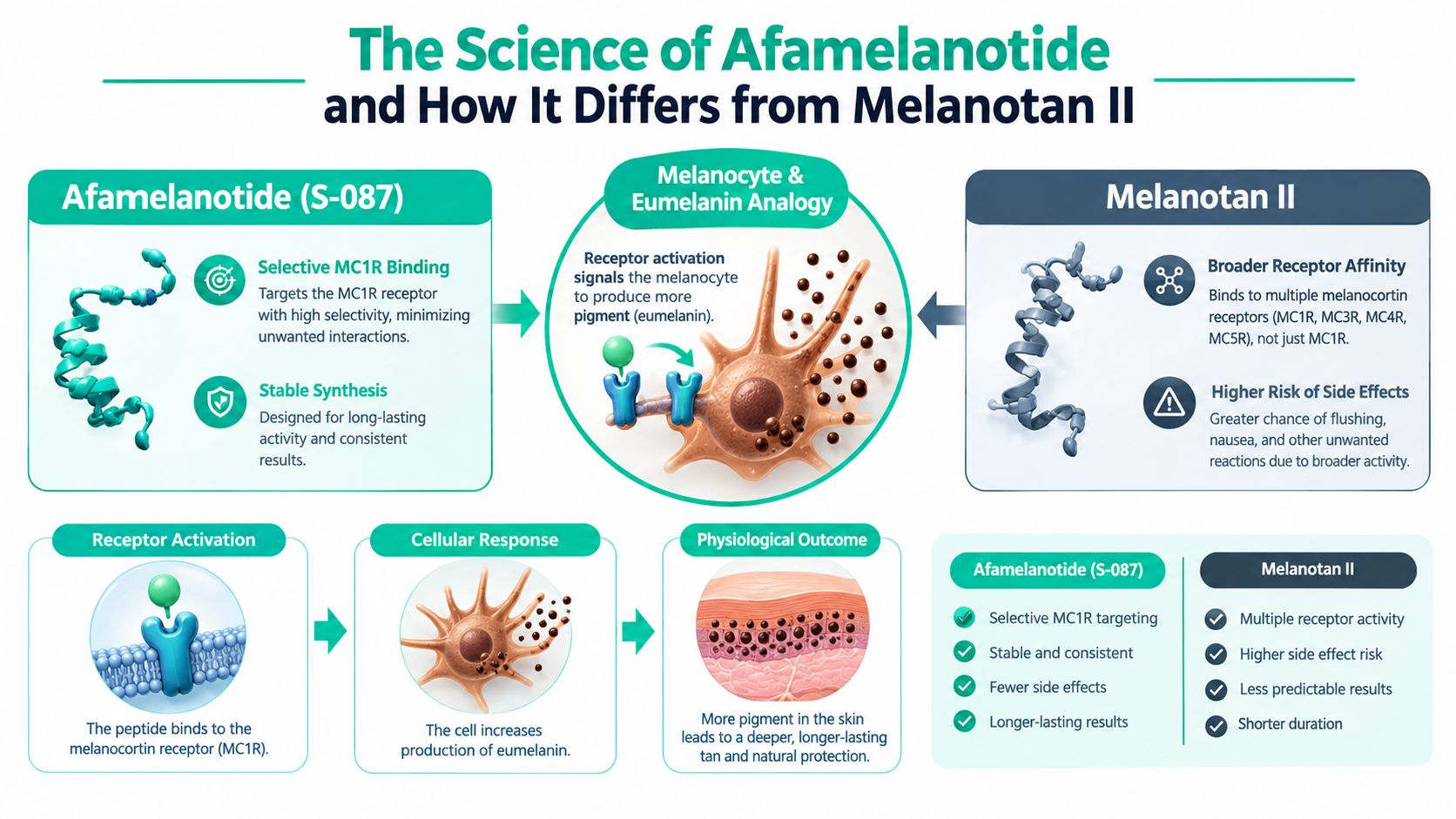
Think of a melanocyte as a pigment-producing workshop. When an appropriate signal activates its melanocortin receptors, the cell can increase production of eumelanin, the darker form of melanin. Afamelanotide is modelled on α-MSH, the naturally occurring hormone that participates in this signalling pathway.
The TGA describes afamelanotide chemically as 4-L-norleucine-7-D-phenylalanine-α-MSH. That name is useful during procurement because a laboratory can compare it with the supplier's specification, analytical report and product identifier rather than relying only on the short catalogue name.
Why catalogue names need careful checking
Melanotan II is not merely another spelling of Melanotan 1. The TGA distinguishes afamelanotide from Melanotan II, which is a structurally different cyclic analogue. A search for “MT-1” should therefore be checked against the full compound name, chemical description, structure, salt or form, and batch documents.
The distinction matters because a laboratory result belongs to the specific material and preparation tested. Results from an approved controlled-release implant can't automatically be applied to a vial, nasal preparation, cream or other research material. Likewise, an experiment involving afamelanotide shouldn't be described as evidence about Melanotan II.
For Australian suppliers, the appropriate framing is laboratory research only, including in-vitro investigations where authorised by the relevant institutional processes. This framing avoids turning receptor or pigmentation research into a clinical claim.
TGA Scheduling and the Current Australian Position
The regulatory history has two important milestones. In its December 2010 scheduling decision, the TGA identified afamelanotide, also called Melanotan 1, as a synthetic analogue of α-MSH and distinguished it from Melanotan II. The decision captured alpha-MSH derivatives, including afamelanotide and Melanotan II, as Schedule 4 prescription-only substances, with the scheduling decision taking effect on 1 January 2011. The TGA also recorded that no products containing either substance were registered for use in Australia at that time and that the substances hadn't been assessed for safety or efficacy. These details appear in the TGA scheduling decision.
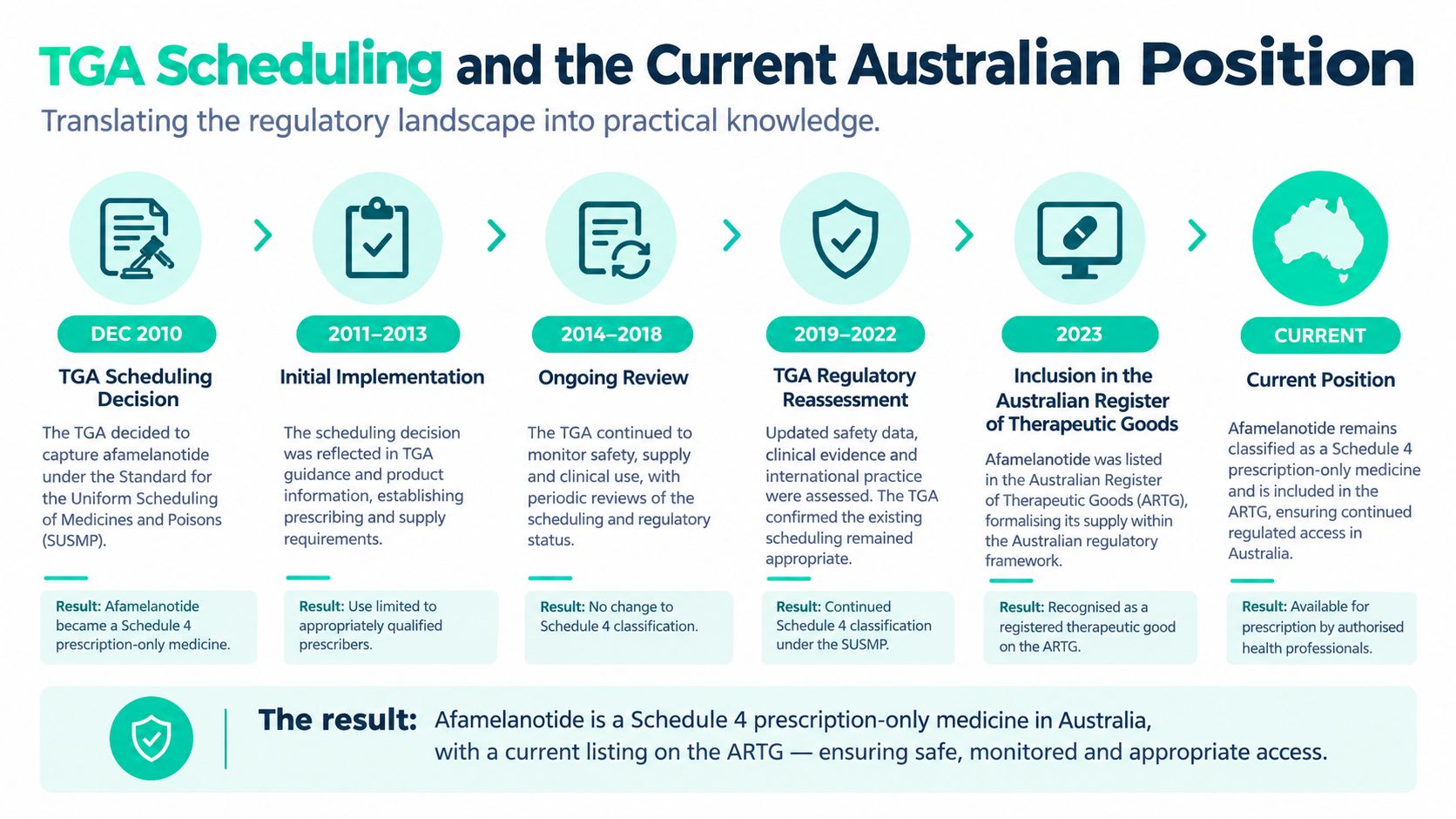
The current consumer position is equally clear. In a January 2025 warning, the TGA said melanotan tanning products aren't approved for sale or use as tanning agents, including products labelled Melanotan 1 and Melanotan II. It identified possible reported effects such as headache, nausea, vomiting, appetite loss and facial redness, and raised more serious concerns involving changes in moles and freckles, kidney dysfunction and brain swelling reported with Melanotan II. Artificial pigmentation also doesn't protect skin from ultraviolet radiation or replace sunscreen. Read the TGA warning on melanotan tanning products.
What this means for supply and promotion
Australian restrictions apply regardless of whether a product is presented as a nasal spray, injection, tablet or another formulation. Supplying melanotan tanning products without a doctor's prescription is illegal, and advertising them to the Australian public, including through social-media influencers, is prohibited.
A “research use only” label doesn't override those rules. It describes the intended laboratory context, but it doesn't create approval for personal administration, therapeutic supply or tanning claims. For a research buyer, that means the product description, invoice, storage record and internal study file should all use consistent, non-clinical language.
For broader context, the Australian research-peptide regulation guide can sit alongside your institution's own compliance review.
Approved Implant versus Research Material
The most important technical distinction is between an approved afamelanotide pharmaceutical product and an unapproved research preparation. The TGA's Australian Public Assessment Report describes Scenesse as a 16 mg controlled-release subcutaneous implant used in the established Australian treatment context for adults with erythropoietic protoporphyria. It also reports sustained melanin-density increases over time and comparable melanin-density findings between the 16 mg and 20 mg dose forms examined. See the TGA Australian Public Assessment Report.
That product-specific evidence doesn't transfer automatically to another format.
| Attribute | Approved Afamelanotide Implant | Unapproved Research Material |
|---|---|---|
| Dosage form | A defined controlled-release implant | May be supplied as a vial or another preparation |
| Regulatory pathway | Evaluated as a specific pharmaceutical product | Not automatically assessed or registered because it carries a research label |
| Evidence | Product-specific assessment and clinical documentation | Requires independent identity, potency and quality verification |
| Procurement question | Is the authorised product and access pathway relevant? | Does the received batch match the catalogue and laboratory specification? |
| Study framing | Connected to an approved medical indication | Limited to the laboratory purpose authorised by the institution |
For procurement, the word afamelanotide isn't enough. Record the formulation, supplier SKU, batch number, analytical method and intended research use. Don't extrapolate implant exposure, outcomes or claims to unrelated research materials.
Documentation a Lab Should Request Before Procurement
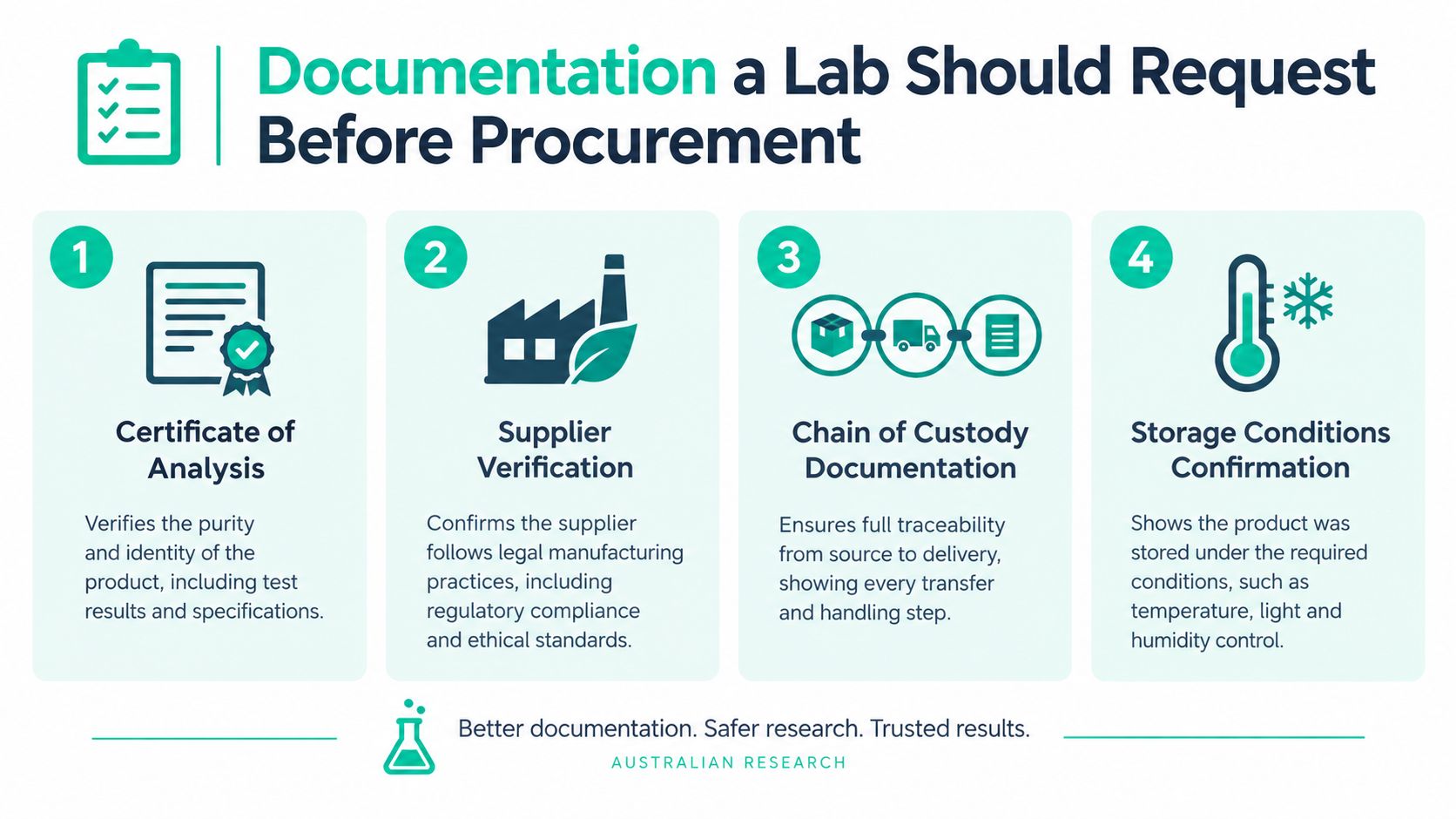
A serious procurement file should let another staff member identify exactly what was ordered, what was received and what testing supports the label. A Certificate of Analysis, or COA, is useful evidence, but it has a defined role. It can report identity, purity and the analytical technique used. It doesn't confer Australian therapeutic approval or permission for human administration.
A practical verification checklist
- Compound identity: Match “afamelanotide” or “Melanotan 1” with the specification and, where available, mass-spectrometry evidence. Check that it isn't Melanotan II.
- Batch traceability: The batch number on the vial, product page and COA should agree. A generic report without a batch connection is weaker procurement evidence.
- Purity and method: Record the stated purity result and the method used, such as HPLC, then keep the complete report rather than copying only a headline value.
- Salt or form: Ask whether the material has a stated salt, chemical form or other presentation detail. This helps researchers interpret results consistently.
- Storage conditions: Confirm how the sealed glass vial and freeze-dried powder cake should be stored and document the condition on arrival.
- Supplier records: Keep the invoice, SKU, dispatch information and any correspondence in the same study or purchasing file.
The COA library provides a useful reference model for how batch documentation can be organised online. Your own laboratory should still assess whether the available evidence meets its quality system, study design and institutional requirements.
Documentation standard: A COA supports verification of a batch. It doesn't turn an unapproved research material into an approved medicine.
Independent testing is especially valuable when the experiment depends on receptor activity or analytical reproducibility. If the report is pending, record that status clearly rather than presenting the material as fully documented.
Procurement Pathways and Shipping Within Australia
A compliant purchasing workflow begins with the study file, not the checkout page. The researcher defines the non-clinical purpose, procurement confirms the compound identity and documentation, and the organisation checks whether any additional restrictions apply before ordering.
For predictable laboratory purchasing, Bulk Aussie Peptides lists research materials in 10-pack formats, with AUD pricing and GST invoices available for institutional accounts. Its catalogue covers more than 60 compounds, with product pages intended to connect the SKU to specifications and batch records. The company describes its materials as sealed glass vials containing a freeze-dried powder cake, with independent laboratory certificates placed in an online lab library or marked “in testing” where documentation is pending.
What the order record should show
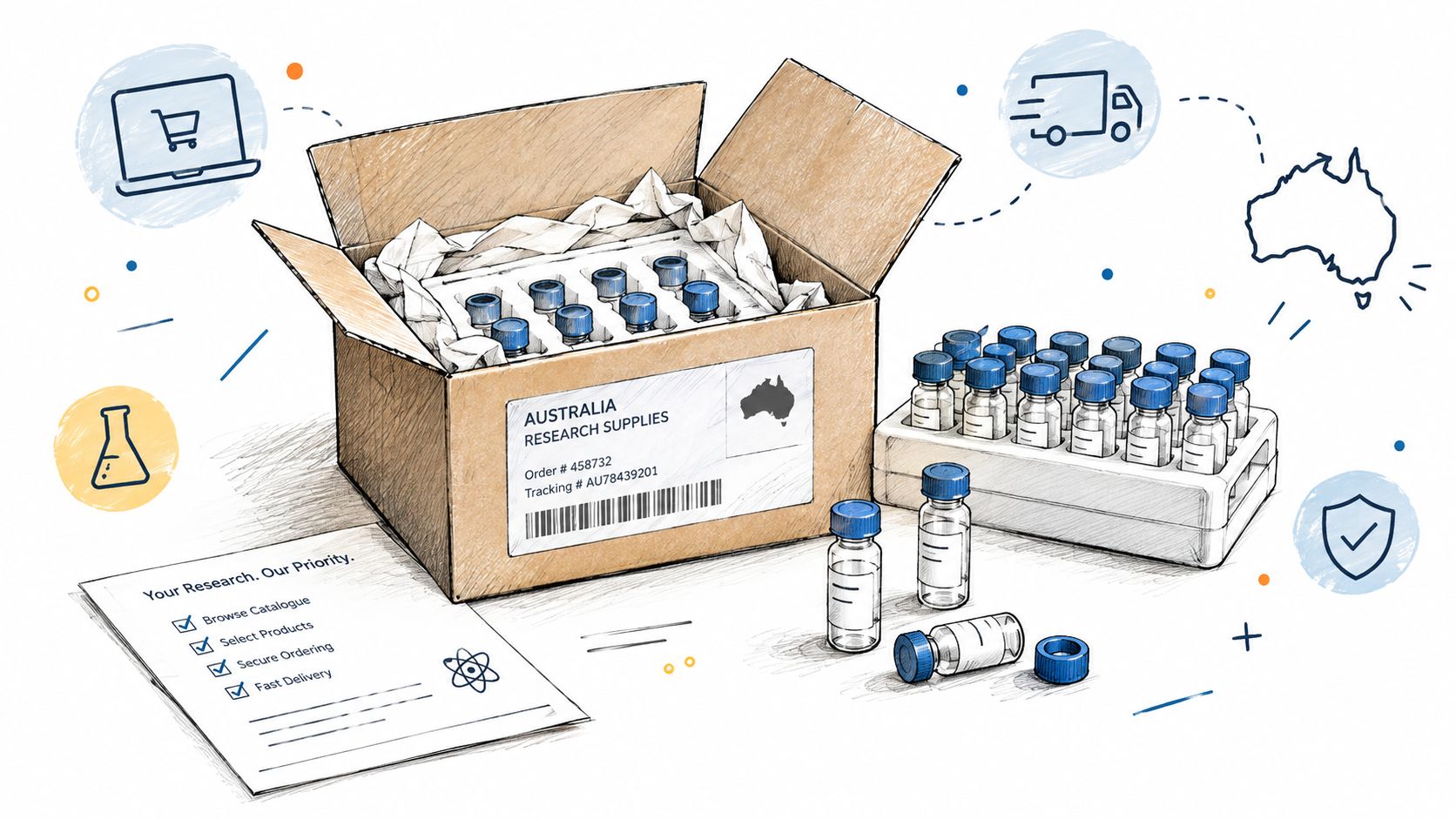
Use the Australian shipping information to confirm the supplier's current process, then retain the following:
- The product name, SKU and pack format.
- The invoice in AUD, including GST details where required.
- The batch number and matching COA or laboratory report.
- The tracking record and delivery condition.
- Any internal approval or procurement reference.
Bulk Aussie Peptides states that it's Australian owned and operated, uses domestic processing, and ships tracked orders around one week door to door. Delivery timing can vary, so procurement teams should plan around the supplier's current information rather than promise a particular arrival date. Larger programmes can also review the bulk and wholesale research supply pathway for institutional purchasing discussions.
Putting the Workflow Together for Australian Labs
A useful workflow is a sequence of checks, not a single supplier claim.
First, define the research question. State whether the work concerns pigmentation signalling, melanocortin receptor activity or another laboratory endpoint. Keep tanning, therapeutic and personal-use language out of the study description.
Next, confirm identity. Compare the catalogue name with the full chemical description, structure, form and analytical evidence. That step is where teams prevent a Melanotan 1 and Melanotan II mix-up.
Then, lock the batch record. Match the vial, SKU, invoice, COA and receiving log. If the certificate is pending, mark the status and avoid interpreting results as though independent verification has already been completed.
Finally, review storage and governance. Record the sealed-vial condition, storage information, institutional approvals and the applicable Australian supply or import requirements.
A clean file should answer five questions: what was ordered, why it was ordered, which batch arrived, what testing supports its identity, and who approved the research use.
That separation protects the scientific interpretation. Laboratory observations belong to the tested material and study conditions, not automatically to every product carrying a similar name.
Common Questions from Australian Research Buyers
Is Melanotan 1 legal to possess for research?
Possession and supply questions depend on the material, intended use, institution and applicable Australian requirements. Afamelanotide is treated as a Schedule 4 prescription-only substance, and unapproved melanotan tanning products aren't approved for sale or use as tanning agents. Ask your institution's compliance officer, pharmacist or relevant regulator before procurement rather than relying on a product label.
Does importing differ from buying domestically?
It can. Importation may involve requirements that don't arise in the same way with domestic supply, including documentation about the substance, intended use and consignee. A laboratory should verify the pathway before ordering and keep the import or procurement decision with the batch records.
What if a supplier can't provide a batch-specific COA?
Pause the purchase or place the material on hold until the supplier can connect the report to the exact SKU and batch. If the supplier provides only a generic specification, ask for the analytical method, identity evidence, purity result, storage information and traceability records. Your quality manager should decide whether supplementary independent testing is needed.
Does research-use-only status replace ethics or procurement review?
No. The label describes the commercial positioning of the material, but it doesn't replace institutional ethics, biosafety, chemical management or purchasing controls. The research proposal, supplier documents and receiving record should all describe the same non-clinical purpose.
Bulk Aussie Peptides supplies research-use-only materials in standardised 10-pack formats, with sealed glass vials, batch documentation and an online laboratory certificate library. Review the available specifications and verification records, then visit Bulk Aussie Peptides to discuss an Australian research procurement pathway. - BAP