
Bpc 157 Side Effects
No side effects observed can still mean safety unknown. That's the central finding for anyone researching BPC 157 side effects: the available evidence doesn't establish how often adverse effects occur in humans, or whether longer-term exposure is safe. Small human reports and encouraging animal findings answer narrower questions than readers often assume. For Australians, the responsible approach is to separate those observations from regulator warnings, product-quality hazards and unanswered clinical questions, rather than turn incomplete evidence into a reassuring percentage.
Table of Contents
- Why the Evidence on BPC-157 Side Effects Is Thin
- What BPC-157 Actually Is in the Research Literature
- What Animal Studies Actually Report on Safety
- What Small Human Reports Actually Show
- Why 'No Side Effects Reported' Is Not the Same as Safety
- Theoretical Biological Risk Signals Worth Tracking
- Practical Monitoring and Risk-Mitigation for Research Programs
- Regulatory Status, Sourcing Considerations, and Common Questions
Why the Evidence on BPC-157 Side Effects Is Thin
The first distinction is between unestablished safety and demonstrated harm. Australia's Therapeutic Goods Administration hasn't evaluated BPC-157-containing products for safety, quality or effectiveness because they're unapproved therapeutic goods. Its warnings describe risks across unapproved peptide products, not a measured BPC-157-specific adverse-event rate, as set out in the TGA's public-health warning on unapproved peptides.
That leaves a basic statistical problem. To calculate how common an adverse effect is, researchers need both a reliable count of events and a reliable count of exposed people. Australia doesn't have a validated BPC-157 pharmacovigilance denominator from which to calculate that frequency.
Why a side-effect percentage would mislead
A percentage would imply that researchers knew what people received, how exposure was measured and how adverse events were identified. With unapproved products, those assumptions may not hold.
- Product identity: Different sources may not supply an equivalent compound or formulation.
- Concentration and contamination: Differences can make seemingly similar exposures difficult to compare.
- Event attribution: A reaction could involve the compound, another ingredient, an interaction or a product-quality problem.
The TGA has reported liver damage, severe allergic reactions requiring hospitalisation, and inflammation or other complications associated with unapproved peptides more broadly. Those reports warrant attention, but they mustn't be presented as outcomes caused exclusively by BPC-157.
The infographic captures the missing foundations behind any Australian safety-rate claim.
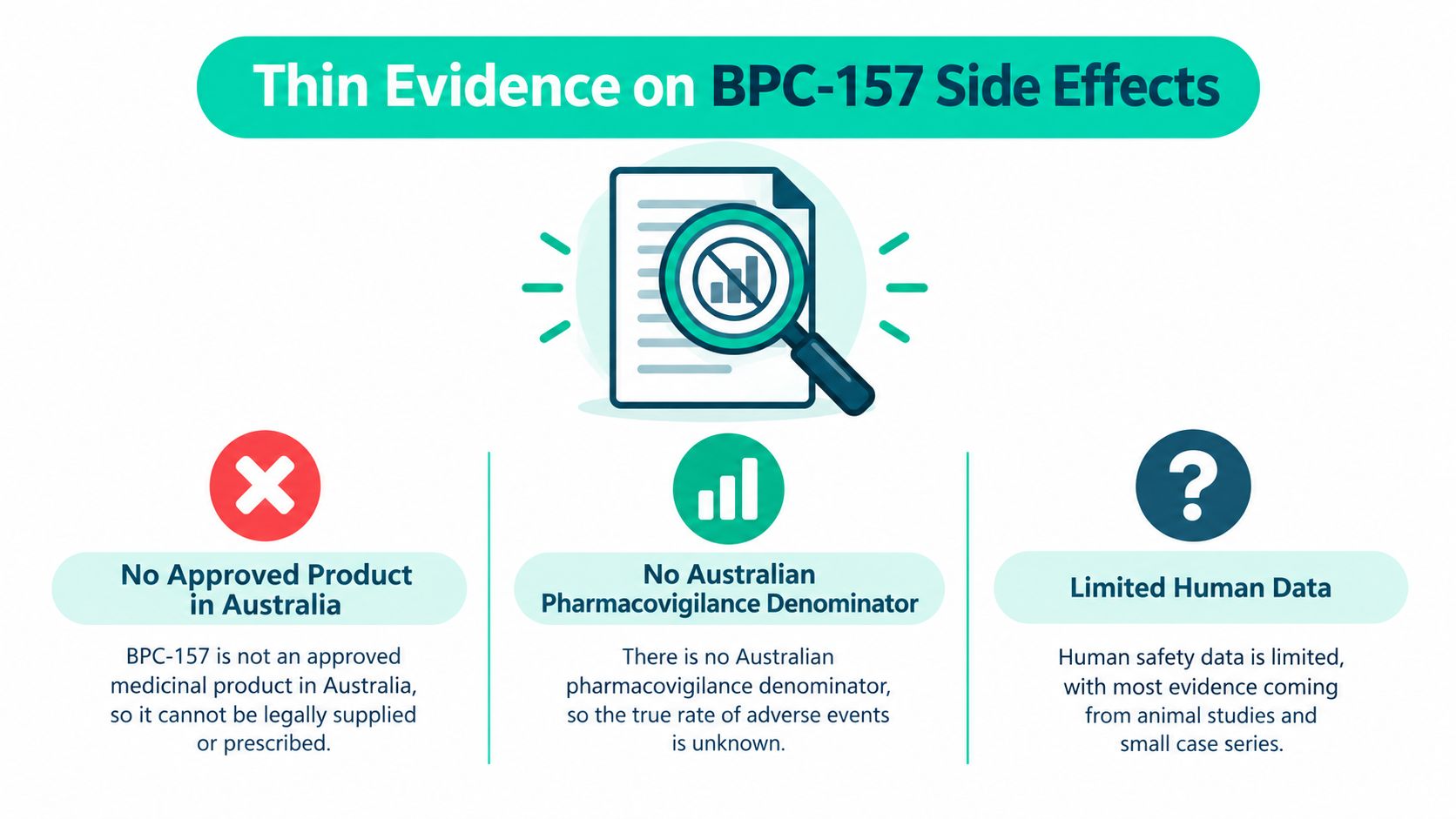
Evidence rule: An unknown adverse-event rate isn't a low adverse-event rate.
A useful research-methodology framework starts by asking what each source can measure. A regulator's warning identifies hazards and reported concerns; it doesn't automatically supply a compound-specific incidence estimate.
The conclusion is therefore limited but important: there's no validated Australian rate for BPC-157 side effects. That gap supports caution and further investigation, not a numerical verdict about safety.
What BPC-157 Actually Is in the Research Literature
BPC-157 is discussed as an investigational peptide in tissue-repair and orthopaedic sports-medicine research. For readers interested in recovery or injury research, the important context is that much of the evidence concerns experimental models rather than established clinical applications.
The label research peptide describes a research context. It doesn't demonstrate that a compound treats an injury, produces a predictable response or has passed the safety evaluation expected of an approved medicine.
BPC-157 research and clinical validation
A useful analogy is a prototype undergoing early testing. Researchers can investigate how it behaves under controlled conditions without knowing how reliably it will perform across different people, settings and exposures.
The same distinction applies to biological activity. A compound may interact with a pathway researchers consider relevant to tissue repair, but that observation alone doesn't establish a useful or safe clinical outcome. Mechanistic interest and clinical validation are different claims.
The research-peptide glossary provides terminology for reading compound descriptions. When evaluating those descriptions, distinguish the identity of the material from the strength of evidence supporting any proposed application.
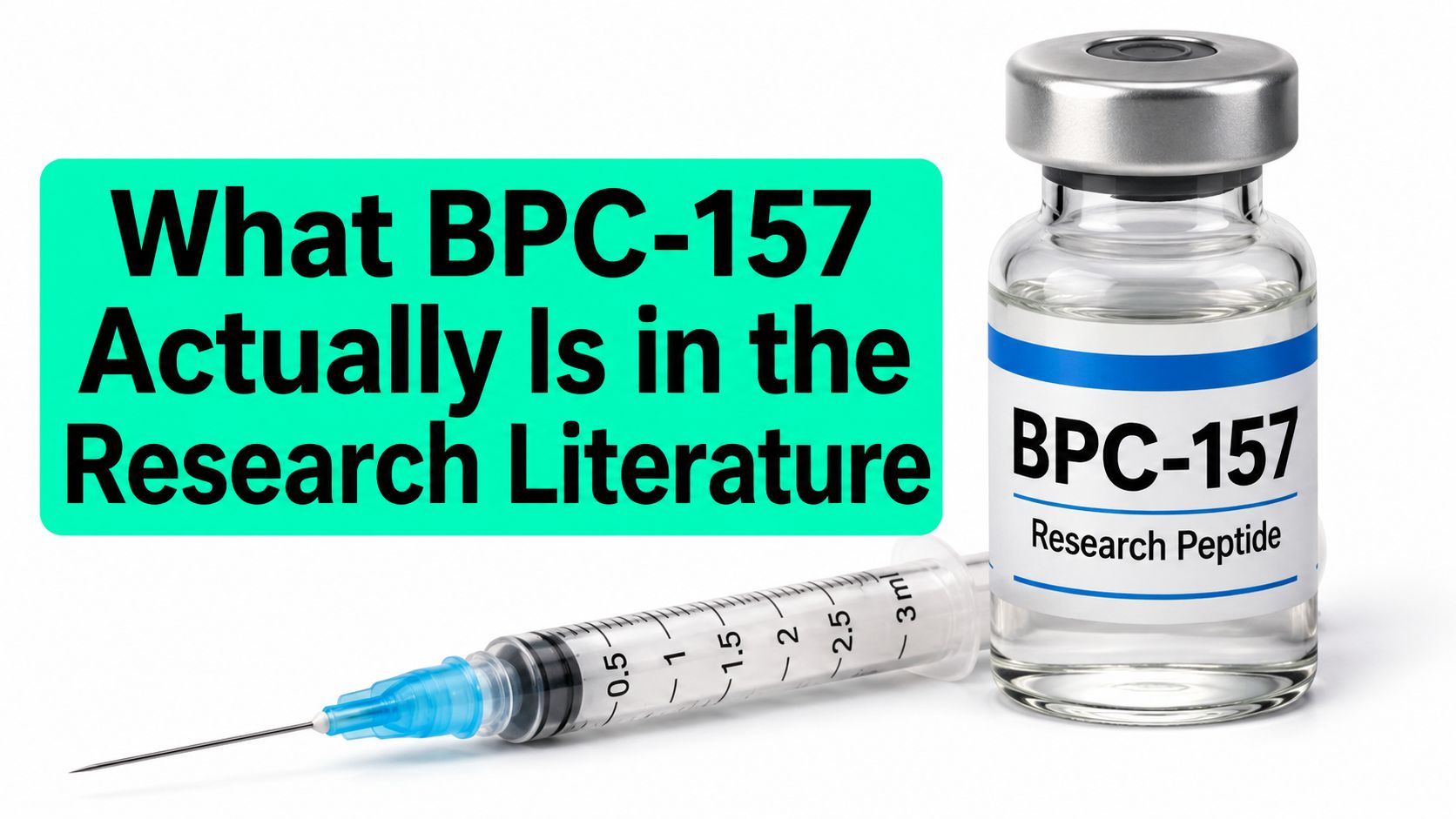
The supplied image depicts a research-labelled vial. That presentation shouldn't be interpreted as evidence of suitability for clinical use.
What a laboratory format does and doesn't establish
Freeze-dried material in a sealed glass vial is a supply format, not a safety finding. The relevant questions remain whether the material matches its stated identity, what testing supports its specification and whether the experimental findings apply to the question being asked.
- Compound description: Identifies what the supplier says the material is.
- Analytical documentation: Provides evidence about tested sample characteristics.
- Clinical evidence: Addresses outcomes in people under defined study conditions.
Keeping these categories separate prevents a common inference error: treating a professionally presented research product as though it were a clinically validated medicine. Packaging, terminology and scientific interest can't substitute for adequate human safety evidence.
What Animal Studies Actually Report on Safety
Animal findings deserve neither dismissal nor promotion beyond their scope. The 2025 systematic review of BPC-157 in orthopaedic sports medicine described preclinical safety studies reporting no adverse effects across several organ systems, while identifying no clinical safety data in humans, according to the review of BPC-157's emerging orthopaedic use.
That's a meaningful distinction. Researchers observed reassuring results within the animal experiments reviewed, but those results didn't establish a human side-effect profile.
Preclinical safety findings have boundaries
The phrase no adverse effects must remain attached to the experiment that produced it. Researchers assessed particular animals, exposure conditions, observation periods and outcomes. The result doesn't automatically cover conditions that weren't studied.
For that reason, it would be misleading to provide a universal dose range, observation window or organ-by-organ safety verdict without a verified study-level account. The review's broad summary supports a narrower statement: the reviewed preclinical work didn't identify adverse effects across the systems examined.
An animal safety finding is evidence about an experimental model, not a certificate of human safety.
Evidence Layers for BPC-157 Safety Claims
| Evidence layer | Typical size | What it can show | What it cannot show |
|---|---|---|---|
| Animal safety studies | Study-dependent experimental groups | Findings under defined preclinical conditions | Human adverse-event frequency or general clinical safety |
| Small human reports | Limited participant groups | Observations in a narrow clinical setting | Reliable detection of uncommon or delayed harms |
| Rigorous human safety trials | Designed around the safety question | Systematically collected outcomes with defined exposure and follow-up | Safety outside the populations and conditions adequately studied |
| Anonymous online accounts | Unknown exposed population | Symptoms that may warrant investigation | Verified causation or a trustworthy incidence rate |
The table isn't a ranking in which lower layers are worthless. Each layer serves a different purpose. Animal work can help researchers decide what to investigate, while a human report can describe what happened in a particular setting.
The analytical mistake occurs when someone changes the claim during translation. No harm detected in an animal model becomes safe for people, even though the population, exposure and outcome assessment have changed.
For laboratories, preclinical reassurance is a reason to examine the underlying methods carefully. It isn't a reason to abandon uncertainty about human risks.
What Small Human Reports Actually Show
The available human observations are much narrower than a general safety claim. A 2025 narrative review identified three human pilot studies, including work involving knee pain and interstitial cystitis, and described their limited ability to establish safety in the review of emerging BPC-157 evidence.
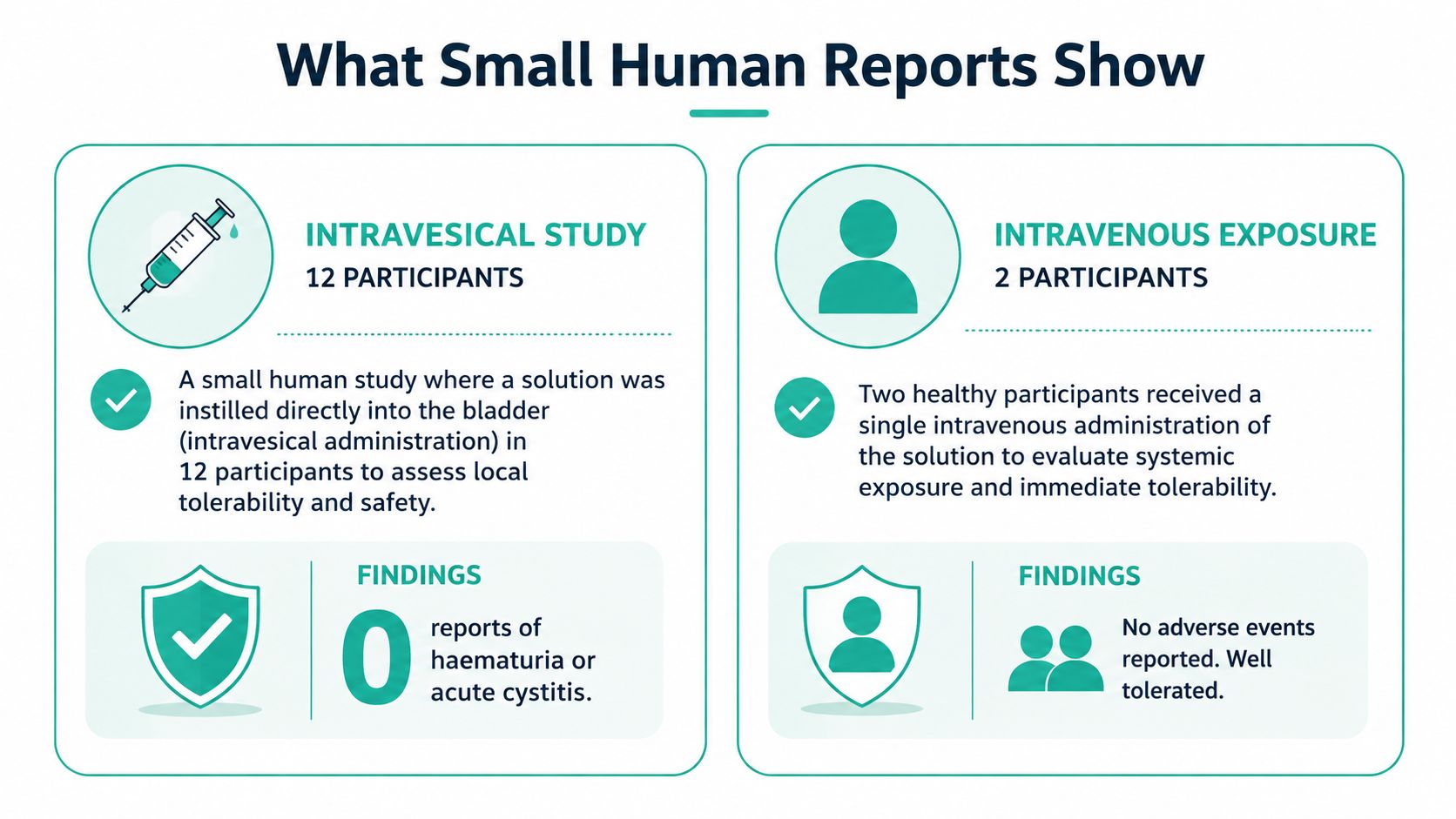
Two observations illustrate the problem. An intravesical study involved 12 participants, with 0 of 12 experiencing haematuria or acute cystitis after treatment. A separate intravenous report involved two healthy adults, with no clinically meaningful changes during the observation period, as described in the same review.
The comparison below highlights the narrow settings behind these findings.
BPC-157 human studies answer specific questions
The intravesical observation concerns a particular clinical setting and specific urinary outcomes. Haematuria means blood in the urine; acute cystitis refers to acute bladder inflammation. Their absence doesn't demonstrate the absence of every possible adverse effect.
The intravenous observation is also limited by its selected participants and observation period. Findings in healthy adults can't establish what would happen in people with cardiovascular, liver or kidney disease, cancer-related concerns, pregnancy or concurrent medicines.
- What was observed: The reports describe findings within their actual study settings.
- What remains unresolved: They don't establish safety across other formulations, repeated exposure or different populations.
- What cannot be inferred: They don't demonstrate that material from an unverified source is equivalent to the studied material.
A supporting video is embedded below. Its inclusion doesn't expand the evidence provided by the published reports.
Tolerability isn't a population-level safety result
A tolerability observation describes what researchers noticed under defined conditions. A general safety claim requires evidence capable of detecting a wider range of outcomes and supporting conclusions about the intended population.
These reports therefore shouldn't be dismissed as meaningless, but their conclusions need boundaries. They provide preliminary observations, not validated evidence that BPC-157 is safe for general use.
Why 'No Side Effects Reported' Is Not the Same as Safety
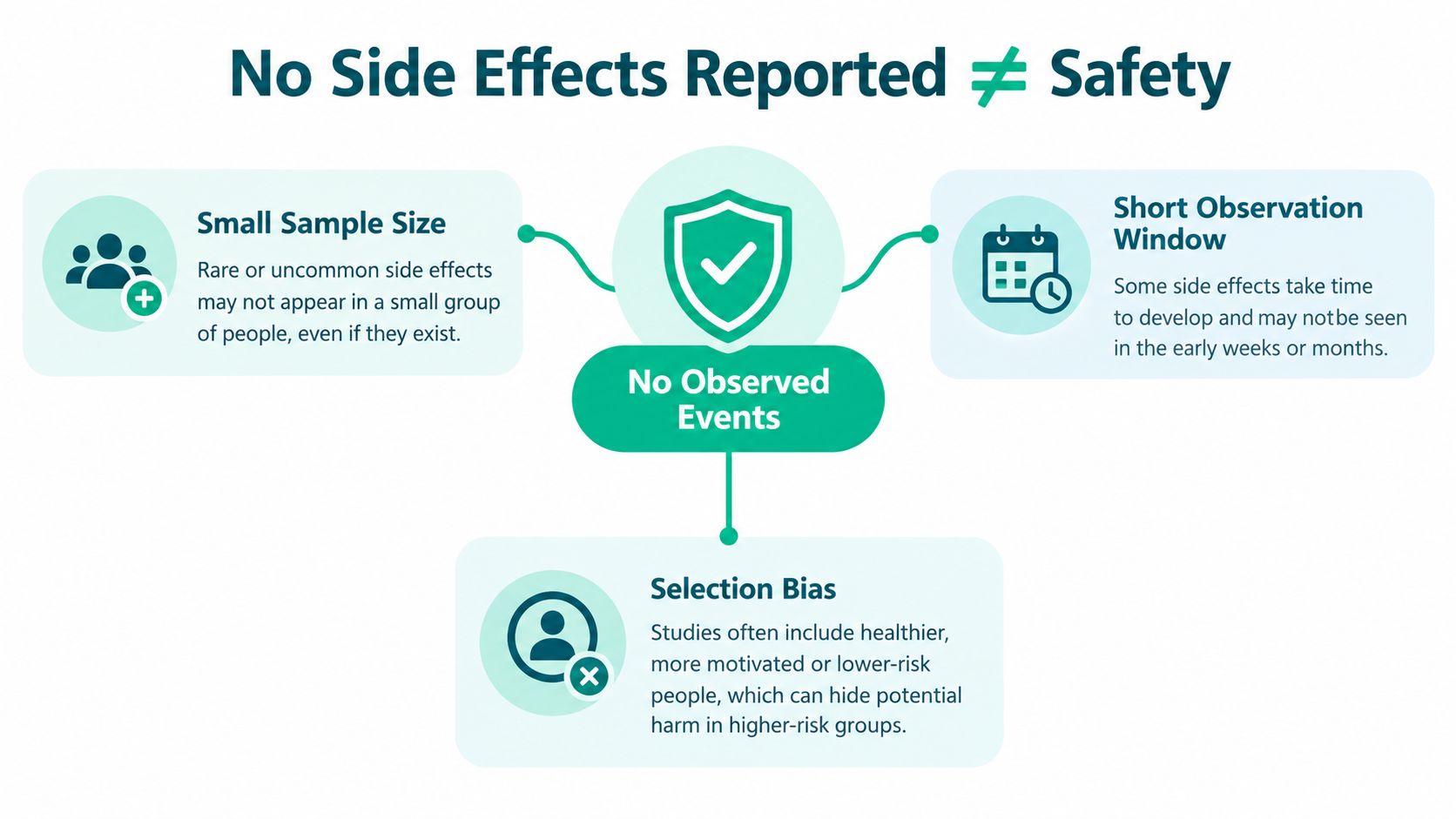
The words reported and observed matter. Researchers can report no adverse events while remaining unable to exclude risks that their study wasn't designed to detect.
A small sample may contain nobody susceptible to an uncommon reaction. A short observation period may end before a delayed effect becomes apparent. Participant selection may exclude precisely the people whose risk researchers most need to understand.
BPC-157 safety claims and missing observations
These aren't reasons to assume an undiscovered harm exists. They're reasons to avoid claiming that researchers have ruled it out.
The logical distinction is straightforward: absence of detected events supports a statement about the observations, not a statement that all relevant risks are absent. Stronger conclusions require stronger methods, including clear adverse-event definitions and appropriate follow-up.
The concept map summarises the limits of an event-free observation.
Why online symptom lists can't establish frequency
The review discussed earlier also describes anonymous accounts of pain or swelling at the exposure site, anxiety, palpitations, insomnia, fatigue, weakness, appetite loss, depression and joint pain. Those accounts lack verified exposure information, product testing, diagnoses and a reliable denominator.
They may identify concerns worth investigating. They don't establish that BPC-157 caused each symptom, and they can't support trustworthy percentages.
- Check the material: Was its identity independently verified?
- Check the outcome: Was the symptom clinically assessed or only described?
- Check the denominator: Does the report identify the full exposed population?
- Check alternatives: Were concurrent medicines, other ingredients or unrelated illness considered?
Reading safeguard: Neither a symptom-free testimonial nor an alarming forum post establishes a clinical safety profile.
A research-use disclaimer should be read as a boundary on intended use, not as supporting evidence for safety. Readers should apply the same scrutiny to reassuring marketing and alarming anecdotes: what was measured, and what conclusion does that measurement support?
Theoretical Biological Risk Signals Worth Tracking
Sport Integrity Australia identifies an additional category of concern: biological pathways and metabolites associated with BPC-157 have been linked in humans to tumour growth, cardiovascular disease and neurodegenerative disease. Its BPC-157 substance guidance also states that short- and long-term safety remain unknown.
These are biological-risk signals, not proof that BPC-157 causes those diseases. A pathway association doesn't establish the clinical consequences of exposure to a particular compound.
Mechanistic concern isn't demonstrated causation
Researchers need to distinguish a reason to monitor an outcome from evidence that the outcome occurs. Collapsing those categories produces opposite errors: declaring a compound dangerous because a pathway is disease-associated, or declaring it safe because other experiments describe protective effects.
Neither inference follows automatically. The clinical question requires evidence about the compound, the exposure conditions, the population and the actual outcome.
The appropriate conclusion is restrained: these associations justify attention in research assessment, but they don't support a quantified disease risk for BPC-157.
Product-quality hazards are a separate question
Product quality creates another route to an adverse event. Incorrect concentration, impurities, undeclared ingredients and microbial contamination could affect an experimental observation independently of the intended compound's pharmacology.
- Biological uncertainty: Concerns what the correctly identified compound might do.
- Quality uncertainty: Concerns whether the supplied material is correctly identified and adequately characterised.
- Attribution uncertainty: Concerns which factor explains an unexpected finding.
This separation matters when interpreting an adverse-event report. If the material wasn't tested, researchers may not know whether the finding concerns BPC-157, a contaminant or another exposure.
Conversely, analytical evidence of identity and purity doesn't resolve clinical uncertainty. Better-characterised material supports a more interpretable experiment; it doesn't establish human safety. Procurement assurance and clinical evidence answer different questions.
Practical Monitoring and Risk-Mitigation for Research Programs
For laboratories and procurement teams, the practical task is to make investigational work traceable and interpretable. That means defining what will be recorded before work begins, rather than reconstructing exposure details after an unexpected result.
This is a documentation framework, not a human-use protocol. Any work involving people requires appropriate professional, ethical and regulatory oversight; a research-product purchase doesn't establish that authorisation.
Research peptide testing and batch traceability
Start with the product specification and match it to the actual material received. A Certificate of Analysis should be reviewed for what was tested, which sample it represents and whether its identifiers correspond to the relevant stock.
The online Certificate of Analysis library is a documentation resource. Researchers should assess the underlying report rather than treating the existence of a certificate as sufficient.
- Record provenance: Retain the product identifier, batch number, supplier documentation and relevant receiving records together.
- Review analytical scope: Identity and purity evidence should be assessed separately from any sterility or contaminant testing.
- Resolve pending information: Material labelled in testing shouldn't be described as having completed independent verification.
- Preserve the audit trail: Keep the report version used for approval and the decision made from it.
Define observation and escalation responsibilities
Under an authorised research plan, records should capture exposure conditions, batch identity, concurrent medicines where relevant, laboratory markers and adverse events. The observation period should follow the research question and approved governance arrangements, not an assumption that an uneventful early period establishes safety.
An unexpected finding should prompt review of both the material and the biological explanation. Researchers should preserve documentation and route the finding through their institution's established escalation process.
Procurement check: Match the certificate to the batch, then match the test scope to the claim.
For people concerned about suspected exposure, the broader TGA warnings identify an important emergency boundary. Breathing difficulty, facial or throat swelling, widespread rash, collapse, severe chest symptoms, confusion or rapidly worsening illness warrant urgent medical assessment; product and batch details should be disclosed to clinicians, consistent with the TGA's guidance on unapproved peptide-product risks and responsibilities.
That guidance isn't a diagnosis of a BPC-157 reaction. It recognises that serious illness requires assessment even when the responsible ingredient or mechanism is uncertain.
Regulatory Status, Sourcing Considerations, and Common Questions
Australian sourcing doesn't change a compound's regulatory status. BPC-157 isn't included on the Australian Register of Therapeutic Goods and is prohibited under the anti-doping framework. The Australian Institute of Sport places peptide-related products in Group D, meaning they're not recommended for athlete use.
The distinction between research supply, therapeutic approval and sporting eligibility should remain explicit. An Australian research-peptide regulation overview can help procurement teams organise those separate questions.
Do clean early reports mean BPC-157 is safe?
No. They describe limited observations, not established short- or long-term safety.
What symptoms require urgent assessment?
The emergency signs listed above warrant urgent assessment. A clinician needs the product details, not an assumption about which ingredient caused the illness.
How does BPC-157 compare with an approved medicine?
Its human safety profile and adverse-event frequency haven't been adequately established. Research interest doesn't substitute for therapeutic evaluation.
What does research-only mean?
It defines the intended laboratory context. It doesn't authorise personal therapeutic use or demonstrate clinical safety.
Bulk Aussie Peptides offers research-only peptides in standardised 10-pack formats, with AUD pricing, batch documentation and independent laboratory certificates available through its online lab library. For BPC-157 research procurement, visit Bulk Aussie Peptides to review product specifications and testing status, keeping analytical verification separate from claims about human safety.
- BAP