
Supplier Transparency for Research Peptides: A Guide
Supplier transparency means verifiable records available before and after purchase, covering supplier identity, location, batch documentation, test reports and delivery traceability. A Certificate of Analysis alone isn't transparency: an Australian modern-slavery reporting review found that 66% of companies didn't address all mandatory reporting requirements, illustrating why having documents isn't the same as providing complete disclosure.
You're comparing peptide suppliers, and each website says its products are lab-tested. One offers a downloadable certificate, another promises Australian shipping, and both display similar product specifications. The useful question isn't which page looks more reassuring. It's which supplier lets you verify what you'll receive and retain evidence of that verification.
Table of Contents
- What Supplier Transparency Means for Research Peptides
- Why Structured Disclosure Sets the Transparency Benchmark
- Connecting Batch Records and Disclosure Depth to Peptide Procurement
- The Five Fields a Reliable Certificate of Analysis Must Show
- Why More Documentation Can Still Mean Low Real Transparency
- A Supplier Evaluation Checklist Tailored to Research Teams
- Reading Transparent Fulfilment Before and After Checkout
- Questions Research Buyers Ask About Supplier Transparency
What Supplier Transparency Means for Research Peptides
For research peptides, supplier transparency is a purchasing discipline rather than a marketing description. The supplier makes relevant evidence accessible, identifies who created it, and connects it to the material being offered.
That distinction matters whether you're ordering for a university laboratory, a biotech project or an institutional research program. A product description tells you what the supplier promises. Supporting records let you assess whether that promise is sufficiently documented for your work.
Evidence across the purchasing cycle
Start by separating the information you need into purchasing stages:
- Before checkout: Review the responsible business, product specification, documentation source, intended research use and proposed fulfilment arrangements.
- At dispatch: Establish which batch is being supplied and whether the associated records are available.
- After delivery: Reconcile the received goods with the order, retain the supporting documents and resolve discrepancies before accepting the material into your research workflow.
Think of this as a connected record, not a collection of unrelated files. A certificate for a product with the same name isn't automatically evidence about the batch in your parcel.
What counts as proof
Different records answer different questions. An invoice identifies a commercial transaction. A test report records analytical work. A shipment record documents fulfilment. None replaces the others.
For example, a laboratory ordering BPC-157 needs to distinguish the advertised specification from the analytical findings for the offered lot. The buyer also needs enough supplier information to know who will investigate a discrepancy.
Practical rule: Ask what each document establishes, which material it covers and what remains unverified.
My procurement recommendation is to assess transparency against your intended research requirements, not against how many certificates a supplier publishes. For reproducibility, keep the evidence that identifies the material used. For procurement governance and any relevant ethics review, retain the basis for accepting that material.
A supplier may not disclose every commercially sensitive detail. Meaningful transparency still requires clear responsibilities, accessible evidence and an honest explanation of the limits.
Why Structured Disclosure Sets the Transparency Benchmark
Australia's public procurement system offers a useful comparison because buyers can review structured records rather than rely solely on supplier descriptions. It's a benchmark for disclosure, not evidence that a research-peptide supplier meets government procurement or therapeutic-goods requirements.
In 2024–25, the Australian Government published 86,926 contracts worth AUD 104.90 billion on AusTender; Australian-addressed businesses received 93.8% by contract volume and 88.3% by value, according to the Australian Government procurement statistics. Those records provide a measurable basis for examining supplier identity, location and purchasing concentration.
Make information comparable
The important lesson isn't that a laboratory supplier should reproduce AusTender. It's that buyers need consistent fields they can compare.
| Disclosure field | What a research buyer can assess |
|---|---|
| Responsible supplier | Who supplies the goods and answers contractual questions |
| Supplier location | Which business-location claim is supported |
| Order scope | What product, format and documentation are included |
| Price and terms | What the purchase covers and which conditions apply |
| Supporting records | Whether another reviewer can follow the purchasing decision |
A supplier's Australian ownership claim and its product-origin claim answer different questions. Record each separately rather than treating either as a substitute for the other.
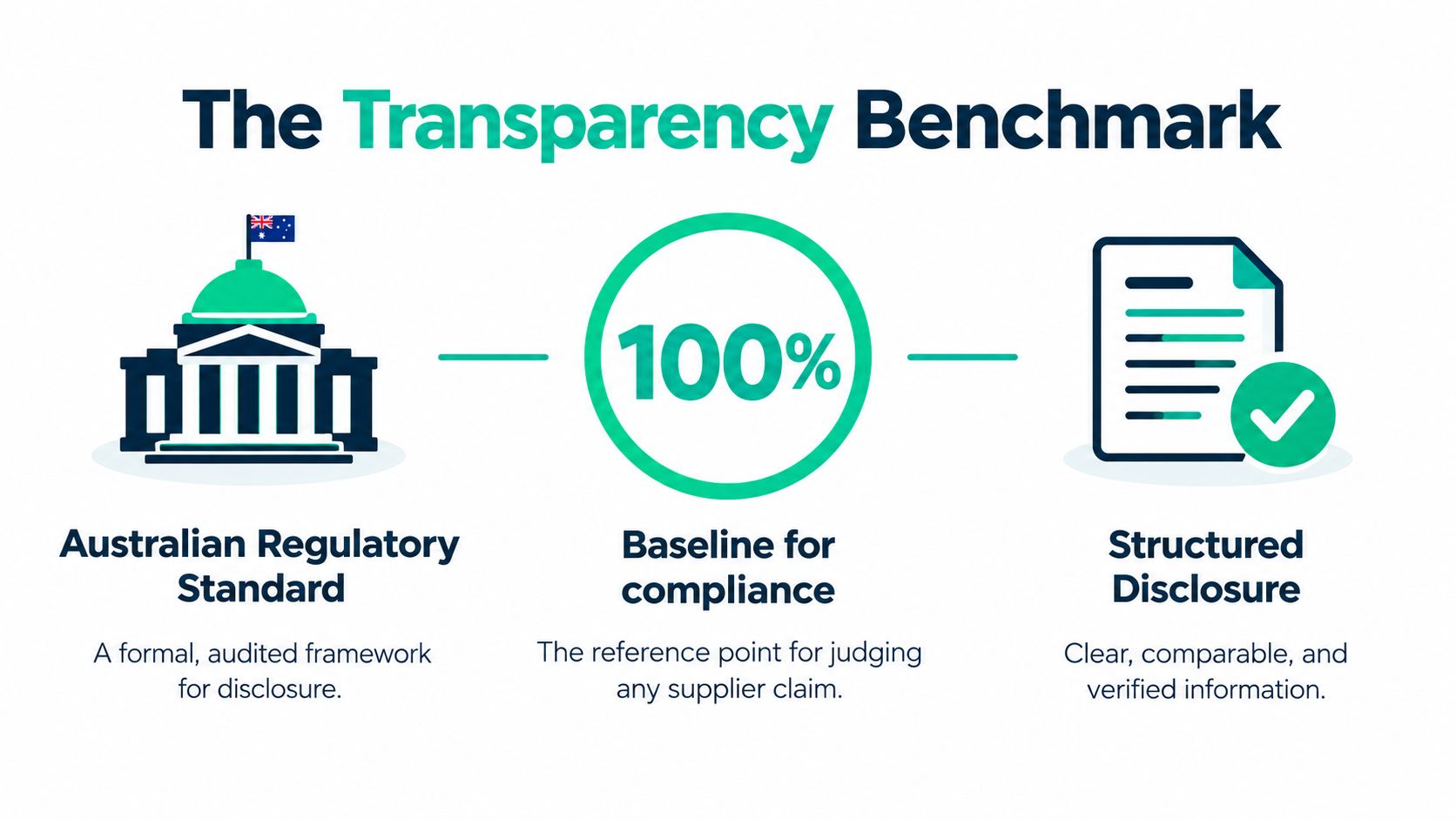
The graphic below illustrates the distinction between a benchmark and structured disclosure. Its compliance baseline is conceptual, not a measured supplier score or proof of regulatory approval.
Require proportionate operational disclosure
The Commonwealth procurement accountability and transparency guidance calls for documentation proportionate to procurement scale, scope and risk, and indicates that subcontractor names should be available on request. For research purchasing, that provides a useful governance model, not a blanket legal requirement for every private supplier.
Ask who manufactures, tests, stores and dispatches the material, and who controls the records. If a supplier won't name an upstream business publicly, request the relevant country, role and responsible entity through your procurement process.
Use a published testing and quality process as an entry point. Then assess whether the supplier's actual records substantiate the process described.
Connecting Batch Records and Disclosure Depth to Peptide Procurement
A product name identifies what you intended to order. A batch identifier helps establish which production lot you received. That difference becomes important when a supplier changes stock between your initial enquiry and dispatch.
The TGA's release-for-supply and manufacturing guidance requires batch records to identify manufacture and quality-control steps, significant deviations and corrective actions, and preserve an accessible batch history that supports rapid identification and recall of affected products. These are medicine-quality requirements, but they provide a practical traceability benchmark for research procurement.
Follow the record back to the material
For a research purchase, request a unique batch reference and a retrievable documentation record. Ask for the manufacturer or supplier identity, relevant manufacturing or testing information, and stated storage conditions where available.
Consider a hypothetical BPC-157 purchase. You review a certificate before ordering, but the supplier allocates a different lot at dispatch. The original certificate may still be valid for its own batch, yet it no longer answers your receiving question.
A BPC-157 batch documentation page is the kind of record to inspect. Don't assume its existence establishes which lot will be shipped; confirm allocation with the supplier.
Disclosure depth matters
The modern-slavery reporting review mentioned in the opening demonstrates how incomplete disclosure can remain despite formal reporting obligations. Its findings included 16% disclosing supplier lists and 13% identifying supplier countries beyond Tier 1 or down to raw materials, while supplier-policy communication improved to 46% from 27%, according to the Australian modern-slavery reporting review.
These findings concern corporate supply-chain reporting, not peptide-testing performance. Their procurement lesson is narrower: disclosure about a direct supplier doesn't necessarily reveal upstream provenance.
- Locate the evidence: Was the record generated by the manufacturer, distributor or testing laboratory?
- Identify the boundary: Does it cover production, testing, storage or only sale?
- Record the gaps: Which upstream details remain unavailable?
A traceable batch and a fully mapped supply chain are different achievements. Record what you can verify without implying more.
Broad lab-tested wording doesn't answer these questions unless the supplier connects it to identifiable material and supporting records.
The Five Fields a Reliable Certificate of Analysis Must Show
A Certificate of Analysis, or COA, should describe analytical findings for an individual manufactured batch. It isn't just a general assurance that a product meets a supplier's expectations.
The TGA's COA guidance for listed medicines identifies manufacturer, product, batch, relevant dates, tests, results, acceptance criteria, method references and an authorised official's signature as important certificate information. The following five checks group those details into a practical reading sequence, rather than replacing the fuller guidance.
Establish identity before interpreting results
Issuing laboratory. Find the organisation that performed or reported the testing. A supplier logo alone doesn't establish the testing facility's identity.
Manufacturer or supplier identity. Check which organisation is associated with the tested material. If the document names only a customer, ask whether that customer supplied the sample, manufactured the batch or acted as a distributor.
Batch number. Compare the certificate identifier with the supplier's allocation and the received vial or pack. Where identifiers differ, request a documented explanation connecting them. Do not assume that a product code and a batch code mean the same thing.
Read the analytical claim
| Certificate field | What to examine | What it doesn't establish alone |
|---|---|---|
| Test methods and acceptance criteria | Named methods, reported findings and limits used to assess them | Suitability for every research question |
| Authorised signatory | Who authorised the statement and their identified role | Independent confirmation of every claim |
Identity, purity and contamination testing answer different analytical questions. A purity finding shouldn't be treated as proof that every possible contaminant was assessed, and a result for the submitted sample shouldn't automatically be interpreted as testing of every vial.
A pass statement is meaningful only in relation to the test and its acceptance criterion. Ask what was measured, how it was measured and what threshold the laboratory or manufacturer applied.
The online COA lab library provides a place to locate batch documentation. Inspect the underlying document rather than treating a library listing as the result itself.
Also check that the product description, sample identity and relevant dates are present and coherent, without relying on the certificate's appearance. A useful COA supports analytical verification; it doesn't by itself establish therapeutic suitability, sterility, clinical efficacy or regulatory approval.
Why More Documentation Can Still Mean Low Real Transparency
A supplier can upload many PDFs without making its evidence easier to audit. Duplicate certificates, unidentified samples and unexplained laboratory claims can leave the central purchasing question unanswered.
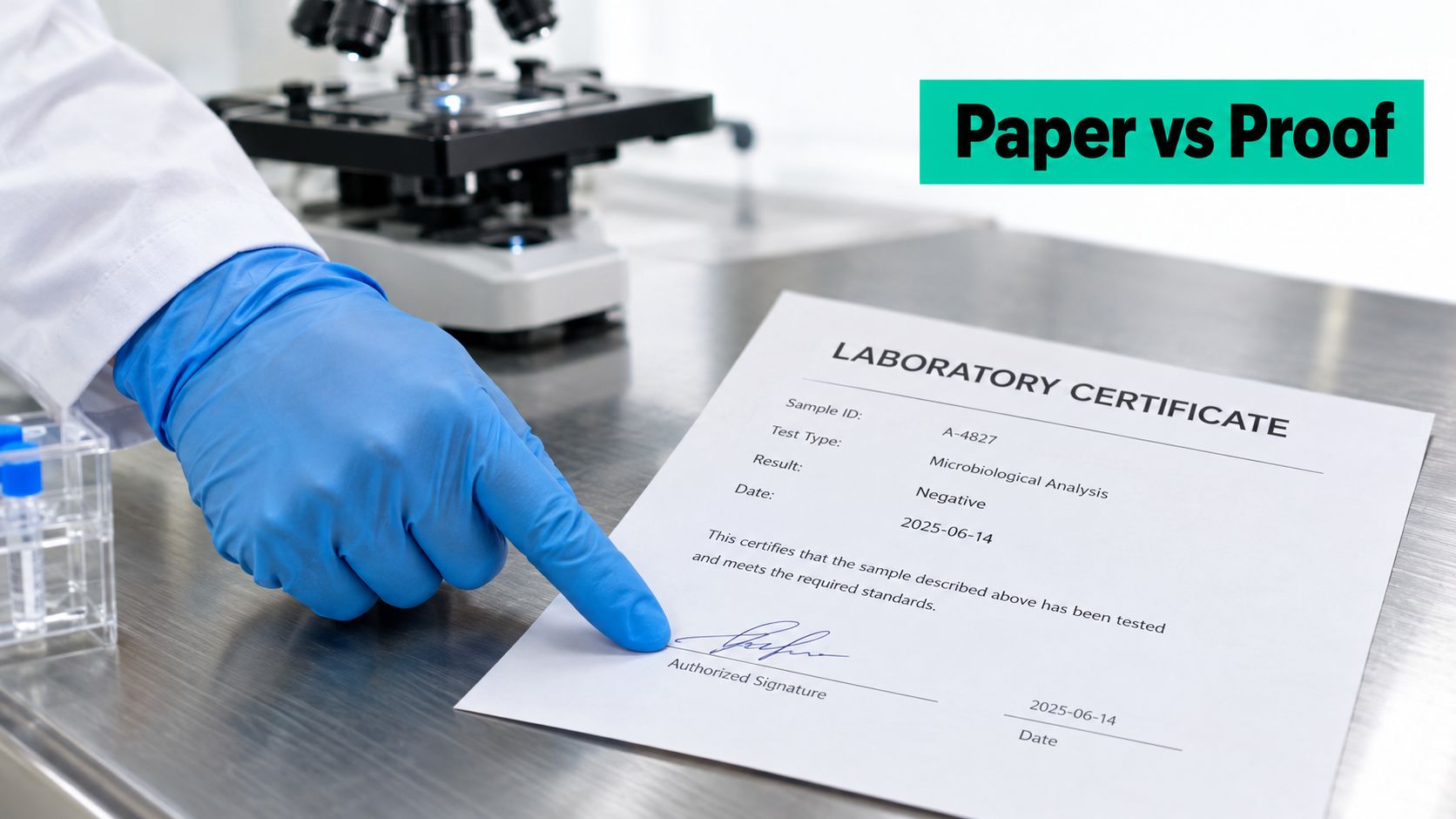
The certificate image below provides a visual reference for document review, not evidence about any particular supplier or batch.
Check laboratory accreditation scope
Independent and accredited describe different things. Independence concerns the relationship between the testing organisation and the supplier. Accreditation concerns demonstrated competence for specified activities.
NATA explains laboratory accreditation under ISO/IEC 17025 as confirmation of technical competence for the particular methods and procedures listed within a laboratory's scope, not all testing activities. A laboratory's accredited status therefore doesn't automatically cover the analytical work shown on a peptide report.
The Australian Submarine Corporation supplier-quality manual offers a separate supplier-assurance benchmark: chemical testing should use accredited laboratories and endorsed NATA/ILAC certificates, while suppliers retain responsibility for goods and sub-tier suppliers. That's an industrial procurement standard, not a universal rule imposed on research-peptide stores.
Separate document provenance from document quantity
| Document type | Useful evidence | Follow-up question |
|---|---|---|
| Manufacturer-issued COA | The manufacturer's reported batch findings | Who performed the tests? |
| Independent laboratory report | Findings produced by a separate testing organisation | How was the submitted sample identified? |
| Accredited, endorsed report | Findings within the relevant accredited scope | Does that scope cover this work? |
Sample chain of custody also deserves attention. Ask who selected the sample, who sent it and how the laboratory associated it with the stated lot. Where testing used a representative sample, request that limitation explicitly.
Audit test: Confidence should rise with what you can independently review, not with the number of downloadable files.
Use the accompanying video as supplementary material, not as a replacement for batch evidence or accreditation checks.
An unexplained accreditation logo or an impressive-looking report shouldn't settle your decision. Resolve the relationship between laboratory, method, sample and batch first.
A Supplier Evaluation Checklist Tailored to Research Teams
Turn verification into a purchasing requirement before requesting a quote. Otherwise, a supplier may offer the right product format but provide documentation that your laboratory can't accept.
Assign responsibility for reviewing the evidence. Procurement staff can check contractual and fulfilment information, while an appropriately qualified laboratory reviewer assesses whether the analytical work meets the project's requirements.
Checklist for supplier onboarding and receiving
- Define the requirement: Record the compound, required specification, pack format and supporting analytical evidence. Include any project-specific acceptance conditions.
- Confirm batch allocation: Ask which lot the supplier intends to dispatch. Match the supplied identifiers at receiving and resolve differences before acceptance.
- Identify document provenance: Mark each record as manufacturer-provided, independently issued or otherwise supplied. Don't merge these categories in the approval record.
- Verify analytical coverage: Request methods, results and acceptance criteria. Where accreditation is claimed, check the relevant scope and report endorsement.
- Clarify sample limitations: Establish whether the report concerns a representative sample and what evidence connects it to the supplied lot.
- Set substitution controls: Require notice if the allocated batch changes. Decide who must approve replacement documentation.
- Retain the evidence: Keep the quote, purchase order, received-batch details, reports, invoice and discrepancy correspondence together.
This checklist should reflect project risk rather than become an indiscriminate demand for every available document. Where evidence is missing, record whether you'll seek clarification, commission further assessment or decline the purchase.
Procurement wording you can adapt
The following is suggested purchasing language, not wording attributed to a regulator:
Suggested purchase-order condition: Supply the agreed product specification with batch-linked analytical documentation identifying the document issuer, tested material, methods, results and acceptance criteria. Notify the purchaser before substituting the allocated batch, and provide replacement records for review. Retain supporting records and identify the contact responsible for investigating discrepancies.
Use the procurement information pack as a starting point for a supplier enquiry, then confirm any conditions in the quote or order. A published information pack isn't itself the supplier's acceptance of your contractual requirements.
For repeat purchasing, retain the reasoning behind approval, not just an approved-supplier label. When the product, testing arrangement or fulfilment model changes, your team needs to know whether the previous assessment still applies.
That discipline supports reproducible research by helping researchers establish which material they accepted, why they accepted it and what evidence remains available for review.
Reading Transparent Fulfilment Before and After Checkout
Suppose your laboratory has approved the analytical evidence and is ready to place an order. The next question is operational: can the supplier explain how the goods will reach you and how it will handle a problem?
Keep order processing, dispatch and delivery separate. Ask for the current processing window, tracked delivery arrangements and the contact responsible for delays. A stated delivery estimate is useful for planning, but it isn't the same as a guarantee.
Build an operational transparency map
A supplier can process orders domestically while relying on overseas manufacturing or third-party testing. Australian customer support, warehousing and dispatch don't establish upstream product origin.
Record the operational roles separately:
- Customer support: Confirm contact channels and published hours, including the applicable AEST schedule.
- Processing and dispatch: Establish where orders are handled and who provides shipment tracking.
- Manufacturing and testing: Request location information without inferring it from the dispatch address.
- Document ownership: Identify who can retrieve batch records and answer technical questions.
- Commercial records: Confirm AUD pricing, invoice details and GST invoice availability where required.
Review the current shipping information before approval. Save the terms relevant to your order, especially if your project depends on a particular delivery window.
Keep the post-purchase record usable
The ACCC's guidance for online sellers states that online businesses must comply with consumer guarantees, avoid false or misleading claims, and provide clear ways to handle problems, replacements and refunds. It also explains that businesses must not accept payment when they don't intend to supply the promised goods or know, or should know, they can't supply within the promised or a reasonable timeframe.
For buyers, the practical response is straightforward: retain the advertised specification, order confirmation, tracking information and supplier correspondence. If the delivered item differs, describe the mismatch precisely rather than reporting only that the order seems wrong.
Ask how the supplier will document a replacement, including any batch change. Transparent fulfilment continues through the resolution of a problem, not merely until the parcel leaves the warehouse.
Questions Research Buyers Ask About Supplier Transparency
Does research-only wording settle regulatory status?
No. The TGA's therapeutic-peptide guidance explains that promotion, supply and use can determine regulatory status, and research-use-only wording doesn't itself remove regulatory obligations. Check the substance of the claims, not just the label.
Is independent testing always preferable?
It provides a separate evidence source, but independence alone isn't enough. Assess competence, analytical coverage and sample provenance against your research requirements.
When should a laboratory request further analysis?
Consider further assessment when the available report doesn't address a project-specific requirement or leaves a material discrepancy unresolved. Ask a qualified analytical reviewer to define the missing evidence.
Which warning signs justify pausing an order?
Unexplained batch mismatches, unidentified report issuers, unsupported accreditation claims and unclear substitution processes warrant clarification before purchase. Confirm decisions against the supplier's current documents and policies; this guidance is research-focused.
Bulk Aussie Peptides offers Australian-owned and operated research supply across 60+ compounds in 10-pack formats, with AUD pricing, sealed glass vials containing freeze-dried powder cake, GST invoices and tracked express Australia-wide shipping around one week door to door. Every batch is lab-tested, with independent certificates linked through the online lab library on product pages and “in testing” shown where pending; visit Bulk Aussie Peptides to compare specifications, review available batch evidence and discuss bulk or institutional procurement before ordering.
- BAP