
Cjc 1295 Australia
CJC-1295 is an unapproved peptide in Australia and the TGA says unapproved peptide products haven't been evaluated for safety, quality, or effectiveness. Government records also show 2025 import-regulatory scrutiny of CJC-1295, which matters for anyone sourcing it for research or comparing suppliers.
A researcher can be in a difficult spot here. The compound may look straightforward on a product page, but in Australia the key question is whether the item is documented, classified correctly, and separated from any claim of therapeutic approval.
Table of Contents
- What CJC-1295 Is and How It Is Regulated in Australia
- How CJC-1295 Works in Laboratory Research
- What Clinical Studies Have Found
- Import Rules and the Personal Importation Scheme
- Why Batch Documentation and COAs Matter
- Choosing an Australian Research Peptide Supplier
What CJC-1295 Is and How It Is Regulated in Australia
A lab team planning a peptide study in Australia needs two answers before anything else, what the compound is, and what the law treats it as. CJC-1295 is a synthetic peptide, but the regulatory position is more important than the marketing language attached to it. The TGA has identified it among unapproved peptide products, and its public warning says those products have not been evaluated for safety, quality, or effectiveness in Australia.
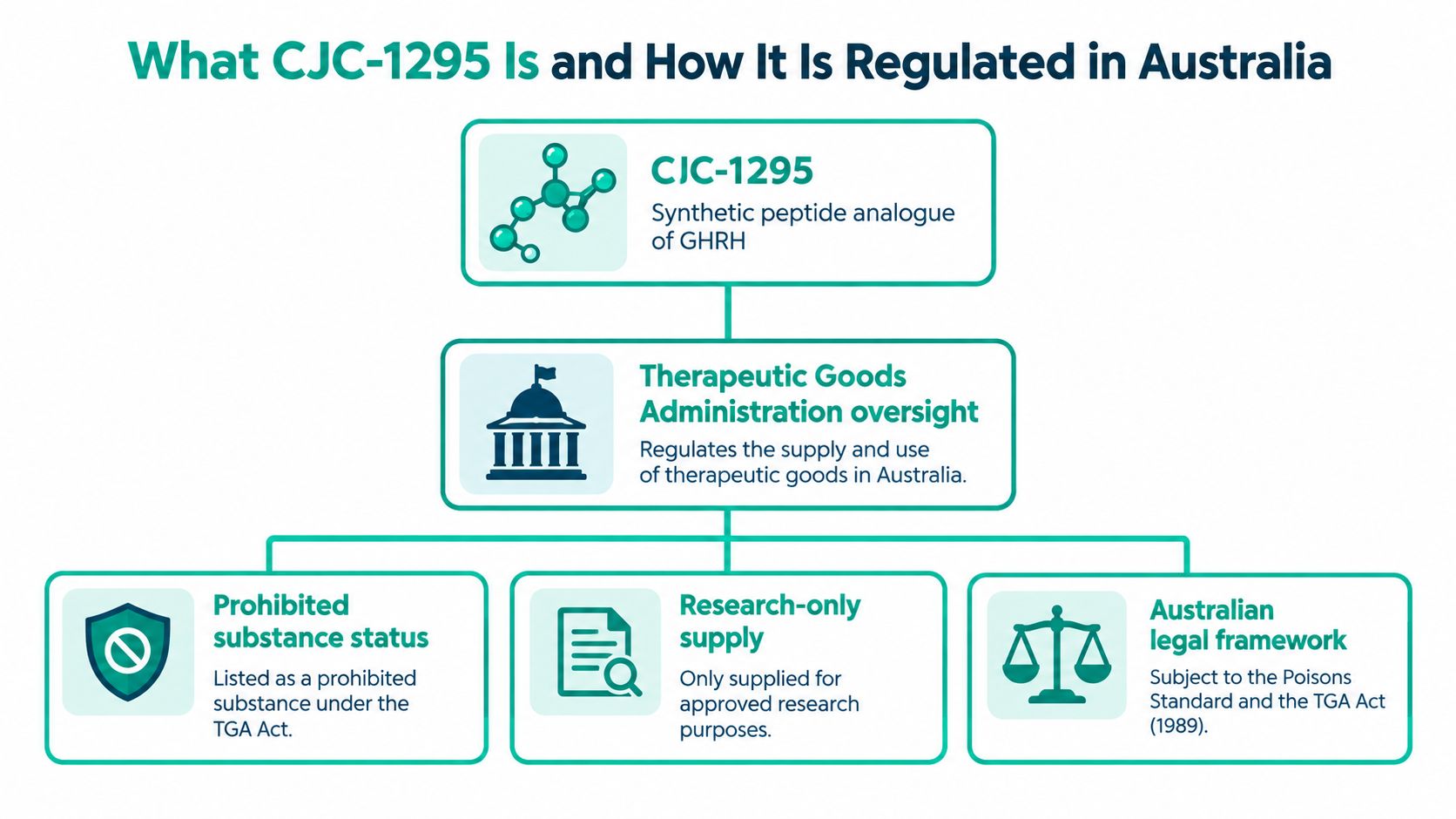
That distinction matters because import scrutiny is not the same thing as approval. A 2025 Department of Health FOI disclosure-log entry shows CJC-1295 was examined for import-permit records covering 1 January 2025 to 31 July 2025, but the accessible summary does not confirm whether permits were granted. For procurement teams, that means the historical record shows regulatory interest, not a therapeutic pathway.
Practical rule: never read a supplier page, batch sheet, or “research use only” label as proof of Australian approval.
The TGA's public warning also links unapproved peptide products with serious adverse effects reported in the broader category, including liver damage, severe allergic reactions requiring hospitalisation, and inflammation or other complications requiring medical attention. That warning doesn't provide a CJC-1295-only event count, so it can't support any claim that a specific number of incidents involved this compound.
For Australian buyers, the safe reading is simple. Import-related documentation, ARTG inclusion, and research-only supply are different questions. If a vial isn't clearly supported by compliant documentation, it should be treated as a research procurement issue, not a clinical product.
research peptide regulation in Australia
How CJC-1295 Works in Laboratory Research

CJC-1295 is described in the literature as a synthetic, tetrasubstituted 30-amino-acid analogue of growth-hormone-releasing hormone (GHRH). In plain terms, it is designed to signal the pituitary gland to release growth hormone, with downstream effects on IGF-1. That biochemical description is useful because it tells researchers what kind of endpoints belong in a protocol and what kind don't.
A clean lab workflow starts with classification. If the compound is being considered for endocrine research, the variables that matter are the ones tied to its pharmacology, not consumer-style outcome claims. That usually means tracking IGF-1, growth hormone response, and related metabolic markers such as glucose, while keeping the project clearly separated from any assumption of therapeutic benefit.
The TGA's position stays relevant here. CJC-1295 sits in the same unapproved-peptide category as other products that have not been assessed for Australian safety or effectiveness. That means a certificate of analysis can help establish identity or purity, but it can't turn a non-approved compound into a medicine.
A useful research mindset is to separate biological activity from clinical value. CJC-1295 may show endocrine activity in studies, but that's not the same thing as proving it improves body composition, recovery, or skin, hair, or nail outcomes in Australian users.
The peer-reviewed material supports that narrower reading. It describes exposure and hormone-response behaviour, which is exactly what a laboratory should care about first.
Later in the workflow, after the compound is classified and the study endpoints are fixed, procurement teams should confirm that any product page or specification sheet aligns with the intended research use and local compliance settings. That's the part that prevents a procurement discussion from drifting into an implied medical one.
What Clinical Studies Have Found
The strongest human evidence comes from two randomised, placebo-controlled, double-blind, ascending-dose trials in healthy adults, lasting 28 and 49 days. Those studies reported dose-dependent increases in mean plasma growth hormone of 2- to 10-fold for at least 6 days, and mean IGF-I increases of 1.5- to 3-fold for 9 to 11 days. The estimated half-life ranged from 5.8 to 8.1 days after single dosing. PubMed study
Those numbers matter because they tell you what the study measured. They show sustained endocrine activity, not a finished answer about human benefit. The trials were short, focused on pharmacology, and designed around hormone levels and safety rather than long-term outcomes.
What those findings do not prove
They do not establish weight-loss effects, injury recovery, or changes in skin, hair, or nails for Australian consumers. They also don't answer the harder question researchers keep asking, what happens with repeated exposure over months or years.
The evidence is about hormone response, not a clinical promise.
Reported short-term effects included injection-site reactions, headache, nausea, and diarrhoea. That's useful for protocol planning because it gives researchers a realistic view of the immediate tolerability profile seen in the study setting. It doesn't tell us enough about longer-term risk, especially in healthy users.
The other useful pharmacokinetic detail is exposure duration. Published results show measurable concentrations for roughly 10 to 13 days after single or multiple doses, with systemic clearance reported in the study data. That helps explain why CJC-1295 is discussed differently from shorter-acting GHRH compounds, but it still doesn't convert the findings into a use protocol.
For Australian buyers, the takeaway is straightforward. Clinical data support biological activity, while the bigger evidence gap remains long-term human safety and any claimed consumer outcome. Those are different levels of proof, and they shouldn't be blurred together in procurement files or product descriptions.
Import Rules and the Personal Importation Scheme
Australian buyers often mix up personal importation with commercial procurement. They're not the same thing. The Personal Importation Scheme allows an individual to import a maximum three-month supply of most therapeutic goods for personal use or for an immediate family member, and the goods can't be sold. Personal Importation Scheme
That rule does not create a general right to stock, resell, or distribute an unapproved peptide in a lab or clinic. For regulated therapeutic peptide products, the TGA states that ARTG inclusion is required before importation, manufacture, supply, export, or advertising. If a procurement team skips that distinction, the order may look convenient but the compliance risk stays with the buyer.
Side-by-side view
| Pathway | What it allows | What it does not allow |
|---|---|---|
| Personal importation | Limited import for personal or immediate family use | Resale or commercial supply |
| Regulated therapeutic supply | Import, manufacture, supply, export, advertising with proper status | Treating an unapproved peptide as approved |
| Research procurement | Controlled sourcing for a defined project | Assuming consumer product claims apply |
The practical move is to verify legal classification before ordering. That means checking intended use, documentation, and whether the supplier is describing the item as a research material rather than a therapeutic good. For laboratories, that's not bureaucratic extra work, it's the first filter that keeps procurement clean.
Why Batch Documentation and COAs Matter
Independent batch documentation is what separates a tidy procurement file from guesswork. Manufacturer claims can describe a product, but a Certificate of Analysis tells you whether a specific batch was tested, what was measured, and how the vial set maps to the test record. That traceability matters when the compound sits in a sensitive research category.
A practical verification workflow
- Match the batch number. Check that the vial, product page, and COA point to the same batch.
- Review the document source. Separate manufacturer-provided material from independent lab testing.
- Read the scope. A COA can support identity or purity, but it doesn't prove clinical efficacy, sterility, or long-term safety.
- Look for pending labels. If testing is still in progress, the product page should say so plainly.
- File the document with procurement records. Keep the COA with SKU notes, supplier details, and any internal approval paperwork.
That workflow reduces uncertainty about what's in the vial, but it doesn't close the much bigger evidence gap around repeated exposure. Healthy human users of CJC-1295 still don't have enough long-term data to support confident claims about sustained outcomes.
Useful distinction: a strong COA can support identity and purity. It can't manufacture evidence that hasn't been generated.
For Australian labs, the core value is transparency. If a supplier publishes batch-specific documentation in an online library, the buyer can inspect what was tested before money changes hands. That's more defensible than relying on a polished product description alone.
A supplier can also improve internal review by linking document metadata to the SKU, showing whether a file is current, and making it easy to compare batches across studies. That doesn't make the product approved. It does make procurement clearer, and clearer is better when a compound sits under regulatory scrutiny.
Choosing an Australian Research Peptide Supplier
The best supplier choice is usually the one that makes verification easiest. Look for Australian ownership, clear research-only positioning, batch documentation, GST invoices, and product pages that show what's in the pack before checkout. If you're comparing CJC-1295 options, a standardised 10-pack vial format can help procurement teams keep study materials predictable across orders.

A strong supplier also gives buyers ways to audit the paper trail. That includes product specifications, access to an online certificate library, and clear notes on whether a batch is available or still in testing. For a team planning controlled research, those details matter as much as the vial itself.
Bulk Aussie Peptides is one Australian option that publishes research-use product information, batch documentation, and a COA library, with procurement pathways for bulk and wholesale buyers. It also helps when the supplier keeps the conversation on documentation, not on outcomes.
What to compare before ordering
- Documentation access: Can you inspect batch records before purchase?
- Order format: Are packs standardised, such as 10-vial formats, or do they vary unpredictably?
- Invoice support: Will you get GST paperwork that fits institutional procurement?
- Dispatch clarity: Are processing and delivery windows stated plainly?
- Research-only language: Does the supplier avoid language that implies therapeutic approval?
If you're comparing suppliers for a project involving CJC-1295, use the same checklist for each one. A tidy lab file starts with a clean source record, not with a marketing claim.
research peptide supplier Australia
If you're sourcing CJC-1295 for a research workflow, review the batch documents, confirm the legal status, and compare supplier transparency before you order. Bulk Aussie Peptides provides research-use peptide listings, batch-linked documentation, and wholesale pathways for Australian buyers, so you can assess what's on paper before you commit. Visit Bulk Aussie Peptides to review the current research range and procurement information.