
Quality Assurance Documentation for Research Peptides

You've received a shipment of research peptides, and the first question is practical: does the documentation prove that the material in the sealed vial is the batch described on the paperwork? Quality assurance documentation answers that question by connecting identity, test results, laboratory competence, storage, and procurement records. A Certificate of Analysis, or COA, matters, but it's only one part of the evidence trail.
For Australian research teams, the strongest file links the physical material to a specification, an identifiable method, a competent laboratory, a defined accreditation scope, and a reviewer's decision. The following framework helps laboratories, universities, biotech teams, and individual researchers evaluate that evidence without treating a polished PDF as proof on its own.
Table of Contents
- What Quality Assurance Documentation Means for Peptide Research
- The Four Core Types of Research Peptide Documentation
- How to Read and Verify a Certificate of Analysis
- Documentation Provenance and Labelling Standards
- Procurement Checklist for Universities and Principal Investigators
- Common Pitfalls and Red Flags When Sourcing Peptides
What Quality Assurance Documentation Means for Peptide Research
Quality assurance documentation is the recorded evidence that a research material was specified, received, tested, reviewed, and controlled in a traceable way. It's not merely administrative paperwork. Australia's laboratory-quality framework treats documentation as evidence of technical competence, traceability, and reliable results. The Australian Government recognises the National Association of Testing Authorities, or NATA, as the country's key accreditation body for testing and measurement laboratories, and most testing and calibration laboratory criteria are based on ISO/IEC 17025. Australian Government information on NATA accreditation explains why accreditation applies to defined activities rather than every possible test.
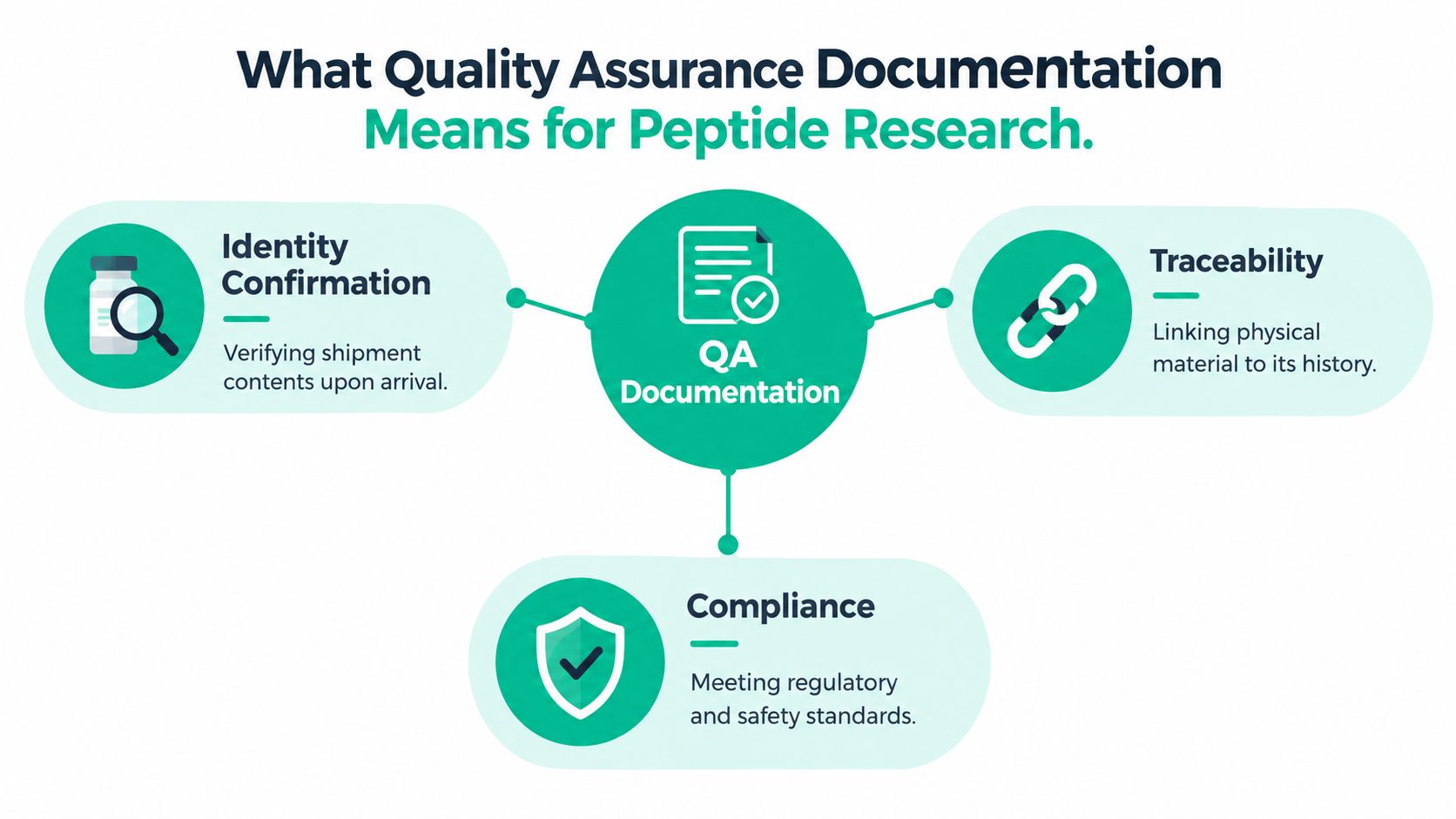
When a shipment arrives, start with the physical label. Record the product name, batch or lot identifier, packaging condition, receipt date, and any storage information supplied with the order. Then match those details to the specification sheet and the relevant COA. This simple sequence protects against a common mistake, accepting a document that describes a similar product or a different batch.
Practical rule: A certificate supports the material only when its identity, batch reference, method, and issuing laboratory can be connected to the material received.
NATA accreditation is granted for activities listed in a laboratory's Scope of Accreditation. A laboratory may be competent for a particular analyte or method without being accredited for every test shown on a report. NATA endorsement on a report also doesn't automatically validate work outside that approved scope. For buyers, “laboratory tested” is therefore incomplete information unless the supplier identifies who performed the analysis and what the laboratory was accredited to do.
The Therapeutic Goods Administration, or TGA, also treats records as a chain covering materials, suppliers, testing, manufacture, release, and distribution. Research procurement can apply the same logic. Keep supplier and lot identity, the analytical method, reported results, acceptance criteria, reviewer approval, storage conditions, and dispatch information together. That chain makes later verification and investigation possible.
The Four Core Types of Research Peptide Documentation
These four documents answer different questions. Treating them as interchangeable creates gaps in the procurement file.
| Document | Main question it answers | What to verify |
|---|---|---|
| Specification sheet | What should the product meet? | Product identity, stated parameters, storage and document revision |
| Certificate of Analysis | What did testing show for this batch? | Batch or sample identifier, method, results, acceptance criteria and laboratory |
| Batch record | How was the batch received, processed, tested and released? | Material history, controls, calculations, deviations and approvals |
| Test report | What additional or independent evidence is available? | Issuing laboratory, scope, method, sample identity and report status |
A specification sheet sets the expected criteria before purchase. It might identify the compound, format, appearance, storage requirements, and tests relevant to the product. Because it describes the expected standard rather than a particular result, it shouldn't be treated as a substitute for batch testing.
A COA reports results for an identified batch or sample. It's useful only when the report connects the result to the material supplied. Check the batch number, sample description, report date, test method, units, acceptance criteria, and sign-off. A document that says only “pass” provides less evidence than a controlled report showing how the conclusion was reached.
A batch record provides history. TGA/PIC/S guidance describes batch-processing records as including the batch number, specifications, test procedures, results, observations, calculations, and quality-control documentation. Selected data should be recorded in a form that permits trend evaluation. The TGA/PIC/S GMP guide also connects distribution records to batch numbers, which supports targeted investigation when a discrepancy arises.
An additional test report may come from an independent laboratory or provide a different analytical technique. It doesn't automatically outrank a manufacturer-issued COA. Its value depends on provenance, method, laboratory competence, and whether the sample tested is the same material received. A useful place to compare available records is the COA library, provided each file's batch mapping and document status are clear.
How to Read and Verify a Certificate of Analysis
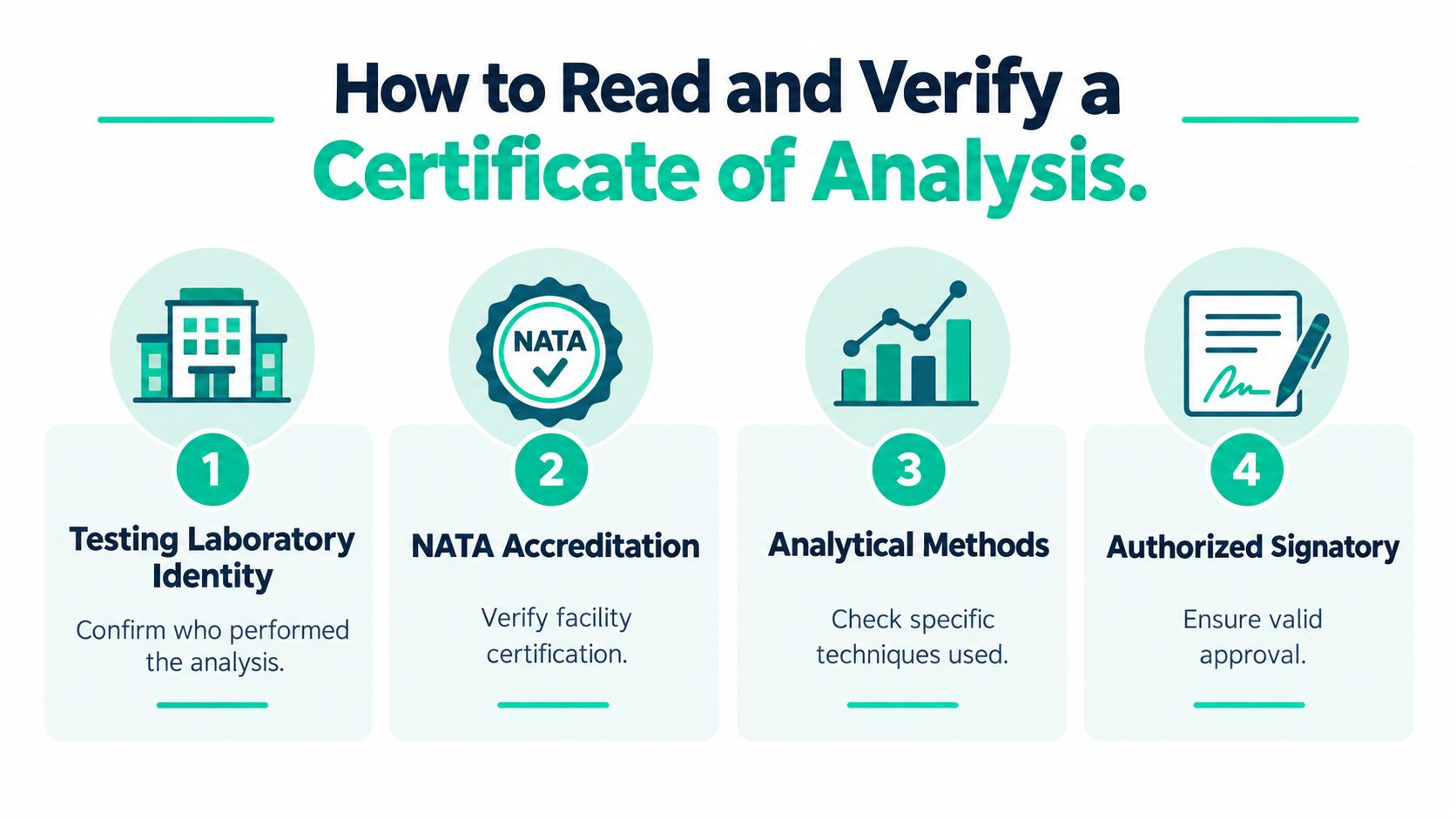
A COA deserves a field-by-field review. Don't begin with the headline purity result and stop there.
Start with identity and provenance
Confirm the product name, batch or lot number, sample identifier, report date, and issuing laboratory. The batch number on the report should match the vial label and the supplier's receipt or dispatch record. If the report identifies a sample but not the supplied batch, ask how the sample was selected and how the link was maintained.
Next, check the stated test method. For peptide documentation, a result may refer to identity confirmation, purity, or another defined analysis. A high assay or purity result alone doesn't establish identity, sterility, endotoxin status, stability, or suitability for a particular research protocol. Those are separate questions requiring appropriate evidence.
Check accreditation and scope
NATA states that ISO/IEC 17025 accreditation supports accurate and reliable results for testing, calibration, and sampling, with peer review and government endorsement. NATA's standards information is useful when checking whether the laboratory named on a report holds relevant accreditation.
The key word is relevant. Verify that the reported test falls within the laboratory's accredited scope, not merely that the laboratory displays a NATA reference. NATA's accreditation records can be method- and product-specific. One accredited chemical laboratory listing, for example, identifies its site, accreditation details, qualitative identification procedures, and HPLC methods for specified compounds. The NATA laboratory listing shows the level of specificity buyers should seek.
Interpret results with their limitations
Review the result, units, acceptance criteria, calculations, analyst or laboratory attribution, and authorised approval. Where relevant, retain the stated measurement uncertainty. NATA records that applicable accredited testing and calibration activities report measurement uncertainty as expanded uncertainty with a 95% confidence level, unless otherwise stated. NATA's laboratory record explains why a numerical result isn't automatically an exact measurement.
Use the testing and quality information to understand how a supplier labels manufacturer-issued documents, independent reports, and pending files. A clear distinction helps procurement teams judge evidence rather than relying on presentation.
Documentation Provenance and Labelling Standards
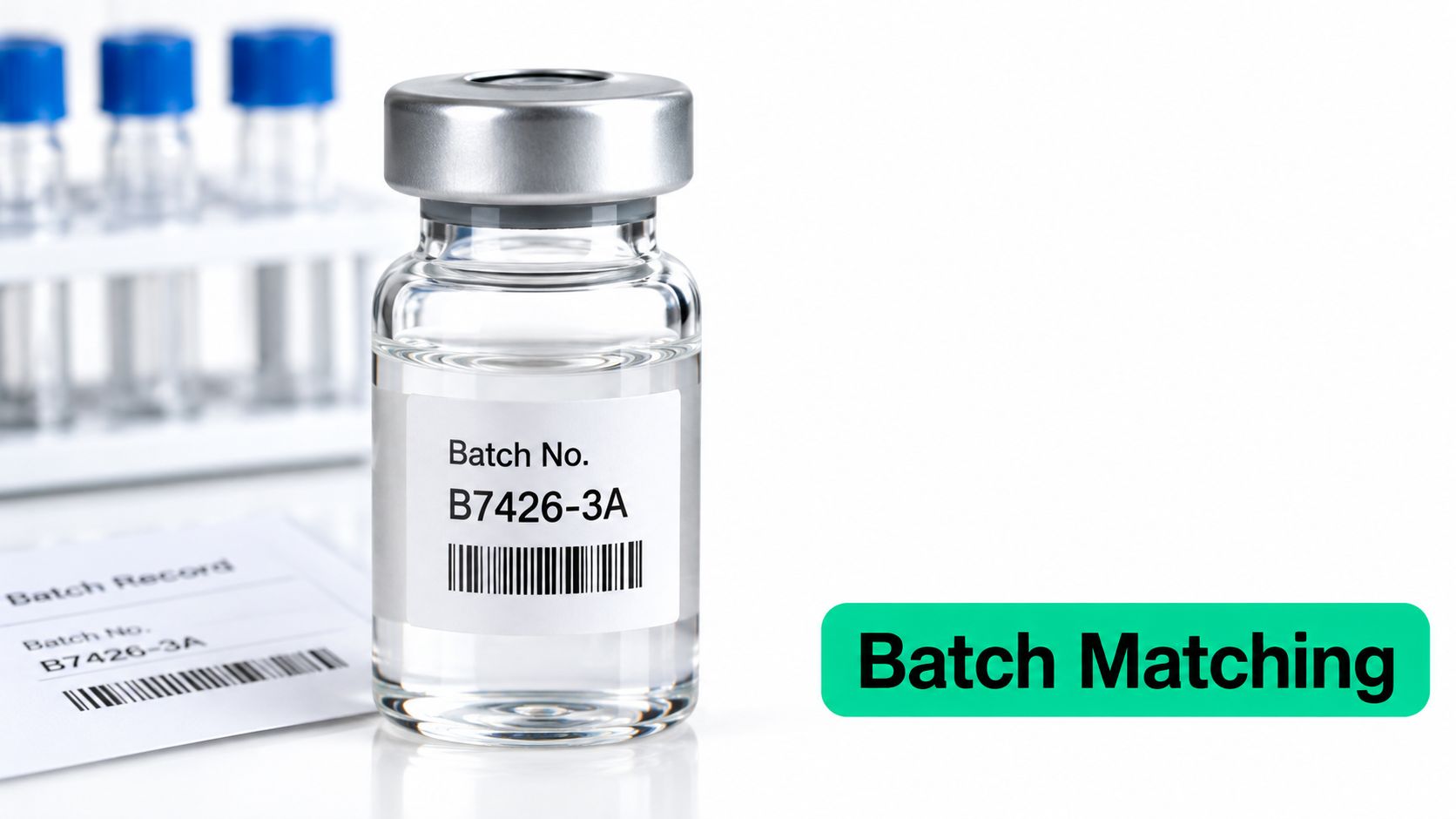
Provenance means that a document can be traced back to the exact physical material it describes. Consider a sealed glass vial labelled with a batch number. The corresponding COA should carry that same identifier, and the internal receipt record should preserve the connection. If the label, report, invoice, and dispatch record use different identifiers, the file contains a gap that needs resolution before the material is treated as verified.
Australian laboratory standards expect records to support reconstruction of quality trends, reviews, and corrective decisions. NATA's ISO/IEC 17025 material says procedures should be documented as far as necessary to ensure consistent activities and valid results. Personnel records should cover competence requirements, selection, training, supervision, authorisation, and ongoing competence monitoring. NATA's ISO 17025 application material also describes the importance of protected original records and retained evidence of quality-control review.
A defensible file should preserve:
- Original results: Keep the initial report and any raw or reported data needed to understand the conclusion.
- Document control: Record document identification, revision status, approval, and replacement history.
- Review evidence: Show who reviewed the results and how deviations or atypical findings were handled.
- System checks: Retain evidence of periodic quality-system reviews and internal audits.
- Electronic provenance: Preserve metadata, audit trails, access history, backups, and readable archived copies where electronic systems are used.
The documentation request process can help a buyer obtain missing records, but a request should be specific. Ask for the batch-linked document, the test method, laboratory identity, report status, and any relevant independent verification. An overwritten PDF is not the same as a controlled amended report.
Procurement Checklist for Universities and Principal Investigators
A university or biotech procurement file should let another reviewer understand what was ordered, what arrived, what evidence supports it, and who approved the record.
Before ordering
- Define the required evidence. Request the specification sheet, expected testing fields, storage information, and available batch documentation.
- Check laboratory details. If independent testing is claimed, identify the facility and compare the method with its relevant accreditation scope.
- Confirm supply terms. Record the product format, quoted AUD price, GST treatment, dispatch information, tracking arrangements, and any institutional purchasing requirements.
- Check document status. Distinguish available certificates from documents marked as pending or in testing.
At receipt
- Match identifiers: Compare the vial label, outer packaging, invoice, dispatch record, and COA.
- Record condition: Note packaging condition and supplied storage instructions.
- File approvals: Have the designated reviewer record whether the documentation is acceptable, incomplete, or requires follow-up.
- Preserve evidence: Store the original COA, specification, invoice, and correspondence in the study or supplier file.
During the project
Retain records according to institutional policy and the needs of the study. TGA record-keeping guidance provides a useful Australian benchmark for batch-linked documentation, including retention for at least 12 months after expiry, or at least six years after manufacture when no expiry date exists. TGA medicine record-keeping requirements sets out those requirements for manufacturers, while research teams should confirm the retention rules that apply to their institution and project.
The procurement information pack can support requests for specifications, GST invoices, and supplier documentation. Keep the final decision and its rationale with the file, not only the documents that support approval.
Common Pitfalls and Red Flags When Sourcing Peptides
More documents don't automatically create more assurance. A folder full of uncontrolled duplicates, generic templates, and unexplained revisions can make provenance harder to establish than a smaller, well-organised file.
The first red flag is a claim that says “lab tested” without naming the laboratory, method, sample identity, or accreditation scope. The second is a COA with no batch identifier. Without a batch link, the buyer can't show that the result applies to the material received.
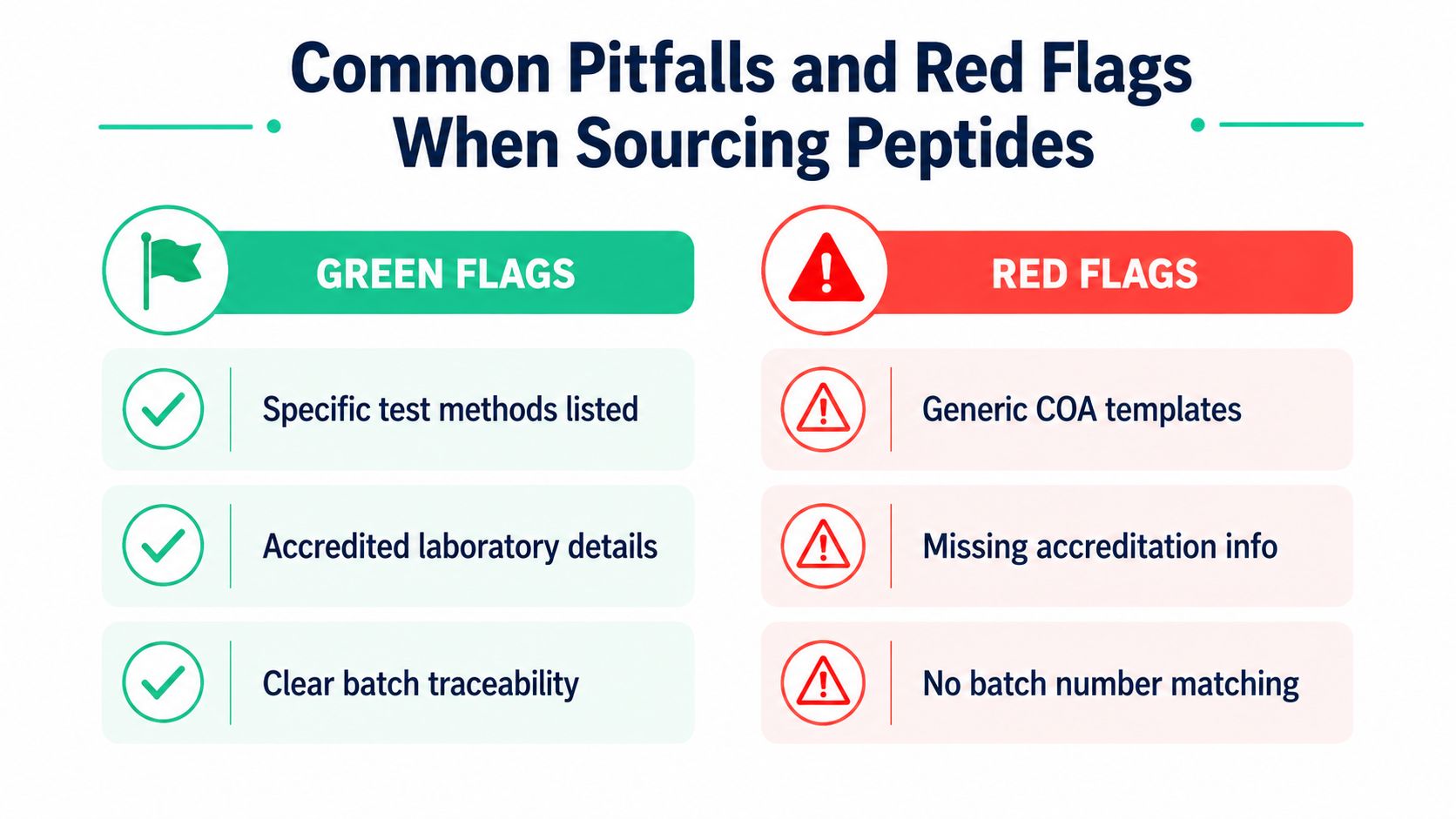
Green flags
- Specific test methods listed: The report identifies the analytical technique and the measured attribute.
- Accredited laboratory details: The facility, accreditation status, and applicable scope can be checked.
- Clear batch traceability: The vial, COA, invoice, dispatch record, and specification use matching identifiers.
- Controlled revisions: The file shows its status, approval, and amendment history.
- Complete interpretation: Results include units, acceptance criteria, limitations, and uncertainty where relevant.
Red flags
- Generic COA templates: The document looks identical across products or doesn't identify a tested batch.
- Missing accreditation information: A logo or phrase replaces the laboratory identity and scope.
- No batch number matching: The report can't be connected to the material in the shipment.
- Undated product claims: A general purity statement has no report date or sample reference.
- Uncontrolled downloads: A library offers files without clear versioning, document status, or access context.
If a discrepancy appears, quarantine the affected material, preserve the original COA and packaging evidence, and compare every identifier. Ask for an investigation or controlled amended report rather than an overwritten file. The research peptide supplier guide can help buyers frame supplier questions, but independent retesting or replacement should be considered according to the project's risk assessment and institutional procedures.
Bulk Aussie Peptides provides research-use-only peptides in sealed glass vials, standardised 10-pack formats, product specifications, and an online laboratory library with independent certificates where available, with pending files marked as in testing. Visit Bulk Aussie Peptides to review batch documentation, request procurement records, and compare Australian supply options with tracked domestic delivery and GST invoices.
- BAP