
What Is Traceability in Manufacturing: A Guide for Labs
Traceability in manufacturing is a documented chain of custody that links each supplied unit back to its production batch, test records and supplier, then forward to the customer, so the history of any item can be reconstructed on demand. In Australian manufacturing and supply work, that means you should be able to show what was made, which batch it came from, and who handled it on the way in and out.
If you've ever had a researcher ask whether the vials on the shelf really match the Certificate of Analysis, you already know why this matters. A label by itself is only a start, while a traceable record shows the full path, much like a parcel tracking number shows every hand a package passed through, except here the history also includes testing, storage and dispatch.
Table of Contents
- A Working Definition for Procurement Teams
- Backward and Forward Tracing
- The Minimum Evidence Chain
- How Traceability Is Built in Practice
- A Supplier Evaluation Checklist You Can Use Today
- Why More Technology Is Not Automatically Better
- Putting It Together When You Compare Suppliers
- Procurement Questions Worth Asking a Supplier
A Working Definition for Procurement Teams
A buyer's first test is simple. If a lab lead asks, “Can we prove these peptides came from the batch the COA names?”, the answer has to come from records, not memory.
For procurement teams, traceability means a supplier can identify the immediate source of a product, the immediate customer it went to, and the records that connect those two points. That's the practical meaning behind our Australian peptide range, because the question isn't just whether a vial exists, it's whether its history can be reconstructed cleanly.
Practical rule: if the batch can't be tied to a supplier, a test record and a dispatch record, it isn't traceable enough for serious purchasing.
Australian guidance frames this as both backward and forward tracing. Backward tracing asks where a unit came from, forward tracing asks where the other units from that same batch went. That's why a procurement file needs more than a neat product page. It needs evidence that the item on the shelf is the same item described in the paperwork.
For peptide and lab supply buyers, that matters because a vial is only useful as a procurement asset if the record trail is solid. A good chain of custody doesn't just support compliance. It makes supplier review faster, reduces argument over provenance and gives you a better basis for repeat ordering. The buyer's job is not to admire a label, it's to verify the record behind it.
Backward and Forward Tracing
Backward tracing is the “where did this come from?” question. Forward tracing is the “who else got units from the same batch?” question. You need both if you want to know whether a record is genuinely useful in a recall, a quality review or a supplier comparison.
The Australian “one step up, one step down” framing makes this easy to remember. A supplier should know from whom the product was received and to whom it was supplied, which keeps the chain short enough to act on and specific enough to trust. The COA library only becomes meaningful when it's connected to both directions, not stored as a loose PDF with no batch linkage.
What each direction proves
| Direction | What it answers | What a weak record leaves unclear |
|---|---|---|
| Backward | Which batch, source and test evidence produced the vial | Whether the item on hand really matches the supplied paperwork |
| Forward | Which customers, locations or shipments received related stock | Whether other units from the same batch are still exposed |
A Certificate of Analysis is backward evidence. It can tell you what was tested and what the results were. It does not, on its own, prove where the rest of the batch went.
That distinction matters in procurement because a complete file should let you move from the vial in front of you to the batch behind it, then out to the customer record in front of it. If one side is missing, the chain breaks. If both sides are present, you can investigate with confidence instead of guessing.
The Minimum Evidence Chain
A defensible batch file includes a small set of essential fields. The goal is not paperwork for its own sake, but ensuring a lot can be traced without guesswork.
Testing and quality records should show, at minimum, the identifiers that tie the unit to a batch, the batch to a supplier, and the shipment to a customer. In plain terms, look for these pieces of evidence:
- Identifier or SKU: the specific product name or code tied to the vial.
- Batch or lot number: the unique link back to production.
- Supplier identity: who provided the material or finished unit.
- Customer identity: who received it.
- Delivery or dispatch date: when custody changed.
- Quantity: how many units or packs were received or supplied.
- Testing source: which laboratory or document generated the test record.
- Document source: where the COA or specification came from.
A COA with no lot number is a document. A COA matched to a physical batch is evidence.
Missing fields tell you something too. No batch number usually means the vial can't be tied to a production run. No customer record means you can't tell where other units went. No testing source makes it harder to judge whether the document belongs to the product in your hands.
For research peptide procurement, this is the difference between verifiable and unverifiable stock. If the paperwork can't answer who made it, what batch it came from and who received it, the file isn't ready for audit or a quality challenge. A strong buyer doesn't ask for every possible document, only for the documents that prove custody and identity.
How Traceability Is Built in Practice
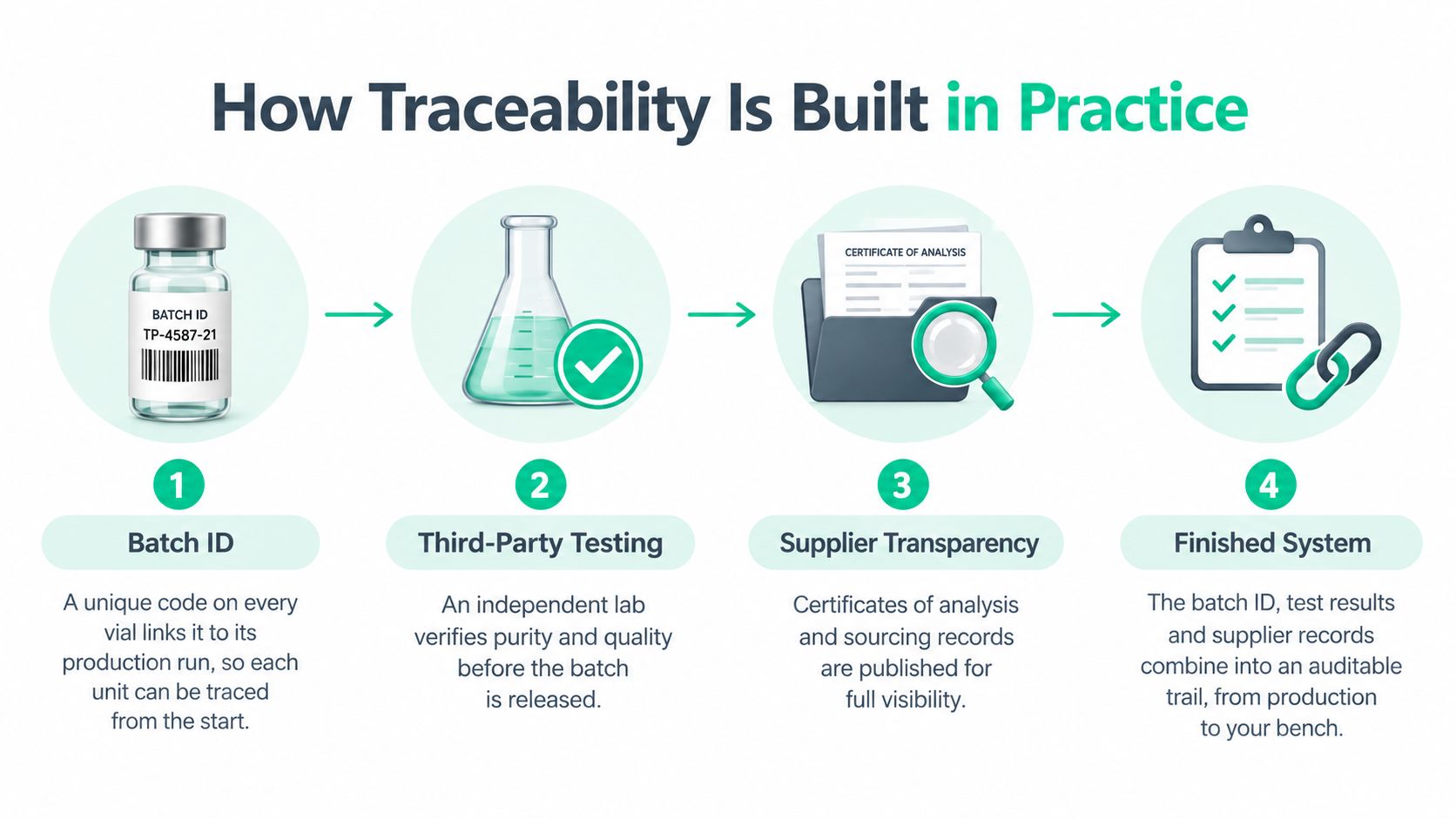
A traceable supply chain starts when the batch number is created and ends only when the customer record is closed. For a 10-pack vial of research peptide, that usually means a unique batch ID at goods receipt, a linked COA, storage records, dispatch records and an invoice that all point to the same unit family.
Request batch documentation is the kind of step a procurement team should expect when a supplier is serious about traceability. The goal is to be able to move from the vial on the bench back to the production record, then forward to the customer record without a manual scavenger hunt.
The Australian recall example makes the logic clear. A batch of Palexia SR tapentadol tablets, batch 985P01, was distributed between 12 November 2019 and 15 January 2020, and the batch number helped identify the affected stock for recall from wholesalers. That's the same mechanic a lab buyer wants in a peptide file, just applied to research supply instead of medicine distribution. The TGA market action record shows why readable batch details matter when something has to be isolated quickly.
A workable process looks like this:
- Receive the batch: record the unit identifier as soon as stock arrives.
- Match the COA: confirm the document names the same batch number.
- Log storage and dispatch: keep the custody trail intact through handling.
- Link the invoice: make sure the commercial record matches the physical one.
That's what turns a folder of files into a usable traceability system. Without the links, the documents are just separate records. With the links, they form a chain that can stand up to review.
A Supplier Evaluation Checklist You Can Use Today
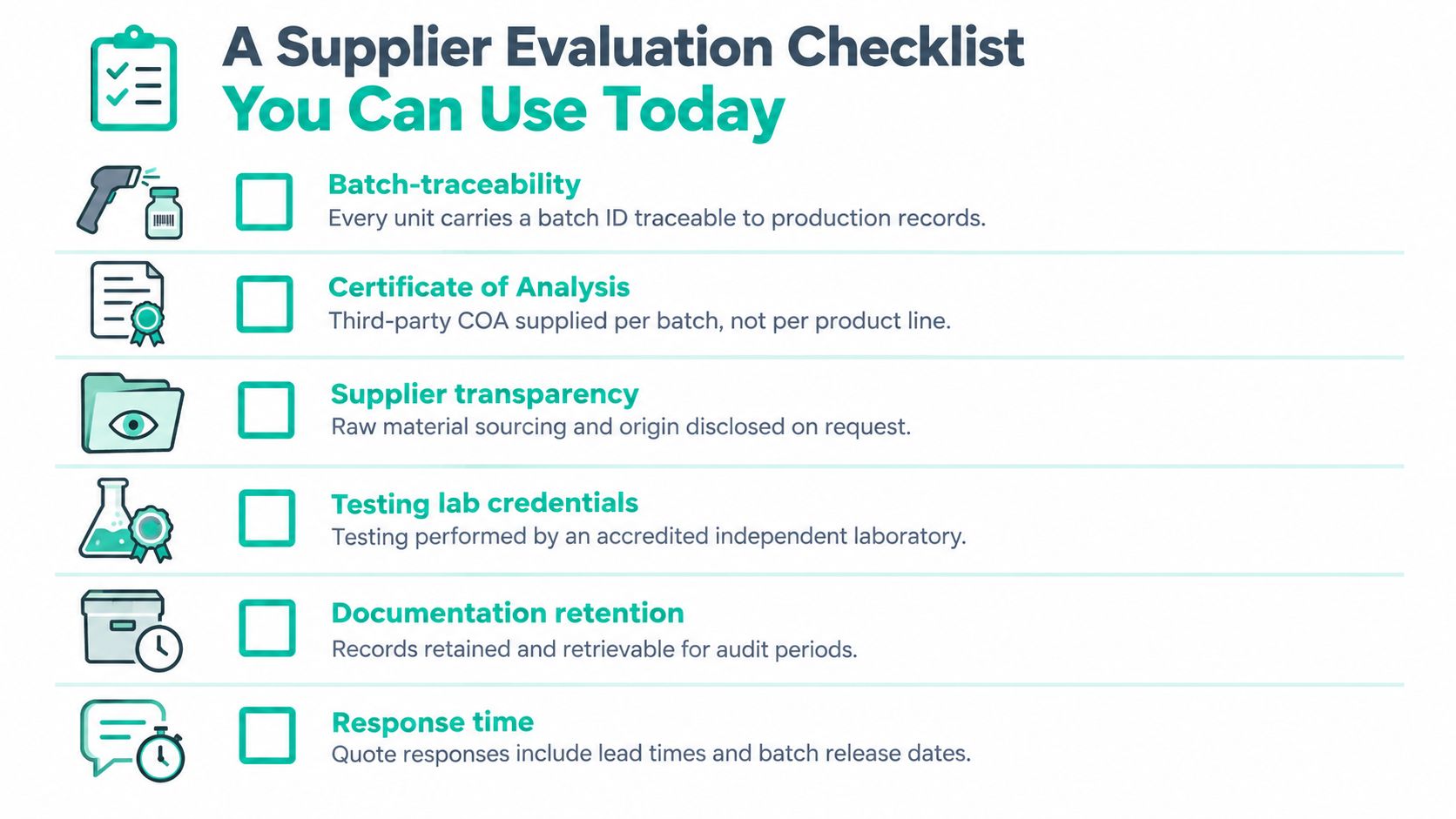
A good supplier check is short, repeatable and hard to bluff. If a vendor can answer these points cleanly, you're looking at a more usable procurement file.
- Batch traceability: every unit should carry a batch ID that maps to production records.
- COA linkage: the certificate should match the exact batch, not just the product name.
- Source transparency: the supplier should disclose sourcing and origin on request.
- Testing credibility: the test record should come from an independent lab where relevant.
- Record retention: documents should be retrievable later for audit or review.
- Dispatch clarity: quote responses should show lead times, batch release status and shipment detail.
The product comparison page is useful as a worked example of how buyers can compare documentation alongside product details, not after the fact. That kind of comparison matters because a clean-looking listing is still incomplete if you can't match it to a batch, a test record and a shipment trail.
For institutional buyers, I'd treat this as a spreadsheet filter. If a supplier can't supply a batch-matched COA, stop there. If the storage or dispatch trail is unclear, ask again before ordering. If the answers keep drifting, the problem isn't paperwork, it's control.
Why More Technology Is Not Automatically Better
Traceability doesn't improve just because a supplier mentions blockchain, RFID or QR codes. The core issue is whether the records can be exchanged cleanly between systems and understood without manual reconstruction.
GS1 Australia's traceability framing is useful here, because interoperability matters more than the tool name. More than one million companies in 150 countries use GS1 traceability, and GS1 Australia says standards-enabled traceability contributes an estimated $19 billion to $27 billion annually to Australian GDP GS1 Australia traceability standards. That puts traceability in the category of operational capability, not just compliance overhead.
Smaller businesses don't need to digitise every transaction on day one. They get better value by prioritising the critical control points first, such as supplier identity, batch numbers, test results and recall-critical events. If those elements are solid, the system already does the important job.
Better traceability comes from consistent identifiers, not fancy labels.
That's the procurement lesson. Ask whether the system can reconcile batch IDs across documents, storage, dispatch and invoices. Ask whether the data is machine-readable enough to survive a review by a customer, regulator or partner. Technology is only helpful when the record behind it stays consistent.
Putting It Together When You Compare Suppliers
Traceability is easiest to judge when you break it into three checkpoints. First, the incoming batch and supplier record. Second, the COA linked to the exact unit or lot. Third, the forward dispatch and invoice trail that shows where the stock went.
That's the buyer-side standard to keep in mind when you compare peptide suppliers. Bulk Aussie Peptides uses 10-pack formats, published documentation and an online lab library to make those checkpoints easier to review, while its Australian-owned model keeps the paperwork and fulfilment path domestic. If you're comparing options, that kind of structure is easier to audit than a listing that only shows a product name and a price.
The main question is not whether a supplier has documents. It's whether those documents answer the three questions a procurement team always ends up asking, what was supplied, which batch it came from, and where it went next.
A traceable supplier gives you a file you can revisit later without rebuilding it from scratch. That's what reduces friction when a quality issue appears, a buyer changes, or a new review starts.
Procurement Questions Worth Asking a Supplier
How do you match the COA to the physical batch? Ask for the batch number on the vial, the matching document source and the record that links both.
What happens if there's a quality issue? You want a clear answer on recall handling and deviation records, not a vague promise that problems are “rare”.
How do documents travel with bulk orders? For institutional buyers, the answer should cover batch records, invoice details and where the documentation sits after delivery.
Bulk Aussie Peptides supplies research-use peptides in 10-pack formats with batch documentation, online lab library access and Australian-based order handling. If you're comparing suppliers on traceability, documentation and procurement readiness, visit Bulk Aussie Peptides and check the batch records before you buy.
- BAP