
Copper Peptides Australia Research Guide
The most popular advice about copper peptides Australia gets one important point wrong: finding a product online doesn't mean it's approved for therapeutic use. In Australia, GHK-Cu and related copper peptides must be assessed according to their intended use, claims, presentation and documentation. A cosmetic ingredient follows a different regulatory pathway from an unapproved injectable or medicinal product, while a research-use-only vial is a laboratory reference substance, not a treatment.
For laboratories, universities, biotech teams and careful buyers, the practical question isn't just whether copper peptides are available. It's whether the compound's identity, batch documentation, storage requirements and regulatory status match the proposed research purpose.
Table of Contents
- Understanding Copper Peptides Australia Research
- The Science and Preclinical Evidence Base
- Navigating TGA and AICIS Regulatory Boundaries
- Verifying Purity Through Lab Testing and COAs
- Sourcing Research Peptides Domestically
- Designing Compliant Preclinical Studies
- Frequently Asked Questions
Understanding Copper Peptides Australia Research
Copper peptides are small peptides that bind copper ions. GHK-Cu, also known as glycyl-L-histidyl-L-lysine copper, is the best-known example in this category. In a laboratory setting, researchers may examine the compound in controlled cell-based, ex-vivo or other preclinical work involving cellular signalling, tissue processes or cosmetic formulation questions.
That context matters because a raw, freeze-dried research compound isn't the same thing as a finished cosmetic serum. A cosmetic formulation is presented for cosmetic use and assessed within the relevant industrial-chemical framework. A sealed vial of lyophilised powder supplied for laboratory investigation needs to be treated as a reference material whose identity and quality must be verified independently.
The compound's online availability also doesn't establish approval. Australian-facing information identifies GHK-Cu as not being included on the Australian Register of Therapeutic Goods, and the Therapeutic Goods Administration hasn't evaluated it as an approved medicine for safety, quality or effectiveness. The Australian research peptide range should therefore be read alongside supplier documentation and government guidance, not as evidence of human suitability.
Practical rule: Separate three questions before procurement. What is the substance? How is the product presented? What does your study actually require?
A buyer comparing copper peptides Australia suppliers should look for a clear compound name, copper-complex form, vial presentation, batch identifier and accessible analytical records. Marketing language about skin, hair, nails, injury or recovery can create confusion if it implies a therapeutic outcome. Research-use-only wording needs to remain consistent across the product page, label, invoice and any supporting material.
This distinction protects both the study and the purchaser. Historical research can justify investigating a compound, but it doesn't establish sterility, efficacy, stability in every formulation or legality for therapeutic supply.
The Science and Preclinical Evidence Base
The common mistake is to treat a long research history as if it settled a product question. It does not. For copper peptides Australia work, the scientific record is best used the way a laboratory manager uses an old method file. It shows what has been studied, which mechanisms keep recurring, and where the evidence is still thin.
GHK-Cu has been discussed in research for more than five decades. Its growth-modulating activity was first reported in 1973, the peptide was identified as glycyl-histidyl-lysine in 1977, and research in 1980 linked GHK with copper transport into cells. That timeline explains why the compound still appears in laboratory discussions about skin biology, tissue repair and cell signalling. For a concise starting point on composition and research context, see GHK-Cu research information.
One observation often cited in this literature is that circulating GHK levels decline over adulthood, reaching approximately 80 ng/mL by around age 60. Treat that as background biology, not proof of a treatment effect. A falling endogenous level can justify further investigation. It does not show that a topical, cosmetic, compounded or research product will reproduce the same biology in human use.
What researchers are investigating
Across preclinical models, investigators have examined several recurring areas:
- Fibroblast activity, relevant to connective-tissue and skin-structure research.
- Extracellular-matrix remodelling, including processes involving structural proteins.
- Inflammatory signalling, assessed through controlled cellular responses.
- Wound-repair pathways and angiogenesis, studied as mechanisms rather than promised outcomes.
- Gene-expression changes, which vary with the model, exposure conditions and analytical method.
Discipline matters here. A cell study can show that a pathway responds under defined conditions, much like a bench assay confirms reactivity without validating a finished formulation. The same logic applies to this area. Mechanistic plausibility supports more study. It does not establish predictable human efficacy, therapeutic suitability, or compliance for any marketed presentation.
That caution is consistent with the published evidence summaries. The review of GHK-Cu regenerative research described a literature base dominated by preclinical work, with only limited randomised clinical evidence. For procurement teams and study authors, the practical takeaway is straightforward. Use language such as investigated, associated, or studied in preclinical models. Avoid wording that turns an experimental mechanism into an expected human result.
The same pattern appears in The 2026 systematic review, which identified 1,247 records before deduplication and screening and retained 64 records for qualitative synthesis. It described more than four decades of preclinical research while characterising the human clinical literature as thin and fragmented, and it reported that no adequately powered, registered human randomised controlled trial had evaluated microneedle-mediated GHK-Cu delivery at that point. That is the evidence base researchers should build from, carefully, and with documentation-first wording.
Navigating TGA and AICIS Regulatory Boundaries
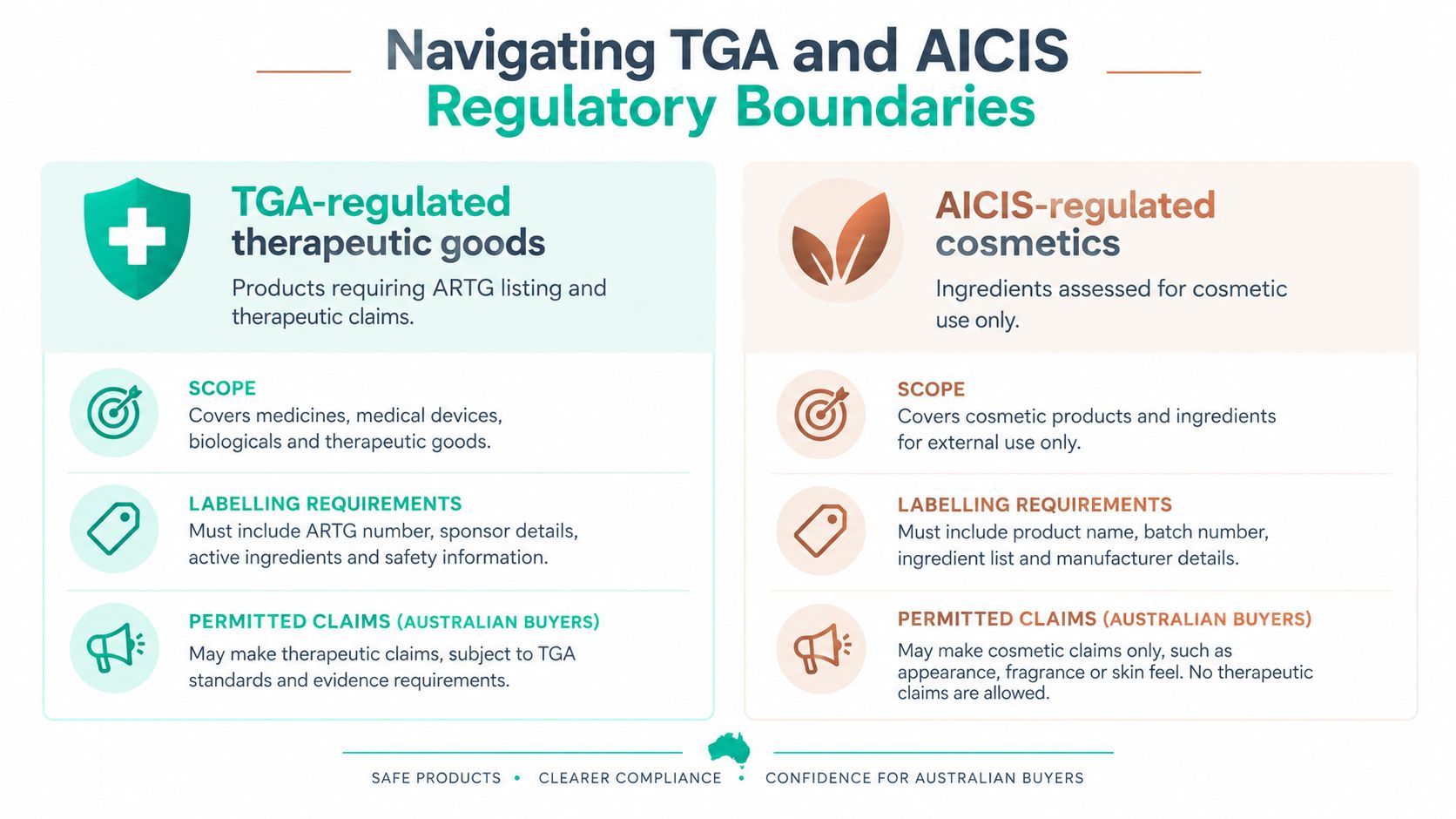
Australian buyers need to classify the product context, not just the molecule. The Therapeutic Goods Administration explains that cosmetic ingredients are regulated as industrial chemicals under the Industrial Chemicals Act 2019 through the Australian Industrial Chemicals Introduction Scheme, or AICIS. Products marketed with therapeutic claims may instead fall under TGA oversight.
The difference becomes material when a supplier presents GHK-Cu for healing, regeneration, disease treatment, hair loss or systemic use. A topical cosmetic formulation with limited cosmetic claims can sit in a different compliance context from an injectable or medicinal product. The product's label, advertising, intended use and supply arrangements all matter.
| Buyer question | Cosmetic pathway | Therapeutic pathway |
|---|---|---|
| Primary regulator | AICIS for relevant industrial chemicals | TGA for therapeutic goods |
| Presentation | Cosmetic use with limited cosmetic claims | Therapeutic purpose or medical claims |
| Approval assumption | Cosmetic handling doesn't validate injection or treatment | Online availability doesn't prove ARTG status |
| Documentation focus | Ingredient identity and compliant presentation | Regulatory status, authorisation and therapeutic compliance |
The TGA lists GHK-Cu among unapproved peptide products and warns that many peptide products promoted online may be unlawful to import, supply or advertise. The Australian peptide regulation guide can help procurement teams organise their questions, but it isn't a substitute for regulator advice or institutional review.
“Research use only” is a product-positioning boundary, not a universal exemption from Australian law. It doesn't turn an unapproved therapeutic product into an approved medicine, and it doesn't prove that an intended import or supply arrangement is authorised.
Procurement teams should document:
- Intended use: Record whether the material is for cell-based, ex-vivo, formulation or another laboratory study.
- Claims and presentation: Check that the supplier doesn't describe the product as a treatment or make unsupported human-use claims.
- Regulatory status: Don't treat an Australian Certificate of Analysis as proof of TGA approval.
- Import and supply pathway: Escalate uncertain cases to the relevant regulator or institutional compliance officer.
Verifying Purity Through Lab Testing and COAs
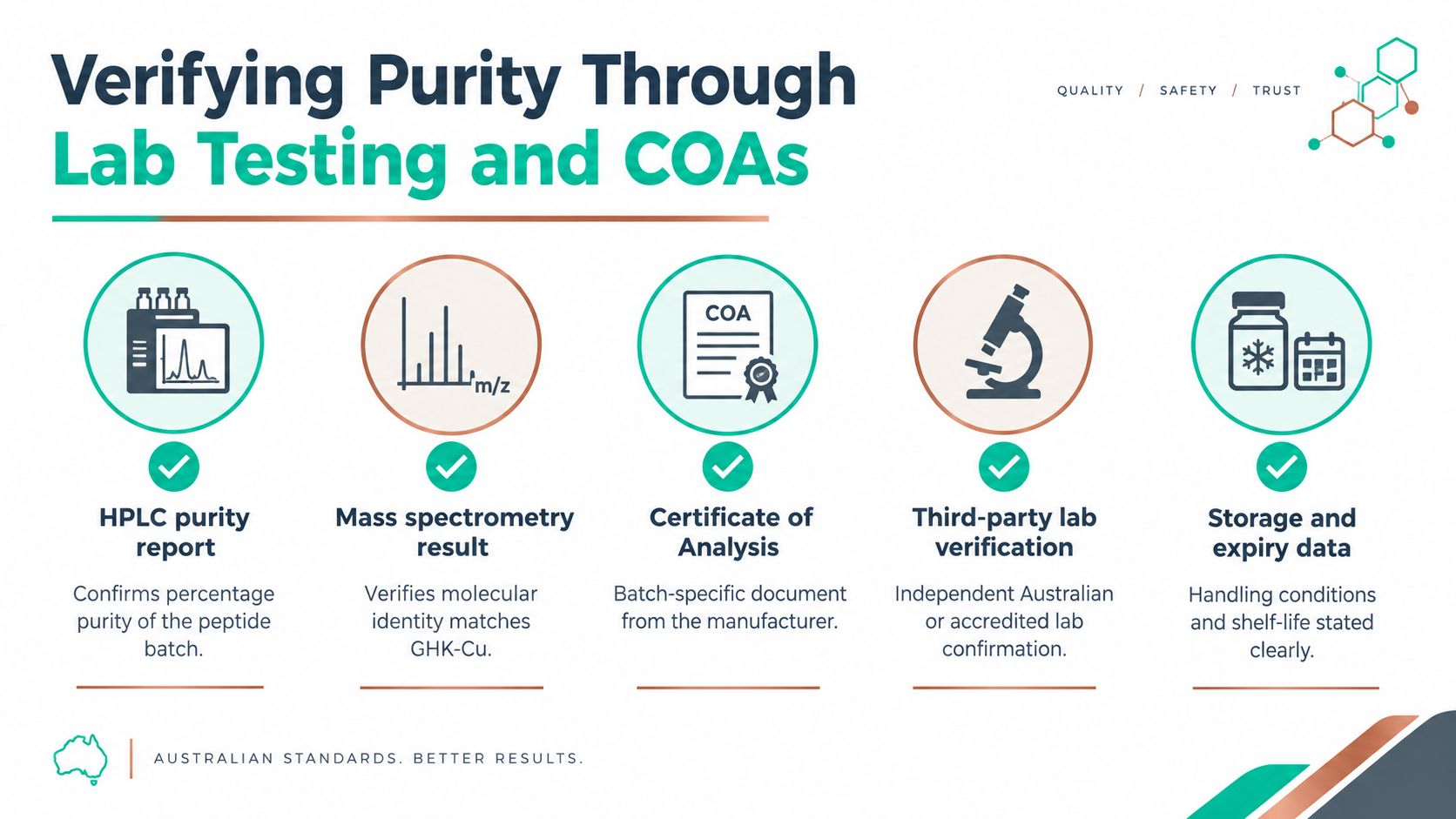
A Certificate of Analysis is useful only when it can be tied to the actual batch being purchased. A generic document with no batch reference gives a procurement team far less traceability than a batch-specific report that identifies the material and records the relevant analytical results.
Start with the product specification. Confirm the compound name, copper-complex form, physical presentation, stated vial quantity, storage requirements and any reconstitution or handling information supplied for laboratory work. For GHK-Cu, the documentation should identify GHK-Cu rather than using the broad phrase “copper peptide” alone.
A practical verification sequence
Match the label to the paperwork. The product name, batch identifier and vial details should align across the label, invoice, specification sheet and COA.
Review identity testing. Mass spectrometry or another appropriate identity method should support the conclusion that the material corresponds to the named peptide and copper complex.
Review purity testing. HPLC results can help assess the reported purity of the batch, but the method, sample identity and laboratory source still need review.
Check provenance. Distinguish manufacturer-provided specifications from independent laboratory reports. A supplier should label those sources clearly.
Record storage information. Lyophilised powder can be sensitive to handling and environmental conditions, so procurement records should preserve the stated storage and transport requirements.
The online COA library is valuable when it lets a buyer locate batch documentation before approving a material. If a report is marked “in testing”, treat that status accurately and don't describe the batch as independently verified until the relevant report is available.
For publication-bound research, institutional review or quality investigations, independent analytical confirmation may be appropriate. The stronger the consequence of an incorrect identity or purity result, the less sensible it is to rely on an untraceable document.
Sourcing Research Peptides Domestically
Domestic sourcing can simplify procurement, but it doesn't remove the need for verification. An Australian-owned and operated supplier may provide local order processing, Australian support, tracked delivery and GST invoices, which can make purchase records easier for laboratories and university finance teams to manage.
Bulk Aussie Peptides supplies research-use-only compounds in standardised 10-pack formats, including GHK-Cu in 50 mg and 100 mg lyophilised powder vials and AHK-Cu in 100 mg lyophilised powder vials. Those product details should always be checked against the current product page and batch documentation before an order is approved.
What a procurement file should contain
A useful file brings together:
- A product specification: Include compound identity, presentation and stated per-vial quantity.
- A batch record: Preserve the batch number and matching Certificate of Analysis.
- A supplier record: Keep the invoice, GST details and order correspondence.
- A logistics record: Save tracking information and the stated handling requirements.
- A status note: Record that the material is research-use-only and identify the approved study purpose.
The supplier reports sealed glass vials containing a freeze-dried powder cake, a catalogue of 60+ compounds in 10-packs, independent lab certificates in an online lab library and tracked shipping around one week door to door. These are operational details, not evidence of efficacy or regulatory approval. They're useful only when they align with the actual order and the laboratory's receiving checks.
Researchers comparing Australian research peptide suppliers should compare documentation quality as carefully as price. A cheaper vial with unclear provenance can create more work through failed controls, repeat experiments or delayed review.
Designing Compliant Preclinical Studies
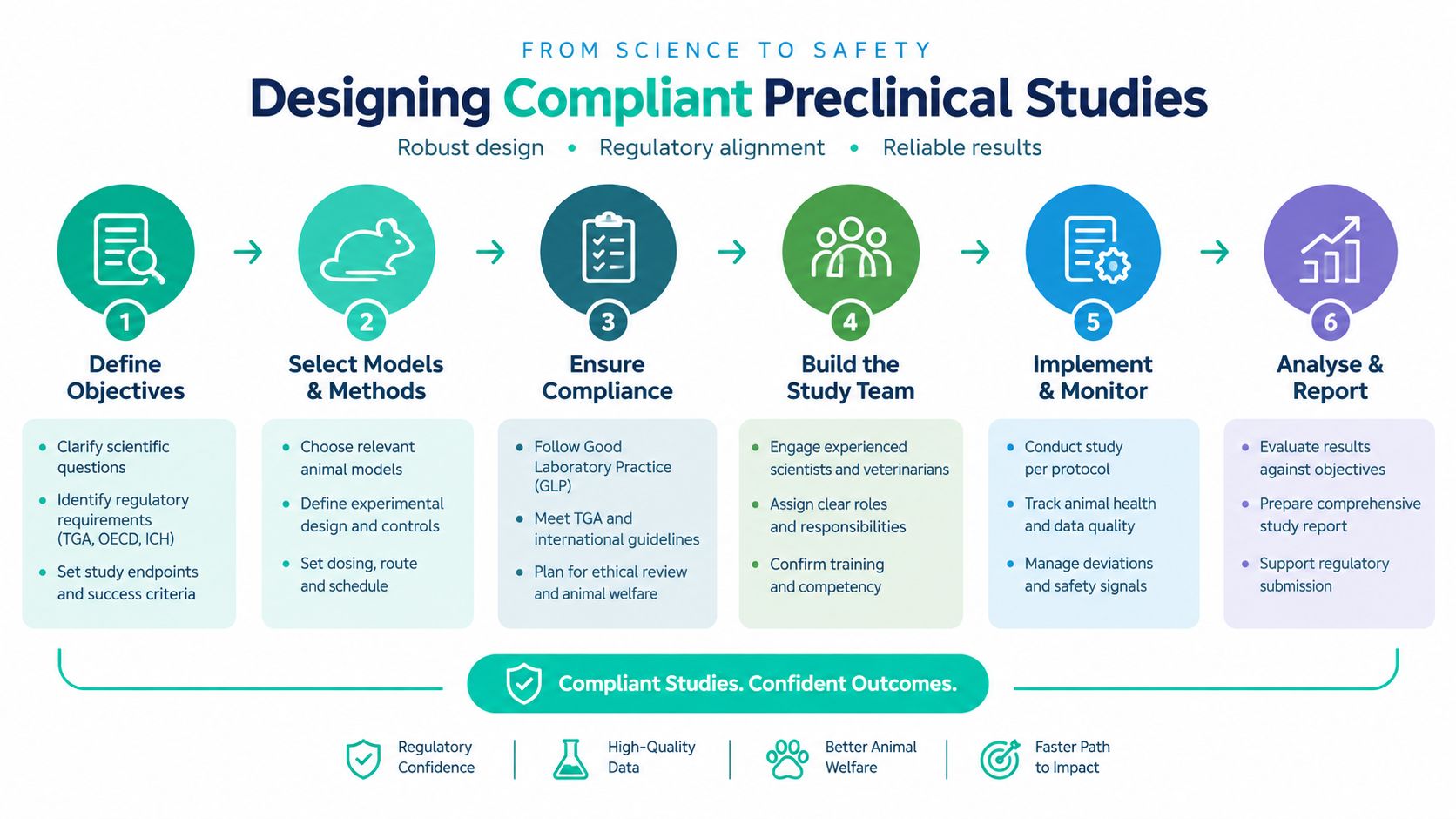
Good preclinical work is decided at the protocol stage, not at the bench. If the paperwork is vague, the study usually becomes vague too. For copper peptides in Australia, that matters twice. You need a design that can answer a scientific question, and records that keep the work on the research side of the cosmetic versus therapeutic boundary.
Start by fixing the study question in plain language. Then match the model to that question, the way a calibration standard must match the instrument it checks.
- Cell-based: Record the cell type, passage information, exposure conditions and controls.
- Ex-vivo: Record tissue source, handling, storage and viability criteria.
- Formulation research: Define the vehicle, pH, compatibility requirements and stability observations.
- Analytical work: Specify the identity, purity or degradation question being tested.
Use the evidence profile discussed earlier as a ceiling on what your endpoints can support. A cell signal, tissue response or stability result can justify a laboratory conclusion under stated conditions. It should not be written up as a conclusion about human treatment, product performance in patients or therapeutic benefit.
Method discipline is what keeps interpretation clean. Concentration, solvent, pH, exposure duration and oxidation conditions can all shift the result. Set each variable before the run, justify any positive and negative controls, and log every deviation from the approved method at the time it occurs rather than at report drafting.
Documentation belongs inside the experiment, not in a separate procurement folder that no one checks again. Record the supplier, batch number, COA location, receipt condition and storage history alongside the raw data. If an outlier appears, those entries help you work out whether the cause sits in biology, formulation, handling or material quality. A six-step infographic guide detailing the process for designing compliant and effective preclinical scientific studies.

A well-controlled preclinical result is valuable because it defines what happened under documented conditions. It doesn't promise what will happen in a person.
Keep the report language equally controlled. Exclude human-use instructions, therapeutic claims and casual extrapolation. If the work may be reviewed for publication, ethics or institutional approval, route the protocol and supporting documents through the proper governance process before any experimental work starts.
Frequently Asked Questions
Are copper peptides approved medicines in Australia?
GHK-Cu isn't listed on the Australian Register of Therapeutic Goods as an approved medicine, and its availability online doesn't prove therapeutic approval. Products presented as therapeutic goods need to be assessed under the relevant TGA requirements.
Does research-use-only wording make every product compliant?
No. The wording helps define intended use and product presentation, but it doesn't override Australian regulation. Importers and suppliers still need to consider the product's claims, presentation, purpose and any applicable exemption, approval or authority.
Does a COA prove TGA approval?
No. A Certificate of Analysis addresses analytical information such as identity or reported purity. It doesn't show that the TGA has assessed a product for safety, quality or effectiveness, and it isn't evidence of ARTG entry.
What does the TGA require for therapeutic peptide products?
The TGA states that therapeutic peptide products generally must be entered in the Australian Register of Therapeutic Goods before they can be imported, manufactured, supplied, exported or advertised, unless a specific exemption, approval or authority applies. The TGA's therapeutic peptide guidance should be checked for the current regulatory position.
What should a first-time buyer compare?
Compare the compound identity, intended-use wording, batch-specific COA, testing provenance, storage information, invoice details and supplier support. Price matters, but it shouldn't replace traceability.
Bulk Aussie Peptides offers research-use-only copper peptide products in sealed glass vials, standardised 10-pack formats, with product specifications and batch documentation available through its online lab library. Visit Bulk Aussie Peptides to compare current GHK-Cu and AHK-Cu research supply information, review documentation and plan an Australian procurement pathway.
- BAP