
What Is TB 500? Australian Research and Regulatory Guide
TB-500 is a synthetic short-peptide fragment of thymosin beta-4, a naturally occurring 43-amino-acid peptide. It has been studied in laboratories, but it isn't approved for human therapeutic use in Australia or elsewhere and is treated as an experimental substance.
Why do so many online explanations discuss TB-500 as though research on another molecule automatically proves its benefits? That question matters for Australian buyers comparing research peptides, especially when recovery, injury, weight management, or skin, hair and nail research is part of the search. The accurate starting point is molecular identity, followed by evidence, regulation and documentation.
Table of Contents
- What Is TB 500 in Laboratory Research
- Molecular Structure and Research Mechanism
- Research Evidence and Clinical Studies
- Australian Regulatory and Anti-Doping Status
- Quality Verification and Sourcing Considerations
- Procurement and Storage Best Practices
What Is TB 500 in Laboratory Research
TB-500 is a synthetic, short-peptide analogue of thymosin beta-4, rather than the full-length molecule itself. Australian regulatory documents describe thymosin beta-4 as a growth factor associated with muscle, tendon and ligament tissues, vascularisation and regenerative capacity. They describe TB-500 as presumed by design to have similar biological properties, but proposed activity isn't the same as proof of a clinical treatment. The TGA's regulatory record states that TB-500 and thymosin beta-4 hadn't been approved for human therapeutic use in Australia and were considered experimental in humans.
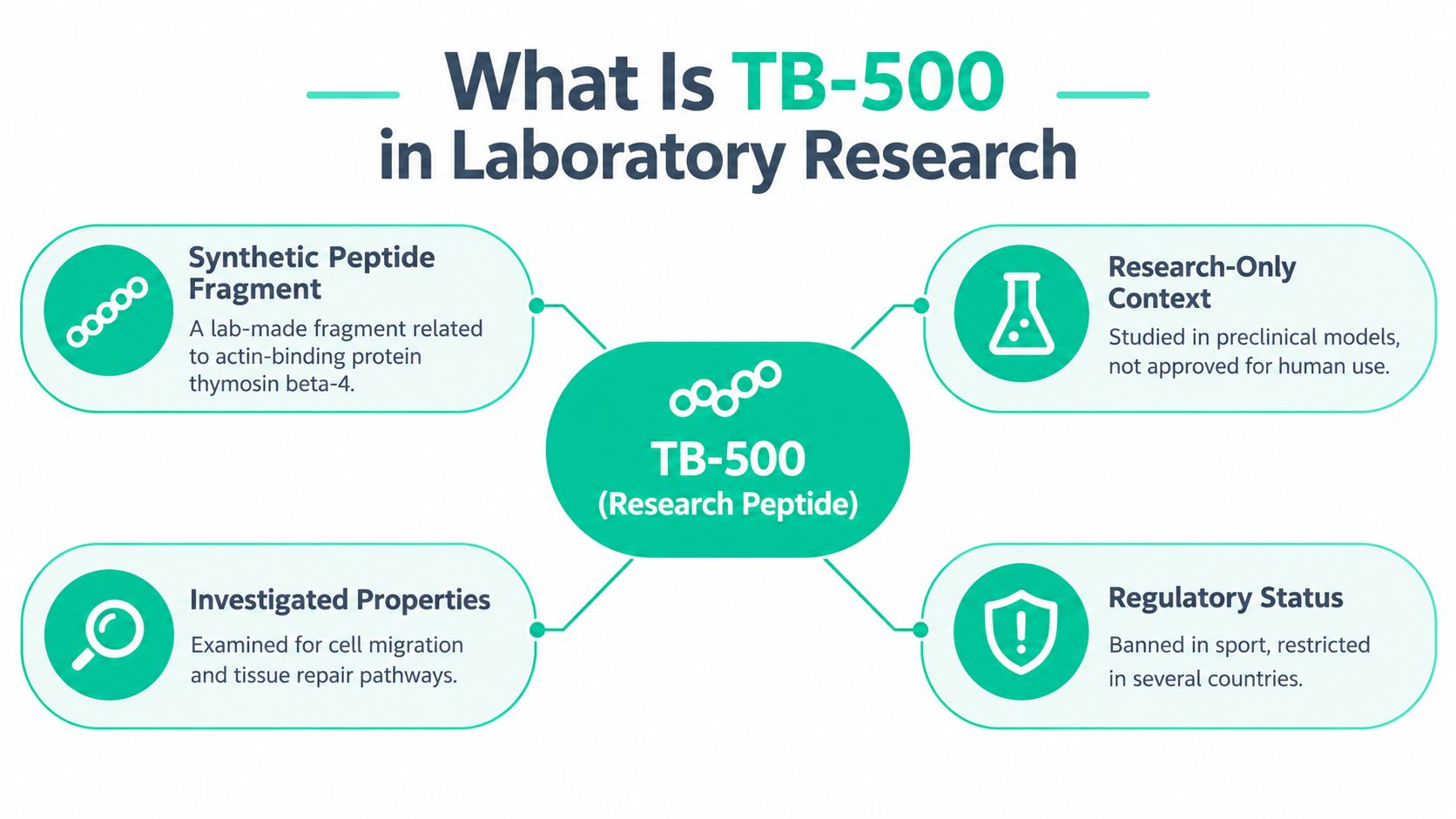
A useful way to understand the name is to separate three ideas:
- Identity: TB-500 refers to a synthetic fragment related to thymosin beta-4.
- Research context: Laboratories examine peptide identity, purity, biological pathways and experimental responses.
- Clinical status: TB-500 isn't an established medicine or demonstrated treatment for injury, muscle growth, wound healing or other conditions in Australia.
Online product descriptions can blur those categories. A statement that a peptide is associated with tissue or cell pathways doesn't establish that a particular product produces a therapeutic outcome in people. It also doesn't establish that evidence for full-length thymosin beta-4 applies to every product labelled TB-500. Researchers comparing related compounds should keep the molecular distinction clear, much as they would when comparing BPC-157 and TB-500 research.
Molecular Structure and Research Mechanism
The most important structural detail is that TB-500 is described in a current trial record as the thymosin beta-4 17–23 fragment. Full-length thymosin beta-4 contains 43 amino acids, while this description identifies TB-500 as only a segment of that sequence. Think of the full molecule as a complete sentence and the fragment as a selected phrase. The phrase may carry useful information, but it isn't automatically equivalent to the whole sentence.
That difference affects how researchers interpret results. Sequence, chemical modification, formulation, route and assay conditions can all influence what a peptide does in an experimental system. A product label alone can't demonstrate that a commercial material matches the molecule, formulation or research context used in a study.
The current trial record describes a Phase 1/2, randomised, double-blind, placebo-controlled, sequential dose-escalation study in adults with stable atherosclerotic cardiovascular disease. Participants in each cohort are randomised in a 3:1 ratio to TB-500 or matching placebo, with safety, tolerability, pharmacokinetics and exploratory cardiovascular biomarkers among the outcomes. Those details come from the ClinicalTrials.gov record for NCT07487363.
This is an investigational design, not approval. It also doesn't establish that findings apply to recovery, weight management, skin, hair or nail research. For laboratory interpretation, the practical lesson is simple: confirm the sequence and identity before comparing results, and don't treat a mechanistic hypothesis as a clinical conclusion.
Research Evidence and Clinical Studies
The evidence for TB-500 must be kept separate from research on full-length thymosin beta-4. Australian clinical guidance warns that findings for full-length thymosin beta-4 can't be transferred directly to products sold as TB-500. The molecules may be related, but related doesn't mean interchangeable.
A TGA freedom-of-information document records only one phase-I study, one small therapeutic trial and an uncontrolled case series for thymosin beta-4. That is a limited foundation for claims about injury recovery, muscle growth, wound healing or systemic safety. Australian clinical guidance for doctors also notes that no reliable Australian evidence was identified showing that TB-500 improves recovery or performance in humans.
How to read the evidence
Research readers should ask four questions before accepting a claim:
- Which molecule was tested? Full-length thymosin beta-4 and TB-500 aren't automatically the same material.
- What was the study context? A laboratory pathway, animal model or early-stage trial answers different questions.
- What outcome was measured? Biomarkers and pharmacokinetics don't prove recovery, performance or cosmetic benefit.
- Does the product match the study? Sequence, formulation and laboratory documentation all matter.
This approach helps explain why claims about weight management, injury recovery and skin, hair or nail health should be described as research topics, not promised outcomes. A supplier's product page, testimonial or certificate can't substitute for clinical evidence. A Certificate of Analysis can support identity and quality review, but it can't establish that TB-500 is effective or safe as a human treatment.
Interpretation rule: Positive findings for thymosin beta-4 may be scientifically interesting, but they shouldn't be presented as proof for a separate TB-500 product unless the chemical and clinical contexts match.
Australian Regulatory and Anti-Doping Status
Australia's regulatory history gives TB-500 a clearer status than many online pages suggest. In March 2016, the TGA delegate made a final scheduling decision concerning thymosin beta-4 and TB-500, with implementation recommended for 1 June 2016. The proposed framework placed the substances in Schedule 4 and Appendix D, Part 5, controlling how they could be advertised, sold and accessed without a legitimate purpose. These classifications are documented in the TGA final scheduling decision.
The same record states that thymosin beta-4 and TB-500 were prohibited for athletes under the World Anti-Doping Agency Prohibited List. Thymosin beta-4 was identified under categories covering growth factors and non-approved substances, with the prohibition applying both in and out of competition.
That makes the common assumption, “research use only means no regulatory issue,” unsafe. A research label describes intended context, but it doesn't override Australian obligations or anti-doping rules. The scheduling record also identified unknown human toxicity and potential concerns including cardiovascular effects and carcinogenicity. Those concerns don't establish that harm occurs in every user, but they reinforce why experimental status matters.
Researchers and sporting participants should treat anti-doping review as part of procurement governance, not as an afterthought. The Australian guide to research-peptide regulation can sit alongside official TGA and sport-integrity checks during internal review.
Quality Verification and Sourcing Considerations
Quality documentation answers a narrower question than clinical evidence. It can help establish what a laboratory material contains and whether the batch matches its specification, but it can't turn TB-500 into an approved medicine.
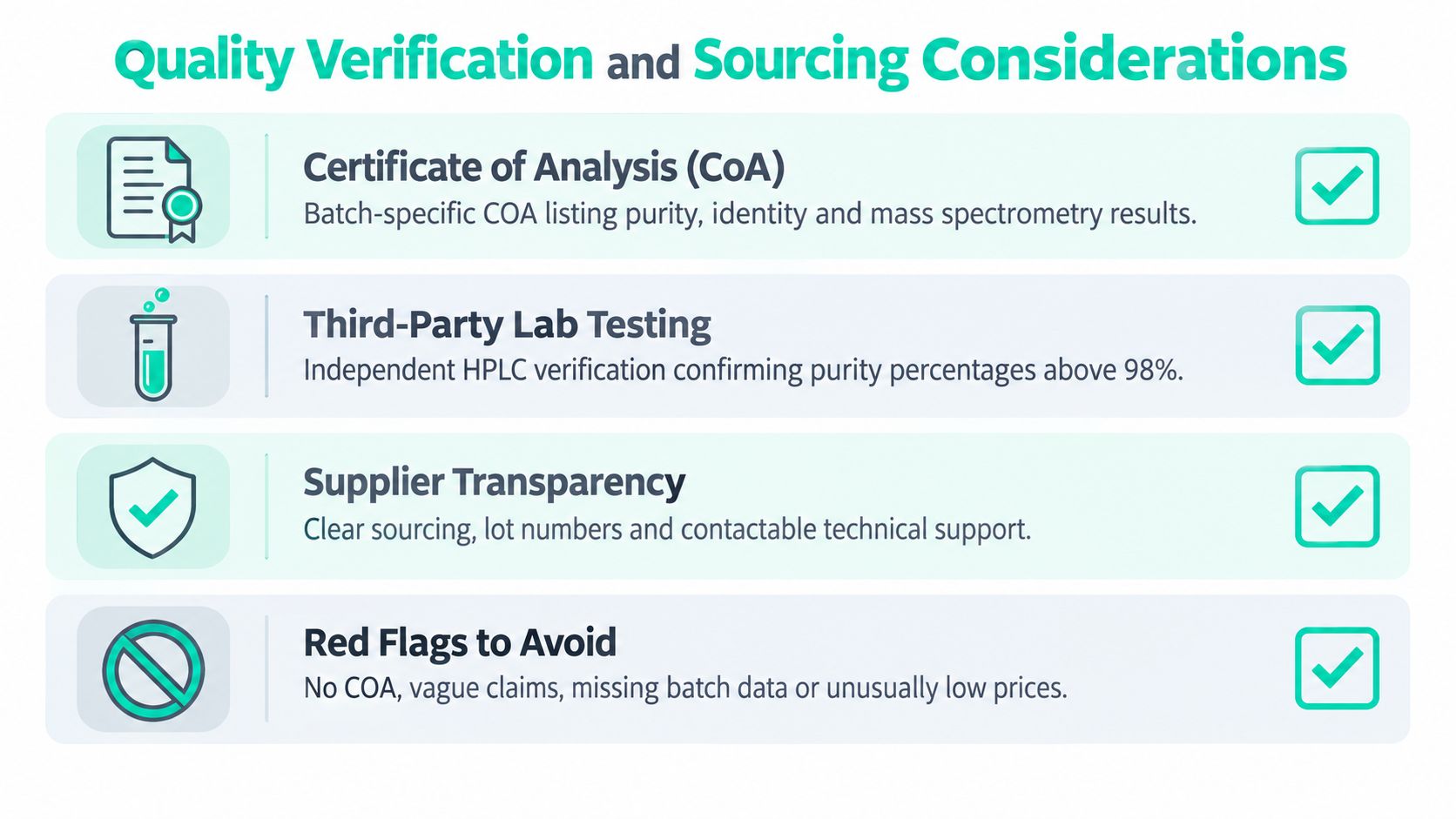
For an Australian procurement team, a sensible review includes:
- Batch-specific documentation: Check that the Certificate of Analysis identifies the relevant lot and reports identity, purity and analytical results.
- Independent testing: Distinguish independent laboratory data from manufacturer-provided documentation.
- Traceability: Match the lot number on the vial, paperwork and purchase record.
- Clear claims: Treat promises of guaranteed recovery, performance or treatment as a warning sign.
- Regulatory review: Remember that a “research use only” or “not for human use” disclaimer doesn't, by itself, remove TGA obligations.
The TGA explains that such disclaimers don't determine whether a product is regulated as a therapeutic good. Advertising, manufacture, import, export and supply obligations may still apply. Its guidance on how therapeutic peptide products are regulated also makes the documentation boundary clear: identity and purity records support quality control, but they aren't TGA approval, efficacy evidence or permission for human administration.
Bulk Aussie Peptides describes an Australian-owned and operated supply model with sealed glass vials, freeze-dried powder cake, 60+ compounds in 10-pack formats, independent laboratory certificates in an online lab library and “in testing” labels where documentation is pending. Its testing and quality information is relevant for teams comparing batch records, specifications and supplier transparency.
Procurement and Storage Best Practices
For laboratory procurement, compare suppliers by identity documentation, lot traceability, testing transparency, storage information and invoice support, rather than by marketing language alone. Keep the material in its supplied freeze-dried form and follow the relevant laboratory's validated storage and handling procedures. Maintain a record linking the product, batch documentation, purchase order and study file.
Australian teams may also compare 10-pack formats, GST invoices, tracked domestic delivery and technical support when planning a research workflow. Peptides Australia provides a starting point for reviewing locally supplied research materials, while laboratories should complete their own regulatory and quality assessment before ordering.
Bulk Aussie Peptides supplies research-use-only peptides in sealed glass vials, with batch documentation and an online laboratory certificate library, including “in testing” status where applicable. Visit Bulk Aussie Peptides to review TB-500 specifications, 10-pack formats, Australian procurement options and supporting documentation for your laboratory workflow.
- BAP