
CJC 1295 vs HGH for Australian Research
Popular advice ranks CJC-1295 vs HGH as if they were two strengths of the same performance product. They aren't. CJC-1295 is a long-acting growth-hormone-releasing-hormone analogue studied for effects on the body's own growth-hormone and IGF-1 pathway. Pharmaceutical human growth hormone is somatropin, an approved prescription medicine in Australia. Early CJC-1295 work measured hormone concentrations. Somatropin is a regulated hormone whose use depends on a diagnosed indication and medical oversight.
Table of Contents
- CJC 1295 vs HGH in Plain Terms
- How CJC-1295 and Somatropin Act
- What the 2006 Human Studies Measured
- Safety Evidence and Approval Status
- Which Situation Each Option Fits
- Choosing a Documented Research Supply
- Next Steps for Laboratory Planning
CJC 1295 vs HGH in Plain Terms
The usual ranking starts from a false match. Gym write-ups and longevity posts often score both compounds on fat loss, recovery, or "strength" of the growth-hormone effect. That frame treats a research peptide and a prescription hormone as interchangeable enhancers. In Australia, the split is evidentiary and legal before it is athletic.
CJC-1295 acts as a signal to the pathway that releases growth hormone. It is not the hormone itself. Somatropin is recombinant growth hormone supplied as a medicine. A shared downstream marker, IGF-1, doesn't give them the same clinical standing. A higher reading on that marker is a biochemical result. It isn't proof of improved body composition, performance, recovery, or general wellness.
An online comparison that swaps the two names is reading a blood test as if it were a treatment trial.
What Australian readers actually need to separate
Three questions get collapsed into one search.
- What was measured: Early human work on CJC-1295 tracked growth hormone and IGF-1 over short periods in healthy adults. It didn't establish muscle gain, fat loss, injury recovery, or longevity.
- What is authorised: Somatropin sits inside prescription medicine rules. Clinical use depends on a diagnosed indication and medical oversight, not on a catalogue description.
- What job the reader has: A person asking about diagnosed deficiency, a person curious about weight or skin research, and a laboratory buying materials are not choosing from the same shelf.
Australian substance education on human growth hormone states the regulatory line clearly. Somatropin in prescription medicines is approved by the Therapeutic Goods Administration. Those products are registered on the Australian Register of Therapeutic Goods and carry an AUST R number. Many peptide products promoted online are unapproved therapeutic goods and may be unlawful to import, supply, or advertise. Mechanism overlap doesn't erase that status.
A clinical summary of CJC-1295 with DAC makes the evidence limit just as plain. The key human research, published in 2006, was small and short. It recorded hormone concentrations. It wasn't a trial of body-composition or wellness outcomes. No phase 3 programme or long-term human safety dataset is identified there, and CJC-1295 hasn't been evaluated or approved by the TGA for a therapeutic indication.
The rest of this comparison follows that order: first the axis, then what those 2006 studies did and didn't measure, then safety and approval, then which reader job each option serves.
How CJC-1295 and Somatropin Act
Before anyone compares papers, the pathway has to be drawn in the right direction. Growth hormone is released from the pituitary in pulses. The liver and other tissues respond, in part, by raising IGF-1. That shared marker is why the two compounds get paired in casual charts. It isn't why they belong in the same legal or clinical box.
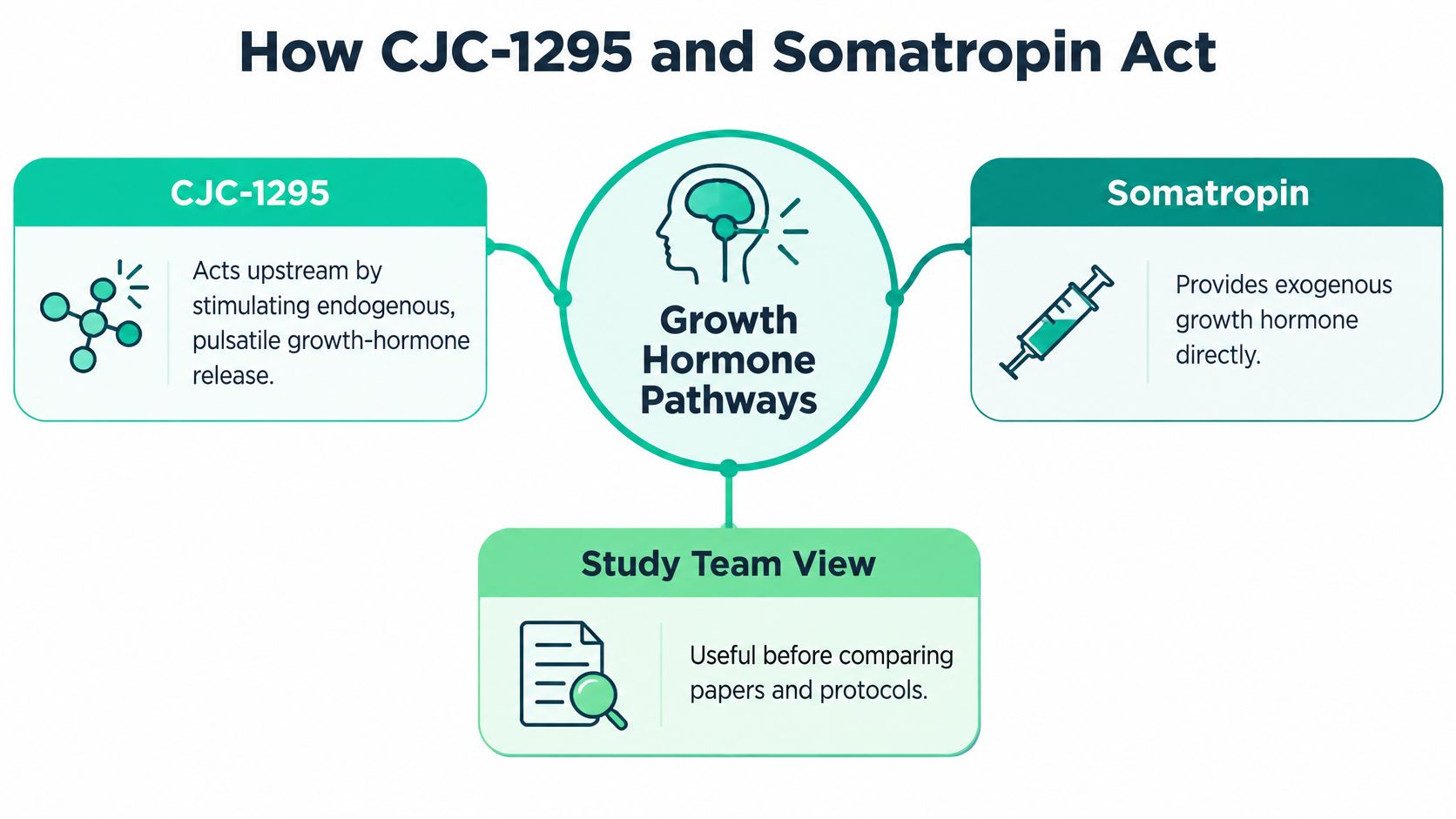
Upstream signal versus direct supply
CJC-1295 is a long-acting growth-hormone-releasing-hormone analogue. It acts upstream. It stimulates endogenous, pulsatile growth-hormone secretion. The pituitary still participates. Somatropin does the opposite kind of job. It supplies exogenous growth hormone directly, so the dose doesn't depend on that releasing signal.
The practical difference for a study team is the question each compound can answer. A secretagogue study asks how the axis responds when it is stimulated. A somatropin study asks what happens when growth hormone is provided from outside that loop. IGF-1 can move in both settings. A common marker still doesn't mean a common approval status, a common risk record, or a common experimental endpoint.
What a single-dose study actually recorded
In randomised, placebo-controlled studies of healthy adults, a single subcutaneous CJC-1295 dose produced dose-dependent mean plasma growth-hormone increases of about 2 to 10 times baseline for at least six days. IGF-1 rose about 1.5 to 3 times for 9 to 11 days. The estimated half-life was 5.8 to 8.1 days. With repeated administration, IGF-1 stayed above baseline for up to 28 days. Those figures are pharmacodynamic surrogate endpoints from the 2006 Journal of Clinical Endocrinology & Metabolism paper. They aren't evidence of superior muscle gain, fat loss, injury recovery, or anti-ageing results versus prescribed HGH.
Practical rule: Record the endpoint as hormone exposure. Don't upgrade it to a body-composition result the protocol never measured.
The with-DAC and without-DAC forms differ in how long the signal is discussed in study design, not in a use schedule. DAC refers to a drug-affinity complex that changes persistence in the research literature. Our notes on CJC-1295 DAC versus no DAC keep that distinction at the level of duration and design. They aren't a protocol, a concentration guide, or a ranking against somatropin.
A clean methods note lists four items and stops. Name the compound form. State whether the design stimulates endogenous release or supplies exogenous hormone. List the timed samples for growth hormone, IGF-1, and glucose markers. File adverse-event reporting beside those assays. Identity and purity of the research material belong in that same file. They aren't a clinical claim.
What the 2006 Human Studies Measured
The biology above is not the same thing as a verdict on outcomes. The evidence audit starts with design.
Two randomised, placebo-controlled, double-blind, ascending-dose trials were published in 2006. One ran 28 days and the other 49 days. Participants were healthy adults aged 21 to 61 years. After one administration, average plasma growth hormone and average IGF-1 moved in the pattern already described, and the estimated half-life sat in that multi-day range. Repeated administration kept mean IGF-1 above baseline for as long as 28 days. The trial report in JCEM also recorded no serious adverse reactions in that population.
What the protocol left out
The useful point is the absence list. These were short phase-1 investigations in healthy adults. They weren't trials of muscle gain, fat loss, injury recovery, skin, hair, nails, or longevity. They didn't follow cardiovascular disease, diabetes incidence, or cancer surveillance. A buyer who hopes the fold-change proves a gym or cosmetic result is asking the paper to certify something it never enrolled.
Background notes for a laboratory or an ethics file can stay exact.
- Compound class: CJC-1295 can be described as a long-acting growth-hormone-releasing-hormone analogue that stimulated the GH and IGF-1 pathway.
- What it is not: It isn't HGH, and it isn't evidence that a wellness, weight, or recovery outcome occurred.
- Safety sentence that fits: No serious adverse reactions were reported in a small, short study of healthy adults. That sentence doesn't travel forward as long-term safety.
Our page on CJC-1295 with DAC research is written in that study-summary register. Weight, recovery, and skin, hair, or nail interest can be discussed only as topics research has examined elsewhere, or hasn't. An IGF-1 rise in healthy volunteers doesn't become those outcomes by implication.
How to cite it without overselling
Quote the population, the duration, and the marker. Then stop. If a later document says the compound "works like prescribed HGH", the citation has already been stretched past the paper. Prescribed somatropin has a different evidence history and a different legal status. Borrowing its reputation because both move IGF-1 is the error this comparison is meant to block.
A notebook line that holds up under review looks like this. "Healthy adults, two ascending-dose trials, biomarker exposure for days to weeks, no serious adverse reactions reported in-study, no body-composition endpoint." Anything stronger needs a different study.
Safety Evidence and Approval Status
A short trial without serious reactions is not a safety monograph. Prescribed somatropin carries a much heavier clinical and regulatory record, and that record can't be lent to CJC-1295.
The TGA's warning on excess human growth hormone is the Australian benchmark. Human growth hormone requires a prescription to possess or import. It can't legally be advertised to the public. Prolonged excess can cause irreversible acromegaly. Even lower doses may contribute to heart disease and diabetes. Australian medicine information for Genotropin also names major contraindication categories: active malignancy, critical illness or serious injury requiring intensive care, and selected severe obesity or respiratory-risk presentations in Prader–Willi syndrome.
Established replacement has its own adverse-effect list. Hormones Australia describes oedema, joint or muscle pain, increased blood pressure, and carpal tunnel syndrome. The same guidance supports growth-hormone replacement for accurately diagnosed deficiency and doesn't support growth-hormone use in adults without deficiency. Those effects are a reason monitored hormone therapy isn't a casual comparator for a research peptide. They aren't a self-check list for unsupervised use.
CJC-1295 and somatropin on the points that change the decision
| Criterion | CJC-1295 | Pharmaceutical HGH (somatropin) |
|---|---|---|
| What is supplied | A long-acting releasing-hormone analogue that stimulates endogenous, pulsatile secretion | Recombinant growth hormone supplied directly |
| Main human evidence in view | Short early studies of GH and IGF-1 in healthy adults | Prescription use tied to a diagnosed indication and oversight |
| Approval status in Australia | Not evaluated or approved by the TGA for a therapeutic indication | Prescription medicine; a prescription is required to possess or import |
| What a lab can responsibly claim | Surrogate hormone changes and materials verification | Not a research listing, and not interchangeable with the peptide |
No published phase 3 evidence or long-term human safety dataset was identified for CJC-1295. The absence of serious reactions in the 2006 cohort doesn't prove equivalence to HGH, suitability for unsupervised use, or a benign long-term profile.
What remains unknown
Named gaps should stay on the page. Long-term cardiovascular, metabolic, glucose, and cancer-surveillance consequences aren't settled by a multi-week biomarker study. Product identity is a separate problem. Public guidance places CJC-1295 among unapproved products for which research is insufficient, and online composition or quantity may be uncertain.
For laboratory governance, pharmacokinetic movement is not clinical approval. A protocol can monitor IGF-1, fasting glucose or HbA1c, blood pressure, oedema, joint symptoms, and other GH-axis effects under an ethics and safety framework. That monitoring list isn't a personal-use plan, and it doesn't convert an unapproved peptide into somatropin. The Australian research-peptide regulation outline is the right companion for procurement staff who need the legal distinction written down before a purchase request.
Which Situation Each Option Fits
The criteria only help if they are applied to separate jobs. Most search traffic glues those jobs together.

Diagnosed adult deficiency
For severe, objectively diagnosed adult growth-hormone deficiency, somatropin can be an approved prescription treatment. Eligible adults may have subsidised Pharmaceutical Benefits Scheme access when an endocrinologist is involved. Accepted stimulation-test thresholds include a peak growth hormone below 2.5 micrograms/L after insulin tolerance testing, below 0.4 micrograms/L after arginine infusion, or below 3 micrograms/L after glucagon testing, as set out in the PBS Growth Hormone Program FAQ. Australian endocrine guidance, already noted, supports replacement for accurately diagnosed deficiency and rejects routine use in adults without it. That pathway belongs to prescribed somatropin. A research-peptide listing isn't an alternative script.
Curiosity about weight, recovery, skin, or longevity
Research has examined CJC-1295 as a short-term endocrine-response question. It hasn't shown that a higher IGF-1 result improves fat loss, injury repair, skin, hair, nails, or lifespan. Gym, beauty, and biohacking audiences are the readers most likely to treat the marker as the outcome. The marker remains a marker. High-quality human evidence is lacking for many unapproved peptide products, and an online vial may not match its label.
University, biotech, or independent laboratory procurement
Here the fit is research-use material, with identity and purity as the live questions. CJC-1295 isn't a substitute medicine and isn't a cheaper stand-in for clinician-managed somatropin. Procurement should assume composition can be uncertain unless batch documents say otherwise.
A short briefing from an endocrine perspective keeps those three paths from collapsing back into a single "which is stronger" argument.
The decision isn't a winner between two enhancers. It's a sort. Diagnosed deficiency stays with endocrinology and PBS rules. Wellness curiosity stays at the level of what studies measured. Laboratory work stays with specifications, assays, and research-only supply.
Choosing a Documented Research Supply
Clinical strength isn't the purchasing question. Provenance is. A peptide name on a label doesn't prove identity, purity, or that the paperwork matches the vial in the carton. Australian laboratories and first-time buyers get stuck at that gap, then treat a product title as if the analysis had already been done.
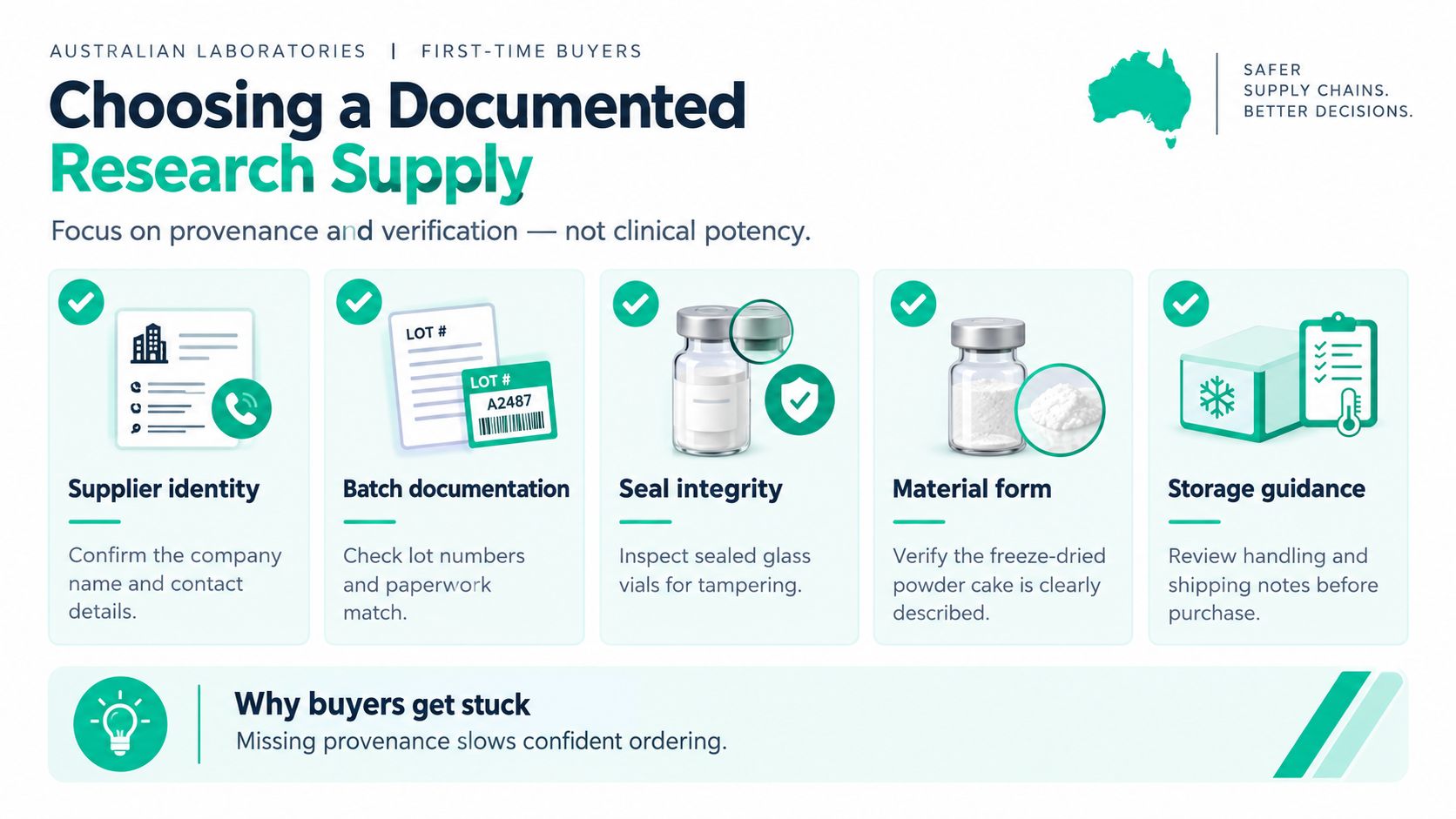
What to check before checkout
Look for a visible specification, a batch-linked certificate, and a clear research-use-only position. Documentation sources should be labelled, so a reader can see whether a file is manufacturer-provided or from an independent laboratory. Pending results should be marked in testing, not implied to exist.
Bulk Aussie Peptides is one domestic option a team can inspect on those terms. We're Australian owned and operated. Research material is supplied as a sealed glass vial with a freeze-dried powder cake, in standardised 10-packs, across 60+ compounds. The catalogue includes growth hormone secretagogues, GLP-1 receptor agonists, and tissue-remodelling and cellular research peptides, so a CJC-1295 comparison can sit beside related research compounds without those compounds being described as HGH. Ipamorelin, for example, is listed at $577.00 per 10-pack of 5 mg vials. That figure is a catalogue price, not a potency ranking.
The Product Comparison Tool lets a user select up to three research peptides for a side-by-side check. That's a catalogue task. It isn't a medical decision and it doesn't compare a research peptide with prescribed somatropin.
Where the certificate lives
The concrete answer to testing questions is the COA library, with batch documentation linked on product pages. Certificates are independent laboratory documents. If a batch is still pending, the page should say in testing rather than imply a finished report. GST invoices are available for procurement. Domestic dispatch is tracked and typically arrives around one week door to door. Institutions that need larger quantities can use the bulk and wholesale pathway and a procurement pack. None of that is a reconstitution guide, a concentration target, or a dosing note.
Match the SKU, the batch number, the test method, and the research-only label before the order is treated as verified.
A listing without those four points is still only a name. Assay-verified identity and purity are part of the study file, in the same way timed GH and IGF-1 samples are part of the endpoint file.
Next Steps for Laboratory Planning
The comparison ends in paperwork, not in a second ranking.
If the question is diagnosed growth-hormone deficiency, the next step is a qualified prescriber. That pathway is somatropin, PBS eligibility, stimulation testing, and endocrine supervision. It isn't a research-peptide product page, and we don't bridge the two.
If the reader is a laboratory, write the study question as biomarker, assay, or materials-verification work. Record in the protocol that CJC-1295 and somatropin aren't interchangeable. File the specification and the batch certificate before ordering. Check the online lab library and confirm whether a certificate is present or marked in testing. Where an institution needs GST documentation, request a procurement pack or a quote. Use the tracked domestic window for scheduling. Don't assume a faster shipment than the stated dispatch.
Everyday readers should keep weight, recovery, and skin, hair, or nail interest in study-summary language. Research has examined endocrine markers. Increased growth hormone or IGF-1 isn't proof of those outcomes. Handling and stability notes belong in peptide storage and stability, read as laboratory guidance, not as a use method.
Optional supply routes are the relevant research category and wholesale information, both bounded as research use only. A purchase confirms a documented material for a defined study question. It doesn't authorise human administration, and it doesn't inherit the approval status of prescription HGH.
- BAP
Bulk Aussie Peptides supplies Australian laboratories with research-use-only peptides, including growth-hormone secretagogues, in documented 10-packs with batch certificates you can check before ordering. If you're comparing CJC-1295 with prescribed somatropin, keep the clinical pathway with a prescriber and use the catalogue only for research materials and paperwork. Visit Bulk Aussie Peptides to review specifications, the COA library, and wholesale options.