
PT 141 Peptide: Australian Research Guide
PT-141 is the investigational name for bremelanotide, a synthetic cyclic melanocortin-receptor agonist studied in preclinical and clinical research. No approved therapeutic product containing it is listed on the Australian Register of Therapeutic Goods (ARTG), so an overseas approval doesn't establish Australian approval or authorise local supply.
A common shortcut says that because the United States approved bremelanotide as Vyleesi in 2019, PT-141 must be approved for the same purpose in Australia. That conclusion doesn't follow. Australian researchers need to assess overseas evidence, the ARTG status of the specific product, any lawful pathway for its supply, and the batch's analytical documentation as separate questions. A vial label alone can't answer them.
Table of Contents
- What PT-141 Peptide Is and Why Australian Status Matters
- How PT-141 Works as a Melanocortin Receptor Agonist
- What the Clinical Research Actually Measured
- Handling, Storage and Reconstitution Calculations
- Verifying Identity and Purity Through Batch Documentation
- Choosing an Australian PT-141 Supplier
- Your Next Steps Before Ordering PT-141
What PT-141 Peptide Is and Why Australian Status Matters
“PT-141 peptide” is a common search term for bremelanotide, a synthetic cyclic peptide that acts on melanocortin receptors. The US Food and Drug Administration approved bremelanotide as Vyleesi on 21 June 2019 for acquired, generalized hypoactive sexual desire disorder in premenopausal women. That milestone applies to the United States. Available Australian regulatory information does not list an approved therapeutic PT-141 product on the ARTG. Read the Australian research-peptide regulatory overview for the local context.
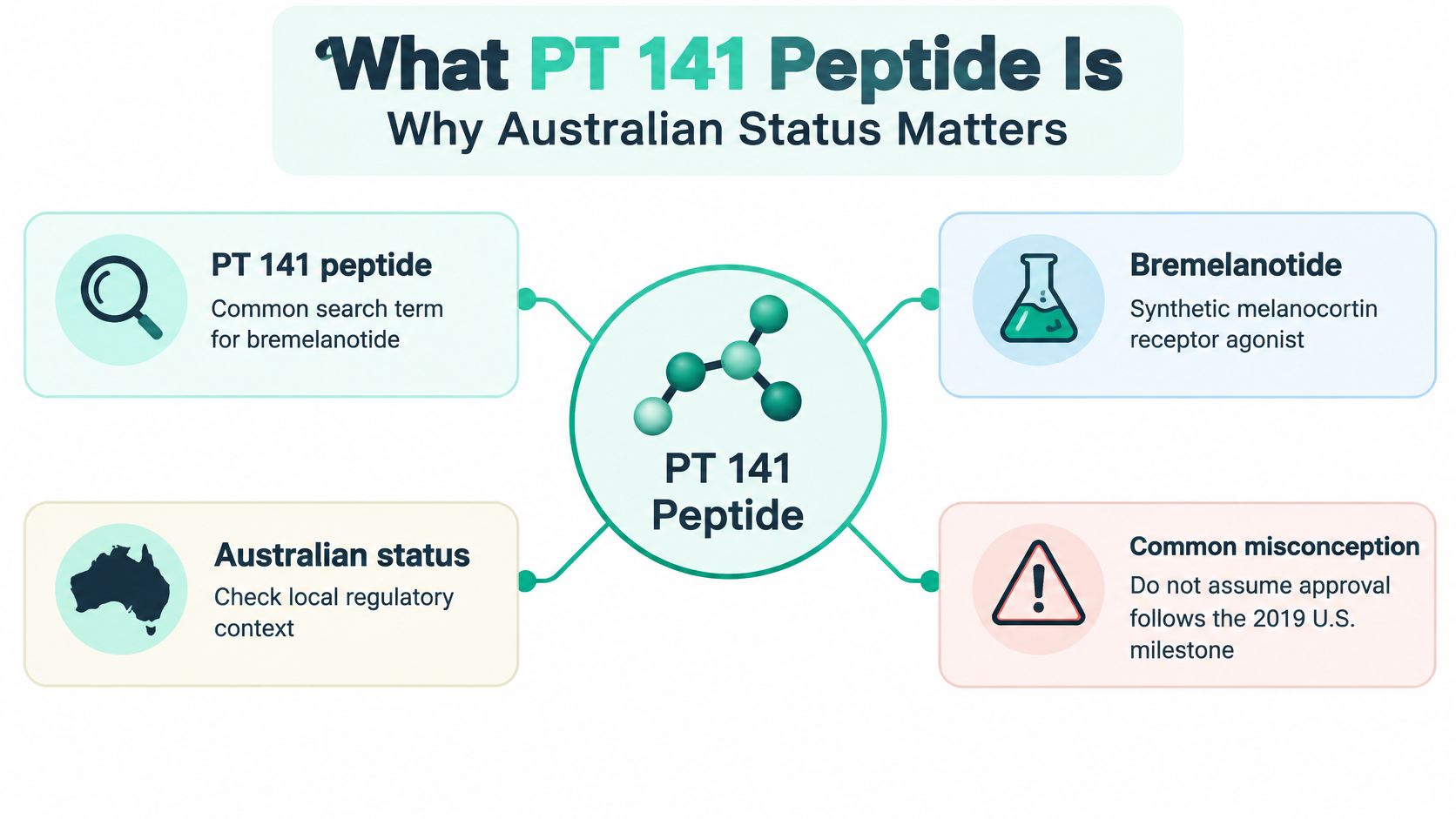
The distinction matters because overseas clinical evidence and Australian legal status answer different questions. A US approval doesn't mean a product is ARTG-listed, generally authorised for Australian retail supply, or assessed by the Therapeutic Goods Administration (TGA) against Australian requirements for quality, safety and efficacy. The TGA's guidance also cautions that many peptide products promoted online are unapproved therapeutic goods, and that an unapproved product hasn't been assessed to the same standard. TGA guidance on therapeutic peptide products explains why a product's intended use and promotion matter, not just its chemical name.
For Australian procurement teams, the four questions are distinct:
- Evidence: What population and research outcomes have been studied overseas?
- Registration: Is the exact product, formulation and sponsor listed on the ARTG?
- Supply pathway: Does a specific exemption, approval or other lawful pathway apply?
- Documentation: Does the batch record support its stated identity and composition?
A “research use only” label doesn't, by itself, create permission for therapeutic supply.
Keeping those questions separate helps laboratories assess material on documentation rather than treating an overseas approval or a vial label as proof of Australian status.
How PT-141 Works as a Melanocortin Receptor Agonist
Bremelanotide is a synthetic cyclic heptapeptide that activates melanocortin receptors. Pharmacology references describe activity at several receptors, with prominent activity at MC1R and MC4R. MC4R is considered the receptor most relevant to proposed central pathways involved in sexual desire. A clinical pharmacology study describing bremelanotide's receptor activity gives useful context for matching a study to the compound's research scope.
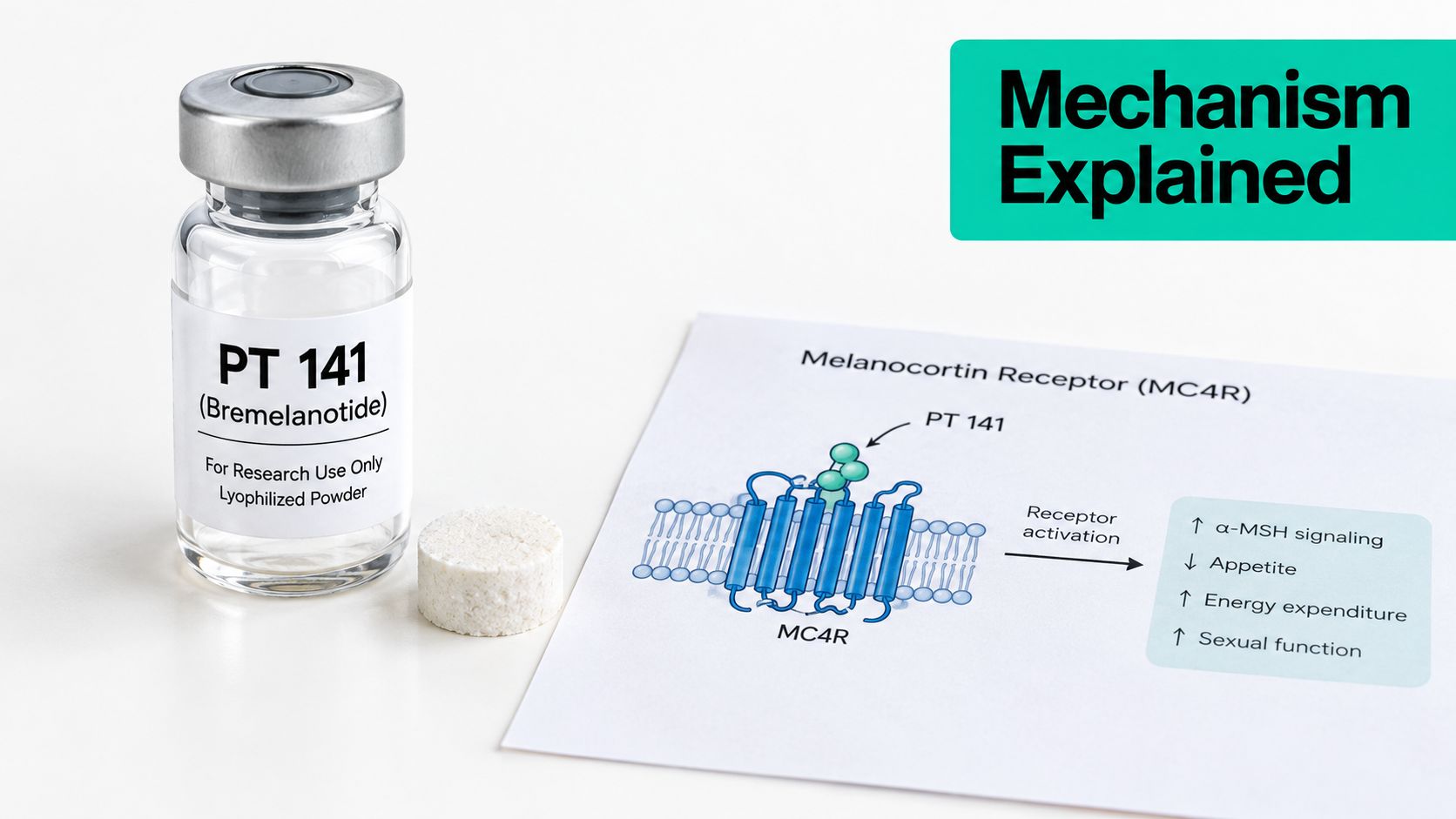
The useful comparison with phosphodiesterase-5 (PDE5) inhibitors is about pharmacology, not a claim that the compounds are interchangeable. Melanocortin signalling acts centrally on neural pathways, while PDE5 inhibitors primarily amplify nitric-oxide-mediated vascular relaxation. In plain terms, the research question for bremelanotide concerns central signalling; a PDE5 study more directly examines a vascular pathway.
This difference affects study design. A behavioural or libido-related measure isn't the same endpoint as a penile haemodynamic measure. Researchers should choose endpoints that fit the proposed mechanism and population; a chemically well-characterised sample can't correct a mismatch between a hypothesis and what the study measures.
In clinical pharmacology research, bremelanotide has been described as an on-demand subcutaneous melanocortin-receptor agonist. That's a description of the research context, not a preparation or use instruction.
For a concise visual explanation of the mechanism, view the embedded overview below.
What the Clinical Research Actually Measured
The strongest clinical evidence described here comes from two phase 3 RECONNECT trials in premenopausal women diagnosed with hypoactive sexual desire disorder (HSDD). The studies were randomised, double-blind, placebo-controlled and multicentre. They examined defined desire and distress outcomes under trial conditions, not a broad claim about sexual performance or general wellbeing. The integrated RECONNECT trial analysis reports the trial populations and outcomes.
RECONNECT trial parameters and reported outcomes
| Parameter | Reported value |
|---|---|
| Participants randomised | 1,267 women |
| Safety population | 1,247 participants |
| Primary modified intent-to-treat efficacy population | 1,202 participants |
| Core assessment period | 24 weeks |
| Effect size for improving sexual desire | 0.39 |
| Effect size for reducing distress related to low desire | 0.27 |
| Average change in sexual-satisfaction-related events | 0.7 per month with bremelanotide versus 0.2 with placebo, p = 0.018 |
The trials reported significant improvement in the Female Sexual Function Index desire domain and a reduction on the relevant Female Sexual Distress Scale item. An integrated results review also reported improvements in several secondary domains, including overall sexual function, arousal, lubrication, orgasm and satisfaction. The review of the integrated clinical results describes these specific endpoints.
These findings support describing PT-141 research in relation to diagnosed HSDD in the studied population. They don't establish results for men, postmenopausal women, or people without HSDD, and they don't make the compound a general-purpose libido, fitness, weight-management or recovery peptide. Researchers planning a study can use the research methodology resource to keep study questions and measured outcomes clearly defined.
Handling, Storage and Reconstitution Calculations
Most research peptides sold by Bulk Aussie Peptides are supplied as a lyophilised, or freeze-dried, powder in sealed glass vials. A dry powder format is relevant to laboratory handling and transport, but it doesn't replace product-specific storage guidance. Follow the documentation supplied for the material and record its storage conditions.
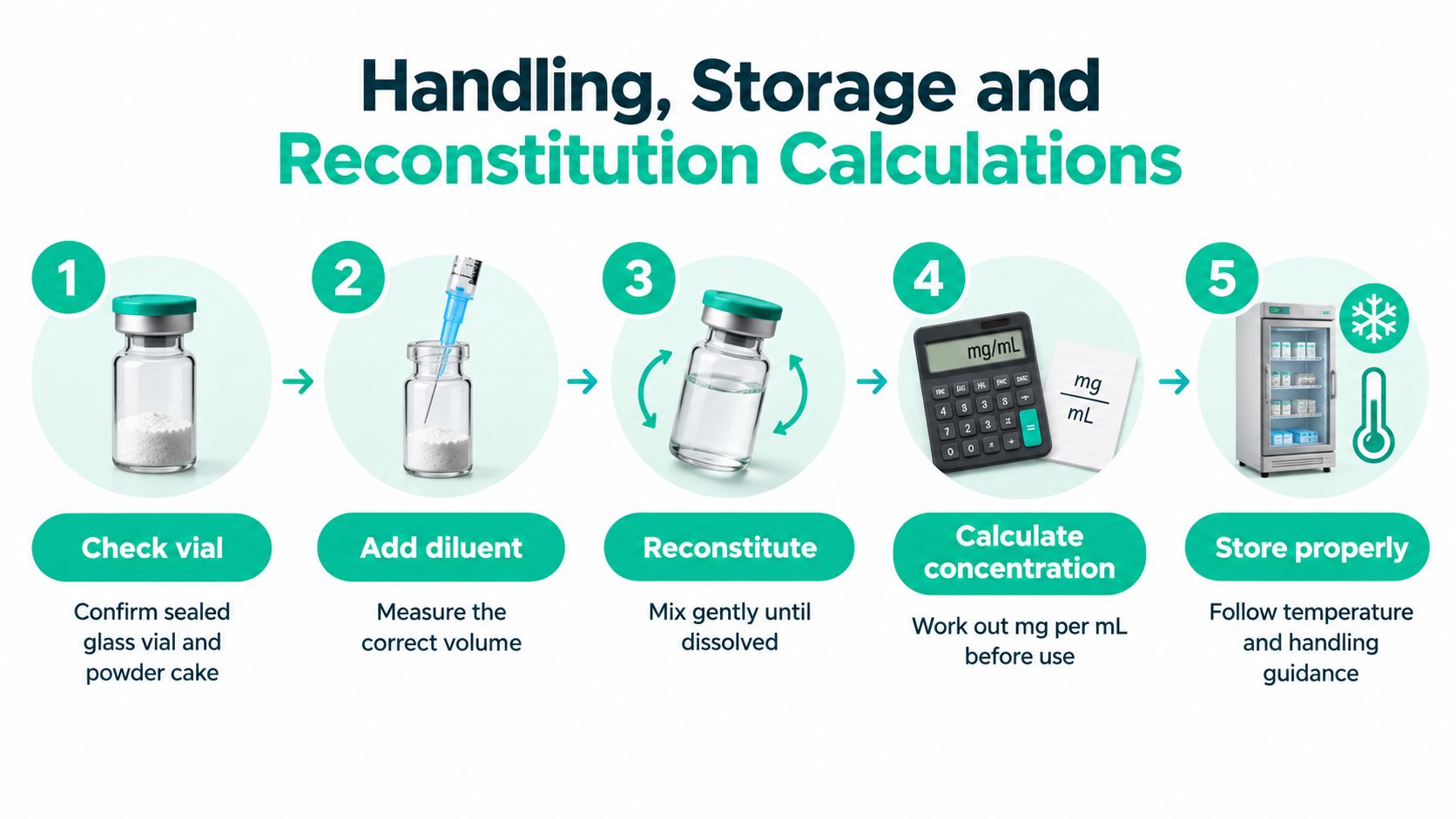
Reconstitution arithmetic is straightforward when a laboratory protocol calls for it: divide the stated quantity of material by the chosen liquid volume to calculate a concentration in mg/mL. For example, the calculation uses the vial's stated quantity as the numerator and the measured volume as the denominator. This is a concentration calculation, not a recommendation about preparation or use. Bulk Aussie Peptides offers a Peptide Calculator to help teams keep calculation records consistent.
A reproducible preparation record should identify the material's batch and document the diluent lot, preparation date and storage conditions. Avoid repeated freeze-thaw cycles where the applicable product guidance advises against them, and keep handling records with the study documentation so another reviewer can understand how the sample was managed.
Record-keeping rule: A concentration calculation is only as reliable as the quantities and units recorded by the operator.
Verifying Identity and Purity Through Batch Documentation
A defensible procurement record begins with batch-specific analytical verification, not a vial label or nominal quantity. The TGA warns that unapproved peptide products may not have been assessed for identity, labelling, sterility, manufacturing quality, safety or effectiveness. Its ARTG search guidance also identifies the register as the public reference for checking product, formulation, sponsor and manufacturer details.
Different tests address different questions:
- LC-MS: Confirms intact mass and can flag inconsistencies, but doesn't alone establish purity or sterility.
- Reversed-phase HPLC: Separates related substances and degradation products. A purity result isn't the same as identity confirmation.
- Peptide content or assay: Estimates the amount of peptide present.
- Residual-solvent and water testing: Addresses properties not established by a chromatographic purity figure.
- Microbiological or endotoxin controls: Address biological contamination risks where they matter to the experimental system.
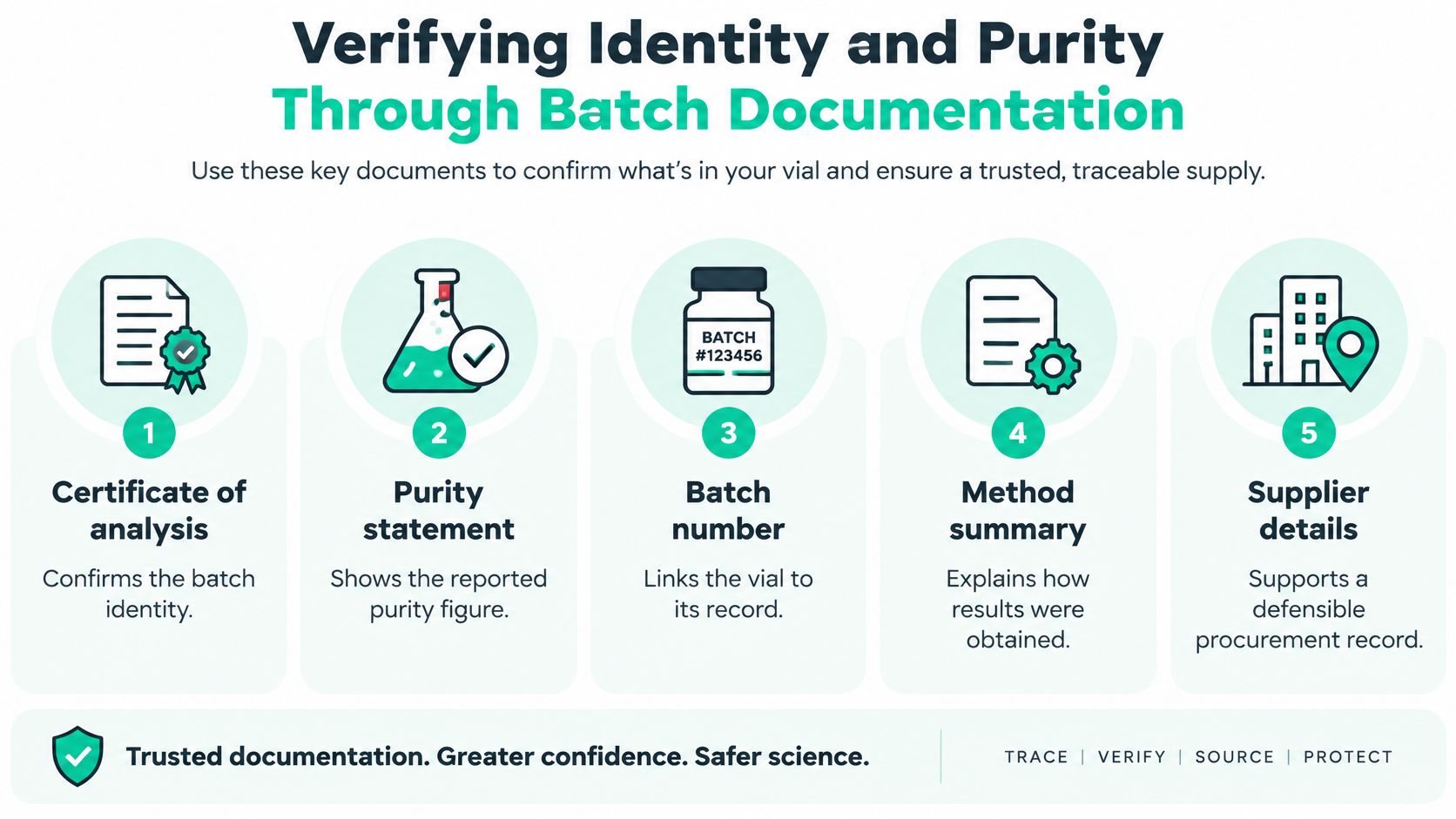
When reviewing a certificate of analysis (COA), check that it names the tested batch and that the vial's batch identifier matches. Look for the method used, whether identity and purity are reported separately, who performed the testing, and whether storage and transport conditions are documented. Bulk Aussie Peptides maintains a COA library, with certificates linked from product pages and documentation marked “in testing” where results are pending.
A COA supports traceability and review; it doesn't prove ARTG registration, regulatory approval or safety for human use. The TGA's information on peptide products also makes clear that documentation doesn't resolve every quality or lawful-supply question.
Choosing an Australian PT-141 Supplier
Supplier comparison should focus on verifiable records and procurement clarity, not an approval headline or a label. For Australian laboratories, the supplier evaluation guide provides a starting point for assessing documentation and supply details.
| Evaluation criterion | What to check | Why it matters |
|---|---|---|
| Batch documentation | Does the COA identify the tested batch? | Links test results to the material received |
| Testing source | Is testing identified as independent or manufacturer-provided? | Helps assess the basis of the result |
| Product information | Are specifications visible before ordering? | Supports procurement review |
| Regulatory status | Can the product and sponsor be checked against the ARTG? | Separates local registration from overseas evidence |
| Delivery information | Are dispatch and delivery arrangements stated? | Helps laboratories plan procurement |
Bulk Aussie Peptides is Australian owned and operated and trades as PMA, ABN 21 102 515 841. Its catalogue includes 60+ research peptide products in sealed 10-vial packs, with some single-vial trial sizes, and it supplies research peptides to Australian laboratories, universities and qualified researchers. PT-141 is listed at $599.00 AUD per 10-pack of 10 mg × 10 vials.
The business provides a COA library, peptide calculator, glossary, product finder and product comparisons. It offers tracked Australia-wide shipping, typically around one week door to door, and GST invoices are available. These business details can help teams assess procurement logistics, but they don't change a product's ARTG status or substitute for checking the applicable supply pathway.
Your Next Steps Before Ordering PT-141
Before committing procurement funds, keep the evidence, legal pathway and batch record distinct.
- Check Australian status: Search the ARTG for the exact product, formulation and sponsor. If it isn't listed, document the specific exemption or lawful pathway that applies before acquisition.
- Review the evidence: Confirm that the research population and endpoints match the question your study is designed to answer.
- Match the batch: Request batch-specific documentation, then compare the vial's identifier with the COA. Check that identity and purity are reported separately.
- Record receipt and handling: Document storage and transport conditions, then maintain preparation records according to the laboratory protocol.
Bulk Aussie Peptides offers request documentation and testing and documentation services. Its bulk and wholesale pathway supports institutional procurement, and its calculator can help teams standardise concentration records when their laboratory protocol requires them.
Visit the PT-141 product page and review its linked batch documentation against your study specifications before ordering. If the specifications fit your research requirements, request a quote through the procurement pathway.
- BAP
Bulk Aussie Peptides supplies research peptides in documented formats and provides batch records, a COA library and laboratory calculation resources. Review the PT-141 specifications and linked batch documentation at Bulk Aussie Peptides, then request a quote if the material's documentation matches your research procurement requirements.