
CJC 1295 vs Sermorelin: Research Differences Explained
Picking the longer-lasting peptide isn't a decision. It's a shortcut that skips the questions that actually change a study. For CJC 1295 vs sermorelin, half-life matters, but it doesn't settle regulatory status, anti-doping exposure, washout, sampling or batch verification. Treat duration as one design variable. The right compound is the one whose exposure shape, documentation and legal position fit the research question you're asking.
Table of Contents
- CJC 1295 vs Sermorelin at a Glance
- How Each Peptide Acts on the Growth Hormone Axis
- Half-Life, DAC and Exposure Shape
- Study Design Implications for Research Protocols
- Australian Rules, Anti-Doping and Safety Endpoints
- Sourcing, Storage and COA Checks for Buyers
- Frequently Asked Questions About CJC 1295 and Sermorelin
- Which Peptide Fits Your Research Question
CJC 1295 vs Sermorelin at a Glance
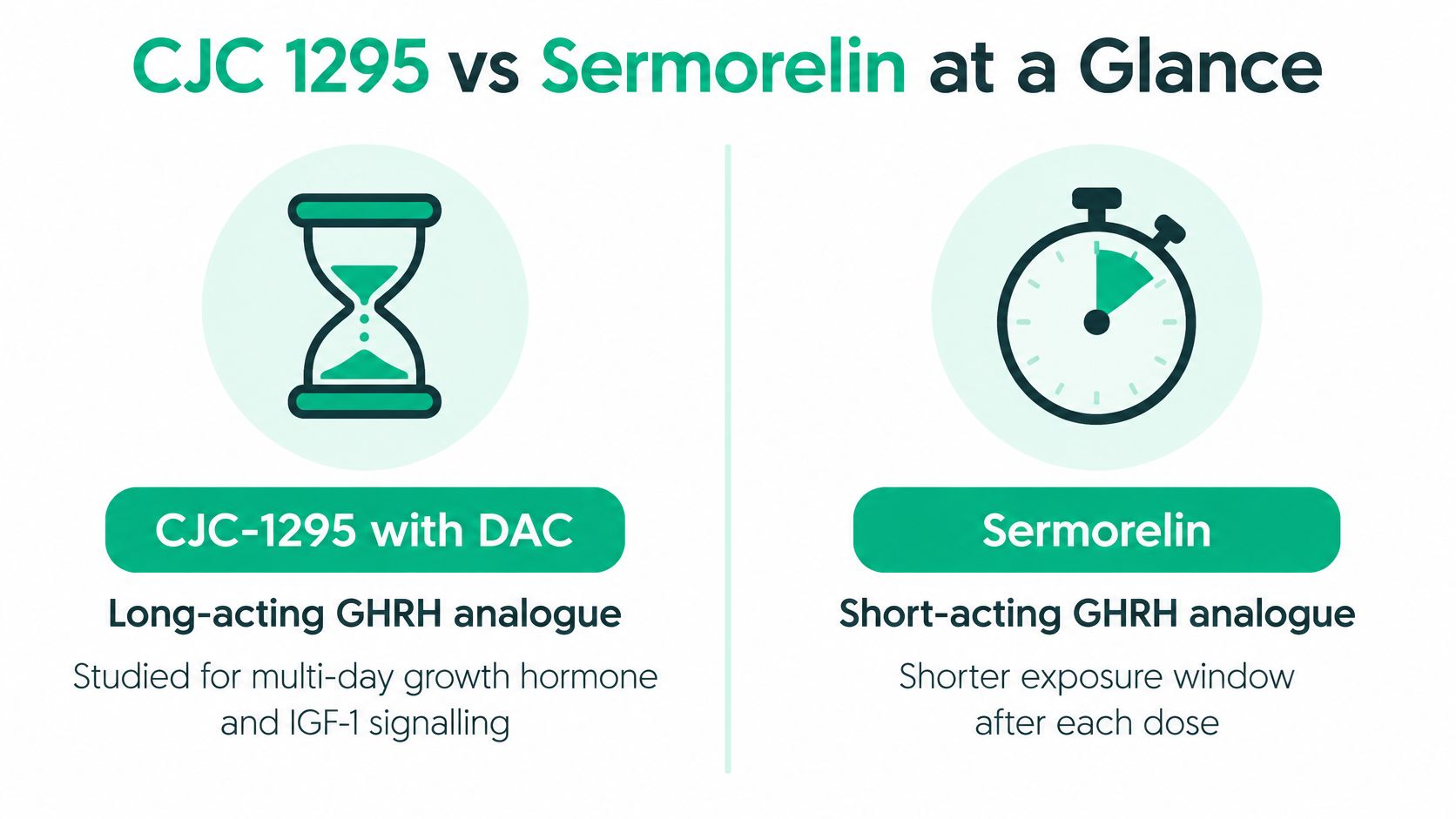
CJC-1295 with DAC is a long-acting growth hormone-releasing hormone (GHRH) analogue studied for multi-day growth hormone and IGF-1 signalling. Sermorelin is a short-acting GHRH(1-29) fragment studied for brief pituitary responses. Neither should be presented in Australia as a TGA-approved treatment, so the practical split is exposure duration and study fit, not a proven clinical winner.
Core attributes side by side
| Attribute | CJC 1295 with DAC | Sermorelin |
|---|---|---|
| Compound class | Synthetic GHRH analogue with drug affinity complex (DAC) | Synthetic GHRH(1-29) analogue |
| Structural feature | Modified GHRH sequence with a DAC side chain that binds albumin | Truncated 29-residue fragment of native GHRH |
| Primary research focus | Prolonged GH and IGF-1 response in multi-day studies | Short-window pituitary GH response studies |
| Exposure window modelled | Days (multi-day GH and IGF-1 elevation reported) | Minutes (rapid clearance) |
| Anti-doping listing in Australia | Named in Sport Integrity Australia educational material | Named in Sport Integrity Australia educational material |
| TGA position | Named by the TGA among unapproved peptide products | Unapproved research peptide; check the TGA position before sourcing |
Read the table as a set of constraints.
- Class defines target: both compounds act on the GHRH pathway, so mechanism alone doesn't separate them.
- Structure drives persistence: the DAC side chain is the reason CJC-1295 behaves differently over time.
- Research focus follows exposure: multi-day questions and minute-scale questions need different tools.
- Regulatory rows override preference: anti-doping and TGA status can rule out a cohort or a claim before pharmacology is considered.
Both compounds are supplied as research-use-only peptides. Batch-level Certificates of Analysis sit in the online COA library, and identity and purity results should be checked against the specific batch before any work begins. Use this table as the reference point. Each row is unpacked in the sections that follow, with the numbers and limits attached.
How Each Peptide Acts on the Growth Hormone Axis
Both compounds act upstream. They target the GHRH receptor on pituitary somatotroph cells. Receptor activation normally triggers pulsatile release of growth hormone (GH). GH then drives IGF-1 production, mainly in the liver. That shared pathway is the starting point, not the conclusion.

Sermorelin as a native fragment
Sermorelin is built from the first 29 amino acids of native GHRH. That portion carries receptor activity. It has no albumin-binding component. The result is a molecule that engages the receptor briefly and then clears. For background on how researchers frame that short-window profile, see our sermorelin research overview.
CJC-1295 as a modified analogue
CJC-1295 is also a GHRH analogue. It carries amino-acid substitutions that slow enzymatic breakdown. The DAC version adds a side chain that binds circulating albumin. Albumin binding extends time in circulation. That's a pharmacokinetic modification, not a different receptor target.
Analytical point. A shared receptor doesn't mean a shared exposure profile. Structure changes duration, and duration changes what a study can measure.
Both compounds act upstream of GH. Natural feedback still shapes the response. Somatostatin can restrain GH release. IGF-1 provides downstream feedback. A research team can't assume that receptor stimulation produces a linear, unlimited hormone rise.
That feedback raises the central mechanistic question. Does sustained exposure from a long-acting analogue alter the normal pulsatile pattern? Does a short-acting fragment preserve that pattern more closely? Those are questions a protocol can test with timed GH and IGF-1 sampling. They're not answers supplied by the chemical structure alone.
The mechanism also has a clear limit. Receptor activity in early studies doesn't demonstrate clinical effectiveness in any population. It doesn't prove benefit for performance, body composition, recovery or disease outcomes. A procurement team should separate three claims that suppliers often blur. The compound binds a known target. The compound changes a biomarker in a small study. The compound improves an outcome that matters. Only the first two are supported here.
Half-Life, DAC and Exposure Shape
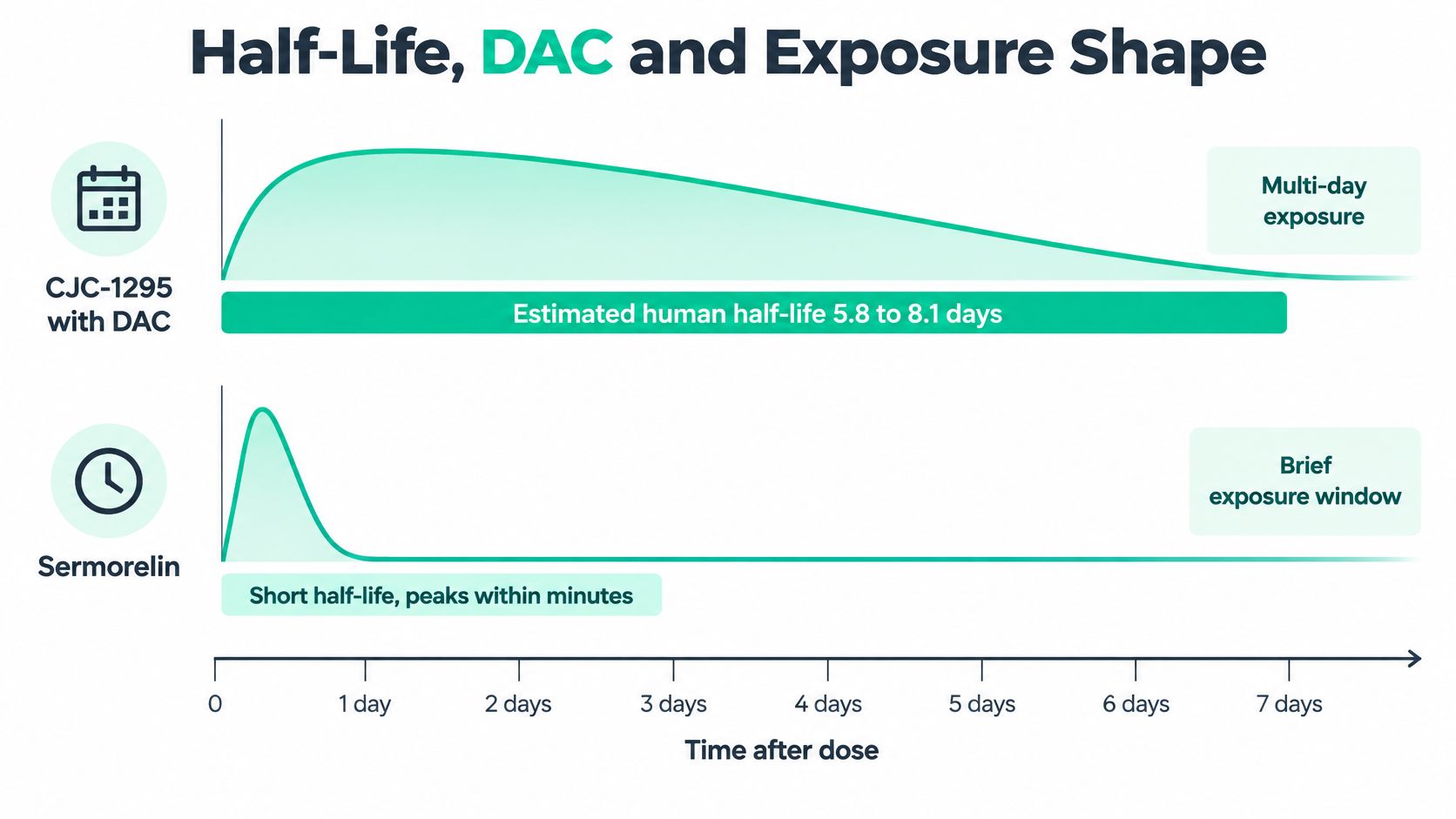
The protocol implications of CJC-1295 with DAC and sermorelin differ more than their shared target suggests. FDA-reviewed pharmacokinetic material estimates a CJC-1295 half-life of 5.8 to 8.1 days in humans (FDA-reviewed CJC-1295 pharmacokinetic material). A pharmacology review reports that sermorelin reaches peak concentration 5 to 20 minutes after subcutaneous administration and has an approximately 11 to 12 minute half-life (pharmacology review of sermorelin exposure. These estimates describe exposure, not comparative efficacy or safety.
Exposure benchmarks from reported data
| Parameter | CJC 1295 with DAC | Sermorelin |
|---|---|---|
| Reported half-life | Estimated 5.8 to 8.1 days in healthy adults in early-phase data | About 11 to 12 minutes |
| Time to peak after subcutaneous dosing | Not stated in reviewed sources | 5 to 20 minutes |
| Receptor-binding duration | Not stated in reviewed sources | Not stated in reviewed sources |
| GH elevation after single dose | Dose-dependent increase reported in an early human study | Short and transient; specific duration not stated in reviewed sources |
| IGF-1 elevation after single dose | Increase reported in an early human study | Not stated in reviewed sources |
| IGF-1 after repeated dosing | Not stated in reviewed sources | Not stated in reviewed sources |
| Clearance in adults | Not stated in reviewed sources | Not stated in reviewed sources |
The CJC-1295 figures come from small early-phase studies in healthy adults. They describe hormone changes, not performance, body-composition or clinical outcomes. A 2006 human study provides the context for the reported single-dose response: researchers examined dose-dependent changes in plasma GH and IGF-1 (2006 Journal of Clinical Endocrinology and Metabolism CJC-1295 study).
What DAC changes in practice
The albumin-binding side chain extends exposure. That persistence can make washout and interpretation harder, while sermorelin's brief exposure permits a quicker adjustment or stop. Neither profile establishes safety or efficacy. The TGA states that unapproved peptide products have not been evaluated for safety, quality or effectiveness (TGA guidance on responsibilities for unapproved peptide products).
For the structural distinction, see the CJC-1295 DAC vs no-DAC research comparison. Half-life is a study-design variable, not a ranking: it informs sampling windows, washout planning and stopping rules.
Study Design Implications for Research Protocols
A longer half-life is a design variable. It decides how often a team samples. It decides how long washout must run. It decides how precisely a time course can be resolved. Teams that treat duration as a verdict usually design the wrong measurements.
Design considerations by protocol question
| Design question | CJC 1295 with DAC | Sermorelin |
|---|---|---|
| Time-course resolution | Coarse; signal persists for days | Fine; sampling can resolve minutes |
| Washout between arms | Long; multi-day gaps may be needed | Short; faster reset between arms |
| Repeated-dose accumulation | Expected across doses; must be modelled | Limited by short half-life |
| Sampling schedule | Daily or multi-day sampling | Dense sampling across the first hour |
| Ease of stopping exposure | Harder to clear quickly once started | Quicker to clear and adjust |
Matching compound to question
CJC-1295 with DAC suits studies asking how a sustained GH and IGF-1 signal develops and decays. Multi-day persistence matches multi-day sampling. The cost is carry-over. Unless washout windows are long, one study arm can contaminate the next, and the team may attribute a lingering signal to a new condition.
Sermorelin suits acute questions. Minute-scale kinetics allow fine sampling early after exposure and quicker resets between conditions. The cost is reach. A compound that clears in minutes can't answer a multi-day exposure question without a very different design, and repeated brief exposures aren't the same as sustained exposure.
Our research methodology resources cover how teams document those choices before procurement.
Choose the sampling clock first. The compound follows from it, not the other way around.
Endpoints and ethics stay separate
Define endpoints separately. GH is one endpoint. IGF-1 is another. Identity, purity and batch traceability are analytical endpoints, not biological ones. A longer half-life is a technical trait. It doesn't prove clinical value, and a strong biomarker response doesn't validate a batch.
Any study involving human administration needs ethics approval, medical oversight, appropriate sourcing and regulatory review. A supplier certificate alone doesn't meet that bar. Procurement teams should confirm that approval pathway before ordering, because a well-documented compound in an unapproved study is still a compliance failure.
Australian Rules, Anti-Doping and Safety Endpoints
The common assumption is that a research label settles the legal question. In Australia, it doesn't. The Therapeutic Goods Administration (TGA) regulates peptide products as therapeutic goods when they're promoted or used to modify a physiological process, including claims involving weight loss, muscle growth, recovery or performance, as explained in TGA guidance on how therapeutic peptide products are regulated.
The ARTG baseline
Therapeutic goods generally must be entered in the Australian Register of Therapeutic Goods (ARTG) before they can be imported, manufactured, supplied or advertised, unless a specific exemption or authority applies. The TGA identifies CJC-1295 among examples of unapproved peptide products and states that such products haven't been evaluated for safety, quality or effectiveness. The Therapeutic Goods Act 1989 is the legislative framework under which these obligations operate.
That has a practical consequence for language. A comparison shouldn't present either compound as an established, TGA-approved treatment. It shouldn't imply clinical superiority from routine consumer claims. Our Australian research peptide regulation guide sets out the sourcing implications in more detail.
Anti-doping exposure
Sport is a separate risk. Sport Integrity Australia explains that the WADA Prohibited List is updated every year and takes effect on 1 January, and its educational material specifically names CJC-1295 and sermorelin among synthetic peptides, as outlined in Sport Integrity Australia prohibited list education. Possession or use can produce an anti-doping rule violation and a significant sporting ban.
A research-use label doesn't remove that exposure. Athletes and support personnel should verify the current prohibited-list position and obtain qualified anti-doping advice before handling either compound. Eligibility consequences come before pharmacology.
Safety endpoints studies measure
Published GH-axis studies monitor safety endpoints. Present these as things studies measure, not outcomes to expect.
- Site reactions: local responses recorded during study monitoring.
- Flushing and headache: symptomatic endpoints captured in adverse-event reporting.
- Fluid-related effects: changes tracked where GH signalling is under study.
- Joint discomfort: musculoskeletal symptoms recorded as safety observations.
The reviewed trials assessed pharmacokinetics, GH, IGF-1 and safety in healthy adults. They didn't establish clinical effectiveness for growth hormone deficiency or other conditions. Nothing in this section is medical advice.
Sourcing, Storage and COA Checks for Buyers
Bulk Aussie Peptides supplies research peptides in sealed 10-vial packs and offers some single-vial trial sizes. The pack label shows the product name, quantity per vial and batch reference; individual vials are unlabelled glass. Keep the pack label linked to the batch record.
Checks to run at receipt
- Match the batch number: compare the pack label with the batch information in the Bulk Aussie Peptides COA Library.
- Review reported tests: check which identity and purity results appear on the COA, and whether the methods are specified.
- Check the laboratory and batch: confirm the report names a testing laboratory and corresponds to the batch supplied.
- Check pending status: note any test marked as in progress and recheck the library before recording the batch as verified.
- File the record: save the COA against the SKU and order record so procurement and laboratory teams can identify the same document.
Release rule. A mismatch between the pack's batch reference and the COA means the batch is not verified.
Storage and handling boundaries
Use the manufacturer's specification sheet for temperature, light and moisture conditions. Do not substitute general peptide guidance for product-specific instructions.
Solvent choice, post-mixing stability and handling depend on the study protocol and analytical method. Document them in the laboratory's standard operating procedure. A supplier article cannot establish conditions for a specific experiment.
The TGA and NSW Police reported a seizure of illicit peptide and anabolic-steroid products in New South Wales in 2026, including CJC-1295, in the TGA media release on illegal peptides and steroids. The report supports careful checks of product identity and batch documentation; it does not verify any particular supplier or batch.
Frequently Asked Questions About CJC 1295 and Sermorelin
Are CJC-1295 and sermorelin the same compound?
No. CJC-1295 is a modified GHRH analogue with a DAC side chain. Sermorelin is a GHRH(1-29) fragment without the albumin-binding component. Their shared target does not make them structurally or pharmacokinetically equivalent.
Which compound lasts longer in reported studies?
Reported pharmacology estimates put the half-life of CJC-1295 with DAC at 5.8 to 8.1 days, compared with about 11 to 12 minutes for sermorelin. That difference affects exposure and sampling design. It does not establish better outcomes.
Is either compound TGA-approved?
Neither should be treated as TGA-approved. The TGA states that unapproved peptide products have not been evaluated for safety, quality or effectiveness. Check the current regulatory position before sourcing or making claims about either compound.
Can athletes use either compound?
Sport Integrity Australia's educational material names CJC-1295 and sermorelin among synthetic peptides. Anti-doping review should come first. A research label does not remove eligibility risk.
How do I check a batch before release?
Match the batch number on the pack to the corresponding COA in the online lab library. Check the reported identity and purity results, and confirm which laboratory conducted the testing. Record the COA against the SKU and order.
Which Peptide Fits Your Research Question
There's no single winner. There's a better fit for a defined question, cohort and sampling plan. Start with the situation, then select the compound.
The short visual below frames the decision materials a procurement team should have on the desk before ordering.

Which compound suits which research question
| Research question | Better fit | Reason |
|---|---|---|
| Multi-day GH and IGF-1 time course | CJC 1295 with DAC | Multi-day exposure matches multi-day sampling |
| Acute, short-window pituitary response | Sermorelin | Minute-scale kinetics suit fine sampling |
| Study requiring quick washout | Sermorelin | Short clearance shortens carry-over |
| Sport-regulated or athlete cohort | Neither until anti-doping review is complete | Both named in Sport Integrity Australia material |
| Identity and purity comparison only | Either, judged on the same COA standard | Analytical endpoints are compound-specific |
Long-window GH and IGF-1 time courses favour CJC-1295 with DAC because the exposure and sampling clocks align. Acute pituitary responses favour sermorelin because teams can resolve the early signal and reset faster. Identity-and-purity comparisons don't need a pharmacological winner at all. They need the same COA standard applied to both batches.
The video below is useful context before you compare product specifications side by side.
Pre-purchase checklist
- Confirm research-use position: check TGA status and remove therapeutic claims from study and procurement documents.
- Pull the batch COA: complete the receipt checks set out in the sourcing section before release.
- Confirm ethics pathway: where humans are involved, approvals and medical oversight must precede ordering.
- Compare specifications: review the CJC-1295 with DAC and sermorelin product pages side by side, including format and documentation.
Our catalogue covers growth hormone secretagogues, GLP-1 receptor agonists, tissue-remodelling and cellular research peptides, among other research categories. The Product Comparison Tool lets users select up to 3 research peptides to compare side by side. For institutional supply, use the bulk and wholesale pathway for quotes and GST invoices.
The practical next step is narrow. Define the sampling window, confirm the regulatory and anti-doping position, then order only against a batch you can verify.
- BAP
For Australian laboratories comparing CJC-1295 with DAC and sermorelin, Bulk Aussie Peptides supplies research-use-only peptides in sealed 10-pack formats with batch documentation in an online COA library and Australia-wide tracked delivery. Compare the product specifications, check the batch COA before release, and visit Bulk Aussie Peptides to source documented material for your next approved research project.