
CJC 1295 vs Ipamorelin: Mechanism, Half-Life and Sourcing
A longer-lasting hormone signal isn't automatically a better research tool. In CJC 1295 vs Ipamorelin, the useful distinction is between sustained exposure through the growth hormone-releasing hormone pathway and a shorter signal through the ghrelin receptor. The published evidence supports comparing their receptor targets and observation windows, not declaring a winner for recovery or body composition. Both are unapproved peptide products in Australia, so laboratory interest must remain separate from therapeutic claims.
Table of Contents
- CJC 1295 vs Ipamorelin at a Glance
- How Each Compound Acts on the Growth Hormone Pathway
- Half-Life and Exposure Windows in Study Design
- Expected Effects Studied and Where the Evidence Stops
- Safety Profile and Australian Regulatory Status
- Procurement Checks for COAs and Batch Records
- Stability and Handling Planning in the Laboratory
- Frequently Asked Questions on CJC 1295 vs Ipamorelin
- Matching Each Compound to Your Research Brief
CJC 1295 vs Ipamorelin at a Glance
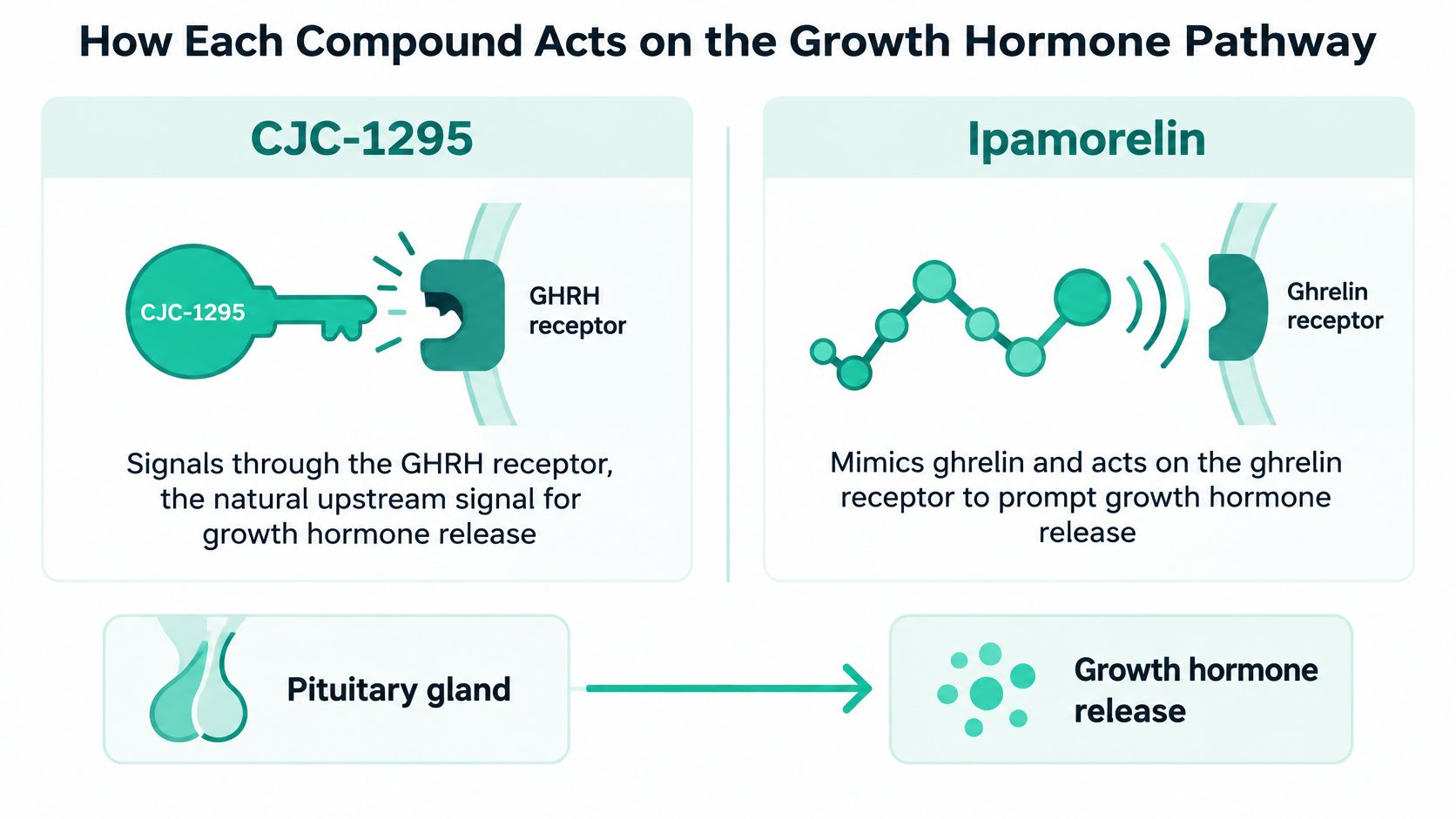
CJC-1295 is a synthetic growth hormone-releasing hormone (GHRH) analogue that acts at the GHRH receptor on pituitary cells. Ipamorelin is a growth hormone secretagogue that acts at the ghrelin receptor, also called the growth hormone secretagogue receptor.
They're separate research tools, not interchangeable versions of one molecule. A laboratory investigating a particular receptor needs to choose by pathway before considering duration, procurement cost or pack format.
CJC-1295 and ipamorelin compared at a glance
| Attribute | CJC-1295 | Ipamorelin |
|---|---|---|
| Compound class | GHRH analogue, synthetic | Growth hormone secretagogue |
| Receptor pathway | GHRH receptor on pituitary cells | Ghrelin, or GH secretagogue, receptor on pituitary cells |
| Depth of published human evidence | Randomised, placebo-controlled dose-escalation studies in healthy adults | Comparatively limited published human evidence |
| Australian regulatory status | Unapproved peptide product | Unapproved peptide product |
| Typical research fit | Designs needing prolonged growth hormone and IGF-1 exposure | Designs focused on acute pulse timing and return towards baseline |
The real question is which signal the study needs to last, not which compound is stronger.
Read the table as a study-design filter, not a performance ranking. More clearly documented hormone changes don't establish broader usefulness, and a shorter exposure window isn't necessarily a disadvantage.
Separate scientific fit from purchasing fit
A mechanistic study may favour receptor specificity even when another compound has a more convenient observation period. A time-course study may instead prioritise whether the expected response can be captured within the laboratory's sampling capacity.
Product specifications should then confirm that the material offered matches the compound described in the relevant publication. This is particularly important where product names, modifications or formulations differ.
At Bulk Aussie Peptides, our product specifications and bulk procurement resources support that document review. First identify the pathway and time course your study needs, then compare the available material.
How Each Compound Acts on the Growth Hormone Pathway
The receptor distinction is straightforward. CJC-1295 acts through the receptor for GHRH, while ipamorelin acts through the ghrelin receptor, a separate route associated with growth hormone release.
Healthy Male's evidence explainer describes these different pituitary receptor pathways and notes that published human evidence is more clearly documented for CJC-1295's growth hormone and IGF-1 effects than for ipamorelin. That distinction supports treating them as separate experimental inputs, even when the measured output is the same hormone.
A shared output doesn't identify the receptor
A growth hormone measurement can describe an endocrine response without proving which receptor-specific process caused it. If the hypothesis concerns the GHRH pathway, the design needs controls that make that interpretation defensible.
The same applies to ghrelin-pathway work. Choosing ipamorelin because it can stimulate growth hormone release doesn't remove the need to establish what the experiment actually measures.
Before procurement, the study team should settle these checks:
- Receptor hypothesis: Is the question specifically about GHRH-receptor or ghrelin-receptor activity?
- Required readout: Will the assay measure receptor-related activity, circulating hormone concentrations or a downstream endpoint?
- Signal separation: Can the controls distinguish the proposed pathway from other explanations for the observed response?
Molecular modification needs its own review
The long-acting CJC-1295 studied in the pharmacokinetic literature incorporates an albumin-binding modification. That molecular feature belongs in the material specification, rather than being treated as a minor naming detail.
A receptor label alone doesn't establish the exposure profile of every product carrying a similar name. Match the exact research material to the publication before transferring any expectation about duration.
Our ipamorelin research reference provides supporting context for reviewing that compound. Neither receptor mechanism, by itself, establishes an effect on body composition, injury recovery, sleep or cosmetic outcomes.
Half-Life and Exposure Windows in Study Design
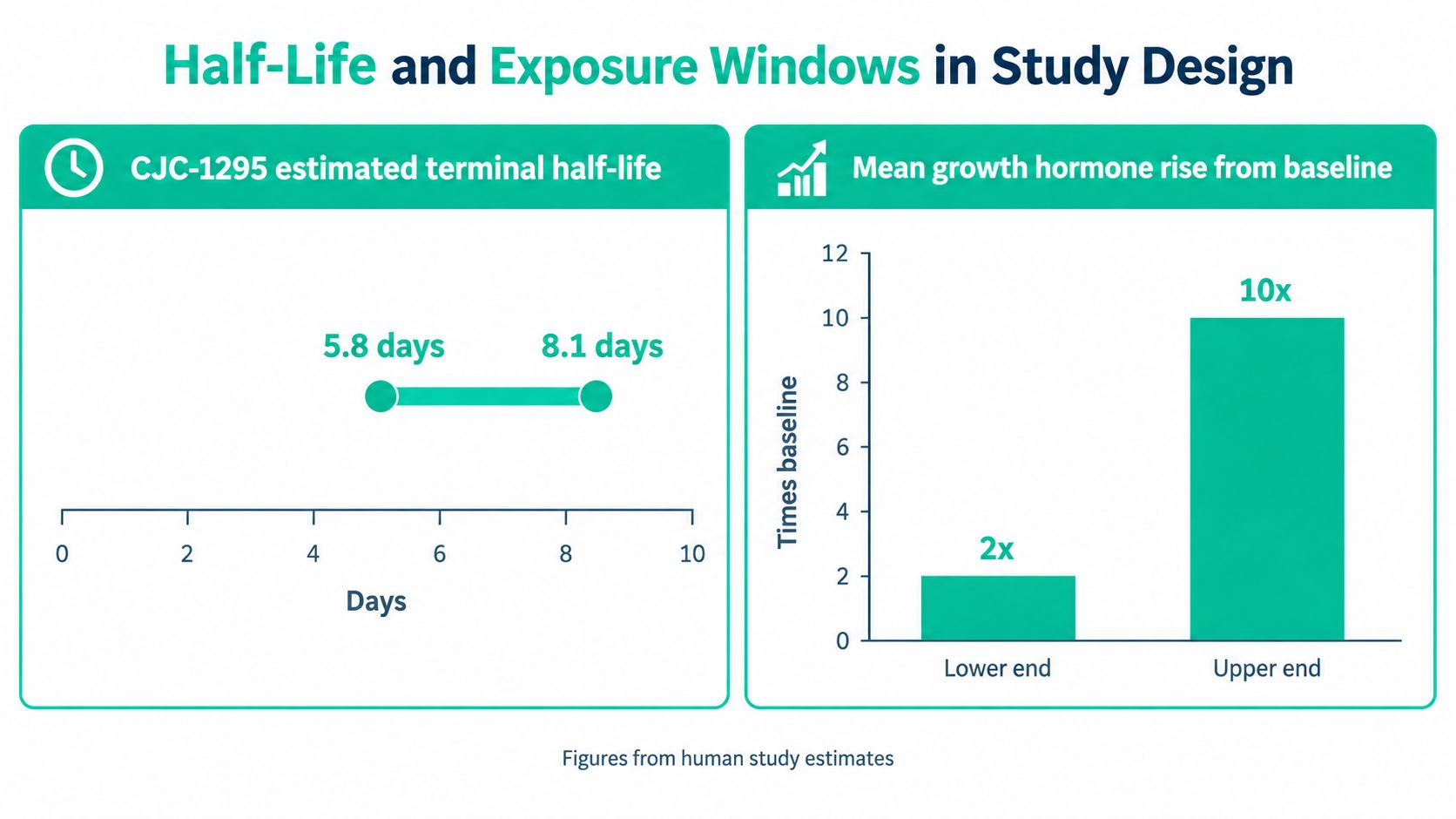
For CJC-1295, compound half-life and hormone-response duration are different measurements, and both matter when planning observations. The published CJC-1295 trial report describes two randomised, placebo-controlled, double-blind dose-escalation studies lasting 28 and 49 days, reporting a terminal half-life of 5.8 to 8.1 days. The pharmacokinetic and endocrine estimates are summarised below.
Pharmacokinetic and endocrine markers relevant to sampling design
| Parameter | CJC-1295 | Ipamorelin | Design implication |
|---|---|---|---|
| Estimated half-life | 5.8 to 8.1 days | Short-acting; published human pharmacokinetic data are limited | Sampling windows must match the compound's exposure profile |
| Growth hormone response | About 2 to 10 times baseline, lasting at least 6 days | Transient pulse, then negligible concentrations | Observation schedules operate on different time scales |
| IGF-1 response | About 1.5 to 3 times baseline, lasting 9 to 11 days | Comparable sustained response window not established in the available evidence | Longer observation is needed for sustained IGF-1 endpoints |
| Source trial design | Two randomised, placebo-controlled dose-escalation studies of 28 and 49 days | Early human work; published design details are limited | Cross-study comparisons need matched conditions |
| Best-fit sampling approach | Well-timed draws across days, with density determined by the endpoint | Dense sampling around the expected pulse | State the observation window before collecting results |
Published human pharmacokinetic data for ipamorelin are limited, and the available reports describe a short-acting compound producing a transient growth hormone pulse. Treat that column as a qualitative profile, not a result drawn from a direct comparison with the CJC-1295 trials.
Match observations to the question
An acute-response study needs observations close enough together to capture the expected rise and decline. Sampling only after that window could miss the response and produce an uninformative comparison. A draw taken after a pulse has passed is a lost data point.
A sustained-exposure study needs a longer observation period. Fewer, well-timed draws may suit a broad persistence endpoint, but they won't necessarily characterise every change in growth hormone secretion.
The CJC-1295 report also describes a synthetic GHRH analogue modified to bind covalently to endogenous albumin. That proposed exposure-extending mechanism is why the long-acting material must not be treated as equivalent to an unmodified, short-lived peptide.
Don't turn cross-study estimates into a ranking
The published programmes were not run under matched conditions. Where administration route, dose schedule or study population differs between reports, each difference limits how far a gap in measured response can be attributed to compound identity alone.
A defensible comparison should record:
- Readout window: Specify whether the endpoint concerns onset, peak, persistence or return towards baseline.
- Sampling schedule: Justify the observation density against the expected response.
- Study conditions: Record route, timing and analytical method so readers can judge comparability.
- Material identity: Confirm that the product's modification matches the publication.
Use our CJC-1295 DAC and no-DAC comparison when checking terminology. Don't transfer a long-acting estimate to a differently specified material.
Expected Effects Studied and Where the Evidence Stops
A hormone change is not a validated functional outcome. The CJC-1295 studies measured growth hormone and insulin-like growth factor 1 concentrations in healthy adults, rather than establishing changes in muscle, fat, injury recovery, sleep or skin.
The CJC-1295 study document hosted by Regulations.gov supports an extended endocrine exposure profile, but it doesn't establish long-term safety or efficacy for those broader outcomes. Research has examined hormone concentrations; the available data suggest a sustained signal, not a proven downstream benefit.
Specify the endpoint before interpreting the result
A laboratory can measure an endocrine marker accurately and still overstate what it means. The reporting problem starts when a result about hormone concentration becomes a claim about an outcome the study never measured.
Ipamorelin's comparatively limited published human evidence requires similar restraint. An incompletely characterised response should remain an evidence gap, rather than being filled with assumptions based on receptor mechanism.
Before data collection, define:
- Named marker: Identify growth hormone, IGF-1 or another specific analyte.
- Sampling times: State which part of the response each observation is intended to capture.
- Control conditions: Explain how the design will separate a compound-related response from background variation.
- Measured outcome: Distinguish the laboratory measurement from any broader hypothesis.
Reporting rule: State the marker measured, the population studied and the limit of what the result demonstrates.
Combination claims need independent evidence
Different receptor targets provide a rationale for asking a combined-pathway question. They don't establish that a combination produces a useful or predictable result.
The available evidence did not identify a direct head-to-head clinical benchmark, validated anabolic endpoints or strong evidence establishing combined performance. A combined-pathway experiment therefore needs a hypothesis, appropriate separate comparators and matched conditions, rather than an assumed advantage.
A precise conclusion might state that research examined endocrine exposure in healthy adult participants and found a persistent hormone response. It should stop there unless the study directly measured and validated another endpoint.
Safety Profile and Australian Regulatory Status
Regulatory status in Australia is a shared constraint, not a point of difference between these compounds. The Therapeutic Goods Administration's peptide safety alert explains that unapproved peptide products haven't been evaluated for safety, quality or effectiveness for general therapeutic supply, and it names CJC-1295 among those products. Ipamorelin sits in the same unapproved category, so neither compound should be presented as an ordinarily registered Australian therapeutic option.
Research labelling doesn't replace regulatory review
Australian therapeutic goods generally require inclusion in the Australian Register of Therapeutic Goods (ARTG) unless a specific legislative exemption, approval or authority applies. A research-use-only label doesn't itself establish TGA approval, lawful supply in every circumstance or human efficacy.
Laboratory teams should keep three questions separate: whether the material is scientifically relevant, whether its quality documentation is acceptable and whether the proposed procurement pathway is lawful. A positive answer to one doesn't settle the others. A supplier can hold complete batch records for a compound the institution has no lawful basis to purchase, and a lawful pathway says nothing about whether a given vial meets the study's purity requirements.
Our Australian research-peptide regulation reference can support an initial document review. Institutional governance remains necessary for deciding whether a proposed purchase meets the organisation's requirements.
Unknown safety is not demonstrated safety
The published evidence doesn't establish long-term safety or provide reliable adverse-event frequencies for either compound. Filling that gap with a numerical risk ranking or an unsourced side-effect list would misrepresent what the literature supports. Treat the missing data as a design constraint instead: shorter exposure windows, conservative dose selection and predefined stopping criteria all become more defensible when long-term evidence is thin.
Purity can vary between unapproved suppliers and between batches from the same supplier. Assess documentation batch by batch, since a supplier-wide statement can't stand in for the batch record attached to a specific vial.
Apply these governance checks before payment:
- Lawful pathway: Document the basis on which the institution can procure the material.
- Documentation review: Confirm identity, testing scope and batch traceability.
- Institutional oversight: Obtain the approvals required for the proposed research activity.
The practical distinction is that the absence of ordinary ARTG registration applies equally to both compounds. No head-to-head Australian trial establishes one as safer, so the regulatory question narrows to documentation quality and procurement pathway rather than compound ranking.
Procurement Checks for COAs and Batch Records
Batch-specific identity, purity and contaminant information should be acceptance criteria for either compound. The study protocol defines which documents are required, rather than assuming a Certificate of Analysis covers every relevant test.
Procurement acceptance criteria for CJC-1295 and ipamorelin
| Criterion | What to verify | Where to find it |
|---|---|---|
| Identity | Batch-specific test confirming compound identity | Batch Certificate of Analysis in the COA Library |
| Purity | Purity result matched to the vial's batch number | Batch Certificate of Analysis |
| Contaminant screening | Independent report covering the contaminants relevant to the study | Third-party report, or an in-testing status if pending |
| Batch matching | Vial batch number equals document batch number | Packaging label and document header |
| Documentation source | Manufacturer-provided or independent laboratory, clearly labelled | Product page documentation section |
| Pack format | Standard 10-pack with stated per-vial quantity | Product specification and order confirmation |
| Purchasing file | Specification, batch records and order requirements on file before receipt | Procurement Pack |
The CJC-1295 and ipamorelin evidence review reports ipamorelin's transient growth hormone response and approximate two-hour plasma half-life, while emphasising the quality-control limitations associated with unapproved products. A short exposure window makes batch quality harder to recover from: a mismatched or impure vial corrupts the entire measurement run, not just one data point. The practical response is to verify the specific batch, not to rely on the compound name.
Match the document to the vial
Compare the packaging batch number with the Certificate of Analysis header. Then check the testing laboratory, the document's source and exactly which results it reports.
Purity, identity and contaminant screening are separate questions. A purity result does not confirm that every contaminant is absent, and an identity result says nothing about stability under your laboratory's storage conditions.
Our COA Library provides access to batch documentation. Independent lab certificates are linked from product pages, with in testing shown where a report is pending; a pending result is not a completed acceptance check.
Build the purchasing file before stock arrives
Our standard bulk format is a 10-pack with stated per-vial quantities, which helps teams plan material requirements and compare like-for-like purchase specifications. The catalogue covers 60+ compounds, but each candidate still needs its own document review.
The Procurement Pack supports institutional purchasing. Request it before ordering so the specification, batch records and order requirements are on file before receipt.
We are Australian owned and operated, with domestic order processing. Orders are processed and dispatched within 1-3 business days, with shipment tracking and Australia-wide delivery. Plan study commencement around receipt and acceptance checks, not dispatch alone.
Acceptance principle: If a required result is pending, record that gap explicitly rather than treating the batch as fully documented.
Stability and Handling Planning in the Laboratory
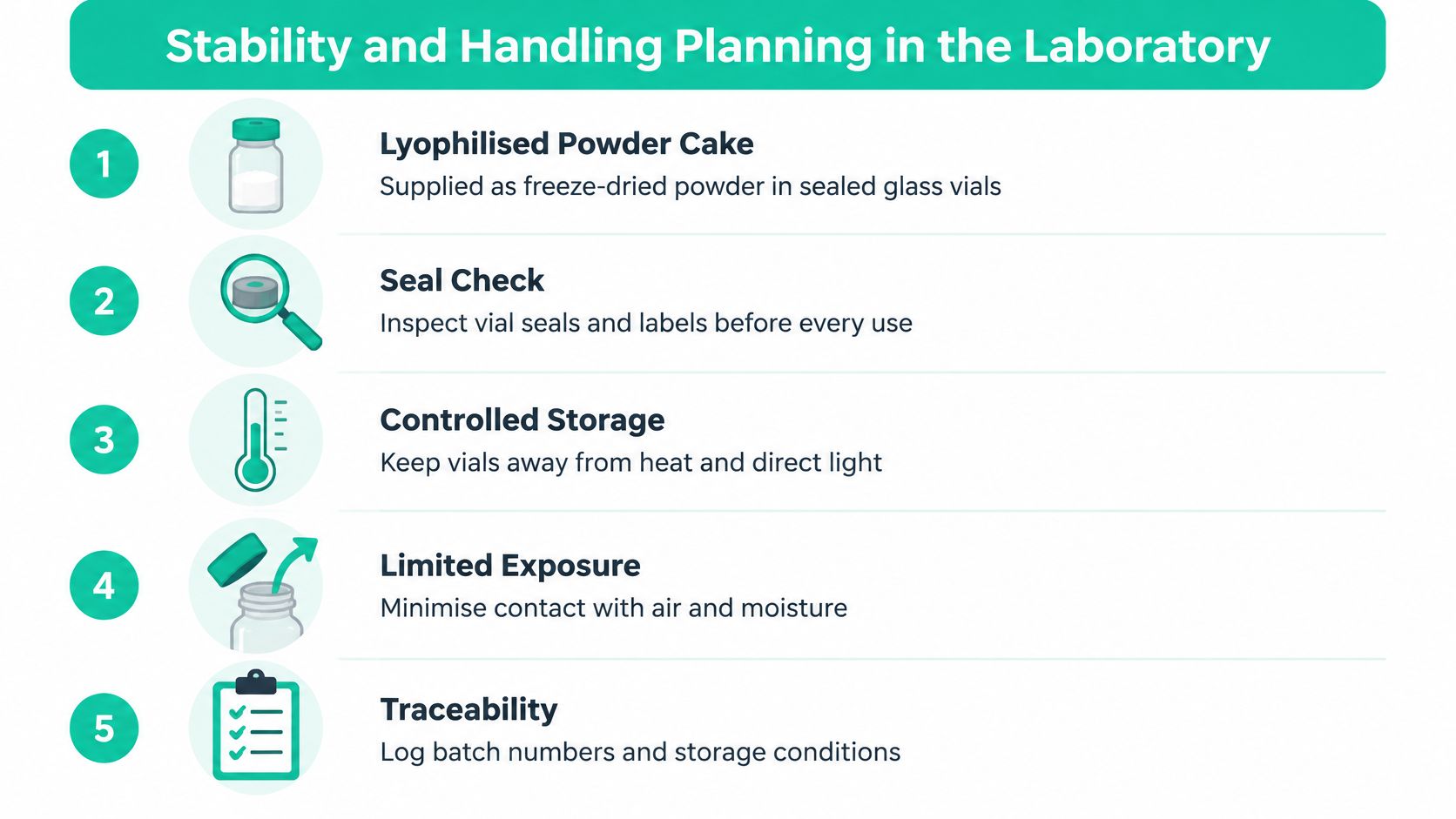
Similar-looking vials can carry different storage requirements. Treat handling conditions as a study design variable: the two compounds differ in half-life and pathway, so a protocol may hold one in active use longer than the other, and the handling record needs to cover that full period.
Confirm the supplied form and required conditions from each vial's product documentation before the material enters research stock. Use the product's handling guidance and available batch documentation to define storage conditions, and avoid assigning a generic shelf life or temperature range to both compounds because their packaging looks similar.
Create a receipt and storage record
The receiving officer should document the condition of the shipment before accepting it into research stock. Keep the original packaging information available for comparison with the purchase order and batch report.
Record:
- Storage temperature and location: Take the required conditions from the product documentation and identify the actual storage unit.
- Receipt date: Establish when the laboratory took custody so time in local storage is traceable.
- Batch and labelled expiry: Match the vial identifier to the Certificate of Analysis, and record the expiry information printed on the label.
- Light and moisture protection: Document the protective conditions specified for that material.
- First opening: Record when the vial was first opened so later observations can be related to its handling history.
Keep observations separate from stability claims
A visible change, damaged seal or unreadable label warrants a documented review. An unchanged appearance does not establish identity, purity or ongoing suitability.
If a storage unit operates outside its documented conditions, retain the temperature record and identify the affected stock. The laboratory should assess that deviation against the supplied guidance before releasing the material into an experiment. A documented excursion is manageable. An undocumented one contaminates every result that batch touches.
Don't extend a labelled expiry or declare a batch unaffected without supporting documentation. Traceability is the objective. A documented chain of custody carries more weight than how a vial looks.
A general peptide storage and stability reference can support handling terminology and early planning, and the peptide glossary explains terms such as lyophilised and identity. Neither replaces the compound-specific documentation supplied with each vial.
Frequently Asked Questions on CJC 1295 vs Ipamorelin
Approval and evidence
Are CJC-1295 and ipamorelin approved medicines in Australia?
No. Both are identified in Australian safety information as unapproved peptide products. They haven't been evaluated for safety, quality or effectiveness for general therapeutic supply.
Which compound has more published human evidence?
CJC-1295 has more clearly documented published human pharmacokinetic and endocrine evidence. Ipamorelin's published human evidence is comparatively limited, which restricts the strength of broader comparisons.
Can both compounds be included in a study?
A combined-pathway question remains a hypothesis rather than an established advantage. A defensible design needs appropriate separate comparators, matched conditions and endpoints that can distinguish the contributions being investigated.
Labelling and documentation
What does a research-use-only label establish?
It describes the product's stated research positioning. It doesn't, by itself, establish TGA approval, demonstrate human efficacy or replace institutional review of the proposed procurement.
How can I check that a vial matches its documentation?
Compare the vial's batch number with the batch Certificate of Analysis. Confirm the testing source, reported methods and test scope, and distinguish completed results from any pending documentation.
Matching Each Compound to Your Research Brief
Choose by the question the laboratory can answer, not by a general preference for longer or shorter activity. Scientific fit requires the receptor target, observation window and available controls to align.
The purchasing decision follows that assessment. A well-documented batch still won't rescue a design whose sampling schedule misses the expected response.
Research situation and better-fit compound
| Research question | Better-fit compound | Reason | Check before ordering |
|---|---|---|---|
| Sustained growth hormone and IGF-1 exposure over days | CJC-1295 | Extended exposure profile in published endocrine work | Batch COA and a sampling plan spanning the endpoint |
| Acute growth hormone pulse timing | Ipamorelin | Short-lived pulse profile | Batch COA and dense early observations |
| GHRH-pathway mechanism work | CJC-1295 | GHRH-receptor activity | Receptor-specific controls defined |
| Ghrelin-pathway work | Ipamorelin | Ghrelin-receptor activity | Receptor-specific controls defined |
| Side-by-side comparison within a shared design | Both, in separate arms | Distinct pathways and time courses | Matched conditions and predefined shared endpoints |
| Body composition or recovery claims | No established better fit | No validated comparative outcome or established combination advantage | Treat as an open hypothesis, not a performance claim |
Compare cost against the endpoint
Our ipamorelin listing is AUD $577.00 per 10-pack of 5 mg × 10 vials. That is a purchase specification, not a suggested experimental quantity.
Compare cost against the material required to answer the research question, including controls and repeat measurements. Per-vial price alone won't tell the team whether a study can produce an interpretable result within its budget.
Our Product Comparison Tool lets users select up to three research peptides side by side. Use it to compare specifications, then review the original batch documents before approving a purchase.
Turn the decision into a procurement request
A useful request should name the compound precisely, identify the intended endpoint and state which documents are necessary for acceptance. It should also distinguish mandatory requirements from questions still awaiting review.
Follow this sequence:
- Write the research question. Identify the receptor pathway or endocrine endpoint without assuming a broader outcome.
- Set the readout window. Confirm that the laboratory can observe the expected response adequately.
- Confirm documentation. Review identity, purity, relevant contaminant results and batch matching in the online library.
- Request a quote or Procurement Pack. Use our bulk and wholesale procurement pathway to confirm specifications, available documentation and institutional purchasing requirements.
The defensible verdict isn't that CJC-1295 or ipamorelin is universally better. It's that each can be relevant to a different, clearly bounded research question, provided the material and design match the evidence.
Bulk Aussie Peptides offers research-only peptides in standard bulk formats, with product specifications, an online COA Library and a Procurement Pack for document-led purchasing. Visit Bulk Aussie Peptides to review the available material and request a quote aligned with your receptor target, observation window and batch acceptance requirements. - BAP