
CJC and Ipamorelin Research: Mechanisms, Testing and Rules
CJC-1295 and ipamorelin are synthetic peptides studied for their combined effect on growth hormone signalling, and neither is TGA-approved for therapeutic use in Australia. The popular advice about CJC and ipamorelin often jumps straight from a hormone rise to promises about muscle, fat loss, recovery or sleep. That's the wrong order. A lab team needs to separate three things first: what each molecule does, what outcome was actually measured, and what a batch document can prove.
Table of Contents
- CJC and Ipamorelin at a Glance
- How the Peptides Act and What the Evidence Covers
- Study Design and Concentration Maths
- Reading a Certificate of Analysis for Identity and Purity
- Confirm Compliance Before You Order
- Frequently Asked Questions
CJC and Ipamorelin at a Glance
A quick comparison of this pair usually starts with price or purity percentages. Those are the last things worth checking. Regulatory status and compound identity come first, because a clean certificate of analysis says nothing about whether a peptide may legally be held or supplied. Use the table below as your baseline.
| Attribute | CJC-1295 | Ipamorelin |
|---|---|---|
| Compound class | Growth-hormone-releasing-hormone (GHRH) analogue | Growth hormone secretagogue |
| Receptor target | GHRH receptor on pituitary somatotroph cells | Ghrelin receptor (GHS-R1a) |
| Variant notes | Studied with or without DAC modification; DAC extends duration in models | Single standard form in most research listings |
| Australian TGA status | Not approved; identified as an unapproved peptide product | Not approved; no ARTG entry |
| WADA status | Prohibited | Prohibited |
Healthy Male's evidence summary on CJC-1295 and ipamorelin reports that neither compound appears as an approved medicine on the Australian Register of Therapeutic Goods, that the TGA specifically names CJC-1295 as an example of an unapproved peptide product, and that both are prohibited under World Anti-Doping Agency rules. Online availability isn't approval.
Scheduling is a separate question from registration, and the TGA identifies both compounds as Schedule 4 controlled substances. Confirm the current Poisons Standard instrument before procurement rather than relying on a supplier's wording, because a batch document describes the material in the vial while scheduling law describes who may handle it. If terms like somatotroph, secretagogue or ARTG are unfamiliar, check them in our research peptide glossary before reading further.
How the Peptides Act and What the Evidence Covers
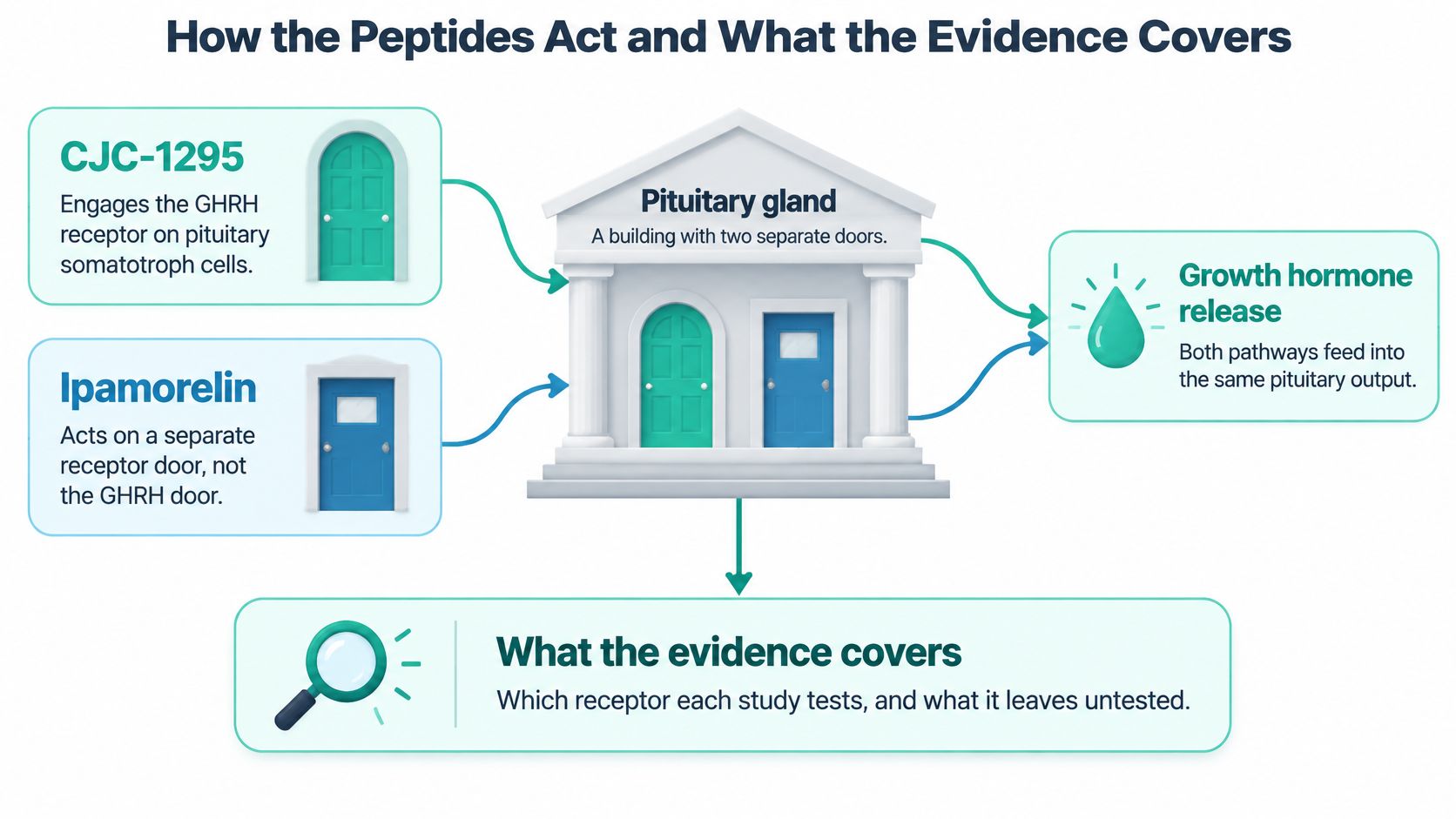
The pituitary gland works like a building with two separate doors. CJC-1295 acts at the GHRH receptor door on pituitary somatotroph cells. Ipamorelin uses a different door, the ghrelin receptor, also called GHS-R1a. Both routes can bias the pituitary toward pulsed growth hormone release, and that signal can raise IGF-1 in the liver and other tissues.
Why they are not duplicates
The pairing is complementary upstream signalling. CJC-1295 is described as a long-acting growth-hormone-releasing-hormone analogue, while ipamorelin is a ghrelin-pathway secretagogue. The TGA guidance on unapproved peptide responsibilities sets the compliance frame for unapproved peptide products; it answers a status question, separate from whether either peptide changes tissue, performance or recovery. Keep those questions apart: mechanism predicts a hormone pulse, a biomarker confirms the pulse occurred, and an outcome study tests whether people felt or functioned better.
For receptor context outside this pair, our GHRP-2 research overview maps another secretagogue pathway. It helps with comparison, and it cannot substitute for evidence on CJC-1295 plus ipamorelin.
A stronger hormone signal shows the axis responded; tissue change has to be shown separately.
What early human research covered
Early CJC-1295 work in healthy adults measured short-term, dose-dependent growth hormone and IGF-1 responses, pharmacokinetics and short-term safety. The FDA submission attachment reviewing CJC-1295 human data lists reported reactions such as injection-site effects, headache, nausea, diarrhoea, flushing, oedema, fatigue and musculoskeletal pain. It centres hormone levels and tolerability, leaving muscle gain, fat loss, recovery, sleep, performance and long-term safety outside the demonstrated result.
That gap covers the combination too. Long-term effects of unapproved peptides are insufficiently studied, and purity can vary between products, so a catalogue page or a vial label never answers the evidence question by itself.
A credible study therefore answers three separate questions:
- Biomarker change: Does each peptide change growth hormone or IGF-1?
- Outcome change: Does the combination improve a patient-important outcome?
- Repeated exposure: Do benefits outweigh risks over time?
Plausible monitoring issues include glucose effects, fluid retention, headaches, cardiovascular symptoms, and pituitary or thyroid disorders. Treat them as watch items to prespecify, with increased GH or IGF-1 read as a pharmacological signal rather than proof of benefit.
Study Design and Concentration Maths
Start with design, not arithmetic. A credible combined-peptide study predefines sampling times, validated analytical methods, inclusion and exclusion criteria, adverse-event monitoring, stopping rules, and documented ethics approval for human or animal work as applicable. Our research methodology guide helps teams structure those decisions before material arrives.
| Endpoint | What it shows | Typical assay |
|---|---|---|
| Pulsatile growth hormone | Pattern and timing of GH release | Serial sampling with immunoassay |
| IGF-1 | Downstream response of the GH axis | Immunoassay on timed samples |
| Glucose | Metabolic response to the signal | Enzymatic glucose assay |
| Insulin | Pancreatic and metabolic response | Insulin immunoassay |
| Reconstituted stability | Degradation of the solution over time | HPLC at timed intervals |
Concentration as a unit idea
Concentration in mg/mL equals net peptide mass divided by final volume. Think of salt in soup. The same salt in more water tastes weaker. The same peptide mass in more diluent gives a weaker solution.
The edge case matters. Net peptide content on a certificate is often lower than the gross weight of the freeze-dried cake, which also contains salts, water and counter-ions. Use the stated net content, not the label weight. All preparation, including diluent choice and volume, follows your lab's own SOP. Our website provides a reconstitution calculator, peptide glossary, COA library, product finder, and product comparisons, but a calculator only checks sums. It doesn't replace the protocol. Record the calculation, batch number and date in the study file.
Reading a Certificate of Analysis for Identity and Purity
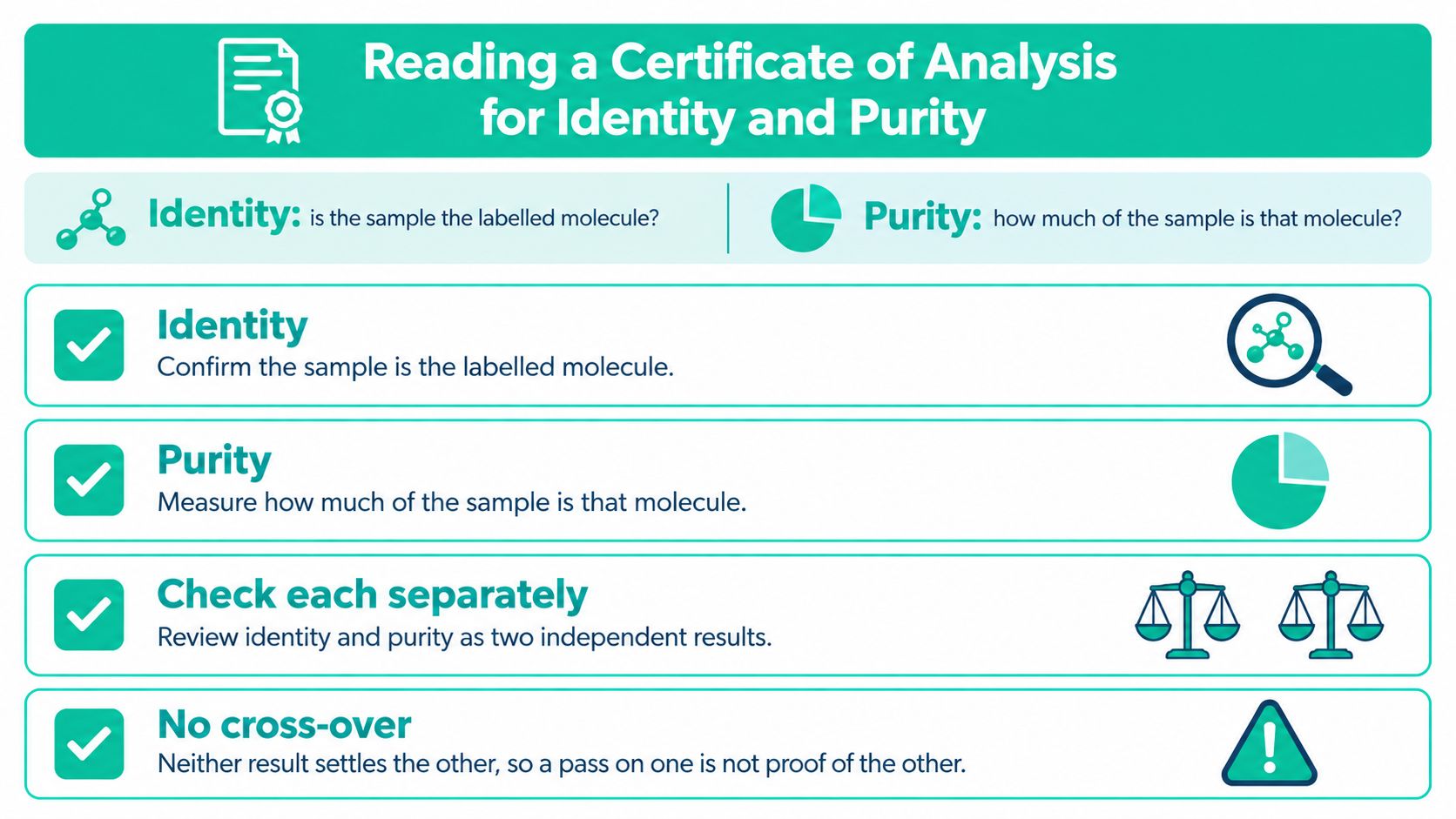
A certificate of analysis answers two separate questions. Identity asks whether the sample is the labelled molecule. Purity asks how much of the sample is that molecule. A vial can show high purity and still contain the wrong compound entirely, so review the two results independently before accepting either.
The checklist below frames that split for a first-pass review.
Australian provider PepScan's peptide analysis service describes HPLC as the method used to quantify purity and mass spectrometry as the method used to confirm molecular identity, including testing for identity, purity and per-vial content for CJC-1295/ipamorelin blends in a laboratory operating to ISO/IEC 17025 requirements.
| Field | What it proves | Red flag |
|---|---|---|
| Compound name and DAC or non-DAC designation | Which molecule was tested | Generic name only, no variant stated |
| Batch number | Links the document to the exact vial | Missing, or does not match the label |
| Test date and laboratory identity | Currency and independence of the result | No laboratory named, or supplier-only source |
| Mass spectrometry result | Molecular mass matches the labelled peptide | No identity result provided |
| HPLC purity | Share of the main peak | Percentage given with no method or chromatogram |
| Net content per vial | Peptide quantity, not gross powder weight | Only gross weight stated |
| Stated accreditation | Quality system of the testing lab | Accreditation claimed but not named |
Now match the document to the vial in hand. The certificate's product name and batch number must match the label you receive, and the compound name should state which variant was tested. A batch-matched document carries more weight than a general catalogue claim. Bulk Aussie Peptides maintains a COA library for batch review, with documentation sources labelled as manufacturer-provided or independent laboratory.
One boundary matters here. A certificate speaks only to what is in the vial. It says nothing about therapeutic effect and nothing about regulatory standing, which are separate questions with separate evidence.
This short video walks through reading testing documents without treating them as therapeutic approval.
Confirm Compliance Before You Order
A certificate answers one question: what is in this batch. Regulatory status answers another: whether Australian law treats the product as an approved therapeutic good. The TGA scheduling materials on growth hormone releasing peptides place CJC-1295 and ipamorelin among growth-hormone-releasing peptides under Schedule 4 controls and describe products containing CJC-1295 as potentially unapproved therapeutic goods when they are not entered in the ARTG. Unapproved products have not been evaluated for safety, quality or effectiveness.
Treat the paperwork as separate gates. A COA can support identity and purity review for research material. It cannot confer ARTG approval, authorise human administration, or turn a biomarker result in a study into a proven clinical outcome. Importing, compounding, manufacturing, advertising or supplying unapproved peptide products can engage obligations under the Therapeutic Goods Act 1989. Online listings can also describe identity or quantity loosely, so verify the file, the batch and the purpose rather than trusting label strength. Read the Australian research peptide regulation guide before procurement is approved.
Pre-order checklist
- Confirm authority: Record institutional approval, research-use-only classification and who is accountable for the material.
- Define the endpoint: State whether the protocol measures a signal such as GH or IGF-1, or a functional outcome, and keep regulatory claims out of the protocol.
- Trace the batch: Require batch verification and certificate access before purchase, then store the document with the receiving record.
- Check criteria: Confirm identity, purity and net content meet your protocol thresholds before acceptance.
- Prepare finance records: Capture supplier ABN details and procurement approval in the order file.
- Set handling rules: Define storage, access and disposal under your lab SOP.
For local supply context, Bulk Aussie Peptides is Australian owned and operated, trades as PMA with ABN 21 102 515 841, lists ipamorelin at AUD $577 per 10-pack of 5 mg x 10 vials, provides domestic order processing with Australia-wide delivery, and offers a COA Library for batch review.
Frequently Asked Questions
Are CJC-1295 and ipamorelin approved medicines in Australia
No. Neither appears on the Australian Register of Therapeutic Goods, and the TGA identifies CJC-1295 as an unapproved peptide product. Research-use-only supply is a separate question from therapeutic approval, so a supplier listing them says nothing about their status as medicines.
Does a certificate of analysis make a peptide approved or safe for people
No. A certificate supports identity and purity review of a specific batch. It doesn't replace TGA evaluation of safety, quality or efficacy, and it answers a different question entirely: what is in the vial, not whether people should take it.
Do studies show these peptides build muscle or speed recovery
Early human research measured growth hormone and IGF-1 levels, which are biomarker signals. It didn't assess muscle gain, fat loss, recovery or performance outcomes, so a rise in the signal can't be read as a proven result.
Why do scheduling sources differ
Listings and descriptions have changed over time, and older references often circulate unchanged. Check the current scheduling instrument and your state controls before any procurement decision.
For research teams comparing CJC and ipamorelin supply, we offer Australian-based 10-pack formats, batch documentation through our lab library, and GST invoices for procurement files. Visit Bulk Aussie Peptides to review product specifications and matching certificates before you order.