
Peptides Explained: A Research Guide for Australian Labs
A peptide is a short chain of amino acids joined by peptide bonds, and longer chains are generally called proteins. If a laboratory report confirms a peptide's identity, does that also prove it's safe or legally approved?
That's the gap worth understanding. Peptides describe a broad family of molecules, not a single treatment, research purpose or regulatory category.
Table of Contents
- What a Peptide Is and How It Is Built
- Peptide Classes at a Glance
- Five Research Areas Peptides Are Studied In
- Where the Legal Line Sits for Peptides in Australia
- Reading a Certificate of Analysis Line by Line
- Storing Lyophilised Peptides Safely in the Lab
- Choose a Supplier That Shows Its Documents Before You Order
- Frequently Asked Questions
What a Peptide Is and How It Is Built
Think of amino acids as letters and a peptide as a word. The sequence matters: changing a letter can change the meaning, just as changing an amino acid can change a molecule's behaviour.
Dipeptides contain two amino acids, tripeptides contain three, oligopeptides are short chains, and polypeptides are longer chains. Glutathione is a tripeptide; oxytocin contains nine amino acids. These names describe chain length, not evidence of benefit.
The diagram illustrates how researchers record a sequence.
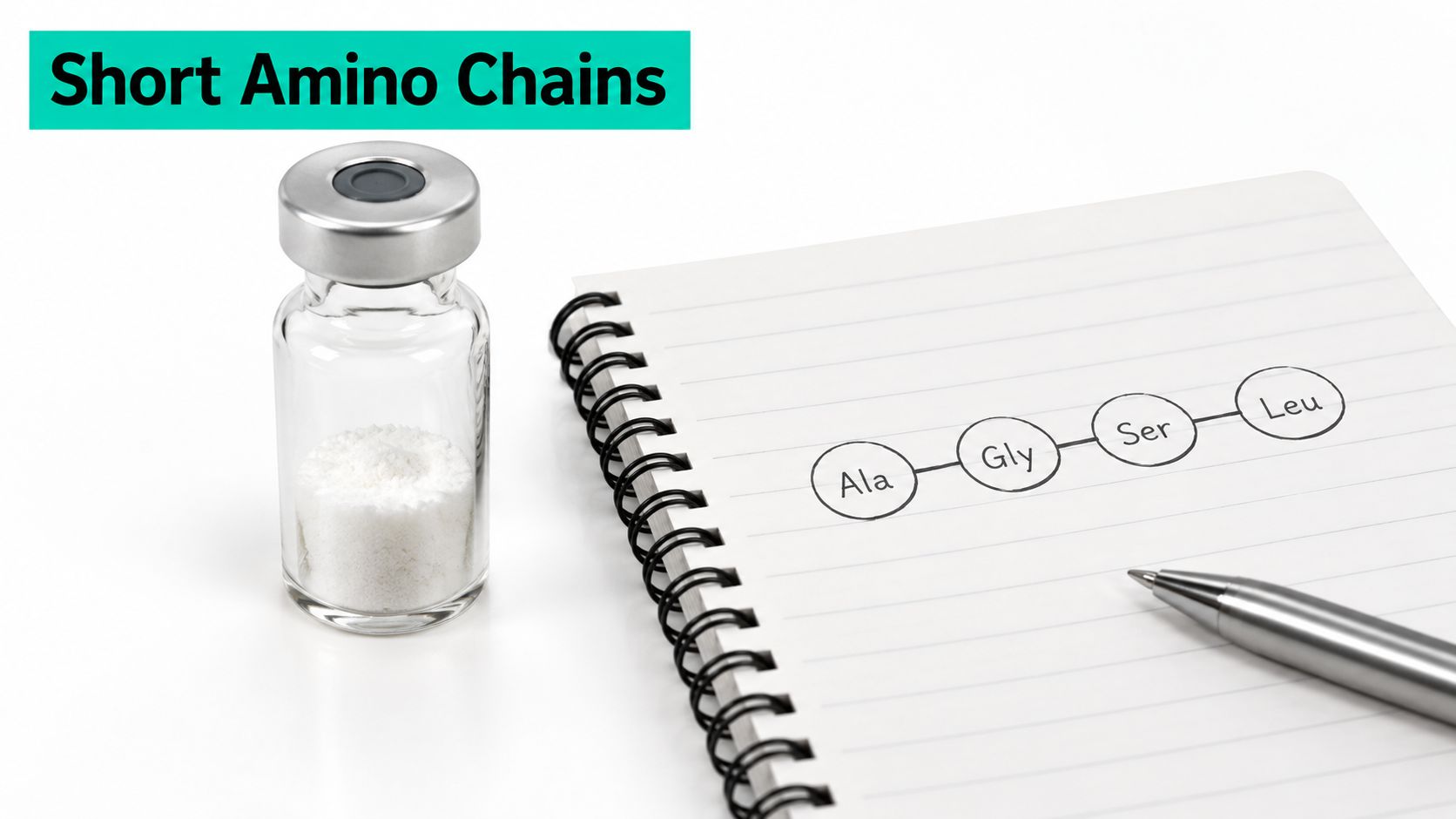
Peptides occur naturally as hormones and signalling molecules. Research materials are often synthetic, assembled step by step in a laboratory. Researchers verify sequence, length and purity, rather than relying on a familiar compound name alone.
Peptide Classes at a Glance
Peptide classes by origin and defining feature
| Class | What defines it | Example |
|---|---|---|
| Hormone peptides | Signalling molecules made by the body | Insulin, GLP-1 |
| Neuropeptides | Released by nerve cells to signal in the brain and nervous system | Oxytocin |
| Antimicrobial peptides | Part of innate immune defence in many organisms | LL-37 |
| Collagen peptides | Short fragments produced when collagen is broken down | Hydrolysed collagen |
| Synthetic research peptides | Sequences built by chemical synthesis and supplied as research materials | BPC-157, GHK-Cu, TB-500 |
These categories describe origin, structure or biological role, not a promised outcome. They can overlap: a synthetic sequence may copy a naturally occurring hormone, while remaining a separately manufactured material.
Classification isn't authorisation. A peptide's class says nothing by itself about its regulatory status in Australia.
Five Research Areas Peptides Are Studied In
Research questions must be separated from demonstrated outcomes. This concept map outlines common areas, but evidence must be assessed compound by compound.
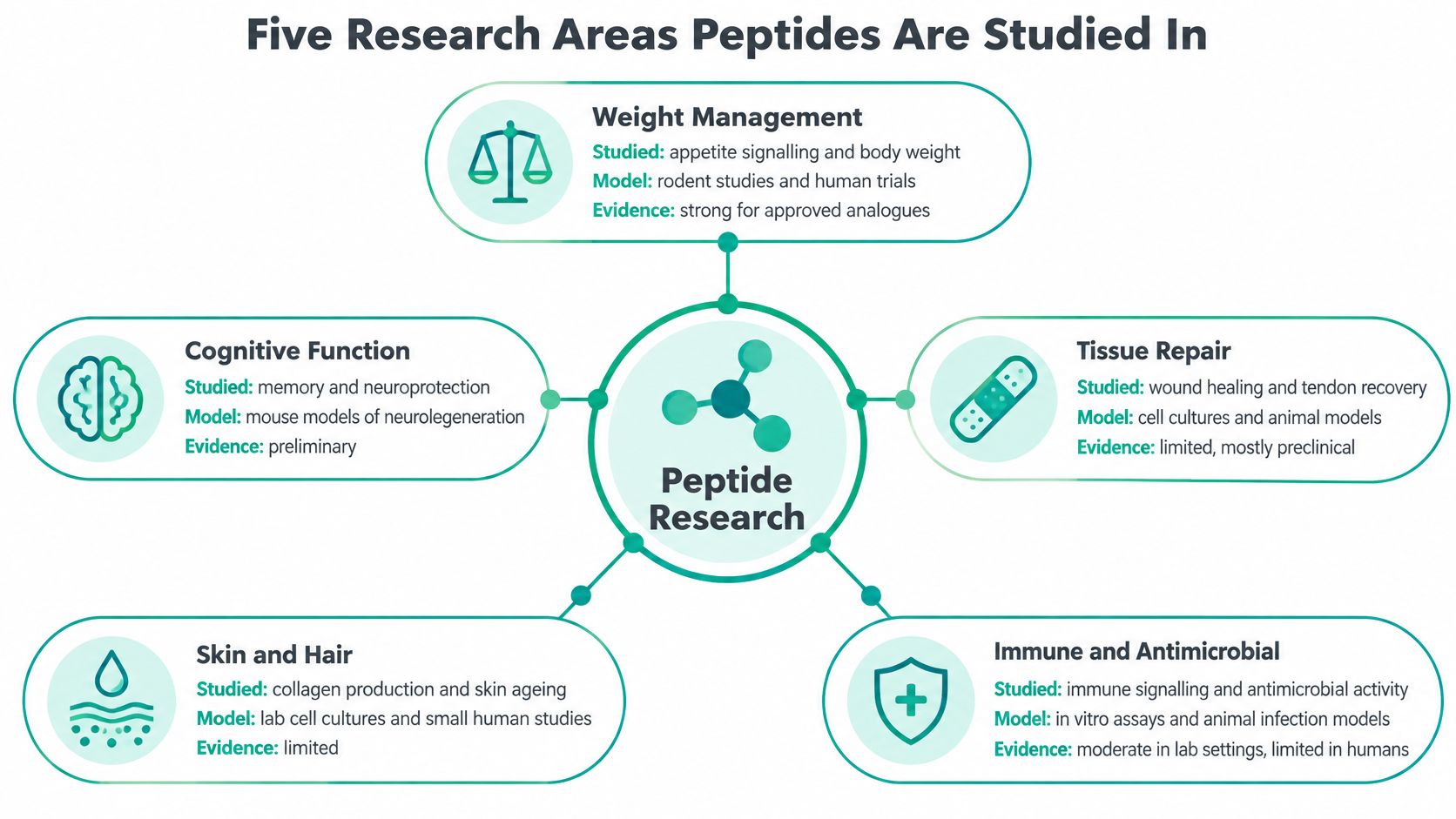
- Weight management: Research has examined appetite signalling and glucose metabolism using incretin-related compounds, including semaglutide, tirzepatide and retatrutide, in preclinical models and clinical trials. Their approval status isn't interchangeable. The TGA's compounded-medicines guidance identifies semaglutide, tirzepatide and liraglutide as synthetic GLP-1 analogues, with approved versions being prescription-only medicines.
- Recovery and injury: Research has examined BPC-157 and TB-500 in tissue and cell models, largely animal studies. This is predominantly preclinical evidence.
- Longevity: Cell-culture and animal research has examined cellular ageing and senescence markers, not established lifespan outcomes in people.
- Skin, hair and nails: Research has examined GHK-Cu in skin and wound-healing models. Findings shouldn't be extended automatically to hair or nail outcomes.
- Neuroscience: Animal studies have examined oxytocin and receptor signalling in social behaviour and brain function. Model findings aren't guaranteed human effects.
Keep research endpoints separate from claims
The TGA's therapeutic peptide guidance explains that presentation and promotion can affect regulatory classification. Research documentation should therefore describe the material, not promise physiological results.
Use the research compound database to locate compound information and review specifications. This accompanying video provides another introduction to the topic.
Where the Legal Line Sits for Peptides in Australia
A peptide can be regulated as a therapeutic good when its ingredients, presentation, promotion, supply or intended purpose involve therapeutic or physiological claims. A research-use-only label doesn't cancel those considerations.
Distinguish these groups:
- ARTG-listed medicines: Approved products, including insulin and prescription semaglutide, have product-specific regulatory status.
- Compounded products: Under the affected Schedule 5, item 6 pathway, pharmacists can no longer compound and supply GLP-1 receptor agonist products made on or after 1 October 2024, according to the TGA's compounding compliance notice.
- Unapproved compounds: Online availability doesn't establish approval, quality or effectiveness, as the TGA's peptide products overview explains.
These distinctions matter in a substantial market: approximately 8% of NSW adults self-reported current GLP-1 medicine use in the 2025 survey, according to NSW Health.
Use this checklist to distinguish documentation from authorisation.
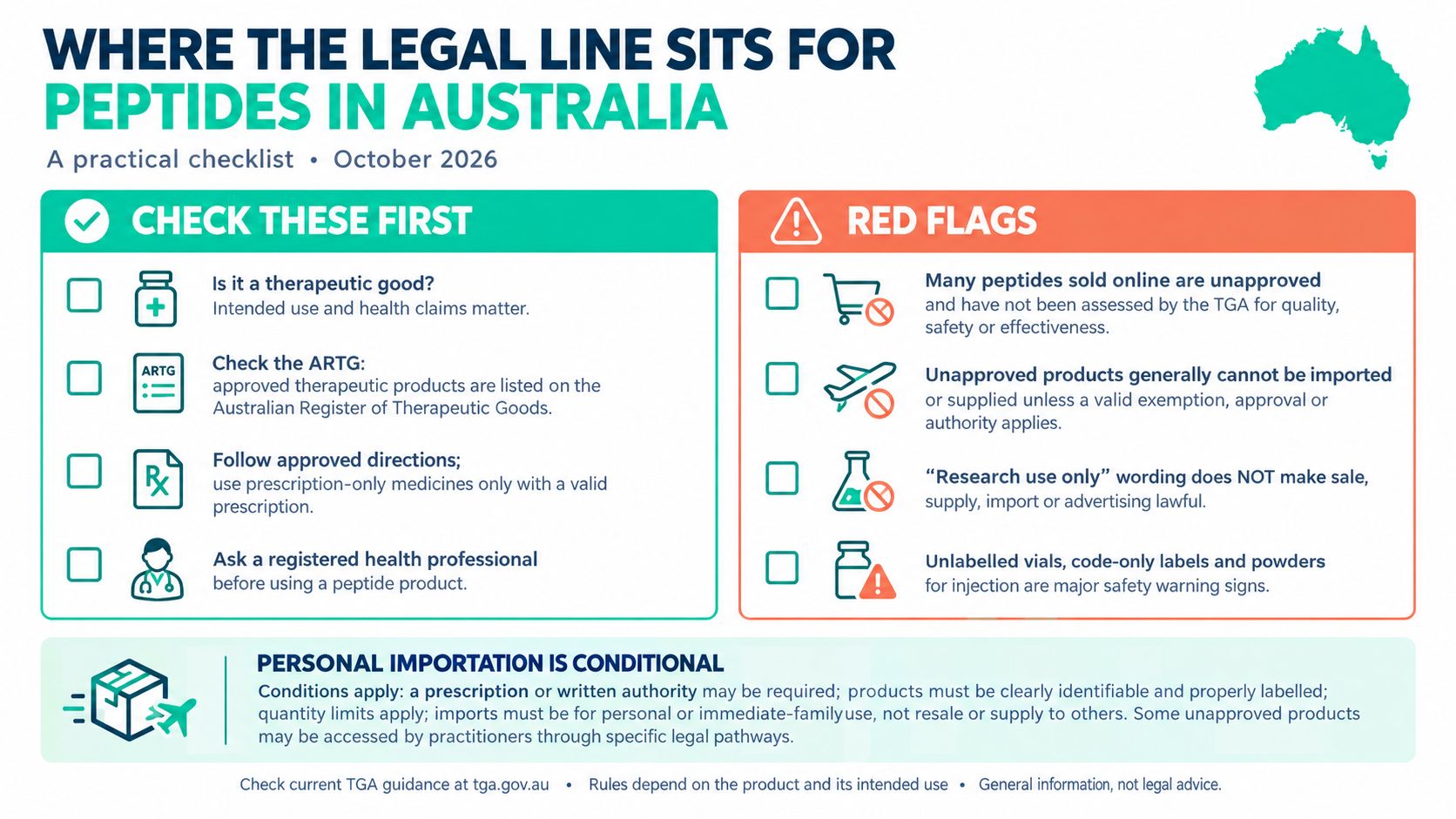
Common assumptions to reject
- A COA proves safety: It reports selected analytical results.
- Research-only means lawful for anything: Intended purpose and promotion still matter.
- Popular means approved: Sales visibility isn't regulatory assessment.
- All peptides share one status: Classification is product-specific.
Institutional teams should separate identity, purity, storage and chain-of-custody records from therapeutic questions. Our Australian peptide regulation guide supports that review. This is general information, not legal advice.
Reading a Certificate of Analysis Line by Line
A Certificate of Analysis, or COA, is a batch-specific laboratory report. Ask which batch was tested, which laboratory tested it, and what was measured. Both the product name and batch number must match.
What each COA item can and cannot show
| Document item | What it can show | What it cannot show |
|---|---|---|
| Identity result, such as mass spectrometry or HPLC retention | Evidence consistent with the expected molecule | Sterility or suitability for injection |
| Purity result, HPLC percentage | Target peptide's share of the measured signal | Contaminants outside the method or stability over time |
| Batch or lot number | Connection to a production run | Quality of other batches |
| Testing laboratory and independence | Whether the laboratory is separate from the manufacturer | Whether the method supports every claim |
| Sample traceability | Which sample was tested | Direct results for untested vials |
Purity isn't a safety score. Check methods, acceptance criteria and sample traceability; identity methods also have limits and may require complementary testing.
A routine COA doesn't establish endotoxin control, stability after preparation, clinical efficacy or lawful human use. The TGA's unapproved-peptide safety alert states that unapproved products haven't been assessed for safety, quality or effectiveness and reports severe allergic reactions requiring hospitalisation and systemic inflammatory response syndrome.
Our online COA library holds independent laboratory certificates linked from product pages; pending records are marked in testing.
Storing Lyophilised Peptides Safely in the Lab
Lyophilised means freeze-dried. A sealed glass vial helps protect the powder cake, but it doesn't replace compound-specific storage requirements.
- Follow the specification: Use the storage conditions stated for that material.
- Keep vials sealed: Limit exposure to moisture and oxygen until the material is needed.
- Avoid temperature swings: Maintain consistent conditions and protect against light.
- Maintain a stock log: Record batch numbers, receipt dates and opening dates.
Dry material is generally more stable than a prepared solution, but the specification sheet governs. Consult our peptide storage and stability guide and Peptide Glossary for terminology.
Preparation, solvent choice and dilution belong to the approved study protocol and institutional standard operating procedure, not a product page.
Choose a Supplier That Shows Its Documents Before You Order
A certificate posted on a website proves one thing: a specific sample passed the specific tests listed on that document. It cannot prove the purity of an untested batch, safety in any model, or lawful status. Treat supply as a procurement decision and check:
- Positioning: Research-use-only labelling without therapeutic promises.
- Documentation: Batch-matched certificates naming the manufacturer or independent laboratory that ran the analysis.
- Packaging and format: Sealed glass vials in the pack size your study requires.
- Administration: Bulk quotes, request documentation and traceable delivery.
Bulk Aussie Peptides supplies Australian laboratories, universities and qualified researchers. The catalogue covers 60+ research peptides, most supplied as lyophilised powder in sealed 10-vial packs, with some single-vial trial sizes and transparent AUD pricing. Batch certificates are listed in the COA library, with pending records marked as in testing.
Orders are typically dispatched within 1–3 business days across Australia, with shipment tracking and stated delivery windows. Domestic support and documentation help procurement teams coordinate orders.
Before committing funds, work through the Australian research peptide supplier evaluation guide, compare candidates side by side with the Product Comparison Tool and request a Procurement Pack. Research-use-only positioning applies across the site.
Frequently Asked Questions
Does a certificate of analysis prove a peptide is safe?
No. A certificate supports specific analytical conclusions about the sample that was tested, such as its identity and purity at the time of the test. It says nothing about how the compound behaves in a living system, and a clean result for one vial does not certify every vial in the pack.
Does research use only make a product lawful?
Not by itself. A label describes intended use, and regulators look at how a product is really presented and promoted. Where a listing or its marketing makes therapeutic claims, the therapeutic goods framework applies regardless of the disclaimer printed on the vial.
Are all peptides regulated the same way?
No. Approved medicines, compounded products and unapproved compounds each sit under different regulatory checks, so the questions a buyer should ask change with the category. Treating them as one group is where compliance mistakes tend to start.
How should a laboratory plan for delivery?
Use the tracked estimate as a planning figure, not a promise. Allow scheduling contingency and avoid committing an experiment to an unconfirmed arrival date, since a stalled shipment should inconvenience a timetable rather than ruin a study.
This is general educational information, not medical or legal advice.
Bulk Aussie Peptides offers research-only materials, batch documentation and institutional procurement support. Visit Bulk Aussie Peptides to review specifications and request a Procurement Pack before ordering.