
Collagen and Peptides: A Research-Grade Reference

In laboratory terms, collagen peptides are hydrolysed collagen fragments, not intact collagen and not a single defined synthetic peptide. In Australia, collagen has already become a meaningful ingredient category: one market report described the local market as 90.4 tonnes in 2021 with 4% CAGR from 2016 to 2021, and another estimated USD 223.4 million in 2025 with projected growth to USD 353.2 million by 2034 at 5.07% CAGR (Australia collagen market research report).
That growth has created a familiar problem for Australian buyers. Many discussions about collagen and peptides still use consumer language such as “beauty”, “recovery”, or “anti-ageing”, but those labels don't tell a researcher what the material is. At the bench, the useful questions are narrower and more testable: what is the molecular weight distribution, what amino acid markers confirm collagen origin, what impurities have been screened, and can the lot be traced across the study?
For postgraduate researchers, lab managers, procurement officers, and CRO teams, that distinction matters. A hydrolysed collagen mixture for fibroblast work isn't interchangeable with intact native collagen for scaffold formation, and neither is equivalent to a single-sequence synthetic peptide used for receptor or signalling studies.
Bench perspective: if the documentation can't tell you what fraction size range you're buying, what the amino acid profile looks like, and which lot the data belongs to, you're not evaluating a reagent. You're evaluating marketing copy.
Products are supplied strictly for laboratory research purposes only. They are not for human consumption, therapeutic use or diagnostic procedures.
Table of Contents
- What Collagen and Peptides Mean at the Bench
- Hydrolysed Collagen Peptides Versus Bioactive Synthetic Peptides
- Research Evidence Across Skin, Joints, Metabolism, and Regeneration
- Assays and Analytical Tests That Define Quality
- Pack Formats, Reconstitution Mathematics, and Storage Principles
- Procurement and Documentation for Australian Research Buyers
- Research-Use-Only Positioning and Practical Next Steps
What Collagen and Peptides Mean at the Bench
The first source of confusion is terminology. Collagen is a structural protein. In biological systems it forms ordered assemblies that support tissue architecture. Peptides are a broader chemical class. They're shorter amino acid chains linked by peptide bonds, and they can range from small oligopeptides to longer polypeptides and fully synthetic research sequences.
Why collagen peptides are not just “small collagen”
In practical laboratory use, collagen peptides usually means hydrolysed collagen. That wording matters. A recent review notes that in research and regulatory contexts collagen peptides are generally described as hydrolysed collagen, and an Australian Therapeutic Goods Administration entry lists a collagen peptides ingredient as hydrolysed collagen rather than as a separate raw material class (review discussing collagen peptides as hydrolysed collagen).
Hydrolysis breaks native collagen into smaller fragments. Depending on process control, the result is not one molecule but a mixture of peptide fragments. That's why a serious laboratory specification focuses on distribution, not just a label claim. A vial marked “collagen peptides” without supporting analytical context tells you very little.
Three identifiers are more informative than branding language:
- Molecular weight distribution tells you whether the lot is predominantly low molecular weight peptide material or contains broader, less controlled fragments.
- Amino acid composition helps confirm that the hydrolysate is collagen-derived rather than generic protein material.
- Hydroxyproline presence is especially useful because it's strongly associated with collagen character.
For terminology that often appears on certificates and product sheets, a peptide research glossary is useful for aligning procurement language with bench use.
What a researcher actually observes
A bench scientist won't “see” collagen chemistry directly. You see its consequences.
With a well-characterised hydrolysed preparation, you'd usually expect:
- High aqueous dispersibility or solubility relative to intact collagen
- Less handling friction during stock preparation
- A specification sheet built around analytical fields, not wellness claims
- Batch-to-batch comparability that can be checked against a certificate of analysis
By contrast, the phrase “peptides” alone is too broad to guide an experiment. It could refer to a collagen hydrolysate mixture, a copper-binding peptide complex, a synthetic signalling fragment, or a reagent designed for completely unrelated targets.
A useful working rule is simple. If the study needs a matrix-derived mixed hydrolysate, ask for collagen peptides. If it needs sequence-level mechanistic precision, ask for a defined synthetic peptide.
Hydrolysed Collagen Peptides Versus Bioactive Synthetic Peptides
Researchers often place three different reagent classes under the same conversational umbrella. At the bench, they behave differently and answer different questions.
The three categories that matter
Intact collagen is the structural parent material. It retains much more of the original protein architecture and is commonly selected when the experiment depends on matrix formation, gel behaviour, or scaffold fabrication.
Hydrolysed collagen peptides are processed fragments of collagen. They're usually handled as a water-soluble or readily dispersible powder mixture. Because they're heterogeneous, they're better thought of as a characterised peptide population than as a single compound.
Synthetic bioactive peptides are different again. These are deliberately defined sequences, often designed or selected for signalling, binding, transport, or motif-driven mechanistic studies. In these materials, primary sequence identity is the point.
Collagen forms and experimental comparison
| Property | Intact Collagen | Hydrolysed Collagen Peptides | Synthetic Bioactive Peptides |
|---|---|---|---|
| Structural state | Largely preserved protein architecture | Fragmented hydrolysate mixture | Single defined peptide sequence or tightly defined sequence set |
| Typical physical behaviour | Often less convenient for simple aqueous handling | Usually easier to dissolve or disperse | Depends on sequence chemistry and counterion form |
| Molecular definition | Parent structural protein | Distribution of fragment sizes | Exact primary structure is expected |
| Main analytical concern | Structural integrity and matrix behaviour | Molecular weight distribution and amino acid profile | Identity, purity, and sequence verification |
| Experimental role | Scaffold, coating, biomaterial, matrix studies | Cell supplementation, comparative hydrolysate studies, oral intervention literature | Mechanistic signalling, receptor, motif, and pathway work |
| Batch interpretation | Focus on source and integrity | Focus on hydrolysis control and lot consistency | Focus on sequence fidelity and impurity profile |
Choosing the right class for the experiment
If the assay asks whether a collagen-derived hydrolysate changes fibroblast behaviour, an intact collagen scaffold may be the wrong tool because matrix physics and peptide signalling become confounded. If the experiment asks whether a specific motif activates a pathway, a heterogeneous hydrolysate may be too broad because you can't assign the effect to a defined sequence.
Supplier language often causes trouble. Consumer markets blur “collagen” and “peptides” because the distinction is commercially convenient. Bench work can't. Australian sport-science and nutrition-facing research resources treat collagen-derived bioactive peptides as a legitimate topic linked to tissue biology and matrix protein synthesis, which supports using precise reagent class definitions from the outset (Australian Sports Commission collagen-support references).
Selection rule: choose intact collagen when you need matrix structure, hydrolysed collagen peptides when you need a collagen-derived fragment mixture, and synthetic peptides when your hypothesis depends on sequence-specific causality.
Research Evidence Across Skin, Joints, Metabolism, and Regeneration
Most human clinical work doesn't study collagen peptides as laboratory reagents. It studies them as oral nutritional interventions. That distinction matters because it limits what you can infer for cell systems, tissue engineering, or comparative reagent selection.
A PubMed-indexed systematic review and meta-analysis reported that oral collagen peptides have been investigated for skin rejuvenation outcomes, while other human studies have examined endpoints such as pain, function, hydration, elasticity, and fat mass (PubMed-indexed review of oral collagen peptide studies). That tells you where the literature is concentrated. It doesn't automatically validate every mechanistic claim made for bench applications.
Skin and joint research
In skin research, investigators have studied collagen-derived materials in cell culture models involving fibroblasts and extracellular matrix markers. Human literature more often looks at visible or functional skin endpoints over time, rather than direct tissue sampling. The Australian-facing evidence base remains cautious. Recent commentary from UNSW notes that many peptide anti-ageing claims still lack high-quality human evidence and that existing studies are often small or short-term (UNSW discussion of peptide anti-ageing evidence).
That caution is useful for laboratory buyers because skin-facing product language often sounds far more certain than the evidence is.
For joint and tendon contexts, there is at least one technically useful Australian example. A University of Canberra pilot trial in chronic Achilles tendinopathy used 2.5 g specific collagen peptides twice daily for 3 months, taken 30 minutes before exercise, in a double-blind placebo-controlled crossover design (University of Canberra pilot trial). The point for researchers isn't to replicate human use. It's that the protocol tried to isolate timing and dose as experimental variables rather than treating collagen as an undifferentiated supplement category.
Metabolic and regenerative contexts
The evidence in metabolic research is more mixed and often indirect. Researchers have explored circulating collagen-derived peptide fragments and downstream physiological endpoints, but these studies don't convert neatly into a reagent selection rule for bench assays. A hydrolysate used in nutritional intervention work may still be too poorly defined for mechanistic pathway studies unless the lot is analytically characterised.
In regenerative and biomaterials work, the literature broadens again. Researchers use collagen-derived materials in scaffold design, hydrogel systems, wound-healing models, and extracellular matrix studies. In Australia, meat-sector R&D has shown that underutilised red-meat by-products can serve as a domestic feedstock source. An AMPC-funded project demonstrated the feasibility of extracting functional collagen-based biomaterials from sheep skin and lung tissue, which is relevant for traceable Australian supply-chain thinking in laboratory or industrial settings (AMPC collagen biomaterials report).
A separate practical issue is effect size and study duration. Recent research on oral collagen and peptides points to a more nuanced picture, where benefits, when observed, are usually measured across 8 to 12 weeks and are commonly described as small-to-moderate, which makes documentation and dose standardisation especially important in R&D settings (Frontiers review on oral collagen and peptide evidence).
A cautious reading of the literature
- In vitro evidence can support mechanism, but not human efficacy.
- Animal or preclinical work can suggest biological plausibility, but not procurement adequacy.
- Human intervention studies often involve oral formulations, not research-grade assay reagents.
- Marketing language usually collapses these categories. Researchers shouldn't.
Assays and Analytical Tests That Define Quality
If you're buying collagen peptides as a reagent, the certificate of analysis isn't an attachment to skim after purchase. It's part of the purchasing decision.
What the core assays actually tell you
The most useful starting point is SEC/GPC. Size-exclusion chromatography or gel permeation chromatography characterises molecular weight distribution. For a hydrolysed collagen product, this answers a central question: are you looking at a low molecular weight peptide population, or a broad mixture that still contains larger fragments than the application tolerates?
The second anchor is quantitative amino acid profiling, usually by UPLC or HPLC. This doesn't just confirm protein presence. It helps you assess whether the profile is consistent with collagen-derived material, particularly when glycine, proline, and hydroxyproline markers are expected. If those markers are absent, weak, or undocumented, you should ask why.
Third comes ICP-MS heavy metal screening. This matters less for label aesthetics than for assay reliability. Trace metal contamination can alter baseline behaviour in sensitive cell systems and can confound toxicity interpretation.
Finally, endotoxin and bioburden testing become important whenever the work touches immune-sensitive or cell-based assays. A nominally acceptable peptide preparation can still produce unusable biological data if endotoxin load is poorly controlled.
Standard analytical tests for research-grade collagen peptides
| Assay | Method | What It Verifies |
|---|---|---|
| Molecular weight distribution | SEC/GPC | Whether hydrolysis produced the expected fragment distribution |
| Amino acid composition | UPLC/HPLC | Whether the lot matches collagen-associated amino acid markers |
| Heavy metal panel | ICP-MS | Whether trace metal contaminants are screened and reported |
| Endotoxin status | LAL or equivalent endotoxin test | Whether the material is suitable for sensitive biological assay contexts |
| Bioburden review | Microbiological quality testing | Whether gross contamination risk has been assessed |
How to read the document like a scientist
A useful certificate should let you answer five questions quickly:
- Which batch was tested
- Who generated the data
- Which methods were used
- What acceptance criteria applied
- Whether the values belong to this lot or a generic master sheet
For buyers comparing suppliers, a published testing and quality overview can help distinguish manufacturer-provided documentation from independent laboratory testing. That distinction matters. They aren't interchangeable.
Don't treat a molecular weight claim in sales copy as equivalent to SEC/GPC output on a lot-specific document. One is a statement. The other is evidence.
Pack Formats, Reconstitution Mathematics, and Storage Principles
Format affects workflow more than many buyers expect. A collagen peptide lot supplied as a single bulk container creates a different handling burden from pre-aliquoted vials, particularly when multiple operators, staggered experiments, or repeated thaw events are involved.
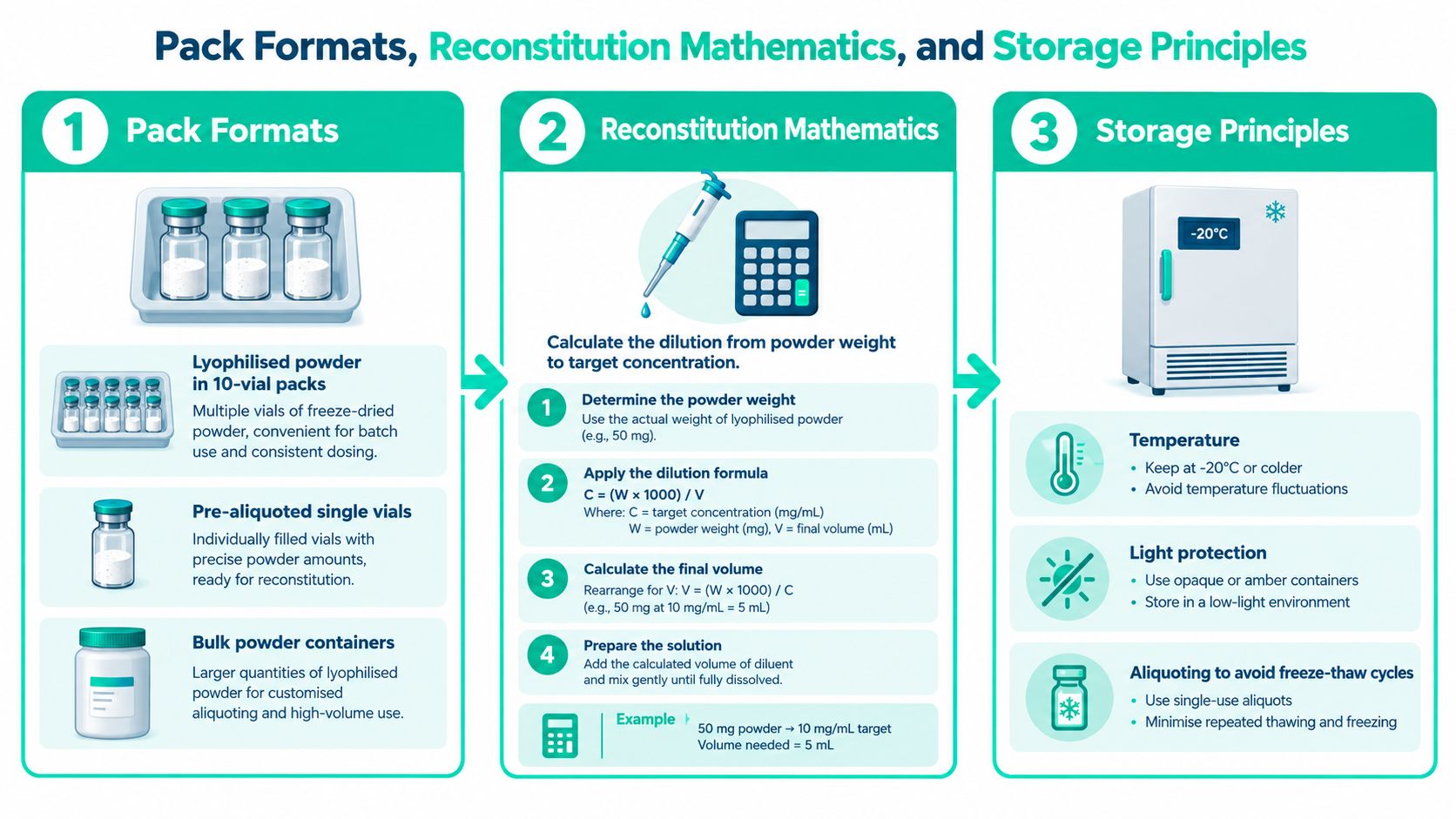
Pack format decisions at lab scale
Common research formats include:
- Pre-aliquoted vials for cleaner lot tracking and reduced repeated exposure
- 10-vial pack configurations for multi-run consistency across a study series
- Bulk powder containers where internal aliquoting capacity already exists
For many teams, the practical advantage of a multi-vial format is not convenience alone. It reduces repeated opening of the same container and makes chain-of-custody logging easier.
Reconstitution mathematics without human-use framing
The basic calculation is straightforward:
Diluent volume = mass per vial ÷ target stock concentration
If a vial contains a known peptide mass and the protocol requires a specified stock concentration, the calculation determines the solvent volume required to reach that concentration. The same arithmetic applies whether the chosen vehicle is sterile water, a buffered aqueous system, or another validated laboratory solvent appropriate to the downstream assay.
What matters in practice is documentation:
- Record the final calculated concentration
- Note the solvent system and pH
- Label every aliquot with lot number and preparation date
- Document any filtration step used for cell-compatible preparation
For handling principles and stability considerations, a dedicated resource on peptide storage and stability is more useful than trying to infer shelf behaviour from general peptide language.
Storage principles that reduce avoidable variability
Lyophilised material is typically stored frozen according to the supplier's documented stability guidance. Reconstituted stocks are often aliquoted into single-use or low-use fractions to reduce repeated freeze-thaw exposure. Light protection, container compatibility, and headspace management can also matter, depending on the assay sensitivity and storage duration.
Small handling decisions become analytical variables when the study is tight enough. Repeated thawing, vague labels, and undocumented solvent changes are common reasons good material yields poor comparability.
Procurement and Documentation for Australian Research Buyers
What should an Australian research buyer ask first: what does the vial contain, or what can the paperwork prove?
For collagen peptides, that distinction matters. A quoted price and a product title tell you very little about whether the material can be traced, compared across batches, or defended in a methods section. Research procurement works more like qualifying a reagent than buying a generic wellness ingredient. You are checking identity, characterisation, and record quality before you check convenience.
Australia adds a practical layer. Local buyers often have to align procurement approval, import handling where relevant, institutional recordkeeping, and assay timelines. The market context noted earlier helps explain why collagen materials are widely available, but availability does not answer the bench question. Can this batch be documented well enough to use in a controlled study?
What procurement teams should verify first
Start with the document set, not the marketing copy. The core file is usually the lot-specific certificate of analysis, supported by a specification sheet that states which analytical fields are measured. A source description can also matter, particularly where tissue origin, processing route, or regulatory screening affects project suitability.
The useful test is simple. If the supplier changed the label tomorrow, would the underlying documents still let you identify the material?
At minimum, buyers should look for:
- Lot-specific certificate of analysis
- Specification sheet with named analytical parameters
- Source or origin description where relevant
- Clear research-use-only labelling
- A statement showing whether test results are manufacturer-generated, independently verified, or still pending
For Australian institutions, operational details also affect study control. AUD pricing reduces friction in budgeting. Dispatch timing matters because a delay of a few business days can shift cell work, animal scheduling, or contract lab bookings. Lot continuity matters for the same reason a chemist tries to avoid changing a critical reagent halfway through a validation run. If the material changes, the result may change with it.
Bulk Aussie Peptides is one example of an Australian supplier that publishes research-use-only product specifications, offers standardised 10-pack formats, and provides batch documentation or certificates of analysis through its procurement workflow. That structure is useful for repeat-order reconciliation because pack format, carton records, and lot identifiers can be checked against each other rather than inferred from a consumer-style SKU.
Products are supplied strictly for laboratory research purposes only. They are not for human consumption, therapeutic use or diagnostic procedures.
Procurement checklist for Australian research buyers
| Criterion | What to Verify |
|---|---|
| Batch identity | Match vial label, outer packaging, and certificate lot number |
| Molecular specification | Confirm molecular weight distribution is documented, not merely claimed |
| Amino acid data | Check whether collagen-associated markers are actually reported |
| Testing source | Identify whether data are independent, manufacturer-provided, or unavailable |
| RUO positioning | Ensure the product is labelled for laboratory research use only |
| Pack format | Decide whether bulk or multi-vial format suits the study design |
| Pricing format | Confirm AUD-denominated pricing for budgeting and approval workflows |
| Dispatch planning | Check stated processing and shipping windows before study start |
| Traceability | Assess whether repeat orders can preserve lot continuity |
| Import and customs paperwork | Review documentation requirements where cross-border supply applies |
Red flags that deserve immediate follow-up
Some problems are obvious once you read the paperwork closely. No molecular weight data means you cannot tell whether “collagen peptides” describes a narrow hydrolysate fraction or a broad, poorly defined mixture. Vague “bioactive peptide” language without sequence information or analytical support creates a second problem. The name sounds specific while the material remains chemically unclear.
A buyer should also pause if the supplier does not distinguish between in-house data and third-party testing, or if the product page spends more time on consumer outcomes than on reagent specifications. Unclear batch traceability across multi-vial supply deserves the same scrutiny. If one order can contain mixed lots without clear disclosure, comparability can fail before the experiment begins.
For Australian research buyers, good procurement documentation is not administrative overhead. It is part of experimental control.
Research-Use-Only Positioning and Practical Next Steps
The useful way to think about collagen and peptides is not as a trend category but as a documentation problem with biological consequences. If the material is a hydrolysed collagen reagent, you should be able to verify that from the analytical record. If it's a synthetic peptide, you should be able to verify identity at the sequence level. If neither is possible, the problem starts before the experiment does.
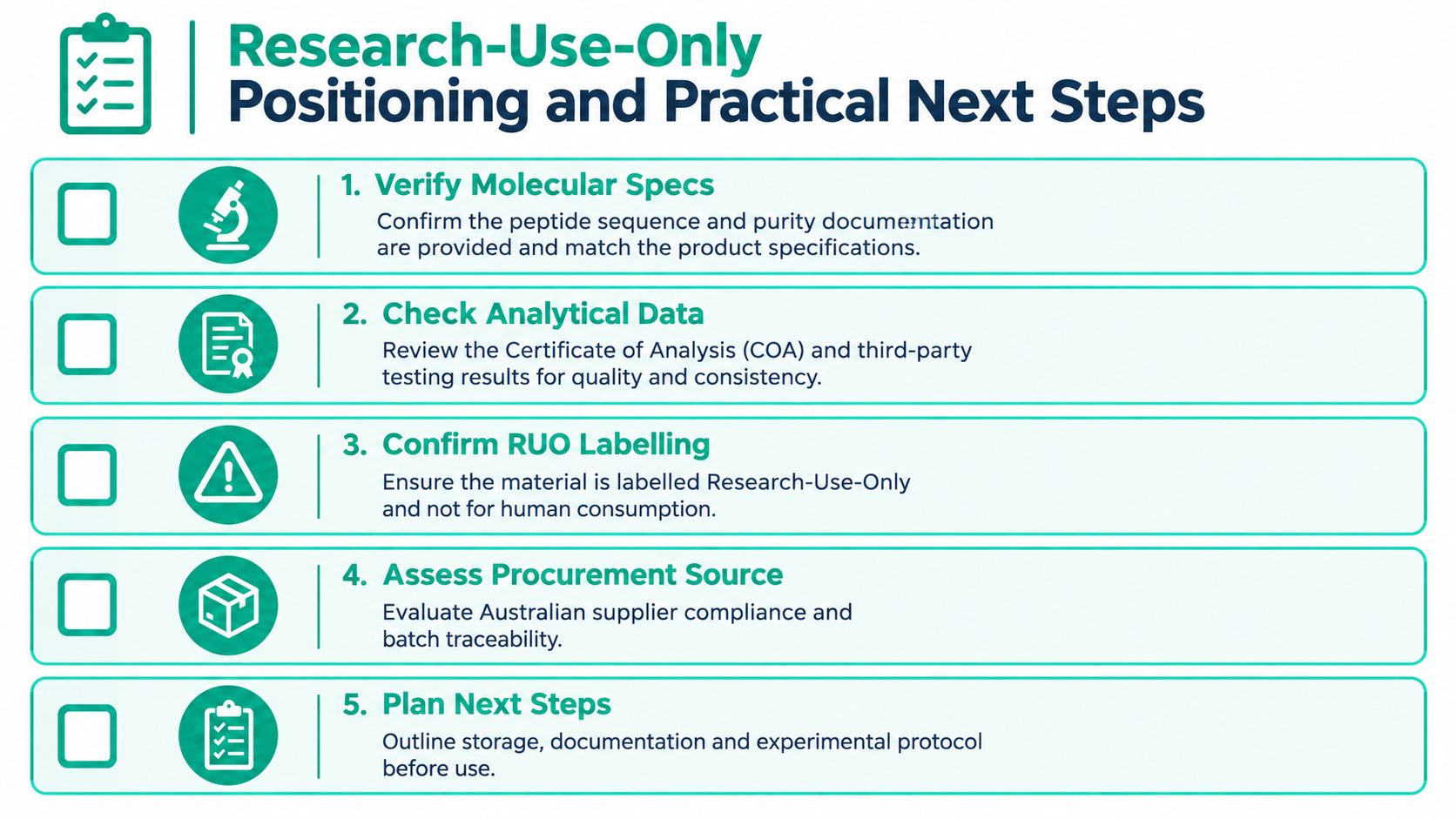
A bench-ready verification workflow
Use this short checklist before committing a batch to a study:
- Confirm molecular characterisation. For hydrolysed collagen material, review SEC/GPC or equivalent distribution data rather than relying on generic “low molecular weight” language.
- Cross-check amino acid markers. Look for a profile consistent with collagen-derived material, including the expected emphasis on glycine, proline, and hydroxyproline.
- Review contamination controls. Check heavy metal data, endotoxin status, and any relevant microbiological testing for assay compatibility.
- Reconcile documentation. Make sure the lot number on the vial, carton, specification, and certificate all match.
- Log storage and preparation conditions. Record solvent, concentration, aliquoting, and freezer conditions in the same way you'd record any other critical reagent variable.
What to do before purchase approval
Ask for the current certificate, not a historic example. Compare pack format against planned replicate count. Note any gaps between what the supplier advertises and what the batch paperwork demonstrates.
Keep the category boundaries clear. Hydrolysed collagen peptides, intact collagen, and synthetic signalling peptides can all be relevant to collagen and peptides research. They are not substitutes by default.
Products are supplied strictly for laboratory research purposes only. They are not for human consumption, therapeutic use or diagnostic procedures.
Bulk Aussie Peptides supplies research-use-only peptides and laboratory support materials in Australian 10-pack formats with product specifications and batch documentation designed to help labs verify what they're buying. If you're evaluating collagen-related reagents, review the available specifications, compare documentation status, and use the published procurement resources before assigning a batch to active experimental work.