
How to Buy Peptides Online Australia: A Research Buyer Guide

A lot of Australian researchers land on the same problem at the same time. The compound is needed for an in-vitro run, the finance officer wants a paper trail, and the supplier website makes the product look simple when the procurement reality is not. For buy peptides online Australia decisions, the question isn't whether a peptide appears on a checkout page, it's whether the purchase can be documented, defended, and processed compliantly from selection to freezer.
That means treating the order like a procurement workflow, not a consumer purchase. The three checkpoints that matter are regulatory status, supplier documentation, and receiving logistics. If any one of those is weak, the order can fail at internal approval, at border clearance, or when the vial arrives with missing identity data.
Table of Contents
- What This Guide Covers and Who It Is For
- Understanding Australian Peptide Regulations in 2026
- Classifying Your Compound Before You Order
- Evaluating Australian Peptide Suppliers
- Placing and Tracking Your Order
- Receiving, Inspecting and Storing Your Peptides
- Procurement Checklist and Common Questions
What This Guide Covers and Who It Is For
A common lab scenario is straightforward on paper and messy in practice. A postdoc finds a peptide needed for an assay, a lab manager has to justify it to finance, and procurement needs enough documentation to satisfy internal controls without slowing the project down. The purchase either becomes a clean, auditable line item, or it turns into email threads about missing paperwork and unclear product identity.
The practical issue is not just price or availability. It's whether the compound has a clear regulatory classification, whether the supplier can show batch-specific documentation, and whether the receiving process preserves traceability once the shipment reaches the lab. Those three checkpoints are the backbone of a defensible procurement file.
Who this is written for
This is written for university lab managers, biotech procurement officers, CRO teams, research institutes, and postdocs placing a first peptide order. It's also relevant to anyone responsible for supplier onboarding, internal approvals, or receiving goods into a regulated lab environment.
It deliberately does not cover human use, clinical prescribing, treatment decisions, or performance applications. It also doesn't treat every peptide as the same category, because that's where a lot of procurement mistakes begin.
Practical rule: if you can't attach the purchase to a product page, a COA, and an internal intended-use note, the order isn't ready yet.
The goal is a purchase trail that can be reviewed later without guesswork. That means keeping the supplier search, approval note, order confirmation, receiving inspection, and storage record aligned from the start.
Understanding Australian Peptide Regulations in 2026
A lab order can look routine and still fail compliance review if the paper trail is weak. In Australia, peptide products are regulated as therapeutic goods under the Therapeutic Goods Act 1989, and the TGA says unapproved peptide products are not included in the ARTG and have not been evaluated for safety, quality, or effectiveness. The regulator also treated unapproved peptides as a compliance priority in 2026 and warned that it is unlawful to import, advertise, manufacture, or supply them in Australia. TGA guidance on unapproved peptide products
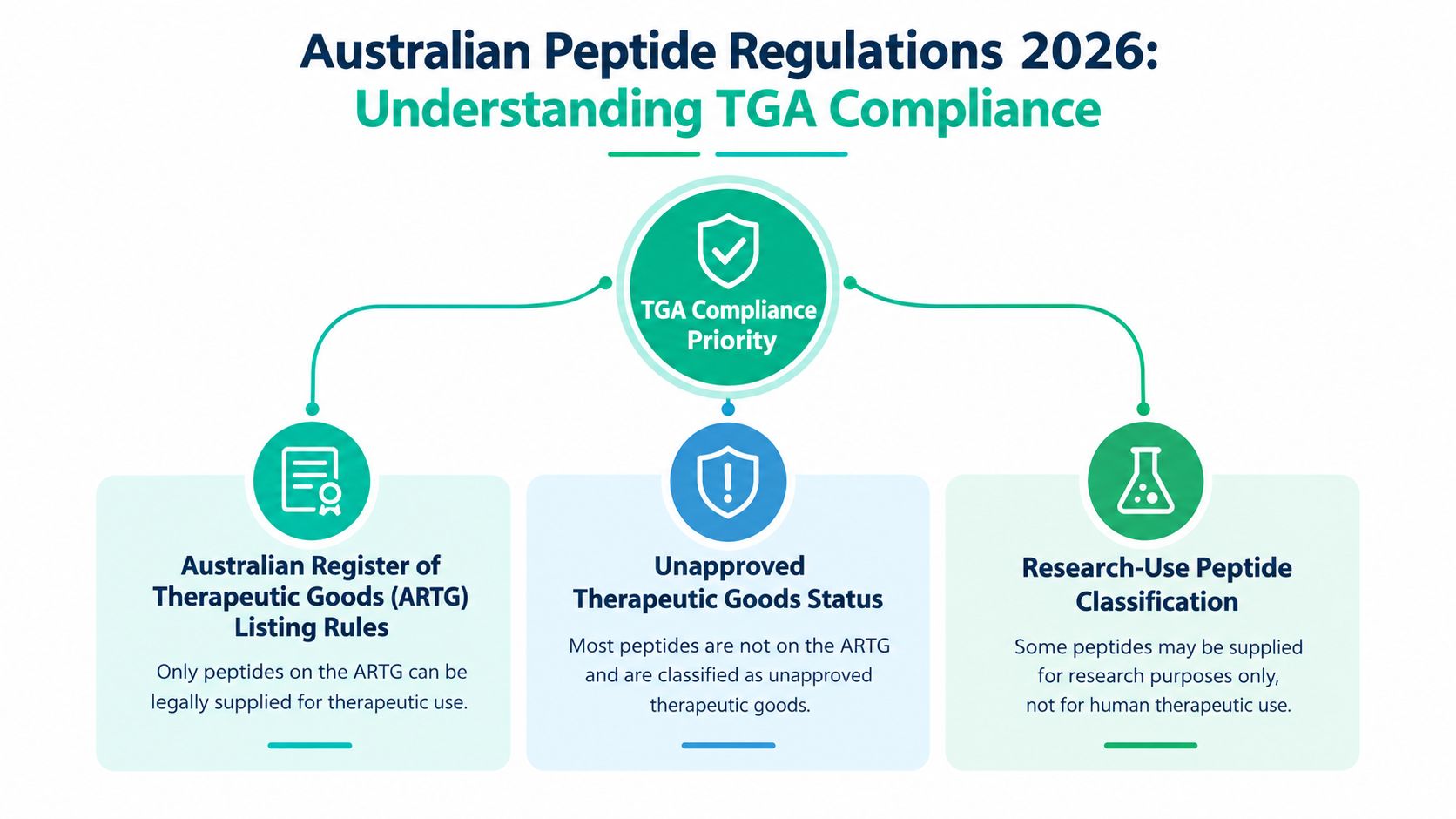
The product label does not decide the legal position. “Research use only” wording does not override the TGA framework, because intended use and product representation drive the classification. A peptide may be handled as a laboratory material in one workflow and as an unapproved therapeutic good in another, depending on how it is described, ordered, and recorded. Before any purchase is approved, classify the compound first. If you want a practical starting point, use this guide on research peptide regulation in Australia.
What the buyer needs to be able to show
For an audit or internal review, the file should show what the product is, why it was needed, and how it was intended to be used. It should also show whether the goods entered under a lawful import pathway, because the TGA's import framework expects the right classification and paperwork, not a broad disclaimer. The regulator's import and export guidance makes clear that therapeutic goods generally need ARTG entry unless an exemption applies, and that incomplete labelling or missing identity data creates a procurement problem as soon as the order is reviewed. TGA import and export framework
For Australian researchers, that is the working standard. If a supplier cannot provide identity details, concentration, or lawful authority documents where needed, the purchase becomes difficult to defend before it reaches the bench.
Why this is a procurement issue, not just a legal one
Consumer articles often stop at “is it legal?” That misses the point for a lab. A procurement team needs to know whether the compound is an unapproved therapeutic good, a prescription-only medicine, or a prohibited substance under the current enforcement environment, because that changes what belongs in the file and what risk sits on the order. Australian regulator commentary has been clear that peptides are under close scrutiny, so the documentation standard needs to stay high. RACGP commentary on the TGA's peptide compliance crackdown
The internal rule is simple. If the product cannot be documented, defended, and processed compliantly, the purchase is not ready.
Classifying Your Compound Before You Order
The first step happens before anyone opens a supplier cart. Identify whether the compound sits inside the TGA framework at all, whether it is better treated as a scheduled substance under the Poisons Standard, or whether it is an analytical or laboratory material outside therapeutic-goods use. That classification decides what paperwork you'll need and whether the intended-use note belongs on a purchasing file or in a restricted-access register.
Use a simple decision tree
Start with the compound name and sequence. If the molecule is identical to, or closely aligned with, a peptide or hormone structure that can trigger therapeutic or scheduling issues, it needs a closer review than an ordinary reagent. Then check whether the intended use is in-vitro laboratory investigation, because intended use drives how the product is represented, how it's ordered, and how it's defended later.
A “research only” label doesn't fix a bad classification. The file has to show what the compound is, how it is being used, and who reviewed it.
A practical classification worksheet keeps the process tidy and repeatable. Use the same document for ethics support, finance approval, and any later request from compliance or procurement.
| Field | What to Record | Source of Truth |
|---|---|---|
| Compound name | Exact product name and variant | Supplier product page and lab request |
| CAS number | If available | Supplier documentation or internal database |
| Sequence | Full peptide sequence | Product sheet or technical file |
| Schedule status | Relevant Poisons Standard outcome | Internal regulatory review |
| Intended use statement | Clear in-vitro research purpose | Lab request and project file |
| Reviewer signature | Named person and date | Procurement or PI approval |
A worked example in practice
Take a common research peptide and run it through the same steps. First, check whether it's being purchased as a laboratory material or represented in a way that pulls it into therapeutic-goods territory. Second, confirm whether the sequence or intended use creates any scheduling concern. Third, attach a short note to the purchase order stating the project context, the assay type, and the named reviewer who approved the classification.
That note does more than satisfy a checkbox. It gives the lab a defensible record if someone later asks why the product was bought, how it was represented, and who signed off on it.
Evaluating Australian Peptide Suppliers
A defensible purchase starts with supplier documentation, not the lowest price. The supplier has to make batch identity, lot traceability, and supporting paperwork easy to verify before you commit to the order. If those basics are weak, the rest of the transaction usually becomes a cleanup exercise.
The four checks that matter most are COA availability, batch traceability, documentation source labelling, and SDS provision. If a vendor can't give you those, they're asking your lab to absorb the quality risk.
What good documentation looks like
A usable Certificate of Analysis should be batch-matched, not generic. It should identify the lot, show the analytical method used, and connect the vial in your hand to the lot number on the file. If the supplier only offers a vague purity statement, or the method details are missing, the document is harder to rely on for procurement approval.
The same applies to source labelling. A procurement officer needs to know whether a COA is in-house analytical, third-party, or a mix of both. That distinction doesn't make one automatically better, but it does tell you how much independent verification sits behind the paperwork.
Supplier checks that should happen before checkout
- Physical presence: Confirm the Australian business address and ABN.
- Technical contact: Verify there's a named person who can answer documentation questions.
- Batch evidence: Ask whether COAs are available before purchase, not after dispatch.
- SDS access: Confirm a current Safety Data Sheet is provided for handling and storage.
- Method detail: Look for instrument and assay information, not just a headline purity claim.
- Traceability: Check that lot numbers tie back to manufacturing or testing records.
Red flag: if the only quality statement is “purity >95%” with no chromatogram, no lot reference, and no SDS, the file is too thin for institutional use.
A domestic option such as Bulk Aussie Peptides can fit this workflow when the lab wants batch documentation, product specifications, and Australian-based support in one place, but the same evaluation rules still apply. The supplier still needs to earn approval through documentation, not branding.
| Evaluation Criterion | What to Verify | Pass Threshold |
|---|---|---|
| Documentation depth | COA, SDS, specs available | Batch-matched files accessible pre-order |
| Batch control | Lot number tied to vial | Vial and COA lot match |
| Support responsiveness | Technical contact named | Clear response path during business hours |
| Shipping reliability | Domestic dispatch process defined | Tracking and stated fulfilment workflow |
For a supplier comparison page, use the Australian peptide supplier evaluation notes as a starting point, then verify every claim against the specific batch you're ordering.
Placing and Tracking Your Order
Once the supplier clears the documentation check, the ordering sequence should stay tight and boring. Select the product, verify the vial size against the COA batch quantity, and make sure the labelled content matches what the lab needs. Vial size and peptide content are not always the same thing, so procurement teams should compare the numeric details rather than assume a headline listing is enough.
Order flow that works in practice
First, decide whether the study needs a single vial or a multi-pack. Multi-pack formats can help with freezer-space planning and keep batch consistency cleaner across longer projects, especially when the same lot needs to cover several runs.
Then move to checkout. Domestic suppliers may offer card, direct transfer, or other modern payment methods, and the finance team should choose the option that fits institutional policy. If a free-shipping threshold applies, use it to reduce landed cost where the order volume already justifies it.
After checkout, save the order confirmation email and file it against the institutional purchase order. The confirmation should show the reserved batch numbers, because that is the link between what was approved and what was packed.
Tracking and escalation
Dispatch should come with a tracking number, and the receiving team should watch the shipment until it reaches the facility. Australian domestic delivery is usually faster than importing, and one published supplier policy states that orders placed after 2pm AEST, on weekends, or on public holidays are dispatched the following business day, with express shipping typically taking 2 to 3 business days. Pillar Research shipping policy
If the parcel hasn't arrived within seven days, escalate it. That's not overreacting, it's protecting the study timeline and preserving evidence if something goes wrong in transit.
Receiving, Inspecting and Storing Your Peptides
Receiving is where the paperwork meets the bench. Treat the consignment like a documented inspection event, not an ordinary parcel drop. Photograph the external packaging before opening, record any temperature indicator if one was included, and keep the records with the purchase file.
Match the vial to the paperwork
Check the printed lot number on each vial against the COA and the order confirmation. If there's a mismatch, quarantine the shipment until the supplier explains it. That's the simplest way to avoid mixing an unverified vial into a study file.
Inspect the container itself for cracked septa, visible damage, or obvious issues in the lyophilised cake. If there's hissing on opening, partial vacuum loss may be present, and that shipment should be treated cautiously. Particulate matter or melt-back is another reason to stop and review before the material is used.
Storage that keeps the record clean
For handling and storage guidance, the relevant supplier page is the peptide storage and stability reference. The basic lab practice remains the same, protect lyophilised material from light and moisture, keep short-term stock at -20 degrees Celsius or long-term archival at -80 degrees Celsius, and only reconstitute the working aliquot you need for the immediate task.
A short receiving log should capture the essentials:
- Receiving date and time
- Lot number and vial count
- Storage location in the freezer map
- Assigned custodian for the batch
- Inspection outcome and any quarantine note
That log is what makes the chain of custody auditable. It also stops a batch from becoming an unlabeled tube in a crowded freezer, which is how well-run studies lose traceability.
Procurement Checklist and Common Questions
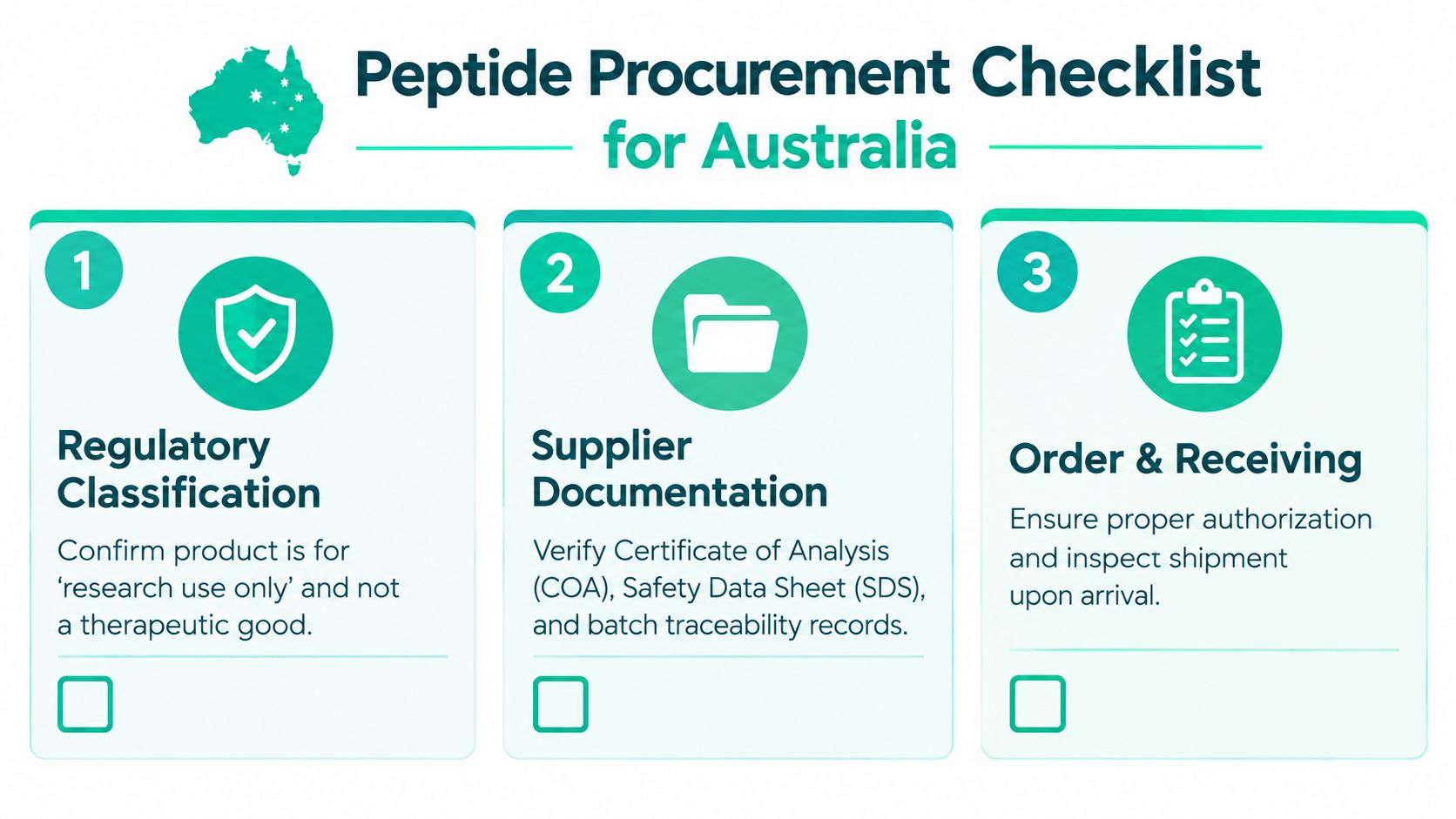
A printable file should capture the whole process in one place. Use it to confirm the product classification, confirm the supplier documentation, and confirm the receiving record before the material is released to the bench.
- Regulatory classification: Record the compound name, intended use, and review sign-off.
- Supplier documentation: Save the COA, SDS, and batch traceability record.
- Order authorisation: Keep the purchase order, approval note, and confirmation email.
- Receiving inspection: Log package condition, lot numbers, and any quarantine action.
- Storage confirmation: Record the freezer location and custodian.
Common questions from Australian labs
Can overseas suppliers ship peptides to Australia without import holds?
Not reliably. If the paperwork or classification is weak, border delays are a real risk, which is why domestic documentation standards matter so much.
How do I verify a COA against the vial?
Match the vial lot number to the COA lot number, then check the assay and identity details line up with the order confirmation.
What does “research use only” mean?
It doesn't override intended use or import rules on its own. The file still has to show how the material is represented and why it was purchased.
Which payment methods are normal for domestic vendors?
Australian vendors commonly use digital checkout and bank transfer options, but the right method is the one that fits the institution's procurement policy.
How long should bench-ready delivery take?
For domestic dispatch, the practical answer depends on fulfilment and courier timing, but the supplier's stated processing and tracking window should be part of the approval file.
If your lab needs a domestic peptide supplier with batch documentation, product specifications, and research-use-only positioning built into the procurement workflow, review the available files at Bulk Aussie Peptides. Check the product pages, compare the batch documentation, and use the supplier's records to keep your next purchase auditable from order to freezer.