
Peptides Australia Review: How to Choose a Supplier
You're probably looking at several peptide suppliers and trying to work out which one gives your lab the least risk, not just the lowest sticker price. In Australia, that means the question is whether the supplier can tie every vial to lot-specific documentation, not whether the product page looks polished. A useful peptides Australia review has to start there, because a batch document that cannot be matched to the vial on the bench is weak procurement evidence.
| Supplier factor | What procurement should look for | Why it matters |
|---|---|---|
| Batch-specific COA | Lot-matched, accessible before purchase | Supports traceability and review |
| Analytical evidence | HPLC plus mass spectrometry | Confirms identity and measured purity |
| Documentation clarity | Catalogue number, batch number, testing method | Helps audits and repeat ordering |
| Domestic handling | Australian dispatch and tracking | Reduces border exposure and uncertainty |
| Research-only labelling | Clear non-clinical positioning | Lowers institutional risk |
| Quote transparency | Visible product specs and procurement documents | Makes purchasing review faster |
Table of Contents
- The Question Every Australian Peptide Buyer Should Ask First
- Six Evaluation Criteria for Research-Use Peptide Suppliers
- Bulk Aussie Peptides Profile Against the Criteria
- Domestic Stock Model Versus International Drop-Shipping
- Procurement Checklist for Universities and Research Institutes
- Compliance, Research-Only Positioning and Institutional Risk
- Practical Next Steps for Your Research Program
- Common Buyer Questions on Documentation and Handling
The Question Every Australian Peptide Buyer Should Ask First
The first question is simple. Can the supplier show that the vial you receive matches the batch in the paperwork? If the answer is no, or if the documents are generic, you are not reviewing a controlled laboratory supply chain. You are reading marketing material.
For Australian research teams, that distinction matters because peptide procurement is not just about headline purity. A Certificate of Analysis is only useful when it is tied to the specific tested sample, with product identity, batch details and measured purity clearly recorded. The COA should also support traceability from the bench back to the tested lot, as described in a COA guide for Australian buyers as described in a COA guide for Australian buyers. Batch numbers, chromatograms and mass spectrometry traces are the evidence chain that lets a lab compare what was ordered, what was tested and what arrived.
Practical rule: if the paperwork doesn't let you link the vial label to the COA, you do not have lot-level traceability.
That is why a peptides Australia review aimed at procurement teams should read differently from a consumer-style review. Consumer reviews often focus on speed or first impressions. Laboratory buyers need to know whether the supplier can support reproducibility, auditability and repeat ordering. If those controls are missing, nominal purity on a product page does not carry much weight on its own.
Six Evaluation Criteria for Research-Use Peptide Suppliers
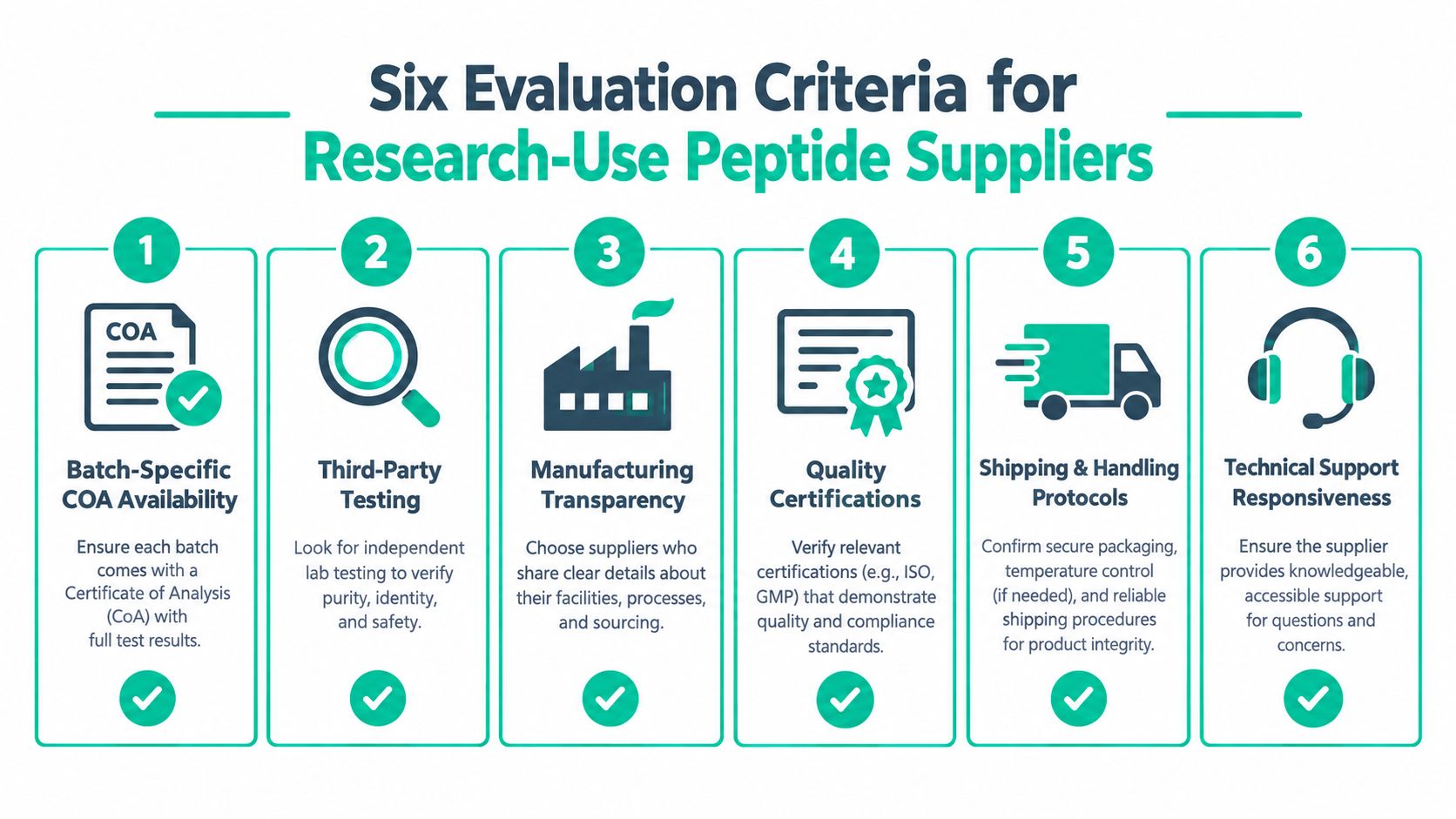
A lab-grade supplier review gets clearer when you score it against six criteria instead of relying on general impressions. The point is not to chase a slogan. It's to test whether the supplier can support reproducible research, institutional review and procurement records.
1. Batch-specific COA availability
A supplier should make the Certificate of Analysis available per batch, not as a generic template. The most useful COA records include the compound name, batch or lot number, analytical method and measured purity, with reverse-phase HPLC plus mass spectrometry used as the standard verification stack in the guidance provided by Australian laboratory buyers. Missing chromatograms, missing lot numbers or vague “spec sheet only” paperwork are all red flags.
2. Testing independence
Manufacturer-provided documentation can be useful, but it is not the same as independent verification. Procurement teams should ask whether the result is in-house, third-party, or a visible product summary. If the source of testing is unclear, the document is harder to defend in an audit.
3. Format clarity
Know whether you're buying a lyophilised vial or a solution, and confirm storage expectations before ordering. If a listing doesn't say how the product is supplied, or hides that detail in fine print, the buyer is left guessing at receipt.
4. Pricing transparency
Domestic pricing should be understandable before the quote is issued. If a supplier adds hidden handling charges, unclear freight rules or opaque cold-chain fees, that complicates budget approval.
5. Dispatch reliability
Australian laboratories need tracking they can plan around. The supplier's own procurement materials state that orders are processed and dispatched within 1–3 business days and handled through Australian-based support via the published synthetic peptides page. That matters more than broad “fast shipping” claims.
6. Compliance posture
Research-only labelling should be explicit, and the language on the product page should not drift into treatment claims. If a supplier blurs the line between research use and human use, that creates institutional risk.
Bulk Aussie Peptides Profile Against the Criteria
Bulk Aussie Peptides presents itself as an Australian-operated supplier with a public testing focus, a COA library and batch documentation linked from product and quality pages. That puts it in the category of suppliers where the paperwork trail is part of the offer, not an afterthought. The operational facts provided also indicate Australian support, domestic order processing and a standardised 10-pack vial format, which is relevant for repeat purchasing and controlled research runs.
Criteria-based assessment
The strongest observed point is documentation accessibility. A public COA library lets buyers inspect batch records before purchase, which is exactly what procurement teams need when they are checking lot numbers against internal approvals. The testing and quality page is the appropriate place to verify how documentation is presented, so that page should be treated as the primary reference point for review testing and quality information.
The main procurement advantage of a domestic model is simple. The batch shown on the site is the batch shipped from Australian stock, so there is less exposure to cross-border uncertainty. That reduces the risk of customs delay, and it makes traceability easier to document. The limitation is that buyers still need to verify each COA on receipt rather than assuming every batch is identical.
A supplier can be domestically stocked and still require normal procurement scrutiny. Domestic storage is helpful, but it doesn't replace batch checking.
The bulk format is also relevant for labs that purchase repeatedly. Standardised 10-pack vials can simplify ordering and inventory tracking, especially when a program needs the same item across several study phases. For procurement, that is more useful than one-off consumer-style ordering.
| Criterion | Observed Position | Procurement Note |
|---|---|---|
| Batch-specific COA availability | Public COA library and product-linked documentation | Useful for lot matching and review |
| Independent testing | Testing page should be checked for source lab details | Distinguish independent from in-house records |
| Format clarity | Standardised vial formats are stated | Confirm lyophilised or solution state on the specific listing |
| Pricing transparency | Bulk format supports clearer purchase planning | Confirm quote terms and freight before PO |
| Dispatch reliability | Australian processing and domestic fulfilment are stated | Reduces cross-border uncertainty |
| Compliance posture | Research-only positioning is stated | Helps with institutional review and auditor questions |
Domestic Stock Model Versus International Drop-Shipping
Domestic stock and international drop-shipping create very different procurement experiences. In a lab, the differences show up in chain of custody, border exposure, and how quickly the purchase reaches the bench. If your institution needs clean records and predictable delivery, the model matters as much as the product.
What changes when stock is held in Australia
A domestic supplier can show documentation before dispatch, then ship the lot already tied to the batch record. That gives purchasing staff a cleaner paper trail and reduces the chance that a received vial will differ from the paperwork supplied at quote stage. It also means there is no need to rely on an overseas seller's packaging, export paperwork or inconsistent naming conventions.
International drop-shippers often create more friction for buyers. Documentation may be generic, the actual batch may not match the brochure-style sheet, and the shipment may be exposed to border intervention. Under the Australian regulatory environment, that exposure is not theoretical, especially where unapproved peptide products are concerned as described in the RACGP summary of TGA warnings.
Procurement comparison
| Criterion | Domestic Stock Model | International Drop-Shipping |
|---|---|---|
| Documentation chain | Lot-matched COA can be tied to local stock | Generic paperwork is more common |
| Customs exposure | Lower border exposure | Higher border and import uncertainty |
| Order visibility | Domestic tracking and local support | Tracking may be limited or fragmented |
| Dispute resolution | Easier to escalate through Australian channels | Cross-border issues are slower to resolve |
| Bench timing | More predictable for lab schedules | Lead time can shift without warning |
The operational conclusion is straightforward. If your lab values documented provenance, domestic stock is easier to manage. If your procurement team tolerates import uncertainty, an offshore supplier may still be usable, but the documentation burden is higher and the risk review is less comfortable.
Procurement Checklist for Universities and Research Institutes
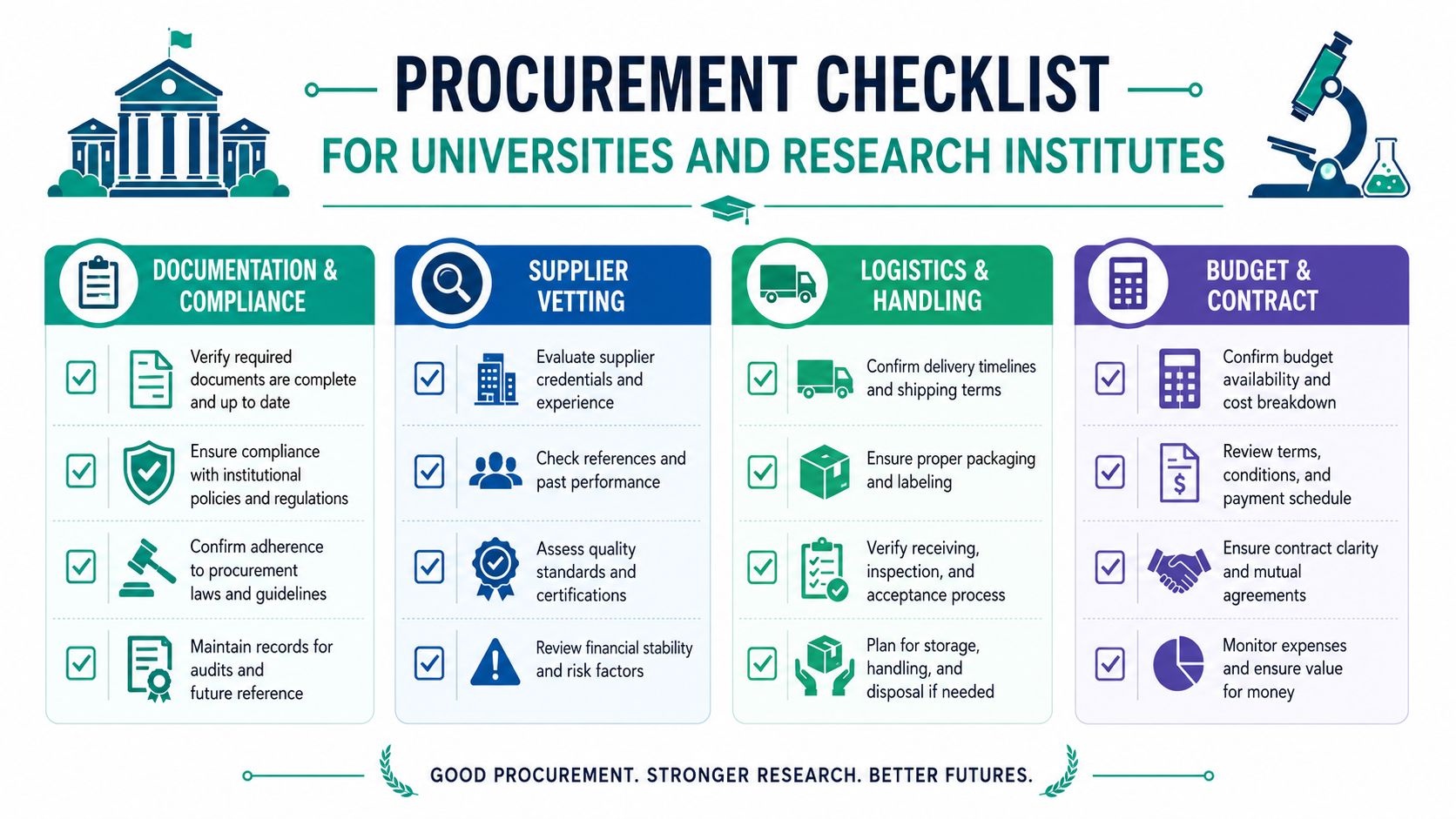
University buyers and CRO procurement teams usually need the same four things. They need proof, consistency, an approvable quote and a shipment that fits the lab calendar. A tidy process avoids half the back-and-forth that slows peptide orders down.
Before the quote
Collect the current COA, the product specification sheet and any storage notes tied to the exact batch. Ask for the supplier's batch traceability statement if it isn't already visible. If the paperwork is missing a lot number, stop there.
During supplier review
Confirm whether the documents are independent, manufacturer-provided or pending. If the supplier offers a procurement pack, review it early, because that is where billing details, institutional purchase requirements and ordering notes should live procurement information pack. A clean purchase file is easier to defend later.
Before the purchase order
Match the quote to the batch documentation and confirm the storage condition on receipt. If your institution requires research-only acknowledgement forms, biosafety endorsement or internal sign-off, clear those before submitting the PO. That prevents a supply hold after finance approves the spend.
For bulk ordering
If the lab is working through repeated studies, the 10-pack format helps with standardised intake and inventory control. Ask for the lot number again on the final shipping notice so that the receiving team can file it against the original quote. A good order file should let a future reviewer reconstruct the purchase without guessing.
Compliance, Research-Only Positioning and Institutional Risk
Australian peptide procurement sits inside a stricter regulatory setting than many buyers assume. The Therapeutic Goods Administration treats peptide products as therapeutic goods under the Therapeutic Goods Act 1989, and unapproved peptides are those not included on the Australian Register of Therapeutic Goods. Approved medicines such as insulin sit on the ARTG and follow a different pathway.
Why the disclaimer matters
A clear research-only disclaimer shows auditors that the supplier is not presenting the product as a therapeutic or diagnostic item. That matters because the TGA has made unapproved peptides a compliance priority and has warned that many peptide products sold in Australia are not assessed for safety, quality or effectiveness as reported in the TGA-targeted compliance coverage. Enforcement can include seizures, import interventions and penalties, so procurement teams should treat documentation as a risk control, not a formality.
Institutional risk is mostly documentary
Missing paperwork can create internal problems even when the vial itself appears acceptable. Research offices, grant auditors and lab managers usually focus on the same failure points, procurement policy breaches, failed record checks and avoidable questions during publication review. The strongest control is straightforward, keep the COA, batch number, invoice, storage notes and receiving record together.
The public health context also matters. NSW Health has warned that there is no standard manufacturing benchmark for unapproved peptide products and that past positive experiences do not guarantee repeatability NSW Health guidance. For laboratories, batch-specific documentation is the central artefact.
Practical Next Steps for Your Research Program
Start by checking the lot number on the vial against the current COA in the supplier's documentation set. If they don't match, don't proceed until the discrepancy is resolved. Then read the testing page and note whether the analytical evidence is independent, in-house or mixed.
Next, use the procurement pack to request a quote that includes the correct quantity, delivery postcode and any institutional billing details. Keep the correspondence thread separate so the shipping confirmation, lot number and receiving notes stay together. That makes later audits much easier to handle.
On receipt, file the batch record immediately and set a recurring review cycle for documentation quality. If your program uses repeat orders, compare the new COA with the earlier batch before you approve the next purchase. If the supplier can't support that workflow, escalate to a formal tender or a more controlled procurement route.
A useful internal rule is straightforward. If the order can't be reconstructed from the paperwork alone, it isn't ready for a research programme.
Common Buyer Questions on Documentation and Handling
How do I read a COA line by line
Start with the identity line, then check the batch or lot number, the measured purity and the analytical method. If the sheet includes HPLC and mass spectrometry, those are the most useful fields for procurement review. Endotoxin or sterility data only matters where the assay or internal workflow needs it.
What should I check before preparing a working solution
Use the listed peptide content on the vial, not just the gross vial fill, when you think about concentration. The calculation is based on the amount of peptide present and the final volume you prepare. If the label or COA doesn't make the peptide content clear, stop and verify it first.
What storage principle matters most
Keep the supplied form and the reconstituted form separate in your notes. Lyophilised material is handled differently from solution, and the COA or specification sheet should be the first place you look for storage notes. If the supplier does not give storage guidance on the product page, ask for it before receipt.
What should a research-only disclaimer communicate
It should make it plain that the product is for laboratory research only and not for human consumption, therapeutic use or diagnostic procedures. That language matters because human-use claims disqualify the document from a research procurement context. For batch records, the most useful supporting reference is the COA library, where you can compare documentation style across products.
If a supplier's wording sounds like a consumer health claim, the item is not being described in a way that belongs in a research file.
Bulk Aussie Peptides offers Australian-based research-use-only peptide supply with batch documentation, a public COA library and domestic order handling. If your lab is comparing suppliers on traceability rather than marketing language, review the available batch documentation and see how the paperwork aligns with your procurement process. Visit Bulk Aussie Peptides to check the research catalogue and assess the documentation trail for your next order.