
Peptides Australia

A lab manager opens a delivery from overseas and finds the vials intact, but the paperwork is not. The packing slip uses one product code, the labels show another batch number, and the Certificate of Analysis is a generic PDF with no clear connection to the consignment. The study can't start until someone determines what was supplied.
That scenario captures the core challenge behind peptides Australia procurement. For research teams, the difficult question usually isn't whether a sequence can be synthesised. It's whether the material can be identified, documented, stored and defended during an internal review. Reliable sourcing depends on a continuous record from SKU to batch, COA and SDS, with the research-use-only boundary visible at every stage.
Table of Contents
- The Sourcing Problem Australian Labs Keep Hitting
- Australian Regulatory Context for Research Peptides
- The Australian Peptide Research Ecosystem
- Reading COAs and Batch Records Like an Auditor
- Single Vials Versus 10-Pack Procurement
- Using a Peptide Concentration Calculator Before Delivery
- Procurement Workflow From Quote to Receipt
- Procurement Checklist and Buyer FAQs
The Sourcing Problem Australian Labs Keep Hitting
The first failure point is often the border. An imported consignment may be held because the commercial invoice describes a chemical differently from the supplier's product documentation, or because the end-use statement doesn't clearly identify laboratory research. Even when customs releases the parcel, a missing or inconsistent document can leave the lab unable to accept the material into its inventory.
The second failure point appears at the bench. A vial may carry a printed lot number, while the accompanying COA refers to a different lot or only describes a representative sample. That gap matters because a generic specification doesn't prove the identity or purity of the exact batch received. Batch traceability starts with reconciliation, not with a supplier's marketing statement.
The third problem emerges during first-pass QC. If the stated purity hasn't been supported by batch-specific analytical records, a failed assay can trigger a difficult investigation. The team must determine whether the issue arose from the peptide, reconstitution, storage, assay design or an undocumented change between lots.
Where the delays accumulate
Each paperwork failure creates practical work:
- Lost experimental days: Researchers may need to quarantine the material while procurement or quality staff request missing records.
- Repeat ordering: A replacement consignment can stretch across international dispatch, customs and institutional receiving processes.
- Audit exposure: Grant reviews, biosafety reviews and internal quality checks may identify an incomplete reagent history.
- Inventory uncertainty: Without a reconciled lot number, staff can't reliably connect assay results to the material used.
Practical rule: Treat the document chain as part of the reagent. If the vial and its records don't agree, the procurement process isn't complete.
Australian teams should therefore evaluate a supplier on more than catalogue breadth or headline purity. They need to understand the TGA and ARTG context, assess the quality of COAs and SDS files, confirm domestic fulfilment claims, and define the receipt checks that happen before a vial enters shared stock. The strongest workflow prevents a procurement firefight instead of trying to repair one after delivery.
Australian Regulatory Context for Research Peptides
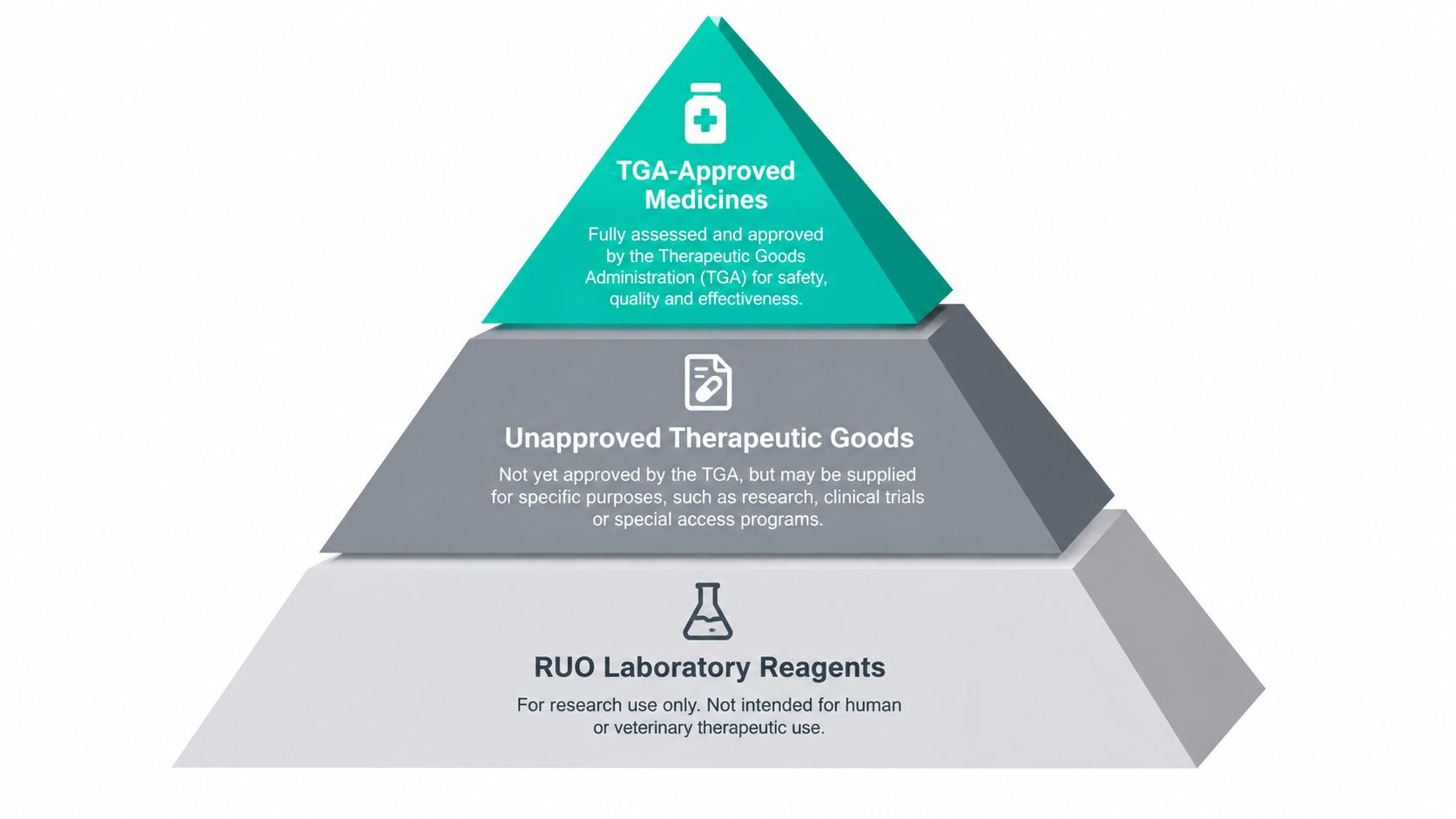
Australian peptide purchasing sits across several regulatory concepts that buyers must keep separate. The Therapeutic Goods Administration regulates therapeutic goods, while the Australian Register of Therapeutic Goods records products approved for lawful therapeutic supply. The TGA states that only approved products have been assessed for quality, safety and effectiveness, and its 2026 compliance notices identify many peptide products supplied in Australia as unapproved therapeutic goods. Unapproved peptide products became a priority focus because of unlawful importation, supply and advertising risks, as described in the TGA compliance update on unapproved peptide products.
A laboratory reagent labelled RUO, or research use only, belongs to a different procurement context from an approved medicine. RUO status doesn't make a product suitable for human administration, and it shouldn't be presented as a treatment or as an alternative to an ARTG-listed medicine. Approved examples such as insulin and some GLP-1 medicines sit in a different regulatory category from unapproved products including BPC-157, GHK-Cu, TB-500, retatrutide and CJC-1295, which Australian guidance and reporting identify as products subject to monitoring or warnings. The RACGP discussion of the TGA peptide warning explains why procurement teams need to check product status rather than rely on online availability.
The scheduling and import layers
The Poisons Standard, or SUSMP, adds another layer. Scheduling depends on the substance and its intended context, not chemistry alone. Schedule 10 is the most restrictive category and covers substances whose risks are considered to outweigh therapeutic benefit, with sale, supply or use prohibited except in narrowly exempted circumstances such as analytical reference standards. The Australian peptide research landscape overview also identifies the Clinical Trial Notification scheme as the main pathway for human clinical research involving unapproved therapeutic goods, after Human Research Ethics Committee approval.
For imported research material, ask the supplier for a clear SDS, country of origin and end-use statement. Department of Agriculture documentation or biosecurity questions may arise depending on the consignment and its description. Inside the institution, keep RUO purchasing, clinical supply and any human research pathway in separate records.
One further control is promotion. The TGA says advertising unapproved therapeutic goods to Australian consumers is generally unlawful, including through websites, marketplaces and social media. A laboratory supplier's catalogue should use restrained, research-focused language and avoid claims that imply therapeutic efficacy.
For an institutional summary of the boundary between laboratory materials and therapeutic regulation, review the Australian research peptide regulation guide.
The Australian Peptide Research Ecosystem
A peptide order can support a university assay, a CSIRO program, a biotech study or a CRO project, but each setting creates different paperwork expectations. Australia's research capability is spread across universities, national science infrastructure and biotechnology programs. The ARC Centre of Excellence for Advanced Peptide and Protein Science, launched in 2019, links the University of Sydney, University of Queensland, Queensland University of Technology, Australian National University, Monash University, Edith Cowan University and CSIRO. The University of Sydney's centre announcement describes a coordinated national network rather than isolated laboratory activity.
The University of Queensland's Institute for Molecular Bioscience also conducts drug discovery and peptide design research. Laboratories across this field may use peptides in biomedical science, immunology, neuroscience, metabolic disease research, protein chemistry and peptide-based drug discovery. CROs and biotech companies add their own requirements, often tied to fixed study milestones, client specifications and defined document packs.
| Institutional Pillar | Typical Research Focus | Procurement Pattern |
|---|---|---|
| Universities | Peptide chemistry, molecular biology, immunology and neuroscience | Preferred suppliers, purchase orders and project-based quotes |
| ARC research networks | Advanced peptide and protein science, discovery and translational research | Coordinated purchasing across participating laboratories |
| CSIRO | Applied science, biotechnology and protein-related research | Formal vendor assessment and documented supply arrangements |
| Biotech companies | Preclinical discovery and assay development | Sequence-specific quotes, batch records and repeat-lot planning |
| CROs | Client-directed laboratory studies | Consignment documentation aligned with study protocols |
Why domestic capacity changes purchasing behaviour
Grant-funded work often groups purchasing around approved milestones, assay campaigns and instrument availability. Procurement teams therefore need more than an item listed as available. They need a supplier that can maintain the same identity and documentation trail across repeat orders, from SKU to batch, COA and SDS.
Domestic fulfilment may reduce handoffs among the supplier, freight provider, customs broker and institutional receiving team. It does not remove regulatory or biosecurity checks. It can, however, make provenance easier to verify when the supplier confirms dispatch location, lot identity and supporting documents before payment.
Biotech programs also benefit from disciplined RUO records during exploratory work. A file containing the sequence, analytical identity, batch history, storage conditions and receiving details supports later internal review. RUO material remains research-use-only and must not be presented as clinical or therapeutic material. Procurement records should preserve that boundary at every stage.
Reading COAs and Batch Records Like an Auditor
A COA should let a second person reconstruct what was supplied without contacting the original purchaser. Start with the SKU and batch number. The product code and lot identifier should match across the vial label, packing slip and COA. If one record uses a shortened sequence name and another uses a different product code, pause the receipt process until the supplier confirms the relationship in writing.
A useful COA normally identifies the tested material, the test date or report date, the analytical methods and the result for each relevant specification. In Australian peptide procurement, supplier COAs commonly include HPLC chromatograms, mass spectrometry identity confirmation, batch numbers, sterility results and endotoxin data, as described in the supplier documentation overview from AusPeptide Labs. Those records help a lab decide whether a compound is suitable for its research workflow, but they don't replace the lab's own acceptance criteria.
Fields that deserve close attention
Look for the following items, then record whether each is present, absent or not applicable:
- Identity: Molecular weight confirmation should align with the expected compound and stated sequence.
- Purity: The HPLC result should include the chromatogram, retention information where provided, and a readable integration baseline.
- Net content: The stated peptide mass should be distinguishable from total vial mass, counter-ion or residual water.
- Composition: Amino acid analysis, counter-ion identification, water content by Karl Fischer and residual solvent data may be relevant to the method.
- Test method: The COA should identify the method or reference standard sufficiently for quality staff to understand what was measured.
- Microbiology: Sterility and endotoxin results require careful interpretation against the intended research use. They don't make an RUO reagent suitable for human use.
The most important distinction is who performed the testing. Manufacturer in-house results are different from independent testing commissioned from an external NATA-recognised or ISO 17025 accredited laboratory. A supplier should label those sources clearly. An in-house COA may still be useful, but it shouldn't be described as independent verification.
Build a five-minute reconciliation record
Save the COA, SDS, invoice, packing slip and receiving photograph in the same QA folder. Note the staff member who checked the records and the date of acceptance. Recycled lot numbers, mismatched masses, missing chromatogram axes and plots without an integration baseline are reasons to request clarification, not details to overlook.
The Bulk Aussie Peptides COA library can help buyers review the type of batch documentation made available before completing an order. Always confirm whether a document is manufacturer-provided, independently generated, pending or unavailable, and never generalise one batch result to every batch.
Single Vials Versus 10-Pack Procurement
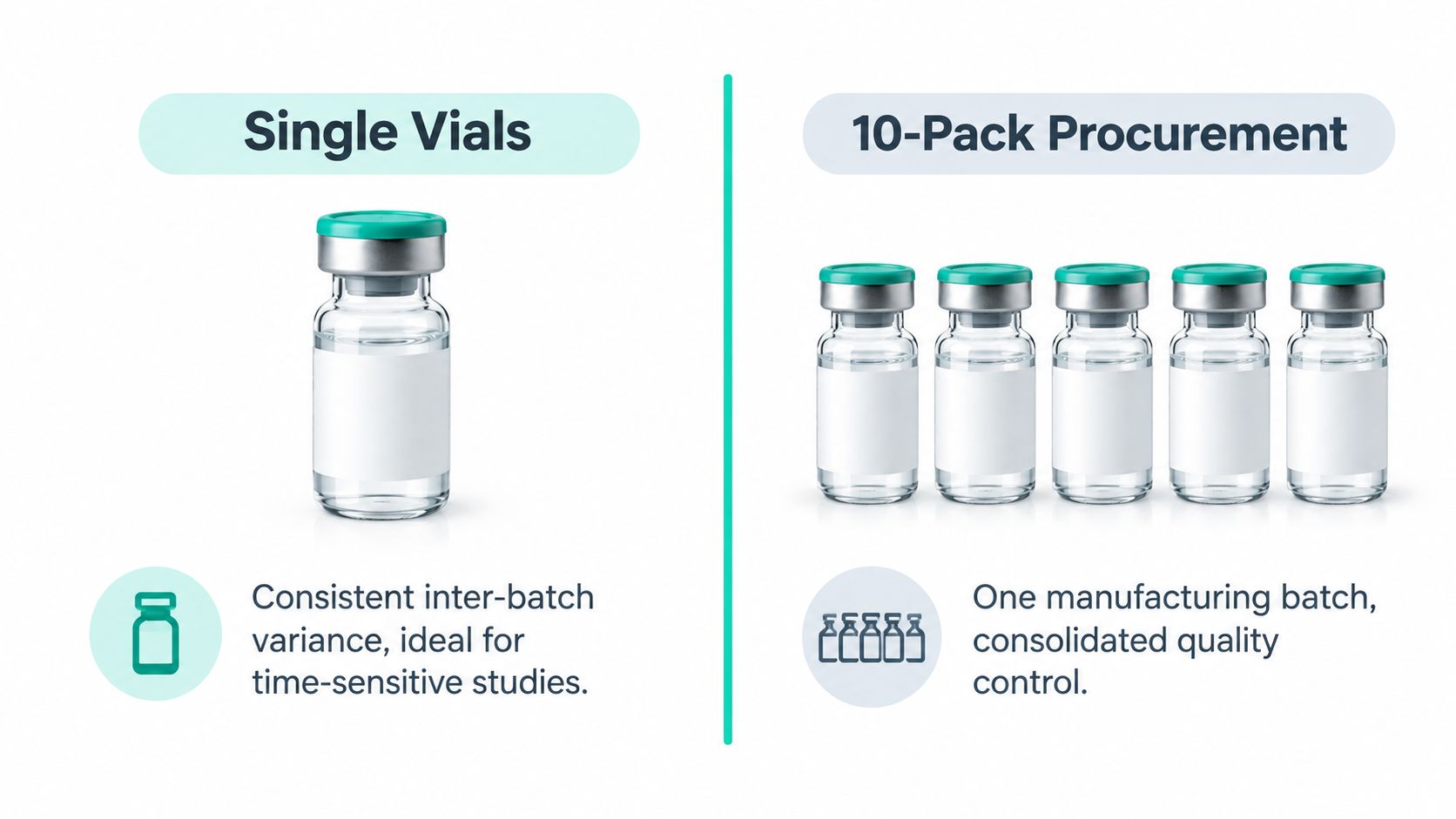
The choice between single vials and a 10-pack is mainly a study-design and traceability decision. A single vial can suit a pilot assay, method development or a project where the required amount is uncertain. The weakness appears when several single vials arrive from different lots and the lab treats them as interchangeable without checking their records.
A consolidated pack may keep the experimental cohort within one synthesis batch. That can reduce the number of purity, counter-ion and water-content variables the team needs to compare across replicates. It doesn't prove that the batch is appropriate, and it doesn't remove the need to review the COA. It does give the lab a clearer baseline for interpreting results.
The storage trade-off
Repeatedly thawing a shared reconstituted stock can create more handling risk than opening sealed vials as required. A multi-vial format allows the lab to keep remaining material lyophilised and stored according to the supplier's documented conditions, rather than repeatedly exposing one reconstituted container to temperature changes.
For many lyophilised research peptides, minus 20°C is a common long-term storage reference supplied by vendors, but the receiving laboratory should follow the product-specific documentation and its own validated storage procedure. Staff should record freezer location, vial status and any excursions in the inventory system.
| Procurement option | Useful when | Main control |
|---|---|---|
| Single vial | Pilot work or uncertain demand | Confirm each vial's lot and COA |
| Multiple single vials | Separate projects or exploratory screens | Don't assume lots are equivalent |
| 10-pack from one lot | Repeated assays and time-sensitive studies | Retain the common batch record |
Consolidation may also simplify shipping administration. A domestic order can avoid international customs paperwork, while imported orders may involve multiple consignments and separate document checks. Australian vendors report domestic warehouse dispatch and tracked delivery windows such as 1–3 business days, but those are supplier-reported operational benchmarks, not regulatory guarantees. Confirm the actual dispatch location and delivery arrangement before placing a deadline-sensitive order.
Using a Peptide Concentration Calculator Before Delivery
A concentration calculator is useful before the parcel arrives because it moves arithmetic out of the time-critical bench window. The essential inputs are peptide mass in milligrams, molecular weight in grams per mole and the intended reconstitution volume in millilitres. The COA's net peptide content should be included where the reported amount is below the nominal amount.
The core conversion is straightforward. First calculate mass concentration in mg/mL. To convert that concentration to micromolar, divide the mg/mL value by the molecular weight in g/mol. The numerical result is in millimolar, so multiply by 1,000 for micromolar, or by 1,000,000 for nanomolar. If the material contains less than 100% net peptide content, adjust the usable mass before calculating.
A neutral laboratory example
Assume a sealed vial contains 2 mg of peptide with a molecular weight of 2,000 g/mol, and the planned reconstitution volume is 1 mL. The nominal concentration is 2 mg/mL. Dividing by 2,000 gives 0.001 mol/L, which is 1 mM, or 1,000 µM and 1,000,000 nM. That is a mathematical example for an in-vitro workflow, not a human-use instruction.
| Input | Value | Result |
|---|---|---|
| Vial mass | 2 mg | 2 mg available before net-content adjustment |
| Molecular weight | 2,000 g/mol | Used for molar conversion |
| Reconstitution volume | 1 mL | 2 mg/mL |
| Calculated molarity | Based on the inputs above | 1 mM, 1,000 µM, 1,000,000 nM |
Prepare the record before the vial opens
The laboratory protocol should specify the diluent, target concentration, calculation method, pipette range and any dead-volume allowance. Allow a lyophilised vial to equilibrate to room temperature before opening if the product documentation calls for that approach. Add the sterile diluent carefully along the vial wall and mix gently to limit foaming. These are general laboratory handling principles, not directions for administration.
A calculator can't compensate for an incorrect molecular weight or an unverified net content value. Save the calculation with the batch record so another researcher can reproduce the concentration. The peptide concentration calculator is one available tool for planning this arithmetic, but the final protocol remains the laboratory's responsibility.
Procurement Workflow From Quote to Receipt
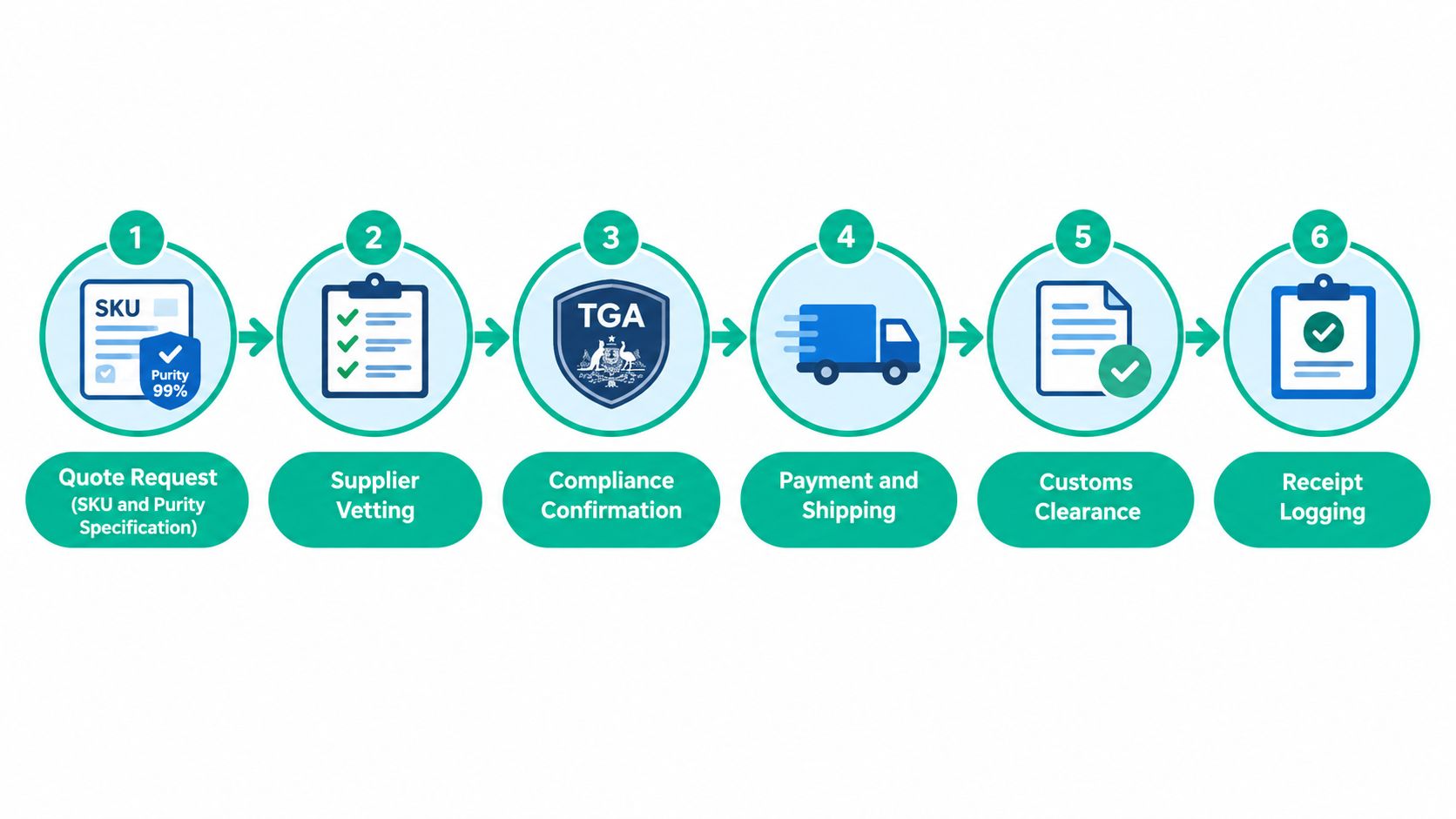
A dependable order begins before the purchase order. Send the supplier the SKU, sequence or compound identity, required nominal amount, purity specification, COA fields, SDS requirement and delivery window. Ask whether the COA is lot-matched and whether any test results are manufacturer-provided or independently commissioned.
The procurement officer then checks the institutional buying rules. That may include an approved-vendor review, an institutional PO number, ABN matching on the invoice, finance approval and agreed payment terms. University teams often use formal purchase orders and may request quote documentation before a supplier can be added to the transaction system. Don't assume that a card payment route will satisfy every institution's audit requirements.
Assign ownership at each handoff
| Stage | Procurement artefact | Primary owner |
|---|---|---|
| Quote | SKU, specification and written quote | Procurement officer |
| Supplier review | RUO wording, COA status and SDS availability | Lab manager or quality contact |
| Purchase order | PO number, invoice details and approval | Finance and procurement |
| Dispatch | Tracking record and stated fulfilment location | Supplier and receiving team |
| Delivery | Packing slip, vial count and condition check | Laboratory receiver |
| Acceptance | Batch reconciliation, freezer log and quarantine sign-off | Lab manager or delegated QA staff |
Domestic dispatch can be operationally useful for time-sensitive studies. Australian suppliers report tracked delivery from domestic warehouses within windows such as 1–3 business days, although the actual result depends on location, courier service, order processing and seasonal disruption. Treat that timeframe as a planning input, not a promise, and obtain tracking before scheduling an assay.
Receipt is a quality event
When the parcel arrives, count the vials against the packing slip and photograph labels if your quality system requires it. Reconcile each batch number with the COA and SDS, inspect seals and packaging, and record any temperature or transport concern before moving the material into shared stock.
Quarantine is appropriate when the COA is missing, the lot number doesn't match, the vial is damaged or the shipping condition is unclear. The lab manager should document the discrepancy and request a written resolution. If the supplier can't reconcile the records, don't relabel the material or place it into an active experiment.
Procurement Checklist and Buyer FAQs
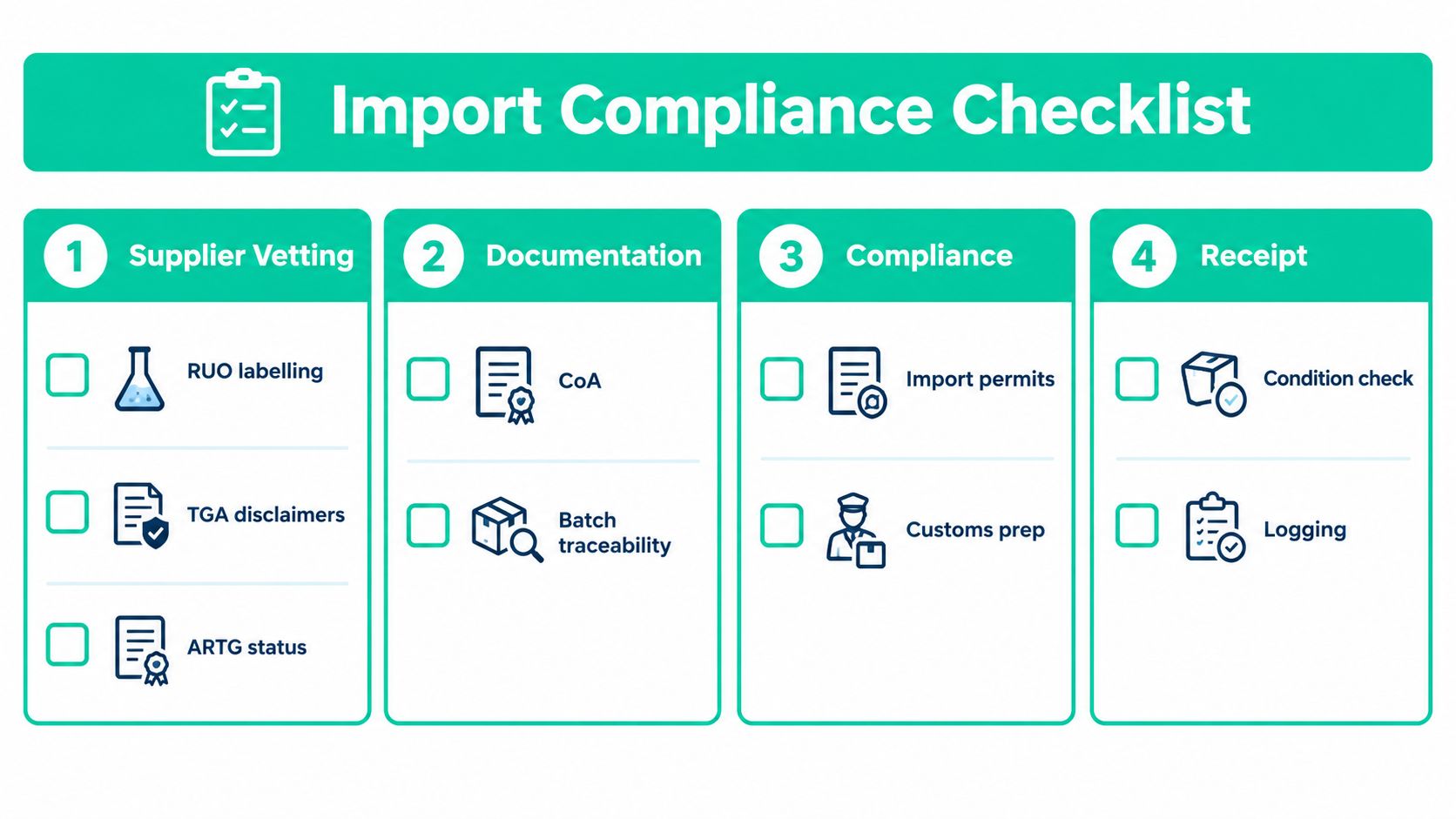
A wall-ready checklist should be short enough to use and detailed enough to stop a weak consignment from entering the freezer.
- Supplier vetting: Confirm RUO labelling, clear TGA-related disclaimers and the current ARTG position where relevant.
- Documentation: Require a batch-matched COA, SDS and packing slip with traceable identifiers.
- Order specification: Record the SKU, sequence, nominal amount, purity requirement, vial count and whether a single-lot 10-pack is preferred.
- Logistics: Confirm domestic dispatch, packaging, tracking and the expected delivery window in writing.
- Receipt control: Inspect the vials, reconcile the batch records, record freezer location and complete quarantine sign-off.
Buyer FAQs
Is WHS documentation supplied with every shipment?
Confirm this before ordering. The supplier should identify whether an SDS is supplied automatically, available on request or accessible through a document portal. Store the current SDS with the product record and check that the document describes the supplied material.
Do SDS files follow Australian GHS formatting?
Ask the supplier to confirm the format and revision status. An Australian laboratory should have a usable SDS for every stored chemical and should escalate gaps to its WHS or safety contact.
What are typical Australian support hours?
Support hours vary by supplier. Request the published hours, time zone and escalation contact before a deadline-driven project begins. A generic contact form isn't a substitute for a defined process when a shipment is damaged or a record is missing.
What should we do if the COA arrives after the vials?
Keep the consignment in quarantine. Don't place it into active experiments until the lot-matched COA is received, reviewed and attached to the receipt record.
How should we escalate a cold-chain breach?
Photograph the packaging, note the delivery time and temperature evidence, preserve the shipment, and contact the supplier and your internal quality or WHS lead. Don't decide that the material is acceptable solely because the vial looks normal.
Bulk Aussie Peptides supplies research-use-only peptides in domestic Australian formats, including 10-pack options, product specifications and batch documentation for laboratory procurement review. Visit Bulk Aussie Peptides to review available research materials and documentation before raising your next quote or purchase order.