
Collagen Peptides in Australian Laboratory Research

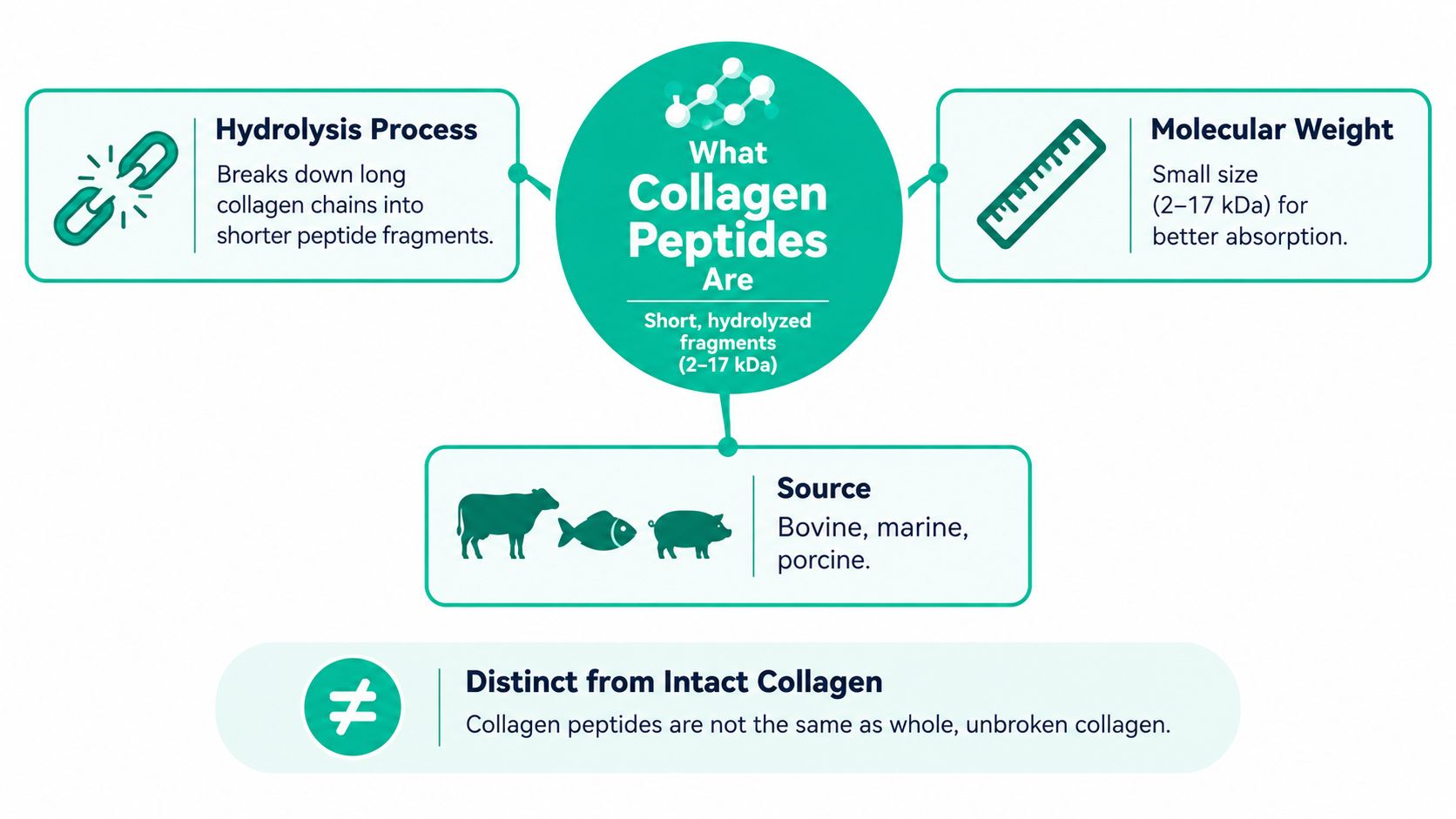
Collagen peptides are short, hydrolysed fragments of parent collagen, typically 2–17 kDa, supplied for laboratory research use only. Their practical value in an Australian laboratory depends less on a wellness label than on whether the lot's source, molecular-weight distribution, identity, purity and storage history are documented well enough for the intended assay.
A principal investigator may be reviewing a new vial while a technician is preparing an extracellular-matrix experiment, a scaffold formulation or a migration assay. The immediate question is simple but consequential: what is inside the vial, and can its measured properties be compared with the previous lot? Collagen peptides are mixtures rather than single uniform molecules, so procurement and characterisation must be treated as part of experimental design.
Table of Contents
- What Collagen Peptides Are in a Research Context
- How Collagen Peptides Are Produced and Characterised
- Research Applications from ECM Studies to 3D Bioprinting
- Documentation and Quality Requirements for Procurement
- Handling, Reconstitution and Aggregation Control
- Storage, Stability and Assay Considerations
- Australian Procurement and Logistics for Research Programs
What Collagen Peptides Are in a Research Context
Start with the parent material. Collagen peptides are short fragments produced by hydrolysing collagen, the structural protein from which the original long chains and higher-order structures are derived. They're distinct from intact, triple-helical collagen and from gelatin, even though all three may originate from collagenous tissue. Chemical characterisation has identified collagen-derived peptides ranging from 5 to 18 amino acids in length, demonstrating that a preparation can contain many short sequences rather than one molecular species (chemical characterisation of collagen-derived peptides).
Structure and source
Collagen types matter because the source protein influences the sequence pool. Type I is associated mainly with skin, bone, tendon and ligament research, while Type II is associated with cartilage. Type III is also found in connective tissue, and other fibrillar and non-fibrillar collagens contribute different biological contexts. Hydrolysis breaks these parent structures into smaller fragments, but it doesn't make every resulting fragment identical.
Researchers may encounter sequence motifs such as RGD-like binding regions or collagen-recognition motifs including GFOGER. Whether a motif remains present, at what abundance and in what surrounding sequence context can affect cell attachment, receptor binding or matrix interaction. A bovine, marine, porcine or recombinant source may therefore produce a different mixture, even when the product name appears similar.
Laboratory rule: Treat the material as a heterogeneous peptide preparation unless the supplier provides evidence supporting a narrower identity claim.
The word “collagen” also needs careful handling in documentation. A vial labelled collagen peptides may contain hydrolysed material with a broad molecular-weight distribution, not intact collagen fibres or a reconstituted triple helix. All discussion here concerns laboratory research. Products are supplied strictly for laboratory research purposes only. They are not for human consumption, therapeutic use or diagnostic procedures.
The rest of the workflow follows from this definition. A lab must connect the intended assay to the preparation's source, molecular-weight profile, identity evidence, purity documentation and handling record.
How Collagen Peptides Are Produced and Characterised
Production generally begins with a collagen-containing source tissue or a defined recombinant material. Hydrolysis, often enzyme-mediated, cleaves the parent protein into shorter chains. The hydrolysis conditions influence the resulting average size and distribution, so “hydrolysed” describes a production step, not a complete analytical specification. A 2024 review of collagen peptide analysis identifies the degree of hydrolysis as a determinant of average peptide length and explains that laboratories can quantify this using mean molecular weight.
A useful working range for collagen peptide preparations is 2–17 kDa, but a single average is insufficient for lot comparison. One profiling study reported a distribution of 1.35–17 kDa by size-exclusion chromatography and 2–14 kDa by mass spectrometry RP-UPLC (collagen peptide profiling study). The difference between methods is itself instructive. Each technique measures a related property through a different separation or detection principle, so the method and reporting convention belong in the batch record.
A practical characterisation stack
A new lab member should ask what each method contributes:
- Size-exclusion chromatography: Estimates the molecular-size distribution and can reveal shifts between lots.
- SDS-PAGE or capillary electrophoresis: Provides an orthogonal view of size-related behaviour, although very short peptides may require method-specific interpretation.
- RP-HPLC: Separates detectable components and supports chromatographic purity assessment.
- Mass spectrometry: Helps confirm peptide mass patterns and, where validated, sequence-related identity.
- Amino acid analysis: Characterises overall composition and supports comparison with collagen-derived material.
- Endotoxin testing: Supplies relevant information for cell-based work, but suitability still depends on the assay and the laboratory's acceptance criteria.
| Parameter | Typical value | Analytical method |
|---|---|---|
| Peptide preparation range | 2–17 kDa | Size-exclusion or related molecular-weight methods (Frontiers review) |
| Reported mass distribution example | 1.35–17 kDa | Size-exclusion chromatography (profiling study) |
| Reported mass distribution example | 2–14 kDa | Mass spectrometry RP-UPLC (profiling study) |
| Peptide sequence length example | 5–18 amino acids | Chemical characterisation and peptide identification (collagen-derived protein study) |
Source tissue adds another variable. Bovine, porcine and marine materials can differ in sequence composition, processing history and contaminant profile. Recombinant material introduces a different manufacturing context again. The procurement specification should therefore record source, hydrolysis description, analytical method, lot number and any stated limits for impurities.
Molecular-weight distribution is the comparison parameter. An average can conceal a broad tail of larger or smaller components, and that tail may influence migration, adsorption, binding and solution behaviour. When a downstream result changes, the laboratory should be able to distinguish biological variation from a changed peptide profile.
Research Applications from ECM Studies to 3D Bioprinting
The most useful way to understand collagen peptides in research is to connect a measured property to an experimental function. In a three-dimensional bioprinting project, for example, a team may add hydrolysed collagen material to a synthetic hydrogel or an electrospun scaffold. The purpose isn't to claim a treatment effect. It's to modify the material environment so researchers can study cell attachment, matrix remodelling or scaffold degradation under controlled conditions.
Synthetic polymers can lack native cell-recognition features. Collagen-derived sequences may provide biochemical cues within a printable matrix, while the peptide preparation's solubility and molecular-weight distribution can affect mixing, viscosity and uniformity. A bioengineer may also adjust the collagen-peptide content or cross-linking conditions to investigate how quickly a scaffold changes as cells deposit new extracellular material.
From matrix coatings to migration assays
Common research contexts include:
- Cell-culture coatings: Researchers exploit solubility and matrix-related sequence availability when coating culture surfaces for adhesion studies.
- Tissue-engineering scaffolds: Peptide-functionalised materials can be assessed for printability, porosity, degradation and cell compatibility.
- Scratch and transwell assays: Teams may examine migration or wound-closure behaviour in vitro, provided the assay controls separate material effects from cell-density and media effects.
- Integrin-binding studies: Mapped motifs can be tested using purified receptors, engineered surfaces or cell-based binding systems.
- In vivo biomaterials research: Rodent models may be used to examine matrix remodelling or implant biocompatibility, subject to institutional animal ethics approval.
The source and hydrolysis profile matter in each case. A preparation with a different distribution may produce different adsorption or diffusion behaviour, even if the nominal mass added to a formulation is unchanged. Low antigenicity should never be assumed from the phrase “collagen peptides” alone. It must be assessed in the context of source, purification, endotoxin results and the biological system.
The Australian Institute of Sport describes collagen-specific peptides as having limited in vivo evidence overall, while noting that exercise-paired protocols have been investigated for connective-tissue outcomes (AIS collagen support guidance). That evidence is not a justification for therapeutic claims, and it doesn't replace a defined laboratory model.
In vivo work must follow the relevant institutional AEC requirements, approved protocol and local ethics procedures. Research-use material isn't a clinical product.
An especially important distinction is between a material study and a human outcome claim. A scaffold experiment may show altered cell attachment under specified conditions. It cannot, by itself, establish a therapeutic, cosmetic or diagnostic result.
Documentation and Quality Requirements for Procurement
Documentation is the first line of defensibility when a laboratory buys collagen peptides. Before issuing a purchase order, the procurement officer and principal investigator should agree on what the assay requires and then check whether the supplier's documents address those requirements.
A batch record checklist
Begin with the certificate of analysis. Review the reported identity, chromatographic purity, molecular-weight data, residual solvents, heavy metals, microbial limits and endotoxin information where relevant. Don't treat an empty field as a clean result, and don't assume that a supplier's chromatogram represents independent testing unless the document identifies the testing laboratory and method.
Next, check traceability. The lot number on the vial should match the lot number on the certificate, specification sheet, invoice and internal sample register. If mass-spectrometry data or chromatograms are supplied, file them with the batch record rather than leaving them in an email thread. A manufacturer-provided document can be useful, but it isn't equivalent to independent laboratory testing.
A practical review should ask:
- Does the method match the property the lab needs to measure?
- Is the result batch-specific?
- Are acceptance criteria stated?
- Is the source tissue or production route identified?
- Are storage conditions and retest information documented?
- Can the supplier distinguish manufacturer-provided data from independent results?
The 10-pack vial format can support longitudinal studies because separate vials reduce the need to reopen a shared container. That format doesn't prove quality, but it can make aliquot planning and operator-level traceability more straightforward.
Australian regulatory assumptions require care. The provided material doesn't verify a general claim that the TGA does not regulate every research-use-only peptide, so that statement shouldn't be used as a blanket procurement conclusion. Laboratories should instead confirm their own institutional, biosafety, import and quality-system requirements.
For batch records and available documentation, laboratories can review the COA library. Confirm whether each document is current, batch-specific and independent before relying on it for a study decision.
Handling, Reconstitution and Aggregation Control
Collagen peptide preparation is a concentration problem as much as a dissolution problem. Record the mass concentration in mg/mL, and convert to molarity only when the molecular-weight basis is clear. For a heterogeneous preparation, molarity can be an approximation because the vial doesn't contain one defined molecular mass.
For dilution work, use the standard relationship C₁V₁ = C₂V₂. Here, C₁ is the starting concentration, V₁ is the volume taken from that stock, C₂ is the target concentration and V₂ is the final volume. An online peptide reconstitution guide or concentration calculator can verify the arithmetic, but it shouldn't replace recording the equation, units and assumptions in the protocol.
Bench-side handling
Bring a lyophilised vial to room temperature before opening it. Opening a cold vial in humid laboratory air can introduce moisture and cause hygroscopic powder to clump. Use a desiccator or suitable controlled workspace where the laboratory's procedures require it.
Choose the solvent according to the preparation and assay. Dilute acetic acid or sterile filtered water may suit many collagen peptide preparations, while DMSO should be reserved for a specific assay need because it can affect cells, enzymes and readouts. Confirm compatibility with the buffer, plate material and detection method before preparing a larger stock.
Add solvent slowly along the inner vial wall, wet the powder fully and dissolve with gentle swirling. Avoid vigorous vortexing and foaming, especially where air-liquid interfaces may promote inconsistent material behaviour. If turbidity appears, record the observation rather than filtering it away without checking whether the filter removes part of the preparation.
A practical concentration check is important at higher concentrations. The supplied handling guidance identifies above 5.0 mg/mL as a point where viscosity may increase significantly, so verify volume and concentration before attempting uniform pipetting. Use low-bind plasticware if adsorption could affect a low-concentration assay.
Finally, prepare single-use aliquots after reconstitution. The supplied handling guidance recommends storage at −20°C, or 2–8°C for active in-vitro use within 24–48 hours, and advises avoiding repeated freeze-thaw cycles. These are laboratory handling parameters, not human-use instructions.
Storage, Stability and Assay Considerations
Storage decisions should follow the claim the experiment needs to support. A lyophilised sample is not the same analytical object as a reconstituted stock that has been repeatedly warmed, mixed and frozen. The supplied storage guidance describes lyophilised collagen peptides as stable at 2–8°C for months to years, while reconstituted material degrades faster and should be divided into single-use aliquots at −20°C or −80°C according to the laboratory's validated procedure.
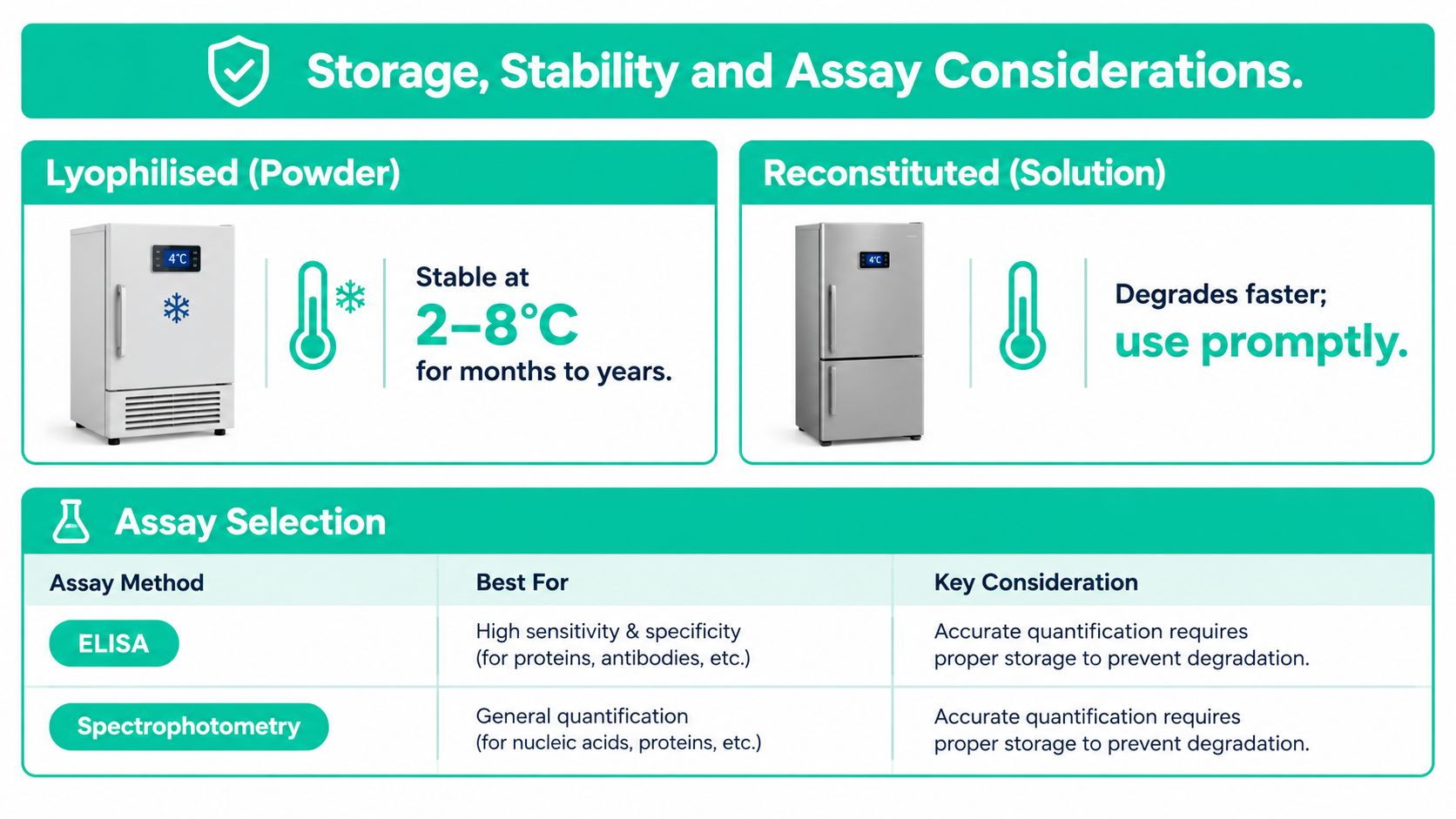
A repeated freeze-thaw history can undermine interpretation. If a functional result is attributed to a stored stock, the batch record should show when the stock was prepared, how it was aliquoted, where it was stored and how many temperature excursions occurred. A long study period doesn't automatically make a single reconstituted vial suitable for the entire project.
Match the assay to the question
- HPLC: Useful for checking chromatographic purity and detecting changes in the chemical profile.
- Mass spectrometry: Supports identity and mass-pattern assessment.
- Circular dichroism or FTIR: May help investigate secondary-structure-related changes, provided the preparation and method are appropriate.
- Cell-based bioassays: Assess functional behaviour in the defined biological model, but they don't replace chemical identity testing.
- Reference monographs: Where applicable, recognised collagen peptide monographs can provide additional method context, but the laboratory must confirm that the material and method fall within the monograph's scope.
A peptide storage and stability guide can be used alongside the supplier's batch documentation, not instead of it. A storage page may describe general principles, whereas a study requires batch-specific records and validated laboratory controls.
The analytical sequence should be proportionate to the claim. If the study compares cell behaviour between lots, verify the lots chemically before interpreting the biology. If the study measures concentration, select a method that distinguishes intact preparation from degradation products and account for matrix interference.
Australian Procurement and Logistics for Research Programs
Australia's collagen peptide supply chain remains import-dependent. One market estimate places the share of domestic blending and repackaging supplied by imported raw material at 70–80%, while marine-sourced peptides are gaining share (Australian collagen peptide market estimate). That makes source documentation and transport records important, particularly where biological-origin hydrolysates are involved.
The market estimate also places Australia's collagen peptide market at about AUD 180–220 million in 2023 and projects AUD 240–290 million by the end of 2025, with an estimated 12–14% CAGR over 2020–2025 (Australian market analysis). These are market estimates, not a guarantee of product availability, pricing or suitability for a particular laboratory.
A procurement file should be assembled before the order progresses. Request the batch-specific COA, SDS and analytical data, confirm the source and lot number, and check whether the proposed material fits the approved protocol. For biological-origin hydrolysates, confirm customs and import requirements directly. Don't assume that a synthetic-peptide process applies to every collagen-derived shipment.
| Parameter | Typical expectation | Verification action |
|---|---|---|
| Source | Bovine, porcine, marine or recombinant material may be available | Request source and production details |
| Documentation | COA, SDS and specification information | Confirm batch number and testing source |
| Pack format | 10-pack vial formats may support study allocation | Check per-vial quantity and study consumption |
| Dispatch | Supplier-specific domestic processing timeframe | Confirm before the purchase order |
| Transport | Temperature and handling requirements depend on material | Check packaging and receiving procedure |
| Pricing | Supplier and quote dependent | Obtain a current written quote |
| Import status | Depends on source, shipment and jurisdiction | Confirm with supplier and relevant authorities |
Procurement FAQ
Is a specific freight surcharge verified? No. Current freight charges require direct confirmation at quotation.
Are pricing tiers verified? No. Bulk, institutional and wholesale pricing can change, so request a current written offer.
Is every collagen peptide shipment exempt from import paperwork? No general exemption should be assumed. Biological-origin materials may require additional documentation.
Can a supplier's COA establish independent verification? Not by itself. Check whether the analysis was performed by the manufacturer or an independent laboratory.
Bulk Aussie Peptides supplies research-use-only peptides and laboratory supplies, including documented product specifications, batch documentation and standardised 10-pack formats. Laboratories comparing collagen peptide lots can visit Bulk Aussie Peptides to review the available research catalogue and request current documentation before procurement.