
Epitalon Australia: A Research Procurement Guide
Preparing an Institutional Biosafety Committee submission or a bulk peptide order can expose an uncomfortable gap in conventional thinking: the main risk may not be understanding epitalon's biology, but proving exactly what has been ordered, how it will be used and where it sits under Australian regulation.
For Australian laboratories, epitalon procurement should begin with evidence classification, batch documentation and governance review. The compound is a synthetic tetrapeptide investigated mainly in laboratory and animal contexts, while the modern synthetic compound lacks independent, controlled human trials establishing longevity, sleep or immune benefits. It also has no Australian Register of Therapeutic Goods listing, so it isn't a registered therapeutic good for ordinary supply in Australia (Australian regulatory overview of epitalon).
This guide is written for laboratory managers, procurement teams, universities, biotechnology companies, CROs and research institutions. It deals with research-use-only purchasing, documentation, storage principles and verification. It doesn't provide human-use, dosing, administration or off-label guidance.
Table of Contents
- What Australian Researchers Need to Know About Epitalon Before They Order
- Epitalon Biology, Sequence and Research Context
- Certificate of Analysis Fields Australian Ethics Panels Scrutinise
- Reconstitution, Diluent Selection and Storage Principles
- Evaluating an Australian Peptide Supplier Without the Marketing Spin
- Bulk 10-Pack Format, Ordering Logistics and AUD Fulfilment
- Procurement Checklist and Research-Use-Only Disclosures
What Australian Researchers Need to Know About Epitalon Before They Order
What has to be on the file before a vial is ordered? For epitalon, the answer is not the product page. It is the research question, the assay design, the governance path and the documents that let a reviewer see what the batch is supposed to support.
A good procurement file starts with the model system and the intended endpoint. That lets procurement check whether a proposed batch matches the protocol, rather than treating the supplier's marketing copy as the specification. In practice, I look for the assay type, the required analytical paperwork and the approval pathway before anyone places an order.
Start with the research question
Epitalon has been studied in relation to telomerase activity, cellular ageing pathways and pineal-related mechanisms. Those areas may be relevant to in-vitro assays, preclinical work or animal studies, but they do not establish a therapeutic result in humans. The historical human literature is often discussed in relation to a 12-year randomised clinical study involving elderly patients with coronary disease and accelerated cardiovascular ageing, while the modern synthetic compound still lacks independent controlled human trials (discussion of the historical evidence and replication limits).
That distinction belongs in the protocol and in the purchase file. A cell-culture study, an animal model and any clinical claim sit in different evidentiary buckets, and a supplier should not blur them with broad RUO language. State the intended use plainly, for example an in-vitro assay or an approved preclinical protocol, and keep the wording aligned with what the batch can support.
Treat Australian status as a procurement checkpoint
Australia's regulatory position matters even when a product is sold as research only. The TGA framework looks at whether a product is an approved therapeutic good, not at the sales wording attached to it. Unapproved peptides with pharmacological activity can still fall under prescription-only controls, and importation or supply pathways may trigger TGA or Border Force scrutiny (TGA framework for unapproved therapeutic goods).
Before purchase, record the following:
- Governance reference: Link the order to the relevant IBC, ethics or institutional approval record.
- Material identity: Match the compound name, sequence and formulation description to the protocol.
- Batch evidence: Request the lot-specific COA and retain it with the purchase record.
- Import position: Confirm whether the proposed route and paperwork fit the laboratory's research workflow.
- Use boundary: Keep internal records within bona fide laboratory research activities.
- Regulatory framing: Record the governance reference under which the unapproved compound is held and confirm the activity stays within bona fide laboratory research, not human therapeutic use.
The Australian research peptide regulation guide is a practical starting point for the questions that need to be checked before ordering. Price should come after traceability and governance. That order matters in real procurement files.
Products are supplied strictly for laboratory research purposes only. They are not for human consumption, therapeutic use or diagnostic procedures.
Epitalon Biology, Sequence and Research Context
Epitalon, also written as epithalon in some literature, is a synthetic tetrapeptide associated with the sequence Ala-Glu-Asp-Gly. Peer-reviewed work has mainly examined it in preclinical ageing and pineal-related research, rather than as an approved therapeutic product in Australia (Australian research peptide reference).
Researchers have investigated whether the sequence influences telomerase activity and cellular ageing pathways. Some discussions focus on possible effects involving hTERT expression, while other work has considered pineal function and circadian biology. Those mechanisms can justify a laboratory hypothesis, but they don't establish that epitalon delivers a clinical longevity, sleep or immune outcome.
Separate the evidence categories
The distinction between evidence types should appear in the protocol, grant application and purchasing file.
In-vitro research can examine cellular endpoints, gene expression, telomerase activity or biomarker modulation under defined experimental conditions. Results describe the tested cells, concentrations and assay design. They don't demonstrate activity in an organism.
Animal research can explore tissue-level or physiological responses in a controlled model. Translation remains uncertain because species, exposure, metabolism and disease context may differ.
Human evidence requires careful examination of the compound, formulation, control group, endpoints and independent replication. The historical evidence often cited for the epitalon family relates to epithalamin or older research, rather than modern synthetic epitalon tested in independently controlled trials. No peer-reviewed randomised controlled human trial has established clinical longevity, sleep or immune benefits (summary of the contemporary evidence gap).
A procurement team shouldn't solve that evidence gap by overstating the compound's purpose. The correct approach is to name the mechanistic question, specify the model and document the limitations.
Epitalon at a glance
| Attribute | Value | Procurement relevance |
|---|---|---|
| Compound identity | Synthetic tetrapeptide associated with Ala-Glu-Asp-Gly | The sequence should match the protocol and supplier documentation |
| Research context | Mainly preclinical ageing and pineal-related research | Supports laboratory investigation, not a clinical-use claim |
| Key research areas | Telomerase activity, cellular ageing pathways and biomarker modulation | Defines the analytical and biological endpoints to plan |
| Australian status | Not listed on the ARTG | Requires careful review of supply, importation and intended use |
| Evidence limitation | No independent controlled human trials for the modern synthetic compound | Prevents unsupported efficacy language in applications |
The biology therefore determines what the COA must answer. If an assay is sensitive to synthesis fragments, counter-ions or identity errors, the review panel needs batch-specific analytical evidence rather than a general catalogue statement.
Certificate of Analysis Fields Australian Ethics Panels Scrutinise
A COA is useful only when the reviewer can connect it to the exact material being purchased. A generic document with no lot match may describe a representative product, but it doesn't prove that the vial in the laboratory has the same result.
Four fields deserve close review
HPLC purity and chromatogram quality should be assessed against the laboratory's method requirements. The reported purity value matters, but so does the chromatogram. Reviewers may want to see whether the main peak is resolved from synthesis-related impurities, truncated sequences or other peaks that could affect a cell-based endpoint. If the chromatogram is absent, unreadable or detached from the lot number, ask for clarification before submission.
ESI-MS identity confirmation supports sequence verification by comparing the observed mass with the expected mass for the specified compound. The document should explain the result sufficiently for the reader to distinguish the molecular ion from common adducts. A mass figure without an interpretable spectrum or lot reference leaves an identity question unresolved.
Net peptide content and counter-ion disclosure are separate from gross vial weight. Acetate or TFA residues can affect how a laboratory interprets the material balance and calculates analytical concentrations. The COA should state whether the reported content refers to net peptide, salt form or another basis. If that distinction is missing, the assay worksheet should flag the uncertainty rather than treating gross mass as active peptide without comment.
RUO batch traceability connects the analytical result to the physical material. Retain the lot number, manufacture or release information where supplied, label image, dispatch record and chain-of-custody documents. Research procurement guidance in Australia commonly emphasises a batch-specific COA, lot traceability and explicit research-use-only labelling (procurement documentation guidance).
Practical rule: A COA supports verification only when its lot identifier matches the vial, invoice and internal receiving record.
Match the document to the question
| COA field | What it reports | Reviewer question it resolves |
|---|---|---|
| HPLC | Chromatographic profile and stated purity | Could related substances confound the proposed assay? |
| ESI-MS | Observed mass and identity evidence | Does the material correspond to the named peptide sequence? |
| Net peptide content | Peptide basis, with counter-ion information where supplied | Can the laboratory document concentration calculations transparently? |
| RUO traceability | Lot, document identity and research-only status | Can the institution link the material to a controlled procurement record? |
Common delays arise when a supplier provides a product-level specification instead of a lot-specific COA, labels the document as independent when it is manufacturer-provided, or omits counter-ion information. Manufacturer documentation isn't equivalent to independent testing. Ask the supplier to identify whether each document is manufacturer-provided, independently generated, pending or unavailable.
The same discipline applies to grant applications. State what the COA demonstrates, what it doesn't demonstrate and how the laboratory will manage any remaining uncertainty.
Reconstitution, Diluent Selection and Storage Principles
Reconstitution should be treated as a laboratory preparation step governed by the approved protocol, not as a general-use instruction. The essential calculation is concentration, expressed as mass divided by final liquid volume.
For example, if a laboratory has a vial labelled with a known peptide mass, the worksheet should record:
- The labelled mass of peptide.
- The volume of diluent added.
- The resulting concentration in mass per millilitre.
- Any conversion from milligrams to micrograms.
- The lot number and preparation date.
- The person who prepared and checked the calculation.
The calculation is:
Concentration = peptide mass ÷ final solution volume
A dilution plan should then convert the stock concentration into the concentration required by the approved in-vitro assay. Don't use a syringe graduation as a substitute for a validated laboratory volume measurement, and don't transfer human-administration conventions into a research protocol.
Select the diluent against the assay
Epitalon is described in the supplied research context as hydrophilic, so aqueous laboratory diluents may be considered where they're compatible with the assay. The choice between sterile water, PBS or another laboratory-approved diluent should be determined by pH tolerance, osmolality, downstream cell viability and the validated method.
Bacteriostatic water contains a preservative and shouldn't be treated as interchangeable with every cell-culture workflow. For sensitive assays, the laboratory should document solvent compatibility and include the appropriate vehicle control. Any sterile filtration decision should follow the laboratory's validated process, since filtration can introduce material loss or adsorption.
Protect the prepared material
Lyophilised peptides are commonly stored frozen for longer-term research stability. Reconstituted solutions are typically refrigerated, protected from light and managed to limit repeated freeze-thaw cycles (research peptide storage principles).
| Diluent volume | Final concentration | Typical use case |
|---|---|---|
| Volume specified in the approved protocol | Calculated from labelled mass and final volume | Preparing a documented laboratory stock |
| Smaller validated volume | Higher calculated stock concentration | Reducing handling volume where the assay permits |
| Larger validated volume | Lower calculated stock concentration | Supporting a dilution series or repeated analytical sampling |
Where practical, divide a prepared stock into labelled aliquots rather than repeatedly thawing the same container. The storage record should identify the lot, concentration, diluent, aliquot identifier, temperature condition and discard criteria. These controls protect the experiment from avoidable variation, but they don't turn an unapproved peptide into a product suitable for human use.
The research peptide reconstitution guide may help teams structure their calculation and storage records. Use it alongside the institution's SOPs, biosafety requirements and assay-specific validation.
Evaluating an Australian Peptide Supplier Without the Marketing Spin
A supplier comparison should begin with documents, not testimonials. The central question is whether the vendor can provide enough information for a laboratory to identify, receive, test and account for the material.
Compare evidence sources carefully
An in-house COA can be useful for release documentation, but it reflects the supplier's own quality process. An independent laboratory report may provide additional assurance, provided the report identifies the same lot and the testing laboratory clearly. Neither document should be described as stronger than it is.
Ask for:
- Source labelling: Is the document manufacturer-provided or independently generated?
- Lot matching: Does the COA number appear on the vial, invoice and dispatch record?
- Analytical scope: Are identity, chromatographic results and content information formally reported?
- RUO wording: Is the research-only boundary explicit on the product and order documents?
- Document timing: Is the active batch COA available before purchase, after purchase or only on request?
Reseller layering creates another traceability problem. If a product passes through several businesses, ask who synthesised it, who tested it and who repackaged it. A low price doesn't compensate for an unclear chain of custody.
Review the commercial record
For institutional purchasing, confirm the legal entity, ABN, physical business address and invoice details. Check whether pricing is shown in AUD, whether GST treatment is clear for the buyer's circumstances and whether a formal quote or purchase-order pathway exists.
Operational claims require the same caution as analytical claims. Confirm dispatch location, processing windows, shipping route and support hours in writing before a time-sensitive study is scheduled. If the supplier's website and quotation differ, the quotation should be treated as the working record.
| Criterion | What to verify | Red flag |
|---|---|---|
| COA source | Manufacturer or independent laboratory status | Source isn't identified |
| Lot traceability | Matching identifiers across COA and vial | Generic or undated document |
| RUO position | Clear wording throughout procurement records | Therapeutic language appears on the page |
| Business identity | ABN, legal entity and address | Only a contact form or trading name |
| Fulfilment | Dispatch origin and documented route | Delivery promises without a stated basis |
| Institutional support | Quotes, purchase orders and invoice requirements | No process for university procurement |
| Reseller structure | Synthesis, testing and repacking responsibilities | Multiple unexplained intermediaries |
A procurement file should let another staff member reconstruct the order without relying on memory or a sales conversation.
Bulk 10-Pack Format, Ordering Logistics and AUD Fulfilment
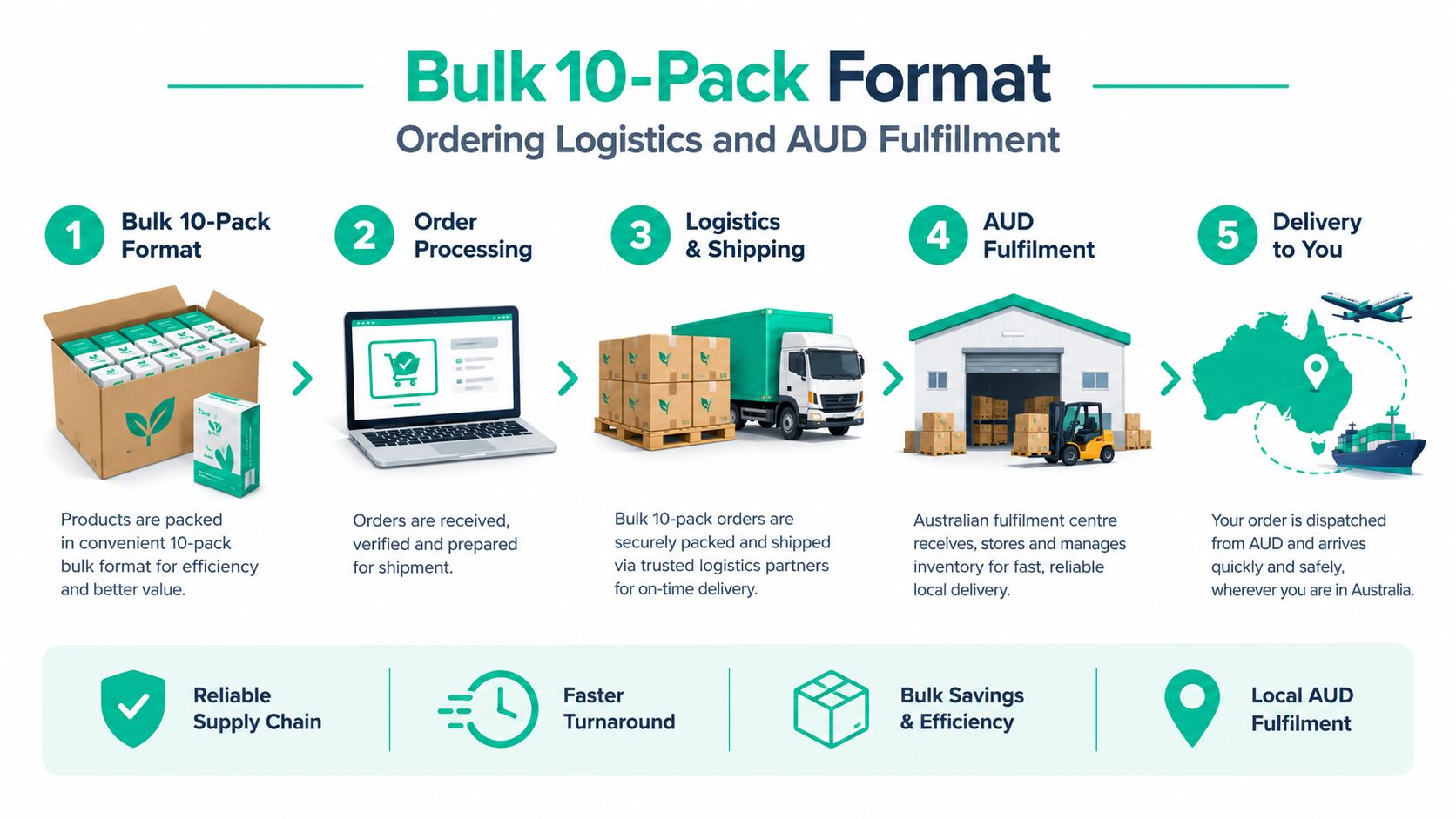
A bulk format can simplify study planning when the laboratory needs repeated access to the same material. It doesn't remove the need to verify each lot, and it shouldn't be treated as evidence that every vial in a programme has identical analytical results.
Before checkout, confirm the actual pack configuration, per-vial mass, lyophilised presentation, available batch documents and whether the quotation covers the required number of lots. These details must come from the current product specification or written quote. They shouldn't be inferred from another peptide's listing.
Build the order around the study record
A practical institutional order pack should contain:
- Material specification: Compound identity, sequence where stated, presentation and intended research use.
- Batch evidence: Lot-specific COA, testing-source label and any available independent report.
- Commercial record: Quote, purchase order, invoice, GST treatment and approved supplier details.
- Transport record: Dispatch information, tracking and any temperature or handling documentation supplied.
- Receiving record: Vial labels, lot match, packaging condition and storage entry.
Domestic and international fulfilment can involve different customs, import and seizure risks. Australian laboratories should confirm the route and required paperwork before payment, particularly because imported unapproved peptide products may face import restrictions or border action (international procurement and importation considerations).
Don't publish or rely on unsupported delivery times, warehouse claims, payment methods or GST statements. Ask the supplier to confirm current AUD pricing, institutional payment options, processing windows and dispatch location in the quotation. For a bulk order, request the procurement information pack and ask whether documents can be aggregated by lot without implying that one batch result applies to another.
Procurement Checklist and Research-Use-Only Disclosures
The receiving process is where a well-prepared order either becomes auditable or creates future work. Treat each checkpoint as a document request, not a verbal assurance.
Before the order
Confirm the approved research purpose and retain the relevant IBC, ethics or governance reference. The protocol should identify the model system, planned assay, storage conditions and responsible laboratory staff.
Then verify:
- Regulatory framing: Record that epitalon isn't listed on the ARTG and that the proposed activity is bona fide laboratory research, not human therapeutic use.
- Supplier identity: Match the legal entity, ABN and invoice details to the institution's purchasing requirements.
- Batch documentation: Obtain the lot-specific COA and identify whether testing is manufacturer-provided or independent.
- Import pathway: Check whether the proposed shipment and documentation satisfy the laboratory's internal requirements and applicable Australian controls.
- Order scope: Confirm pack configuration, per-vial quantity and quotation details before approval.
When the material arrives
Compare the vial label with the purchase order, invoice and COA. Photograph the packaging if the institution's SOP permits, record the receiving date and note any damage, missing documents or mismatch in identifiers.
Create a storage log that records:
- Lot and vial identifiers: Preserve the original label information.
- Condition on receipt: Note packaging and lyophilised presentation where applicable.
- Storage location: Record the freezer or refrigerator location used by the laboratory.
- Access history: Track movement, aliquoting and disposal.
- Document location: Link the physical material to the electronic COA and procurement file.
Laboratories should also retain cold-chain or dispatch records where supplied. If documentation is missing, quarantine the material under the institution's procedure until the responsible manager decides whether it can be released for the approved study.
During annual review
Use the same file for ethics renewals, grant reporting and internal audits. A complete record contains the approval reference, supplier quote, lot-matched COA, HPLC and ESI-MS evidence where provided, vial label, dispatch record, storage log and RUO statement.
The regulatory distinction remains important. TGA guidance treats unapproved peptides as not having been assessed for safety, quality or effectiveness, and research-use-only labelling doesn't create approval for therapeutic supply. Keep the material, documentation and language within the approved research boundary.
Products are supplied strictly for laboratory research purposes only. They are not for human consumption, therapeutic use or diagnostic procedures.
Bulk Aussie Peptides offers research-use-only peptide supply, bulk formats, product specifications and batch documentation for Australian laboratory procurement. For an Epitalon project, review the available lot documents and current ordering information before committing funds by visiting Bulk Aussie Peptides.