
Semax Australia: A Research Buyer's Practical Guide
Semax in Australia sits in a narrow but active research market, not a mainstream therapeutic one. One Australia-focused price comparison tracked 27 suppliers, 33 listings, and 31 shown in stock, with a reported range from A$4.16/mg to A$13.00/mg and a median of A$7.00/mg. That spread matters because it shows buyers can compare suppliers, but they still need to separate price from documentation quality, regulatory positioning, and batch verification before anything reaches a laboratory bench. Australian Semax price comparison and supply snapshot
For procurement teams, the practical question is simple: what exactly is being bought, under what regulatory frame, and with what proof of identity? In Australian settings, Semax is best treated as a research-use-only peptide with local supply and local compliance implications, not as a clinical product. That makes the decision path more disciplined than a normal catalogue purchase, because the buyer has to check COAs, confirm end use, and align the order with institutional controls rather than just availability.
Table of Contents
- What This Guide Covers for Australian Research Buyers
- Semax Identity and Research Context
- Regulatory Status in Australia
- Australian Supply Landscape and Pricing
- Documentation and Batch Verification
- Logistics, Storage and Laboratory Handling
- Procurement Checklist and Common Questions
What This Guide Covers for Australian Research Buyers
Procurement decisions for Semax in Australia depend on evidence that can survive internal review. The product is presented as a synthetic seven-amino-acid heptapeptide for laboratory research, so the buyer's task is to assess identity, documentation, supplier controls, and domestic fulfilment before approving an order.
For semax australia buyers, the absence of approved-therapeutic status creates three practical procurement gates: confirm research use only labelling, match the batch or lot number to the certificate of analysis, and archive dispatch records before the material reaches the laboratory. These checks convert a catalogue listing into a traceable purchasing decision.
Australian supplier information commonly refers to research-use presentation, domestic dispatch, and batch paperwork. The Australian supplier FAQ on research peptide status and Australian research supply context illustrate the type of information buyers may encounter. The TGA position remains the relevant compliance frame for institutional review, so supplier wording should not be treated as proof of therapeutic approval.
What a buyer actually has to verify
Approval should rest on four checks. Confirm the label and stated end use. Match the vial identifier with the COA. Assess whether the documentation supports internal sign-off. Then check whether shipping, receipt, and storage arrangements fit the study timeline.
Practical rule: if a vendor cannot provide batch-level documentation before dispatch, place the order in review instead of approval.
This guide therefore focuses on identity records, regulatory positioning, price comparison, verification workflow, logistics, and procurement controls. It excludes human-use instructions, dosing guidance, and off-label claims, which do not answer the laboratory sourcing question.
Semax Identity and Research Context
Semax is a heptapeptide analogue of ACTH(4-10) with the sequence Met-Glu-His-Phe-Pro-Gly-Pro. PubMed-indexed research describes intranasal use in rat and human studies focused on learning, memory, and neurotropic effects, which is why it is often discussed in CNS research rather than in general peptide procurement. PubMed record on Semax identity and research context
Why identity matters in procurement
For a buyer, the molecular identity is not academic trivia. It is the anchor for every downstream document check, from the peptide name on the vial to the mass confirmation on the COA. If a supplier lists Semax but the documentation uses ambiguous naming, the risk is not just clerical, it can affect traceability, storage decisions, and institutional acceptance.
Semax has been discussed in relation to BDNF upregulation, neuroprotective research, and cognition-focused assays, but those are research themes, not therapeutic conclusions. The right procurement lens is therefore analytical, not promotional. The buyer should read the product as a defined scaffold for CNS-related laboratory work, then ask whether the supplier's documentation proves that the material matches the declared scaffold.
Semax Identity Snapshot
| Attribute | Value | Research Relevance |
|---|---|---|
| Compound class | Synthetic heptapeptide | Confirms a short peptide scaffold for CNS research |
| Sequence | Met-Glu-His-Phe-Pro-Gly-Pro | The identity marker that should align with the COA |
| Origin of reference | ACTH(4-10) analogue | Helps buyers interpret naming and related literature |
| Research context | Learning, memory, neurotropic studies | Frames expected assay and documentation needs |
| Physical format in supply chains | Lyophilised research vial | Supports storage and reconstitution planning |
A useful distinction for labs is that Semax is commonly treated as a standard peptide research material, while longer-acting analogues can appear separately in the literature or supplier catalogues. That matters because the label on the vial has to match the exact compound described in the study plan, not a nearby analogue with a similar name.
Regulatory Status in Australia
Australian demand does not create therapeutic approval. The TGA position is the first procurement checkpoint: Semax is not sold in Australia as a mainstream therapeutic good. An Australian supplier FAQ states that research peptides are not approved therapeutic goods and are not included on the Australian Register of Therapeutic Goods, so buyers should treat ARTG status as a documented regulatory question rather than infer it from local availability. Australian peptide FAQ on ARTG status
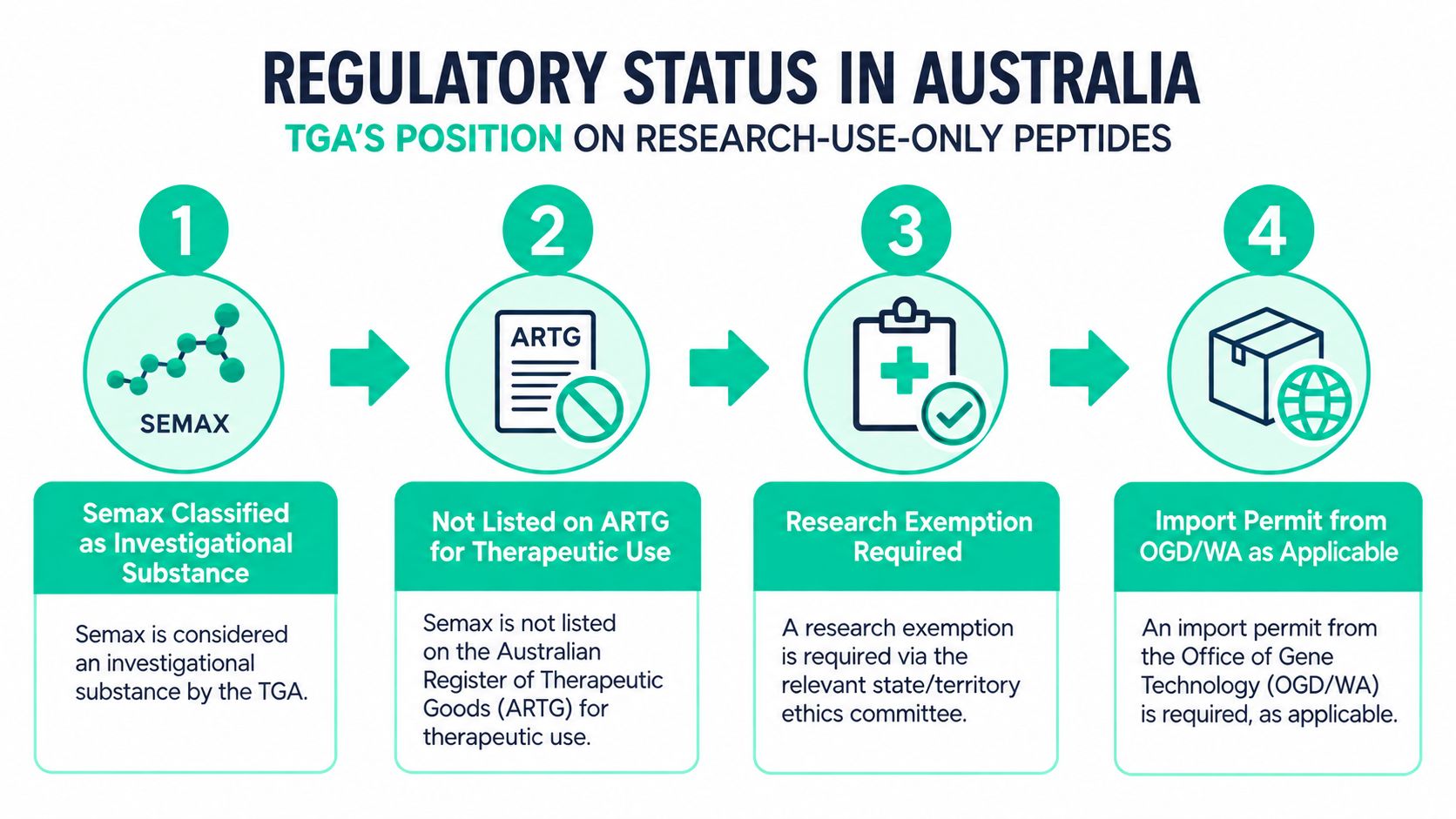
The procurement gap is clear: domestic supply may exist while approved-therapeutic status does not. For a university, CRO, or biotech group, the purchase therefore needs to fit a research-use-only framework. Before ordering, the buyer should confirm the proposed laboratory use, institutional procurement rules, ethics requirements, and any applicable import review. A vial label does not establish approval, and domestic dispatch does not remove Australian regulatory obligations.
A defensible file should connect intent, identity, and end use. It should contain the purchase rationale, the supplier's research-use statement, the COA, the lot reference, and any import or ethics documents required by the institution. The aim is not paperwork volume. Another reviewer should be able to determine why the material was purchased, what it is claimed to be, and where it will be used.
Fast dispatch can still leave the compliance file incomplete.
Supplier availability and permission for the proposed use are separate questions. A local listing may simplify fulfilment, but it does not establish that the institution can receive or use the material under its own controls. The Australian research peptide regulation guide provides a reference for placing these checks beside the purchase request.
Australian Supply Landscape and Pricing
Rather than repeating the headline counts, this section interprets the dispersion. The A$4.16/mg to A$13.00/mg spread may reflect packaging, documentation depth, domestic fulfilment layers, or distributor mark-ups, so procurement should filter first on batch traceability, then compare price with the A$7.00/mg median benchmark. The underlying comparison tracked 27 suppliers, 33 listings, and 31 shown in stock across the AU region. Australian Semax supply and pricing comparison
What the spread tells a procurement team
The market supports comparison, but price alone does not establish material quality. A lower-cost listing may provide limited batch information, while a higher per-milligram price may include different packaging, more complete documentation, domestic dispatch, or another distribution layer. Those differences should be recorded rather than treated as proof of superior analytical results.
The supply picture gives procurement teams room to shortlist vendors by COA access, lot traceability, fulfilment location, and dispatch reliability. A listing shown as available remains only a starting point. Stock status, product identity, and batch-specific records still require confirmation before a purchase order is approved.
| Metric | Value | Procurement Signal |
|---|---|---|
| Tracked suppliers | 27 | Competition supports comparison of documentation and service |
| Listings tracked | 33 | Multiple SKUs or variants may exist, so naming needs checking |
| Listings shown in stock | 31 | Active supply is present, but stock still needs verification |
| Price range | A$4.16/mg to A$13.00/mg | Pricing dispersion makes the lowest price an incomplete filter |
| Median price | A$7.00/mg | A practical benchmark for internal budget planning |
A second supplier describes Semax as a 10 mg research peptide sold in Australia at A$69.99 per vial, with domestic shipping and a stated limit to legitimate in-vitro research purposes. Australian supplier page for Semax research vial This price format reinforces the distinction between a domestic research-supply channel and an approved clinical channel. The listing should still be assessed against the buyer's documentation requirements.
For shortlisting, apply three filters. First, compare prices only after confirming that the listing is batch-specific. Second, distinguish domestic dispatch from generic shipping language. Third, check whether the catalogue entry provides COA access or only a marketing description.
Documentation and Batch Verification
A Semax vial enters a research inventory only when its paperwork supports the label. The Certificate of Analysis should identify the material, state its purity where tested, and connect the result to a specific batch. Because Semax lacks approved-therapeutic status in Australia, procurement teams should evaluate it as research material and separate supplier documentation from evidence of clinical approval. One Australian supplier reports HPLC-MS verification and same-business-day dispatch, but those operational claims do not replace review of the certificate. Australian Semax product page with verification and dispatch notes
Fields that deserve real attention
Review the COA against the vial and purchase record before the material is accepted:
- Batch or lot number, matching the vial label exactly.
- Product name, with no ambiguity between Semax and another peptide.
- Identity method, such as mass or chromatographic confirmation.
- Purity statement, where testing is reported.
- Analyst or laboratory identification, rather than anonymous paperwork.
- Issue date, confirming that the document relates to the supplied batch.
- Storage statement, aligned with the stated stability conditions.
- Any residual testing panel, since additional analytical detail improves review quality.
The buyer should also compare the COA format across available batches. Identical documents with changed dates but no unique lot information weaken traceability, while unexplained differences between the label, invoice, and certificate should pause approval. A document that omits analyst details, uses unclear reference standards, or cannot be tied to the offered vial belongs in exception review.
Decision rule: a manufacturer-issued COA can support procurement, but it is documentation, not proof of independent third-party testing.
Store the reviewed file with the purchase record and batch identifier. The COA library provides a practical place to compare certificates before approval. Its value is traceability, not PDF volume: the offered batch should connect clearly from catalogue entry to vial label to analytical record. That workflow gives Australian research buyers a firmer basis for comparing suppliers when domestic demand exists without approved-therapeutic status.
Logistics, Storage and Laboratory Handling
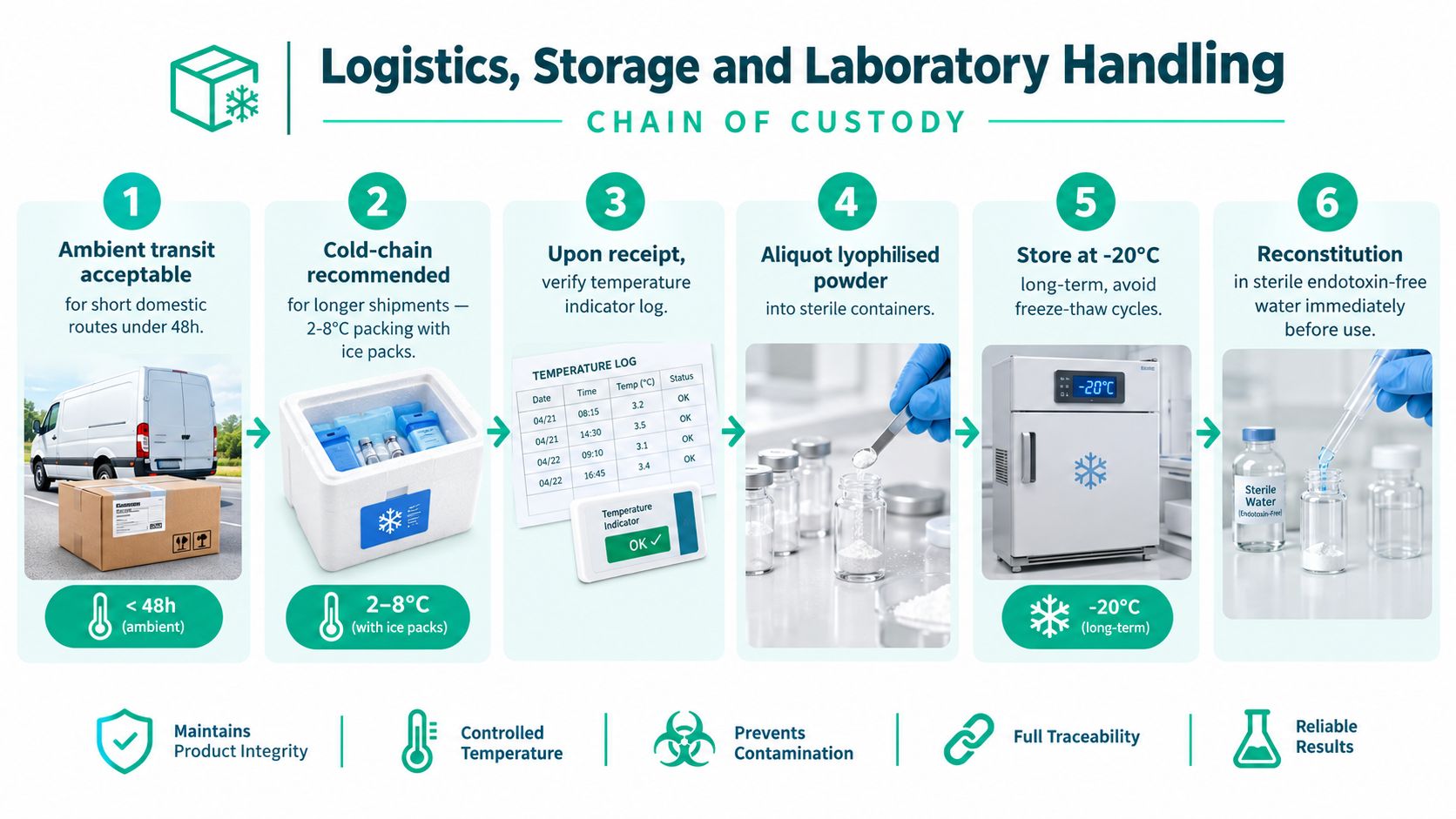
For Australian research buyers, domestic fulfilment changes the logistics assessment, but it does not remove the need for controlled receipt and storage. One Australian supplier notes that Semax is commonly supplied as a lyophilised 10 mg research vial with domestic fulfilment, as noted earlier. This can reduce overseas shipping steps, while batch identity and handling records still determine whether the material is suitable for a documented laboratory workflow.
Receipt and storage controls
Receipt should begin with a physical inspection. Check seals, labelling, and agreement between the vial, packing slip, and batch documentation. If temperature-controlled transport was specified, retain the relevant packing evidence with the batch record. Any mismatch should place the material in quarantine until the discrepancy is resolved.
Storage must follow the supplier's stated conditions and the laboratory's quality system. A lyophilised peptide should be protected from avoidable moisture and unnecessary handling. Reconstituted material requires separate controls based on the laboratory's validated short-term storage procedure. The peptide storage and stability guide can help align internal notes with the relevant handling considerations.
Neutral reconstitution maths
Reconstitution is a concentration calculation, not a treatment instruction. Concentration equals mass divided by volume. A 30 mg vial dissolved in 3 mL produces 10 mg/mL. Dissolving the same vial in 6 mL produces 5 mg/mL. Recording the selected volume supports consistent preparation, aliquot planning, and inventory reconciliation.
Stability assumptions should be checked against the actual vial state, storage method, and batch record. The product name alone cannot establish a valid handling condition.
Keep the chain of custody as tight as the assay itself. If receipt documentation is incomplete, quarantine the material until the record is complete.
This approach reduces avoidable handling errors and gives laboratory managers a defensible file for later audit or replication.
Procurement Checklist and Common Questions
Australian Semax procurement should follow documented gates rather than supplier claims or price alone. Define the research protocol and quantity first, then confirm that the purchase fits the institution's research-use-only position. Regulatory, ethics, or import review should be completed before release where applicable.
Sequential procurement gates
- Define the study requirement, including the intended research use, quantity, and acceptance criteria.
- Check the regulatory frame, including any institutional ethics, import, or purchasing review.
- Shortlist suppliers with batch-level documentation, and request the COA before finalising the order.
- Match the batch number to the label, product description, invoice, and COA.
- Review shipping terms, including domestic processing, dispatch confirmation, tracking, and handling assumptions.
- Validate storage compatibility with the laboratory's existing quality procedures.
- Archive the procurement file, including the invoice, COA, shipping record, approval, and receipt check.
One Australian supplier describes domestic processing and dispatch in the 1 to 3 business day range. That information can support scheduling, but it does not verify identity, assay, or lot conformity. Bulk Aussie Peptides operational overview
Common questions from Australian buyers
How do I verify an Australian supplier's legitimacy?
Review the stated research-use-only position, business identity, Australian contact details, shipment origin, and availability of batch-specific records. Vague listings should trigger escalation before payment, not after delivery.
Can Semax be imported without an import permit?
Do not assume that it can. The appropriate pathway depends on the institution, intended end use, and applicable compliance framework. Record the decision and any approval before shipment.
What should purity claims look like on a COA?
A useful COA states the result, analytical method, test date where provided, product identity, and matching batch details. A purity figure without a lot match provides limited procurement assurance.
What price range should we budget around?
Use the A$7.00/mg median from the Australian comparison as the internal budget baseline. Flag quotes below A$4.50/mg or above A$12.00/mg for enhanced COA review, while recognising the observed A$4.16 to A$13.00 spread. Require lot-matched documentation before price-based shortlisting.
How should we assess reconstitution stability?
Treat reconstitution as a laboratory-controlled preparation step. Check the batch record, solvent, vial condition, storage notes, and validated short-term procedure rather than inferring stability from the product name.
What delivery timeframes are realistic inside Australia?
Domestic fulfilment may be relatively quick, but the purchasing schedule should include processing, dispatch confirmation, transit, receipt inspection, and document reconciliation.
Bulk Aussie Peptides is one supplier referenced in the Australian research-use-only procurement context. Buyers at universities, CROs, and other institutions should assess its specifications and batch records against their own approval requirements before ordering.