
Hair Growth Supplements: What the Evidence Shows
Why would the same ingredient help explain one person's shedding but have little relevance to another's? Hair growth supplements make sense only in relation to the cause of hair loss. A nutrient involved in normal hair production isn't automatically a solution for immune-related, hormonal or thyroid-related thinning. And a long ingredient list isn't evidence of benefit.
Table of Contents
- What Hair Growth Supplements Are and Why Hair Loss Varies
- Common Ingredients and What Research Has Examined
- Matching Ingredients to the Type of Hair Loss
- Safety Limits and Interactions to Know First
- Reading Australian Listings on the TGA Register
- Common Questions About Hair Supplements
- Confirm the Cause Before You Choose a Product
What Hair Growth Supplements Are and Why Hair Loss Varies
Hair supplements are capsules, tablets or powders marketed for hair, skin and nails. They commonly contain vitamins, minerals and amino-acid-related ingredients, but similarly named products can have different formulas.
Say two people notice thinning. One has a confirmed nutrient gap; the other has immune-related hair loss. The same bottle doesn't address the same biological problem in both.
A nationally representative Australian survey included 8,256 participants and identified 194 with potential alopecia areata, including 188 aged at least 15. Among Australians aged at least 15, estimated lifetime prevalence was 1.2% to 2.3%, and point prevalence was 0.9% to 1.4%.
Those estimates concern alopecia areata, not all thinning. Other categories include androgenetic hair loss, telogen effluvium, nutrient-related shedding and thyroid-related thinning.
For a plain-language introduction to these distinctions, Vitamin Planet's resource on understanding hair thinning provides useful context.
The important distinction: A nutrient gap and a hair-loss diagnosis aren't interchangeable.
Common Ingredients and What Research Has Examined
Common hair supplement ingredients and research status
| Ingredient | Role in the body | What research has examined | Key caution |
|---|---|---|---|
| Biotin | B vitamin involved in energy and amino acid metabolism | Deficiency-linked shedding; benefit at normal levels isn't established | Can distort laboratory immunoassays |
| Zinc | Supports enzymes involved in cell division and repair | Associations between low zinc and shedding | Excess can reduce copper absorption |
| Iron | Part of haemoglobin; stored as ferritin | Low ferritin and diffuse shedding | Unneeded iron can be harmful |
| Vitamin D | Acts through receptors in hair follicles | Associations with hair-loss conditions; findings are mixed | Excess can cause toxicity |
| Cysteine | Helps form sulphur bonds in keratin | Included in combination formulas; direct evidence is limited | Combined formulas complicate attribution |
| Collagen | Supplies amino acids | Consumer hair formulas; direct regrowth evidence is limited | Isn't equivalent to identifying a nutrient gap |
| Herbal products | Plant-derived ingredients with different biological actions | Product-specific evidence | Can interact with medicines |
Keratin is the structural protein that makes up hair. Nutrients supporting its production provide biological plausibility, but that isn't the same as demonstrated improvement in hair density.
The TGA record for a biotin-containing formulation illustrates how products combine biotin, vitamin D, zinc, copper, cysteine and B vitamins. Its composition doesn't establish which ingredient contributes a clinical effect.
Research peptides belong to a separate category. The AHK-Cu research overview concerns laboratory research, not an alternative consumer supplement.
Matching Ingredients to the Type of Hair Loss
The useful comparison starts with what is happening in the follicle, not which bottle contains the most nutrients. Australian Prescriber's review of pattern hair loss describes nutritional-supplement evidence as highly variable, with uncertain benefits and potential risks.
Hair loss patterns and what supplements can and cannot address
| Pattern | Typical signs | What supplements can and cannot address |
|---|---|---|
| Androgenetic hair loss | Gradual thinning in women and men | Nutrients don't resolve its hormonal basis |
| Alopecia areata | Sudden, patchy bald spots | Nutrient formulas don't establish or address the immune-related cause |
| Telogen effluvium | Diffuse shedding after illness, stress, surgery or childbirth | A confirmed deficiency is a separate consideration from the trigger |
| Nutrient-related shedding | Diffuse shedding with confirmed low iron or zinc | A documented gap provides a defensible nutritional rationale |
| Thyroid-related thinning | Diffuse thinning, sometimes with other symptoms | Supplements aren't thyroid-disease treatment |
Clinical assessment can consider dietary intake, iron status, thyroid function, medicines, menstrual or postpartum history and scalp signs. These details distinguish conditions that can look similar in the mirror.
Commercial pages such as Supplemynts Inc.’s saw palmetto for men's wellness routines also show why product positioning matters: a wellness description isn't evidence that a botanical matches a particular hair-loss mechanism.
Safety Limits and Interactions to Know First
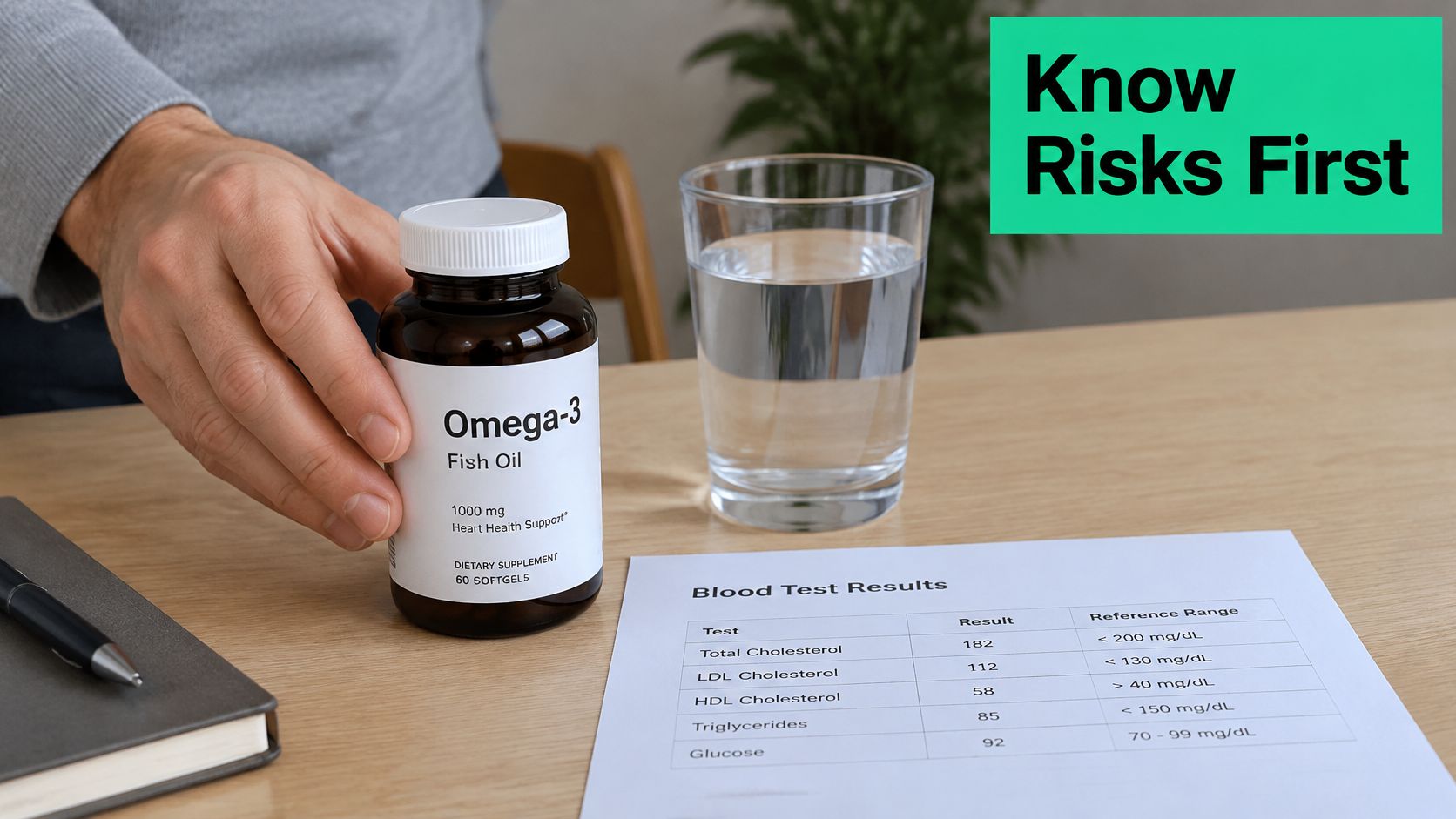
Natural doesn't mean risk-free. Nutrients and plant ingredients can affect body processes beyond hair.
The label is a useful starting point for recognising overlapping ingredients.
Supplement interactions and overlapping ingredients
- Iron: Unnecessary iron can be harmful; its presence isn't automatically an advantage.
- Zinc: Sustained excess can reduce copper absorption.
- Biotin: High intake can interfere with some immunoassays, laboratory methods used for thyroid and certain cardiac-marker results.
- Other ingredients: Medicines, pregnancy and existing medical conditions can change a product's suitability.
A multivitamin and a beauty formula can contain overlapping biotin, zinc, iron, selenium or B vitamins. Total exposure matters more than the number of separate bottles.
A surprising laboratory result can reflect interference as well as a change in health.
The following video offers additional context.
Research-only materials have a different purpose and boundary, explained in our research disclaimer.
Reading Australian Listings on the TGA Register
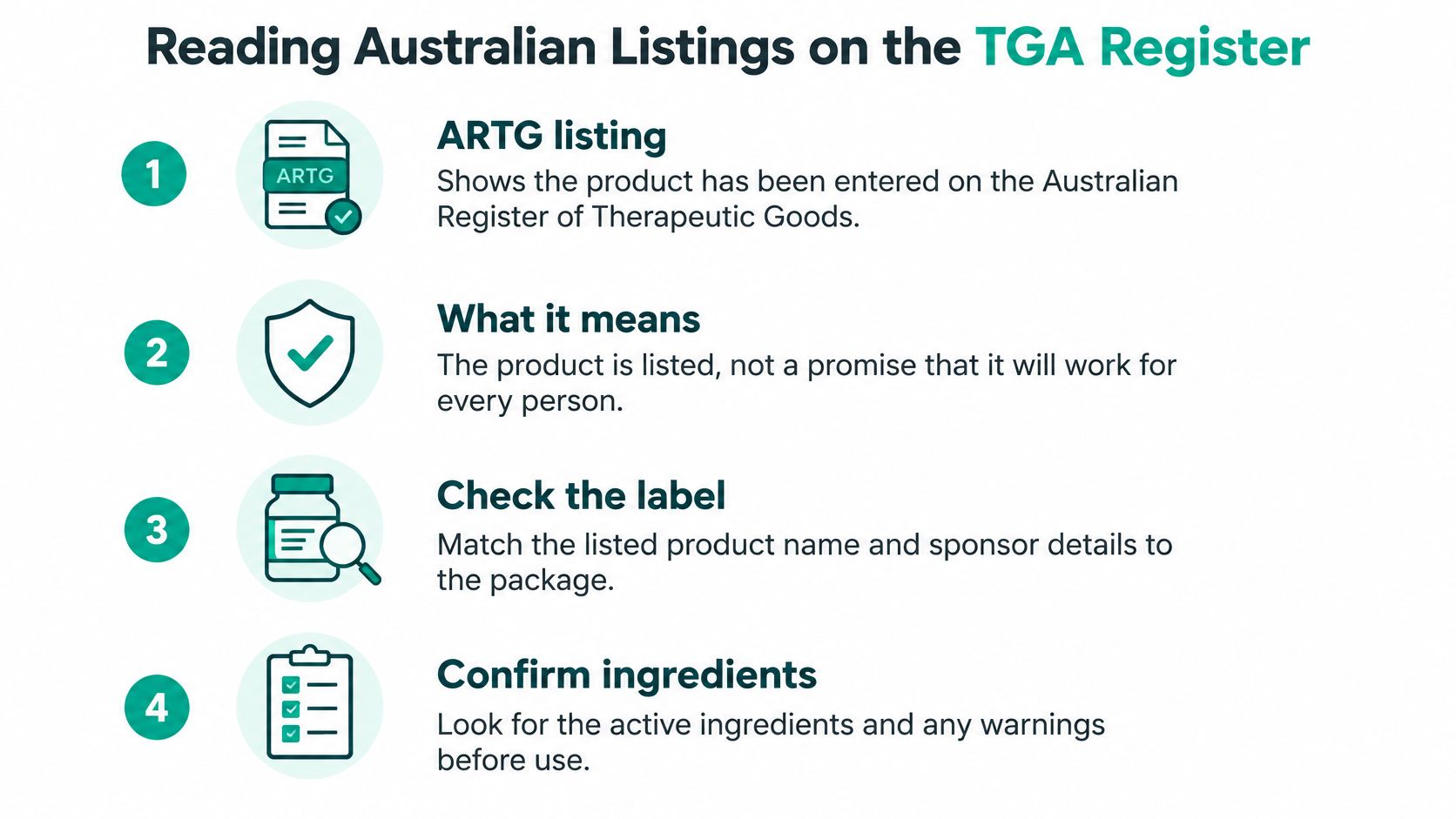
A register entry can tell you what a product contains and who sponsors it. It cannot tell you whether those ingredients match the reason your hair is shedding. The TGA entry for ARTG 408030 shows this gap clearly: the record lists a formula, while visible regrowth still depends on cause, dose, adherence and time.
TGA listing checks
- Match the product name and ARTG number to distinguish similarly named products.
- Compare sponsor details with the package to confirm the record concerns the same product.
- Record ingredients and label quantities because presence alone says little about the formula.
- Identify overlapping nutrients across other listed products.
- Separate composition from efficacy by looking for clinical evidence rather than assuming registration proves benefit.
One ARTG record shows the limit
| ARTG example | Listed ingredients named in the record | What the listing does not show |
|---|---|---|
| ARTG 408030 | Biotin, vitamin D3, zinc, copper, cysteine, B-group vitamins, methylsulfonylmethane and other nutrients | Clinical effect, regrowth or efficacy of every ingredient |
Similar Australian hair product names can hide different panels, doses or sponsor details, so the ARTG number needs checking against the TGA record rather than the front label. A long ingredient list reads like coverage, yet it can also combine nutrients with different evidence and different safety limits.
Laboratory research compounds sit under a separate framework. Our Australian research-peptide regulation overview explains that context.
Common Questions About Hair Supplements
Are biotin supplements all the same formula?
No. Biotin can appear alongside different minerals, vitamins and amino acids. The full panel is more informative than the front-label ingredient.
What does ferritin mean on a blood-test report?
Ferritin is a protein associated with iron storage. It isn't a hair-specific measurement, and a result alone doesn't establish why someone is shedding.
Is collagen the same as keratin?
No. They're different proteins. Collagen supplies amino acids, while keratin forms much of the hair shaft's structure.
Are research peptides hair supplements?
No. A laboratory research material isn't a consumer nutritional product. Research documentation doesn't establish suitability for human consumption or therapeutic application.
Confirm the Cause Before You Choose a Product
The cause determines whether a nutritional explanation fits. Sudden, patchy, painful or scarring loss belongs to a different assessment question from gradual thinning or a documented nutrient gap.
Useful information in a clinical history includes onset, recent illness, stress, surgery, childbirth, medicines, supplement names and family history. A complete ingredient panel adds context; a product title alone doesn't.
For laboratory readers, our GHK-Cu research overview is a separate educational resource. Our materials are strictly for laboratory research, not human consumption, medical use, veterinary use or therapeutic application.
A certificate of analysis, or CoA, documents identity and purity checks, typically using methods such as HPLC and mass spectrometry. Batch-level documentation connects those checks to the supplied material; our independent CoAs sit in the online lab library and are linked on each product page, with pending testing labelled “in testing”.
Bulk Aussie Peptides offers research peptides in 10-pack formats for laboratory research, not consumer hair supplements. Visit Bulk Aussie Peptides to review research information and product-linked documentation, or explore bulk research supply for laboratory procurement.
- BAP