
Peptides Explained: Research Uses, Testing and Supply
Meta title: Peptides Explained: Research, Testing and Supply Meta description: Peptides are short amino acid chains. See how classes, batch testing and Australian supply rules differ from a research-use label.
Does a research-use-only line, or a PDF certificate, prove the vial is the compound named on it?
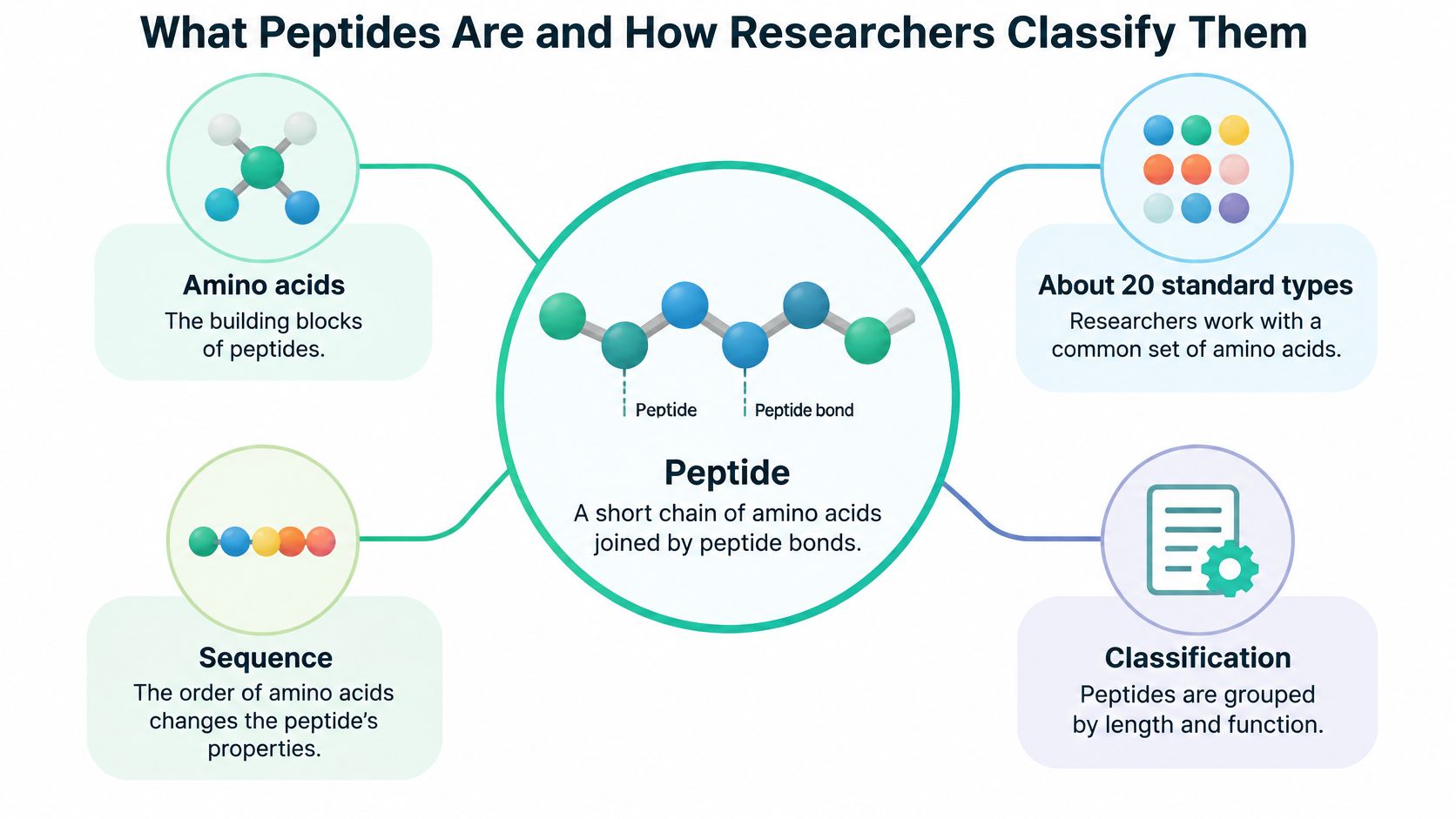
A peptide is a short chain of amino acids joined by peptide bonds. Its sequence is what distinguishes one peptide from another. A certificate of analysis works like a batch ticket: it records checks on that lot. Suitability for a purpose is a separate question, and so is regulatory status.
Identity evidence, regulatory status and the wording used to present a product answer three different questions. A research-use-only line only states how the product is offered. A PDF can speak to identity for one batch and still leave status and intended-use wording unresolved.
Synthetic peptides made to a set sequence still need those checks one batch at a time. The next vial is a new record, not a copy of the last PDF.
Table of Contents
- What Peptides Are and How Researchers Classify Them
- Major Classes Researchers Compare
- What a Certificate of Analysis Shows and Misses
- Australian Rules for Research Products
- How to Evaluate Australian Suppliers
- Bulk Orders, Pack Formats and GST Invoices
- Confirm Documentation Before You Order
- Questions Buyers Actually Ask
What Peptides Are and How Researchers Classify Them
Amino acids are the building blocks, and researchers work with about twenty standard types. The order of the chain, called the sequence, spells one peptide the way a set order of letters spells one word.
Chains of roughly 50 amino acids or fewer are usually called peptides. Longer chains are called proteins. That line is a convention, not a sharp border.
The body makes some peptides, including the hormone GLP-1. Others are synthetic peptides, built in a laboratory to a defined sequence. Research peptides in our range are synthetic compounds supplied for laboratory research. The same terms are set out in our research peptide glossary.
- Sequence: the order of the amino acids.
- Identity: whether the material is the compound named.
- Purity: how much of the sample is that compound rather than something else.
Major Classes Researchers Compare
| Research class | Example compounds listed | Areas research has examined |
|---|---|---|
| Metabolic incretin agonists | Semaglutide, tirzepatide, retatrutide | Glucose metabolism, appetite signalling, energy balance |
| Growth-factor and growth hormone secretagogues | Growth hormone secretagogues | Growth signalling pathways |
| Tissue and cellular | BPC-157, TB-500 | Tissue repair and cell signalling in laboratory models |
| Skin, hair and nail | GHK-Cu | Skin, hair and nail biology |
| Longevity and senescence | No named example in this class | Ageing-related cell changes |
| Neuroscience | No named example in this class | Nerve signalling |
| Fertility and reproductive | No named example in this class | Reproductive biology |
A category label shows where published work has focused. It doesn't show what a compound does. For many research compounds, human data are limited or absent, and much of the work comes from cell and laboratory models.
A separate discussion of approved versus unregulated weight loss peptides is about regulatory status, not about an effect from a research vial. Confirm the exact compound name, then look for its certificate of analysis. A class is a starting point for reading, not evidence of an effect. Our product comparison sets up to three research peptides side by side before that paperwork check.
What a Certificate of Analysis Shows and Misses
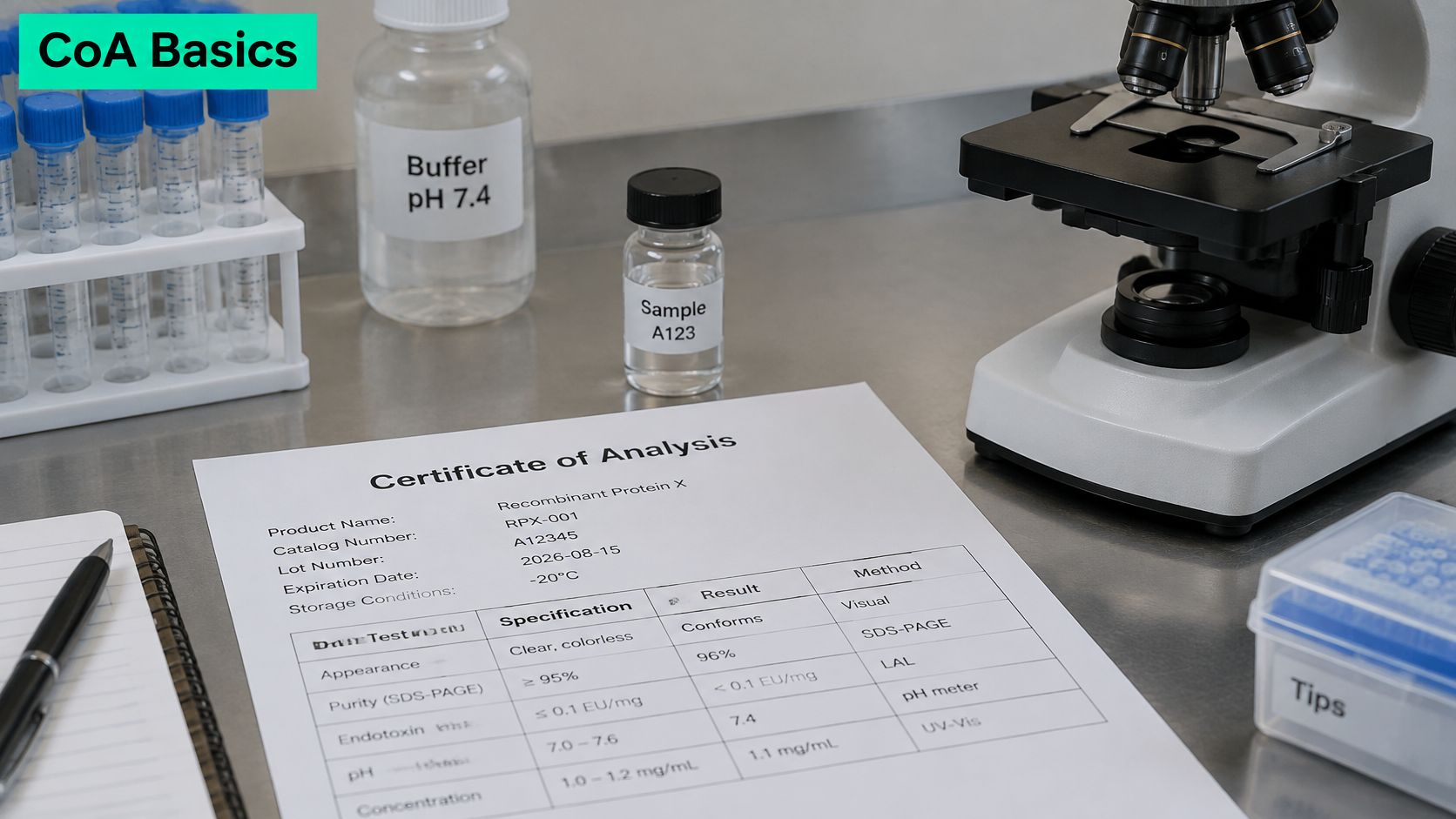
A certificate of analysis (CoA) is a laboratory report for one batch. It records identity and purity checks. It isn't proof the material suits any particular application.
High-performance liquid chromatography (HPLC) separates the parts of a sample, a bit like sorting coins so you can weigh the main pile against the rest. The result is a purity figure. Mass spectrometry measures molecular weight, which helps show the material is the named compound, much as a scale checks a parcel weight.
TGA guidance for health practitioners states that unapproved peptide products haven't been assessed for safety, quality or effectiveness. There's no regulatory assurance they're safe, effective, correctly labelled, sterile or made to appropriate quality standards. A batch CoA can support a laboratory review of identity and purity. It shouldn't be treated as proof of clinical suitability, sterility or approval.
Lot match on receipt
The report describes one batch, so the lot on the vial has to match the lot on the CoA. On receipt, write down the product name, lot number, quantity and date, then compare them with the report.
Our certificates sit in the online lab library and are linked on every product page. Where testing is pending, the page says "in testing".
A short walk-through of how laboratories read a report sits here:
Ask three things of any CoA. Does the lot match, which tests were run, and who ran them?
Australian Rules for Research Products
The Therapeutic Goods Administration doesn't decide status by chemistry alone. Intended use and marketing decide it.
The TGA explanation of therapeutic peptide products says a product can be a therapeutic good when intended use or claims relate to preventing, diagnosing, curing or alleviating disease or injury, or to modifying a physiological process. Promotion for weight loss, muscle growth, recovery, performance enhancement and other health outcomes may fall inside those rules.
A "research use only" line doesn't take a product outside that framework. The TGA says those disclaimers don't change whether a product is a therapeutic good, and they don't remove import, manufacture, supply or advertising obligations.
Therapeutic peptide products generally must be entered on the Australian Register of Therapeutic Goods before import, supply or advertising, unless an exemption applies. Compounding exemptions are narrow. They cover limited cases such as compounding for one patient, not routine bulk supply.
A plain wording test
Practical rule: If the wording describes a health outcome, treat regulatory status as unsettled until you've checked it.
Ask what the stated intended use is. Laboratories keep research stock apart from any clinical or personal channel, keep specifications and batch records, and avoid public wording that implies a treatment or a physiological benefit. Get regulatory advice before any activity involving administration or supply to people. This is general information, not legal advice. Our note on research peptide regulation in Australia points to the same split, and current rules sit on the TGA website.
How to Evaluate Australian Suppliers
Fair criteria are items you can check on a supplier's own pages or documents. This list doesn't name or rank other sellers.
| Criterion | What to look for | Evidence to request or check |
|---|---|---|
| Batch testing | Independent testing of each batch | CoA for the lot, available in a lab library |
| Documentation match | CoA linked to the exact product | Product page link and lot number on the CoA |
| Pending tests | Status shown clearly when testing is pending | Product page wording such as "in testing" |
| Intended-use wording | Research-only positioning with no treatment claims | Product and policy page wording |
| Pack format | Format and per-vial quantity stated | Specification sheet |
| Shipping | Tracking and transit time stated in writing | Shipping policy and tracking details |
| Invoicing | GST invoices available | Sample invoice on request |
- Choose one compound.
- Open its product page and note whether a CoA is linked and whether the lot is named.
- Request the specification sheet.
- Ask for a sample CoA for the lot you would receive.
- Read the intended-use language on the product and policy pages.
- Confirm the pack format and the quantity per vial, with prices in AUD.
- Ask whether a GST invoice is available.
A lower price says nothing about testing or documentation.
Mark each criterion met, not met, or unclear. Treat each unclear item as a question to answer before you buy. File the marked list with the product name and the date so a procurement team can review it later.
Bulk Orders, Pack Formats and GST Invoices
We sell research peptides in 10-pack formats priced in AUD. The quantity per vial is on the specification sheet. Match the pack count to the number of lots the project needs, and to the documentation each lot will carry. Don't match it to any level of use.
Compounds are supplied as a freeze-dried powder cake in sealed glass vials. On arrival, check that seals and vials are intact and log their condition.
Shipping is express and tracked, Australia-wide, about one week door to door. Record the tracking details. Don't treat that window as a promised date.
GST invoices are available. Send the entity name, billing details and any purchase-order requirements before you order, so the invoice matches internal records. Quotes and institutional supply are on our bulk research supply page.
- Pack count: matched to the lots you need documented.
- Invoice details: entity name and purchase order confirmed.
- Receipt: seal and vial condition logged.
Confirm Documentation Before You Order
Does a linked PDF settle quality? A certificate of analysis works like a luggage tag. It names one lot. It does not decide regulatory status, and it does not replace intended-use wording.
Use this order.
- Open the product page for the compound.
- Confirm the CoA is linked, or that the page says "in testing".
- Check the lot number on the CoA against the lot you will receive.
- Separate intended-use wording from the identity result.
- Request a quote through the bulk supply path and confirm any invoicing and purchase-order requirements before you order.
- Request lot documentation before purchase.
Bulk Aussie Peptides supplies research peptides to Australian laboratories, universities and qualified researchers. A clinic write-up such as Tesa IPA explained by ProMD Health is background on one named blend. It isn't a batch record, and it isn't a reason to skip the lot check. The material is supplied for laboratory research only.
Questions Buyers Actually Ask
Is a CoA the same as regulatory approval?
A certificate of analysis is a batch-level record, like one exam paper from a single sitting rather than a licence to practise. It speaks to that lot. Whether the product is a therapeutic good depends on intended use and the wording around it, not on the PDF.
What if the page says in testing?
Testing for that batch is unfinished. Do not treat identity as confirmed until a report that names the lot is available from the COA library, or until documentation you requested does.
Does a class name replace the compound check?
A class only marks the research area. You still match the exact compound on the specification sheet to the lot named on the CoA.
Can a lower AUD price stand in for paperwork?
Price is a supply term. Lot testing, intended-use wording and a GST invoice are separate checks, and any one of them can still be unclear.
Bulk Aussie Peptides supplies research peptides for laboratory work, with batch certificates available in the COA library or on request for active customers, and 10-pack formats priced in AUD. When you compare compounds, start with the paperwork for the exact lot rather than a class name. Visit Bulk Aussie Peptides to review the range and request documentation.